130 SaaS Ideas Scored: The Q2 2026 Saturation Report

The best SaaS ideas for 2026 are not the loudest ones. We scored 130 of the most-discussed SaaS business ideas against 25 live data feeds, and only 19 came out both fundable and uncrowded. Below is the saturation map and the outliers worth building.
Key Takeaways
The numbers behind the map:
The quadrant numbers, beside the rest of the 2026 dataset: Startup Statistics 2026.
Stop Building in 2019's Gold Rushes
I see founders waste years building products for markets that were already won by 2022. They read a blog post titled '50 Best SaaS Ideas', pick one, and start coding. This is a recipe for failure. These lists are based on vibes, not data. They are lagging indicators, pointing you toward yesterday's opportunities. By the time an idea makes a list, the first-mover advantage is gone. The market is likely crawling with well-funded competitors.
This report is the antidote. We don't use vibes. At Fluenta, we scored 130 of the most-discussed SaaS business ideas using 25 live data feeds. We measure two things: saturation and fundability. Saturation tracks competitors. Fundability is a proxy for demand, monetization, and defensibility. The result is a real-time map of SaaS markets, showing which are barren, overrun, or greenfield.
The situation is worse than most think. The median idea is already in a market that is 57% saturated. It has a fundability score of just 44 out of 100. The default outcome for a founder following generic advice is to enter a crowded market with a product that's hard to monetize. You cannot win by following the herd. You win by finding the pockets of opportunity the herd has missed. This report shows you where those pockets are.
Your job is to find a high-demand, low-saturation market. This report uses our Q2 2026 data to show you how to identify these rare opportunities. Your next step is to stop brainstorming and start analyzing market structure. Do this before you spend another week on a doomed project.
What Fluenta's data shows
Our analysis of 130 SaaS ideas is stark. Only 19 land in the 'fundable-but-uncrowded quadrant'. This is the zone where saturation is below 35% and fundability is above 60%. It’s the only quadrant where a new indie founder has a statistical edge. That's just 14.6% of the dataset. Every other idea is a trap.
Let's break down the numbers. We found 41 of the 130 ideas (32%) are in the 'too late' quadrant. They have saturation scores above 70%. These are ideas you see on every blog post: generic AI wrappers or project management tools. Another 29 ideas (22%) are in the 'no demand' quadrant, with fundability scores below 30%. These are solutions looking for a problem. The data is clear. Picking an idea at random lands you in a dead-end market.
The outliers in the green zone share common traits. They are rarely glamorous. A top-scoring idea is 'regulated SMB workflow automation'. You can see it at /ideas. It has a low saturation of 28 and a high fundability of 71. Demand signals aren't on TechCrunch. They come from plumbers on Reddit. They complain that enterprise software is too complex and expensive. This is where you find gold.
Another outlier focuses on outcome measurement for vertical AI agents. This is a classic 'sell pickaxes' play. The data shows the biggest opportunities are not in the hype cycle's center. They are on the periphery, solving second-order problems created by new technology. Your next step is to internalize this data. Start looking for boring, painful problems in niche industries. Do this by the end of the day.
The Four Quadrants of SaaS Ideas
We map every idea onto a 2x2 matrix: Saturation vs. Fundability. This creates four quadrants. Understanding them is critical to your survival as a founder. The first is the fundable-but-uncrowded quadrant. This is where you want to be. These 19 ideas (15% of our dataset) have strong demand signals but low competition. They are typically unsexy, niche B2B tools that solve a specific, expensive problem.
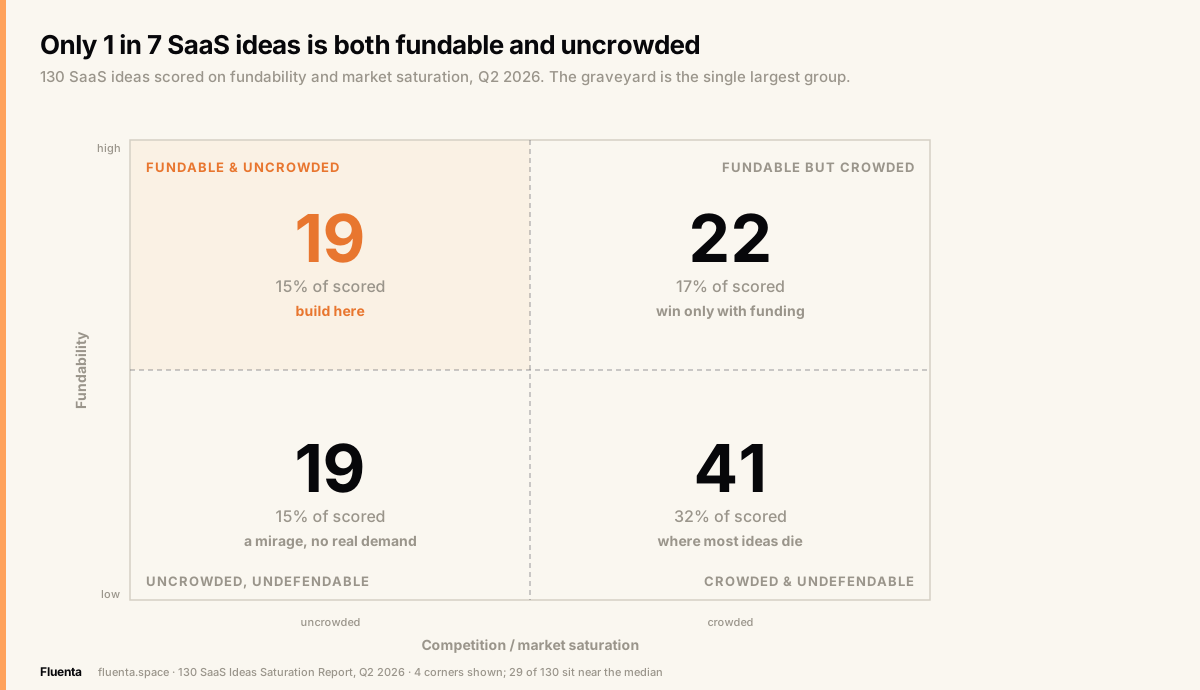
The second quadrant is 'Fundable but Crowded'. This is the red ocean. It contains 22 ideas (17%) with high demand but also high saturation. Think AI chatbots or generic CRMs. You can succeed here, but only with massive funding. You need a 10x better product or a world-class distribution advantage. For an indie founder, this is a low-probability bet. You're fighting incumbents on their home turf.
The third quadrant is 'Uncrowded but Undefendable'. These 19 ideas (15%) look tempting because they have no competition, but it's a mirage. They have low fundability scores. There's no clear market demand or willingness to pay. These are 'cool tech' projects that don't solve a real business problem. The fourth quadrant is 'Crowded and Undefendable'. This is the graveyard. It's the largest, containing 41 ideas (32%). These are bad ideas in crowded markets. This is where most Twitter-thread SaaS ideas end up.
Your strategy depends on which quadrant you choose. Our data suggests a rational choice for indie founders. Focus only on the fundable-but-uncrowded quadrant. It's not about a unique idea. It's about finding a valuable problem that others are ignoring. Our guide on seven signals that predict market disruption shows you how to spot them. Your next step is to take your current idea and honestly place it into one of these four quadrants. Do this now.
Generic 'Best SaaS Ideas' Lists Are Actively Harmful
Many founders end up in the graveyard quadrant because they source ideas from the wrong places. Content marketing blogs from companies like Webflow and Elementor publish lists like '35 SaaS website examples'. These articles create social consensus around a few visible ideas. This consensus is a trap. It signals a market is already legible and therefore likely saturated.
Consider the numbers. One popular blog curates 54 SaaS examples. Another lists 50 unique business ideas. This concentrates founder attention on the same categories. These include AI meeting notes, remote work tools ($45B market), and customer service software ($20B market). When thousands of builders look at the same map, they run to the same spots. This is how red oceans form. These lists describe what has already worked, not what will work next.
The core issue is a lack of quantitative scoring. An idea's presence on a list is treated as a validation signal, but it's often the opposite. It's a saturation signal. You are flying blind without data on competitor density, search volume for pain-points, and monetization potential. You are mistaking popularity for opportunity. Real opportunities are in niches that LLMs and content marketers miss. They aren't popular enough to write about yet. We wrote a playbook on finding these underserved niches.
AI-enabled SaaS is not a bad category. But the generic implementations are played out. Don't build another AI chatbot. The opportunity is in tooling for companies that already bought one, like measuring its ROI. Your next step is to unsubscribe from every newsletter that offers 'SaaS ideas' without saturation scores. Replace that input with raw data from niche communities. Do this by the end of the week.
How to Systematically Find Underserved Niches
If you can't trust idea lists, how do you find opportunities? You have to build a system for identifying pain. Stop looking for solutions and start collecting problems. The best source is online communities for specific professionals. Think subreddits for electricians or forums for dentists. These are modern factory floors where you can observe real work and frustration.
Listen for phrases like 'I hate having to manually...' or 'I wish [Enterprise Tool X] wasn't so clunky'. These are raw, unfiltered demand signals. This is how we found the outlier in 'outcome measurement for vertical AI agents'. We saw founders in AI communities complaining. Their agents worked, but they couldn't prove the financial impact to customers. That's a fundable problem. The pain is clear, and the person with the pain has a budget.
Once you have a candidate problem, quantify it. This is where a tool like the Fluenta X-Ray is necessary. It takes your hypothesis and tests it against 25 data sources. For example: 'Compliance officers need a better way to track regulatory changes.' It looks for search trends, measures competitor authority, and analyzes social media sentiment. It replaces guesswork with a statistical forecast.
This process flips the standard model. Don't start with a popular idea and hope for a market. Start with a painful problem and verify the market exists before you build. This is how you find the fundable-but-uncrowded quadrant. Your next step is to spend one hour this week lurking in a professional subreddit outside your expertise. Document five complaints you see. Do this by Friday.
How Fluenta uses data
Every idea we score comes from public reports from sources like Forbes, McKinsey, a16z, and YC essays. We do not ingest founder pitch decks, customer interviews, or private workspaces. We have no insider access to roadmaps. When you score an idea in X-Ray, your input is private and never used in our public datasets.
The Only Way Out is Through Data
You have two choices. You can source ideas from popular lists and compete in a red ocean for scraps. Or you can use data to find overlooked, profitable niches. The first path is easier but has a near-zero chance of success for a bootstrapped founder. The second path requires more upfront rigor. It increases your odds of building something that matters.
The Fluenta X-Ray is the tool I wish I had when I was starting. It's a 20-minute analysis that routes your idea through multiple LLMs to query 25 live data feeds. It's not a 90-second gimmick. It's a rigorous process. It gives you the ground truth about a market. You get this before you invest time and money. It gives you a saturation score, a fundability score, and a detailed breakdown of the competition.
This report is based on the aggregate, anonymized outputs of this system. It's designed to prevent a catastrophic error: building something nobody wants in a full market. The data shows that such errors are the default outcome. You have to actively work to avoid them.
What would invalidate this analysis? Our premise weakens if we double the dataset and the 'fundable-but-uncrowded' share rises above 25%. That would suggest the market is less saturated than these 130 ideas indicate. We will republish when the dataset grows. Until then, the data is clear: be selective. Your next step is to stop guessing and start scoring. Do it today.
FAQ
What are the best micro SaaS ideas for 2026?+
Data suggests the best ideas are niche solutions, not generic AI tools. Examples include 'Website-as-a-Service' for specific verticals or AI tools for regulated SMBs. The best ideas solve a specific, painful problem in an uncrowded market.
How saturated is the SaaS market in Q2 2026?+
Our data, based on scoring 130 ideas, shows a median saturation of 57/100. This indicates most well-known SaaS categories are highly competitive. However, 14.6% of ideas fall into an 'uncrowded' category with saturation below 35%.
What makes a great SaaS startup idea?+
A great idea in 2026 scores high on fundability (>60) and low on saturation (<35). This is often an AI tool for a niche B2B customer. It solves a specific, expensive problem, unlike a broad horizontal tool.
How do you validate SaaS business ideas?+
Validation requires data, not just opinions. The best method is to quantify market saturation and demand signals. Use a data tool like Fluenta's X-Ray. It analyzes 25 live market feeds before you build an MVP.
Is 2026 a good year for SaaS startups?+
Yes, but only for founders who use data to pick their market. It's easier than ever to build. It's also easier to build the wrong thing in a crowded space. Large markets like remote work tools ($45B) still have niche opportunities if you can find them.
Cite this article
Researchers and journalists: this article is freely citable. Click to copy the academic-format reference for your bibliography or footnote.
Ivanov, O. (2026). 130 SaaS Ideas Scored: The Q2 2026 Saturation Report. Fluenta. Retrieved from https://fluenta.space/resources/reports/130-saas-ideas-saturation-report-q2-2026.
About the author

Fluenta Research
Data & Market Intelligence, Fluenta
Fluenta Research scores startup ideas against 25 live market, social, and competitor data feeds. Every claim in our reports is backtested before publishing. We ship weekly signal reports, quarterly saturation analyses, and on-demand X-Ray runs for individual founders.
Related Resources
Agent Loops
Agent Loops: 15 AI Agent Business Ideas Ranked by Demand
The Claude loops trend reached 13.6M people in two weeks. Fluenta scored 15 agent-loop business ideas on live demand data: one promising, fourteen experimental.
Report
194 YC Spring 2026 Startups, Scored on Public Data
We scored all 194 YC Spring 2026 startups on six public signals before Demo Day. Four groups, a tight score band, and three questions to ask each founder.
Demand Spike Trackers
Demand Spike Trackers: 47 Trending Business Ideas
47 trending business ideas from Exploding Topics, Idea Browser and 3 more tools, scored on six signals. The average came back 47 of 100.
Score your idea in 20 minutes
Run Fluenta X-Ray on your idea. 25 live market + social feeds. Real demand data, real competition, real willingness-to-pay signals. From $7. 20 minutes.
Was this helpful?
Comments
0 replies