B2B SEO: Win the Buyer Before Sales Does

The center of gravity in B2B buying has moved. A typical buying group now spends only 17% of its time meeting with all potential suppliers combined, and 27% of it researching independently online, according to Gartner's B2B buying journey research. Any single sales rep competes for as little as 5% to 6% of a buyer's attention. The decision is mostly formed in search results, documentation, review sites, and now AI answers, long before a form gets filled. Winning that research phase is the whole job now, and it splits into two motions that a clean AEO versus SEO breakdown pulls apart: rank in classic search, and get cited inside the AI answers buyers increasingly trust. A free Fluenta Magnet audit shows a brand where it already stands on both.
Check AI visibility for my website
Free. No subscription, no card. 24 hour turnaround, checked by a human analyst.
Look at how that time actually divides. Buyers spend more of the journey talking to their own colleagues and combing the open web than they spend with the vendors they are evaluating. The content a brand publishes is doing the selling in the rooms sales never enters.
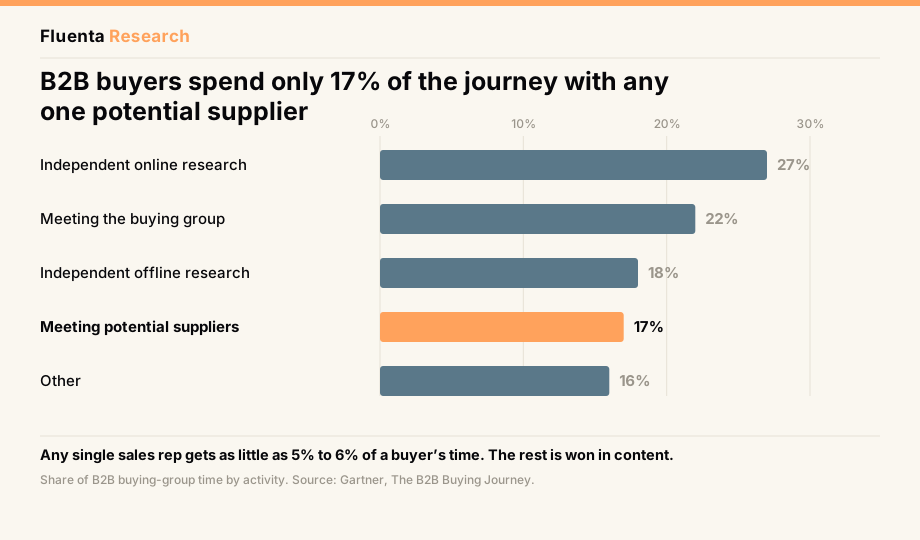
Source · Gartner, The B2B Buying Journey
This is not a story about sales teams working harder. It is a story about where influence lives. When 83% of a buying group's time is spent away from any given supplier, the collateral, comparison pages, and technical answers a brand puts on the open web are the only presence it has for most of the cycle. B2B SEO is the discipline of making sure that presence exists, ranks, and reads as the credible option.
Key Takeaways
What self-directed research actually means for pipeline
Independent research is not a browsing habit. It is the phase where the shortlist gets built and, very often, decided. 6sense found that B2B buyers are roughly 70% of the way through their purchasing process before they engage a seller, that 81% already have a preferred vendor at the moment of first contact, and that 85% have largely set their requirements before reaching out. Buyers initiate that first contact themselves more than 80% of the time.
The split is moving, but not in sales's favor fast enough to matter. 6sense's 2025 data shows the balance between independent research and seller engagement shifting from a 70/30 to a 60/40 ratio. Even after that shift, the vendor a buyer prefers before talking to anyone still wins about 80% of deals. Sellers are increasingly confirming a decision, not creating it.
The group doing this research is large and slow. 6sense puts the average B2B buying cycle at 11.3 months and the average buying group at 11 people, and more than 90% of buyers have prior experience with at least one of the vendors they consider. So the reality is roughly eleven people, over almost a year, each forming impressions from independent research, with incumbents holding a memory advantage. A brand absent from that long quiet phase does not get a tidy late-stage chance to correct the record. It gets left off the shortlist that the group assembles on its own.
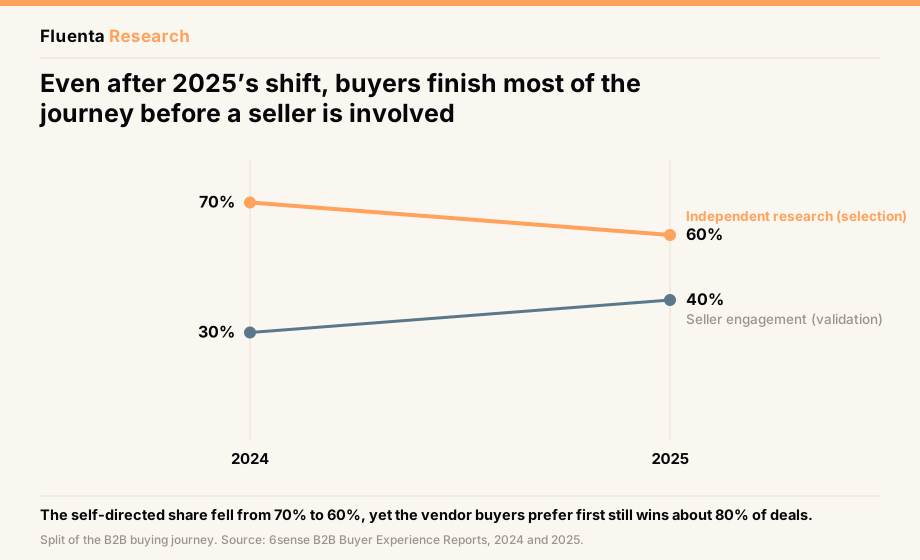
Source · 6sense B2B Buyer Experience Reports, 2024 and 2025
The people who study this behavior for a living draw the same conclusion: the work of marketing has to happen upstream, before a seller is ever in the picture.
“To compete effectively, marketers must drive awareness and preference early in the buying journey.”
Read that against the requirements stat. If 85% of buyers have their requirements set before they call, then the criteria a deal is judged on were shaped by whatever they read during the quiet phase. A brand that owns the ranking answers for how to evaluate a category is writing the scorecard its own deals are graded against. A brand that is absent lets a competitor write it.
This is why B2B SEO cannot be scoped as a traffic exercise. The metric that matters is presence at the exact moments a buying group is defining the problem, comparing approaches, and validating a shortlist. Those moments map to specific queries, and those queries are winnable.
B2B SEO is now two jobs: rank, and get cited
For fifteen years, B2B SEO meant one thing: earn a position on the Google results page for a commercial query. That job still exists, but it now sits alongside a second one. A growing share of research happens inside answer engines that summarize the web rather than list it, and those engines cite sources that classic ranking does not predict.
The scale of the shift is hard to overstate. About 68% of US Google searches now end without a click, per SparkToro's zero-click research, because the answer is delivered on the results page itself. Pew Research found that when a Google AI Overview appears, users click a traditional result only 8% of the time, versus 15% when no overview is present, roughly a 47% drop in onward clicks. Referral traffic from AI assistants is concentrating fast: by mid-2026, ChatGPT accounted for about 53% of AI-assistant referrals and Gemini about 27%, with Gemini surging from a low single-digit share the year before.
The uncomfortable part for SEO teams is that AI answers do not cite the pages Google ranks. Only about 12% of the sources ChatGPT cites overlap with Google's top ten organic results. A brand can hold position three for its head term and still never appear in the AI summary a buyer reads instead. Ranking and being cited are now two separate outcomes, and B2B brands need both. The playbook for the second one has a name, answer engine optimization, and it rewards different signals than link-count SEO ever did.
Buyers now bring AI into the purchase itself
The self-directed buyer is also, increasingly, an AI-assisted buyer. Gartner's 2026 sales survey found that 67% of B2B buyers now prefer a rep-free buying experience, up from 61% a year earlier, and that 45% used AI tools during a recent purchase. The survey covered 646 buyers between August and September 2025. AI is no longer only a discovery channel that sends referral traffic to a site. It has become a research collaborator inside the buying process, summarizing options, helping draft requirements, and comparing vendors on a buyer's behalf.
That changes what a content strategy is competing for. When an assistant assembles a comparison for a buyer, the sources it pulls into that comparison become the frame the decision is made in. A brand that is not among them is not merely lower in a ranking; it is missing from the conversation the buyer is actually having. The strongest B2B SEO programs now treat the AI answer as a first-class placement, on par with the blue link, and design content so an engine can lift a clear, sourced claim into its response.
Why most B2B brands are invisible to AI
Here is the gap that turns this from theory into a pipeline problem. In a study of 175 brands, 89% never appeared when an AI engine was asked a category question, even though the same model described each brand accurately when asked about it directly by name. B2B brands tend to pass the named-brand test and fail the buying-question test. The model knows the company exists. It does not reach for the company when a buyer asks which vendor solves their problem.
The signal that predicts AI citation is not the one SEO teams have optimized for. Across roughly 75,000 brands, off-site brand mentions correlated 0.664 with AI visibility, while traditional backlinks correlated only 0.218. Mentions predict citation about three times more strongly than links. And 99.99% of AI citations point to third-party sites rather than the brand's own domain, which means the game is being talked about accurately across the web that models read, not just publishing a polished page and waiting.
For B2B, where the buying group runs to double digits and each member arrives with independently gathered research, invisibility inside AI answers is compounding. Every member who asks an assistant a category question and never sees a brand is a member whose mental shortlist forms without it. The fix is not a bigger ad budget. It is entity presence: consistent, accurate, well-sourced descriptions of what a company does and who it is for, across the sources models cite.
Practically, entity presence has three layers. The brand describes itself in structured, machine-readable terms on its own site, so an engine can parse what it is and who it serves. Third-party sources describe it in the same language, so a model sees agreement across the web rather than a single self-serving claim. And every description ties back to the problem the buyer is searching on, not only the product name, so the brand surfaces on the buying question rather than only on a query for itself. Miss any one layer and a model can know a company exists while still declining to recommend it.
The B2B SEO and AEO playbook
The work is concrete, and it starts before a single page is written.
Start from the buyer, not the keyword
Every strong B2B SEO program is anchored to a sharp ideal customer profile and a realistic view of the total addressable market. The ICP tells you whose questions to answer; the TAM tells you how many of those questions are worth answering at scale. Map the buying group's real questions across the journey, from problem-aware to vendor-comparison, and build a page for each intent rather than a page for each keyword volume spike.
Publish the formats buyers actually convert on
Content type matters more than word count. In the Content Marketing Institute's 2025 B2B benchmarks, marketers rated a clear hierarchy of formats by the results they produced.
| Content type | B2B marketers rating it a top performer |
|---|---|
| Videos | 58% |
| Case studies and customer stories | 53% |
| E-books and white papers | 45% |
| Research reports | 45% |
| Short articles and posts | 43% |
Educational content still drives roughly three times more leads than promotional content in the same research. For B2B SEO, that means the evaluation-stage assets, the comparison pages, the methodology explainers, the honest category guides, are the ones that both rank and earn the mentions that feed AI citation.
The bar for effectiveness is low, which is the opportunity. Only 29% of B2B marketers rate their own content strategy as extremely or very effective, and 81% of teams now use generative AI to help produce it, per the Content Marketing Institute. A flood of AI-written content competing for the same rankings raises the value of content that carries something a model cannot fabricate: primary data, named sources, and a defensible point of view. Those are the same signals that earn AI citation, so the investment pays into both jobs at once.
Write for the way engines pick sources
Generative engines reward specific, verifiable content, and the effect is measurable. In the Princeton GEO study, adding cited quotations lifted a source's visibility inside AI answers by up to 41%, and adding statistics lifted it by up to 34%. Keyword stuffing, the oldest SEO shortcut, reduced visibility by about 8%.
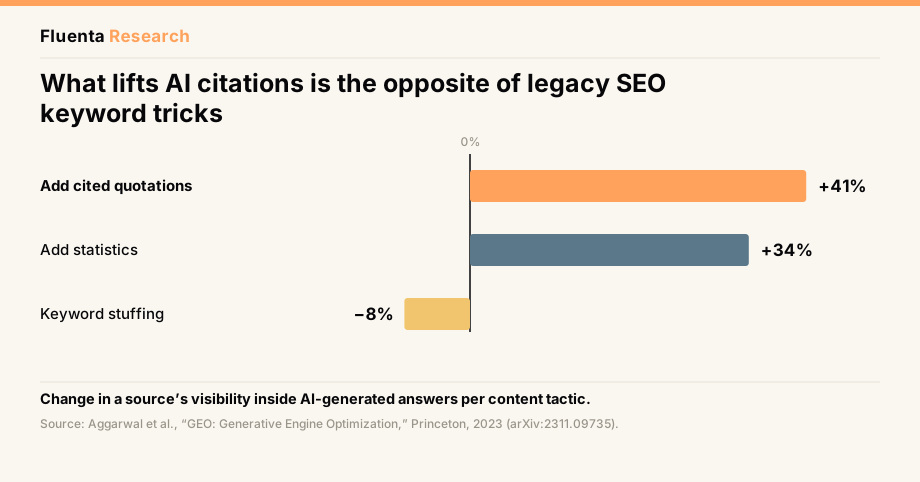
Source · Aggarwal et al., GEO: Generative Engine Optimization, Princeton, 2023 (arXiv:2311.09735)
The pattern is the point. The moves that get a page cited by an AI engine are the opposite of the tricks that once gamed a ranking. Quote named sources. Attach real numbers with attribution. State claims a model can lift verbatim. Structure answers so the useful sentence stands alone and can be extracted. This is craft that legacy link-building never taught.
“B2B buyers are progressing through critical buying tasks in more autonomous ways. Sellers can't rely on static collateral to carry influence in those moments.”
Build entity presence off your own domain
Because mentions predict AI citation and almost every AI citation points off-domain, a B2B SEO program has to reach past the website. Accurate, consistent descriptions on the review platforms, industry directories, podcasts, and editorial coverage that models read are what move AI visibility. The goal is that when the web is asked about the category, the brand is described the same way everywhere, in the language of the problem it solves. Treat entity consistency as an SEO deliverable, not a PR afterthought.
Stop optimizing for signals that no longer move the needle
Three habits keep B2B pages invisible in the new environment. The first is chasing high-volume head terms while ignoring the specific evaluation questions a buying group actually types near a decision. The second is treating backlinks as the only off-site goal, when mentions predict AI citation about three times more strongly and are far easier to earn at volume. The third is thin, keyword-led pages that read as filler to both a person and a model, which the Princeton data shows actively suppresses citation. Auditing an existing library against these three failure modes usually surfaces more upside than commissioning a batch of new pages does.
Measure citation, not just rank
Rank trackers answer an old question. The new one is whether AI engines cite the brand when buyers ask category questions, and how that compares to competitors. That is exactly what a Fluenta Magnet audit measures for free, so a team can see the gap before committing budget to close it.
Where to start this quarter
The buying journey has quietly inverted. Buyers self-educate through the phase that decides the deal, they trust AI answers that cite different sources than Google ranks, and most B2B brands are absent from those answers entirely. None of that is a reason to abandon SEO. It is a reason to run it as two jobs at once: rank for the questions buyers ask, and become the source their AI assistant quotes back to them.
A practical order of operations for the next ninety days: audit AI-answer visibility for the category's real buying questions, fix the highest-intent comparison and evaluation pages so they rank and read as citable, and get the brand described consistently across the third-party sources models actually read. The brands that do this now are writing the scorecard. The ones that wait will keep losing deals to a shortlist that formed before sales ever heard the name.
Check AI visibility for my website
Free. No subscription, no card. 24 hour turnaround, checked by a human analyst.
FAQ
What is B2B SEO?+
B2B SEO is the practice of making a business's content rank in search and get cited in AI answers for the questions a buying group researches before contacting sales. It combines classic search ranking with answer engine optimization, because most of a B2B purchase decision is formed during independent research, not during sales calls.
How much of the B2B buying journey happens before talking to sales?+
Gartner finds a buying group spends only about 17% of its time meeting all potential suppliers, and 6sense finds buyers are roughly 70% through the purchase before engaging a seller. By 2025 the split of independent research to seller engagement had moved from about 70/30 to 60/40, but buyers still do the majority of the work themselves.
Does ranking on Google mean I will show up in AI answers?+
No. Only about 12% of the sources ChatGPT cites overlap with Google's top 10 organic results. AI engines cite different sources than Google ranks, so a brand can rank well and still be absent from the AI summary a buyer reads. Ranking and being cited are separate outcomes that need separate work.
Why are B2B brands invisible in AI answers?+
In a study of 175 brands, 89% never surfaced for a category question even though the model described each accurately when named. AI citation is predicted far more by off-site brand mentions (0.664 correlation) than by backlinks (0.218), and 99.99% of AI citations point to third-party sites, so consistent off-domain presence matters more than an on-site page alone.
What content wins B2B SEO and AEO?+
Educational, evaluation-stage content: comparison pages, methodology explainers, and honest category guides. The Princeton GEO study shows that adding cited quotations and real statistics lifts AI-answer visibility, while keyword stuffing lowers it. Educational content also drives about three times more leads than promotional content (Content Marketing Institute).
How do I know if AI engines cite my brand?+
Rank trackers do not measure it. A Fluenta Magnet audit checks, for free, whether AI engines cite your brand when buyers ask category questions, and how that compares to competitors, so you can see the visibility gap before spending to close it.
Cite this article
Researchers and journalists: this article is freely citable. Click to copy the academic-format reference for your bibliography or footnote.
Ivanov, O. (2026). B2B SEO: Win the Buyer Before Sales Does. Fluenta. Retrieved from https://fluenta.space/resources/guides/b2b-seo.
About the author

Oleg Ivanov
Co-founder & CEO, Fluenta
Oleg is co-founder and CEO of Fluenta. He spent the last decade shipping products across fintech, commerce, and AI tooling, and now leads Fluenta's work scoring startup ideas against 25 live market and social data feeds.
Related Resources
AEO VS SEO
AEO vs SEO: What's the Difference? (2026)
AEO vs SEO: SEO ranks a page for the click, AEO gets a brand cited inside AI answers. How they differ, why SEO alone is not enough, and what to do.
AI SEO SERVICES
AI SEO Services: Done-For-You AI Visibility (2026)
AI SEO services get a brand cited by ChatGPT, Perplexity, and Google AI, not just ranked. What done-for-you AI visibility includes, and who should buy it.
SEO in 2026
Is SEO Dead? What Changed in 2026, and What Works
797,444 impressions, 7 clicks. The hard 2026 data on what died in SEO, what still works, and how to get cited by ChatGPT and AI Overviews.
Find out if AI recommends your business
Fluenta Magnet checks whether ChatGPT, Perplexity and Google AI Overviews name your business or your competitor, then ships the fixes. Free, human-checked, in 24 hours.
Was this helpful?