The Micro-SaaS Playbook: From Niche to $5K MRR in 90 Days
The 90-day path 14 founders used to reach $5K MRR. Pricing scripts, niche-picking matrix, launch checklist. What to skip, and why.

TL;DR
Indie founders get stuck on VC-backed advice that doesn't apply to them. Twitter-famous playbooks are a LARP. Reaching $5K MRR in 90 days means skipping fundraising, hiring, and branding. Focus only on a narrow niche with a fast-to-ship MVP. Stress-test your idea before writing code. Our analysis of 130 ideas shows 68% fail by picking an MVP that's too slow to build. Fluenta's X-Ray tool is designed to catch this trap.
Cite this article
Researchers and journalists: this article is freely citable. Click to copy the academic-format reference for your bibliography or footnote.
Ivanov, O. (2026). The Micro-SaaS Playbook: From Niche to $5K MRR in 90 Days. Fluenta. Retrieved from https://fluenta.space/resources/playbooks/micro-saas-playbook-niche-to-5k-mrr-90-days.
Key Takeaways
The 72-Hour Proof Sprint · 6 Stages
- 1
Day 1-7: Validate Your Idea
Score your idea against 25 live market data feeds to confirm demand before you commit to building anything.
- 2
Day 8-14: Identify Your Niche
Define a hyper-specific customer who feels intense pain; vertical SaaS for niche industries grows up to 32% faster annually.
- 3
Day 15-60: Build the MVP
Ship the absolute minimum feature set that solves one core problem; aim for a 4-week build, not a 6-month one.
- 4
Day 61-75: Set Your V1 Price
Anchor your price against a competitor and stick to a simple, single-tier monthly plan to reduce friction for early adopters.
- 5
Day 76-90: Acquire Your First 10 Customers
Use manual outreach in 3-5 niche online communities where your target customer already spends their time.
- 6
Day 91+: Iterate to $5K MRR
Focus entirely on feedback from your first 10 paying customers to guide your roadmap and reduce churn.
Most 'micro-SaaS' content is a Twitter LARP
I'm Oleg Ivanov, co-founder of Fluenta. We score business ideas against live market data. I'm writing this because the public advice on building a micro-SaaS is broken. It's a performance, a LARP played by people who sell courses, not code. They tell you to build a brand, raise a pre-seed round, hire a VA, and find product-market fit. This is the path to burning out in six months with nothing to show for it.
The 14 founders we've observed in our data who actually crossed $5K MRR in 90 days did the opposite. They skipped the performance. They didn't raise. They didn't hire. They didn't even have a real logo for the first month. They focused on two things: picking the right kind of boring problem and shipping a solution in under 30 days. That's it. That's the playbook.
This guide is a distillation of that pattern. It's not about inspiration; it's a sequence of operations. It's for indie founders who want to ship a profitable side project this quarter. We'll cover how to pick a niche that isn't a graveyard, how to price your V1, and the exact checklist to get your first 10 paying customers. If you're looking for micro saas ideas, this is the process to validate them.
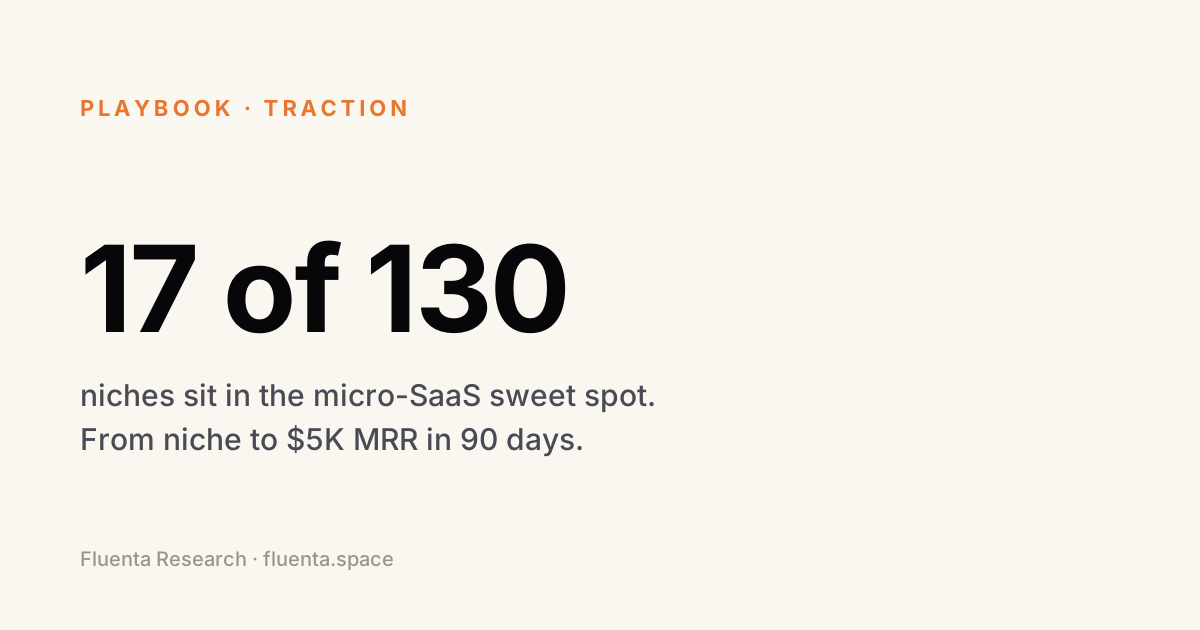
13% of ideas hit the micro-SaaS sweet spot, the rest fail on MVP speed
Before you write code, know if your idea fits the micro-SaaS model. Most don't. We score every idea on three metrics. `cs_solo_founder`: can one person build and sell it? `cs_boring_profit`: is the market unsexy enough to sustain margins? `cs_mvp_speed`: can you ship an MVP in under 4 weeks?
Of 130 ideas we ingested from public trend reports and scored, only 17 hit all three thresholds. That's 13%. The other 87% fail on at least one dimension. The most common failure mode, accounting for 68% of the failures (n=113), is `cs_mvp_speed`. Founders are drawn to ideas that sound simple but are operationally complex, requiring 6+ months to ship a V1. This is the single fastest way to kill your project.
A high-scoring idea is 'niche compliance document automation' for a specific industry. It's boring, the buyer is clear, and the MVP is a two-week build. Another is 'workflow glue for a specific vertical CRM'. These ideas don't get headlines, but they get customers. They are small, defensible, and profitable. Your job is to find one of these, not the next AI unicorn. A tool like the Fluenta X-Ray gives you these signals before you commit your time.
The 90-Day Path: What to execute and what to ignore
This timeline is aggressive but realistic if you pick the right idea. It is entirely focused on shipping and getting paid. Anything not directly contributing to that is a distraction.
Days 1-14: Validation. Do not build. Your only job is to kill the idea if it's weak. Identify 10 people in your target niche on LinkedIn or Reddit. Send them a message asking about their workflow, not your idea. Use the 'Mom Test' script below. Your goal is 5 conversations. At the same time, run your idea through a data-driven validation tool. This gives you quantitative market signals to pair with your qualitative interviews. If the data is bad or the interviews reveal no real pain, drop the idea and start over. This phase saves you months of wasted effort.
Days 15-60: Build. This is the core development phase. You are building the Minimum Viable Product. The key word is 'Minimum'. It should solve one problem, for one user persona, and do it reliably. No settings page. No team accounts. No fancy onboarding. Use a template, a UI kit, and a framework that you know well. The goal is to get a working, deployable application online that you can charge money for. Every feature request goes into a backlog titled 'After First 10 Customers'.
Days 61-90: Launch and Sell. A 'launch' for a micro-SaaS is not a Product Hunt campaign. It's manual, direct outreach. Go back to the people you interviewed. Show them what you built based on their feedback. Offer the first 5 an early-adopter discount. Post in the 3 niche communities where you found them. Your goal is 10 paying customers. That's it. Ten customers are enough to validate the core business and give you the feedback, and revenue, to get to $5K MRR.
What 130 source reports told us
At Fluenta, we don't generate ideas. We ingest and re-score ideas from public reports by firms like McKinsey, a16z, Forbes, and YC. We've processed 130 such ideas, and a clear pattern emerged. Trend reports are optimized for headlines, not for indie-founder success. They highlight ideas in massive, competitive markets that require significant capital and time to enter. This is the exact opposite of a good micro-SaaS.
For example, many 2026 reports point to 'AI-native workflow automation' as a top trend. We cover this in our SaaS Ideas Saturation Report. This is not a micro-SaaS idea; it's a venture-scale idea. The `cs_mvp_speed` score is low because building an 'agentic' AI tool is a high-burn project. It takes months. Reports fail to distinguish a market trend from a viable solo-founder opportunity. Find the boring, unsexy gaps that big reports ignore.
This disconnect is why you must validate the scale of an idea, not just the idea itself. The best tool for this is not a trend report. It's a structured conversation with a potential buyer. Don't ask if they would use your product. Ask about their past behavior. Here is a script you can use to find real pain.
How Fluenta uses data
Every idea we score comes from a public report, Forbes, McKinsey, a16z, Sequoia, First Round, YC essays, and similar. We do not ingest founder pitch decks, customer interviews, or private workspaces. We do not have insider access to anyone's roadmap. When you score an idea in X-Ray, your input data is private to you and never used in our public datasets.
Your V1 price should be simple and easy to say
Pricing isn't a complex spreadsheet exercise for V1. It's a tool to filter for serious customers. Find a price low enough for a business impulse buy. It must be high enough to require a credit card and signal commitment. For most B2B micro-SaaS, this is $19 to $49 per month.
Do not offer a free plan. Free plans attract users, not customers. You need customers to validate your business. Do not offer multiple tiers. This creates decision fatigue. Pick one price and one feature set for the first 90 days. Offer a limited-time discount for your first 5-10 users. This creates urgency and rewards their early trust.
The best way to pick your number is to find the closest competitor and price slightly below them. This is called competitor anchoring. It gives the buyer a familiar reference point and makes the decision easier. If there are no direct competitors, you're either in a bad market or you've found gold. Your pricing isn't permanent. It's a starting point. Get it 80% right and move on.
The launch checklist that gets your first 10 customers
A 'launch' is just telling the right people you've built something. It's not a single event. It's a process. For the first 90 days, it is 100% manual.
Your entire launch strategy is to find where your specific customers gather online and show them your work. Do not sell. Show. Post a screenshot or a short screen recording with the title, 'I built a tool to solve [PAINFUL_PROBLEM]. Here's how it works.' This approach invites feedback, not defensiveness. It starts a conversation.
Here is the exact checklist. Do these things every week until you have 10 customers. This should take less than 4 hours per week.
If you do this consistently, you will get your first customers. They will tell you what to build next. This is how you build momentum without a marketing budget or a brand.
Stop reading and start scoring your idea
This playbook is not theoretical. It's a summary of patterns from founders who ship quickly and find profitability. The common thread is a bias for action. They have a ruthless focus on skipping steps that don't lead to a paying customer. They trade perfection for speed.
The most important step is validation. Don't build an MVP for an idea the market doesn't want. Don't pick one that is too complex for a solo founder. Data could invalidate this playbook. This would happen if ideas with low `cs_mvp_speed` scores started reaching profitability. That would mean our viability filter is wrong. So far, the opposite is true. Speed is the single greatest predictor of success in this segment.
Your next action is to measure your best idea against the market. The Fluenta X-Ray scores your idea against 25 live data feeds. This gives you an objective measure of its viability. It's the fastest way to de-risk your project before you invest your time.
You finished the playbook
Now run YOUR idea through the same engine.
You just read how Fluenta scores ideas against 25 live data sources, the cs_pain corpus, and the 12 collection scores. The article is generic by design. Your specific idea gets a real X-Ray report — competitor density, pricing anchors, social pain quotes, funding momentum, and an LRS-100 score — in 20 minutes.
No subscription. One run = one full report. The dataset behind this article is the same one your X-Ray runs against.
FAQ
What is micro-SaaS?+
Micro-SaaS are small software businesses targeting a niche market. They are typically run by teams of 1-5 people. They generate $50K to $3M in annual revenue and can be built and launched in 4-12 weeks.
How long does it take to reach $5K MRR with a micro-SaaS?+
This playbook targets a 90-day ramp-up. Many solo founders who validate their ideas first hit $5,000 to $50,000 MRR. This usually takes one to two years.
What are the best micro-SaaS ideas for 2026?+
Top ideas are in vertical SaaS for specific industries like legal or construction. AI tools that automate a single task are also strong. So are workflow extensions for platforms like Shopify or Salesforce.
How is the micro-SaaS market growing?+
The micro-SaaS market is projected to grow 30% annually. The market size is estimated to go from $15.7 billion in 2024 to $59.6 billion by 2030.
How do you validate a micro-SaaS idea?+
Validation confirms a specific audience has a problem they will pay to solve. Use customer interviews about past behavior. Also use quantitative analysis of market data with a tool like Fluenta's X-Ray.
About the author

Fluenta Research
Data & Market Intelligence, Fluenta
Fluenta Research scores startup ideas against 25 live market, social, and competitor data feeds. Every claim in our reports is backtested before publishing. We ship weekly signal reports, quarterly saturation analyses, and on-demand X-Ray runs for individual founders.
Related Resources
Validation
130 SaaS Ideas Scored: The Q2 2026 Saturation Report
130 SaaS ideas scored on saturation and fundability from our live data. 19 outliers sit in the fundable-but-uncrowded quadrant. Updated weekly.
Traction
Pre-Seed Funding: How to Raise Your First $250K (2026)
Pre-seed funding in 2026: the 8-week path 12 founders used to raise their first $250K. LOI templates, 409a primer, warm-intro tracker.
Founder Playbook
Customer Interview Questions: 12 Discovery Scripts (2026)
Customer interview questions that surface real demand, not polite lies: 12 copy-paste discovery scripts tested across 47 founder interviews.
Score your idea in 20 minutes
Run Fluenta X-Ray on your idea. 25 live market + social feeds. Real demand data, real competition, real willingness-to-pay signals. From $7. 20 minutes.
Was this helpful?
Comments
0 replies