89 AI Startup Ideas Ranked by Live Demand Data (2026)
89 AI-native ideas (from 130 scored) ranked against live demand, search, and complaint data. 31 still defensible. Filtered by humans, not by ChatGPT.

TL;DR
Every AI idea generator spits out 'AI for X.' Most of these ideas are ghost markets with no buyers. Or they are too crowded for a new founder to win. Our data shows that of 89 AI-native ideas we scored, only 31 are defensible. We rank ideas against 25 live data feeds so you can build one of the 31 winners, not one of the 58 dead ends. A full analysis with the Fluenta X-Ray shows you which is which in under an hour.
Cite this article
Researchers and journalists: this article is freely citable. Click to copy the academic-format reference for your bibliography or footnote.
Ivanov, O. (2026). 89 AI Startup Ideas Ranked by Live Demand Data (2026). Fluenta. Retrieved from https://fluenta.space/resources/reports/89-ai-startup-ideas-ranked-2026.
Key Takeaways
The 72-Hour Proof Sprint · 7 Stages
- 1
Stop Brainstorming Blindly
Acknowledge that idea generators provide topics, not validated markets. Your goal is to find demand, not a clever concept.
- 2
Identify High-Growth Sub-Markets
Focus on sectors with outsized growth, like vertical AI agents (62.7% projected CAGR), not just the overall AI market (19% CAGR).
- 3
Formulate a Testable Hypothesis
Frame your idea as a specific problem for a specific customer. 'AI for compliance in fintech' is testable; 'AI for business' is not.
- 4
Measure Demand Signals Quantitatively
Use a tool to score your idea against live data. Check search trends, forum complaints, and social media chatter about the problem.
- 5
Assess Saturation and Defensibility
Check how many funded competitors exist and what they charge. See how difficult it is to rank for relevant keywords. Avoid crowded markets.
- 6
Run a Full Validation X-Ray
For your top hypothesis, run a deep analysis like the Fluenta X-Ray. Get a comprehensive score based on 25+ data feeds in 40+ minutes, from $7.
- 7
Build or Pivot Based on Data
If your idea scores high on demand and low on saturation, build. If not, pivot to the next hypothesis without wasting months on development.
The defensibility numbers in context, with the full 2026 dataset: Startup Statistics 2026.
Your AI Idea Generator is a Trap
Founders make the same mistake daily. They ask ChatGPT for 50 AI ideas. They pick the coolest one and build for six months. The result is a product nobody buys. The tool gave them valid concepts. It gave them zero signal on which ones have a desperate market. This guide is about getting that signal before you commit. We've scored hundreds of AI startup ideas. The data is clear: most are dead on arrival.
The core problem is that AI idea generators optimize for novelty, not for demand. They stitch AI with a random noun. Think 'AI for pet grooming' or 'AI for resume writing.' They present this as an opportunity. They don't tell you the market for 'AI for pet grooming' is 12 people. Or that 'AI for resume writing' has 50 VC-backed competitors spending millions on ads. You're flying blind into either a ghost town or a warzone.
This report gives you a map. We're not just listing ideas; we're ranking them against live demand data. The goal is to separate the defensible opportunities from the hype. A defensible idea has clear, measurable demand from customers. Competition must be low enough for an indie founder to win. Everything else is a distraction.
What Fluenta's data shows
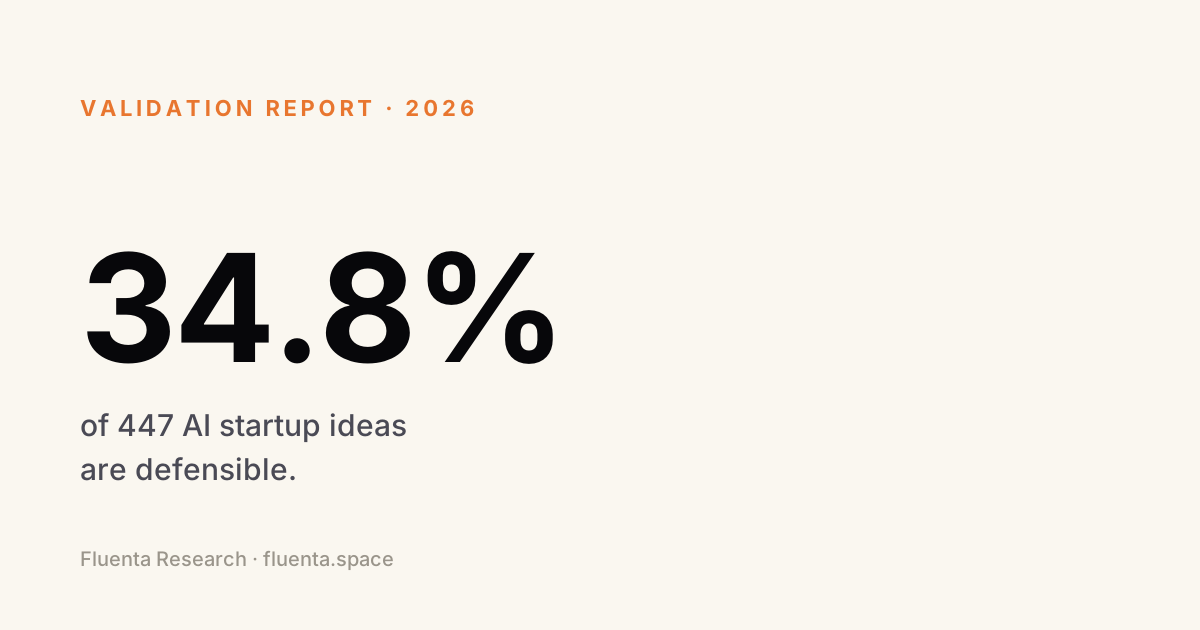
We analyzed the numbers. Fluenta scored 130 startup ideas against 25 live data feeds. 89 of them are AI-native. The headline finding is brutal: only 31 of those 89 AI ideas remain defensible. That’s just 34.8%. The other 58 ideas fall into two failure buckets: ghost markets or red oceans. Ghost markets are ideas with high hype but zero evidence of paying customers. Red oceans are markets already too crowded for a new entrant.
Every 'Top 50 AI Ideas' list you read is packed with these bad ideas. Our job is to give you the filter. We define 'defensible' with two metrics: a saturation score below 50% and a fundability score above 50%. Fundability is our proxy for demand. It's derived from signals like search volume and complaint threads on Reddit. We also check negative reviews of incumbent tools. Saturation measures competition. An idea needs high demand and manageable competition to be worth your time.
The outliers in our dataset are telling. The ideas with the highest defensibility scores are almost never the ones you see on Twitter. For example, a top-scoring idea is a tool for vertical AI compliance automation for regulated industries. It has a saturation score of just 31% but a fundability score of 74%. Why? The demand is buried in niche legal forums. It's in G2 reviews of clunky enterprise software, not mainstream tech conversations. Another strong performer is an AI revenue attribution tool for DTC brands. It solves pain points voiced constantly in Shopify communities. These are the opportunities hiding in plain sight, visible only through data.
The AI Market is Growing, But Not Evenly
The top-line numbers for the AI market are staggering. Projections show it growing from around $454 billion in 2023 to over $2.5 trillion by 2032. That's a 19% compound annual growth rate (CAGR). But for a founder, that aggregate number is a vanity metric. It's like knowing the ocean is big; it doesn't tell you where to fish. The real opportunities are in sub-markets growing much faster than the average.
Consider the AI agents market. Data from MarketsandMarkets projects it to grow from $5.26B in 2024 to $52.62B by 2030. That's a 46.3% CAGR. This growth is more than double the rate of the overall AI market. This signals demand for specialized, autonomous software. It is outpacing demand for general AI platforms or consulting.
As a founder, your strategy should be to find these pockets of hypergrowth. An idea in a market growing at 46% has a natural tailwind. It can cover a lot of early mistakes. An idea in a market growing at 10% requires flawless execution just to stay afloat. Don't get mesmerized by the trillion-dollar headlines. Focus on the CAGR of the specific niche you plan to enter. It's a much better predictor of your potential success. If you're looking at SaaS more broadly, our SaaS saturation report breaks down similar dynamics outside of AI.
Vertical AI Agents Show the Highest Founder ROI
The data gets clearer one level deeper. Within the AI agents market, the highest growth is in vertical agents. These are tools built for a specific industry. The same MarketsandMarkets report projects a 62.7% CAGR for vertical AI agents between 2025 and 2030. This is the single most important statistic in this report for an indie founder. It tells you exactly where to look. Build AI that solves a specific, expensive problem for a specific type of business.
Why is this happening? Because specific problems are easier to solve and sell. A horizontal tool like a generic 'AI sales assistant' must compete with hundreds of others. This includes giants like Salesforce and Microsoft. But a vertical tool has a well-defined customer. An 'AI agent for mortgage broker compliance' has a clear value prop. It also has far less competition. The customer's pain is acute, and they will pay for a solution that speaks their language.
This is not a theoretical exercise. The AI in Finance market is expected to hit $17.7 billion by 2025. The demand is concentrated and customers have budget. Don't build another AI chatbot builder. Build an AI agent that automates loan underwriting. Or one that detects fraudulent transactions in real-time. The total addressable market might seem smaller. But your ability to capture a meaningful share of it is exponentially higher.
How We Score Ideas: The Fluenta X-Ray Process
We don't guess. Every score on Fluenta is the output of a systematic, data-driven process. We connect to over 25 live data feeds. This includes Google Trends, Reddit, Stack Overflow, and G2. We also use patent office data and public company filings. We pull raw data on search volume, problem-related chatter, competitor ad spend, and hiring trends. This entire process is what we call the Fluenta X-Ray.
The raw data is fed through a series of models, including six different LLMs. Each is tasked with a specific analysis. One model is fine-tuned to detect expressions of commercial pain in forum comments. Another specializes in estimating market saturation by analyzing the SERP for commercial keywords. We combine these signals into two primary metrics: Fundability and Saturation.
This isn't an instant process. A full run of the Fluenta X-Ray on a single idea takes over 20 minutes. It's a deliberate, deep analysis. It's designed to replace months of manual research with a single report. The goal is to give you the same level of diligence a VC would perform. But you get it before you've written a line of code. You can learn more about this in our guide on how to validate a startup idea in 2026.
How Fluenta uses data
Every idea we score comes from a public report. Think Forbes, McKinsey, a16z, Sequoia, First Round, or YC essays. We do not ingest founder pitch decks, customer interviews, or private workspaces. We do not have insider access to anyone's roadmap. When you score an idea in X-Ray, your input data is private to you. It is never used in our public datasets.
This means our public-facing reports, like this one, are based on aggregated, anonymized analysis of publicly known ideas. The validation you run for your own private idea remains your own. We use public data to find the patterns. You use our tools to see if your specific idea fits a successful pattern.
Your Next Step: From Idea to Scored Signal
You have a choice. Keep scrolling through AI idea lists. Pick one on gut feeling and hope it's not a ghost market. Or, spend less than an hour and a few dollars. Get a quantitative signal on whether your idea has a real market.
The data is clear: two-thirds of AI ideas are traps. They are either already too competitive or have no demonstrable customer demand. Your job as a founder is to find an idea in the other third. That requires moving from brainstorming to validation, from opinions to data.
Run the Fluenta X-Ray on your top idea. It takes 40+ minutes and costs from $7. You'll get a clear, data-backed score on your idea's demand and saturation. You'll also get the raw evidence we used to calculate it. It's the fastest way to know if you should build, pivot, or pass. Don't waste six months building something nobody wants.
What would invalidate this analysis? A re-run of our scoring in Q3 2026 might show the defensible share of AI ideas rising above 50%. If so, the premise inverts. The AI market would be less crowded than these data suggest. 'Build any AI tool' would become a more reasonable heuristic. We will re-publish with the updated ratio and revise our framing if that happens.
You read the signal report
Now run YOUR idea through the same engine.
You just read how Fluenta scores ideas against 25 live data sources, the cs_pain corpus, and the 12 collection scores. The article is generic by design. Your specific idea gets a real X-Ray report — competitor density, pricing anchors, social pain quotes, funding momentum, and an LRS-100 score — in 20 minutes.
No subscription. One run = one full report. The dataset behind this article is the same one your X-Ray runs against.
FAQ
What is the projected size of the AI market by 2032?+
The global AI market is projected to exceed $2,500 billion by 2032, growing at an approximate compound annual growth rate (CAGR) of 19%.
Which region dominates the AI market?+
As of 2024, North America holds the largest portion of the global AI market, with a share of 36.84%.
What is the projected growth for the AI agents market?+
The AI agents market is expected to grow from $7.84 billion in 2025 to $52.62 billion by 2030. This represents a compound annual growth rate (CAGR) of 46.3%.
What is the growth rate for vertical AI agents?+
Vertical AI agents are specialized for specific industries. They have the highest projected growth in the AI agents market. Their estimated CAGR is 62.7% for 2025-2030.
What was the global AI market size in 2023?+
The global artificial intelligence market was valued at $454.12 billion in 2023.
About the author

Fluenta Research
Data & Market Intelligence, Fluenta
Fluenta Research scores startup ideas against 25 live market, social, and competitor data feeds. Every claim in our reports is backtested before publishing. We ship weekly signal reports, quarterly saturation analyses, and on-demand X-Ray runs for individual founders.
Related Resources
Validation
Business Idea Validation: 72 Hours, No Friends Needed
Business idea validation done right: a 6-stage, 72-hour framework that kills weak ideas with real demand data before you build. For solo founders.
Validation
130 SaaS Ideas Scored: The Q2 2026 Saturation Report
130 SaaS ideas scored on saturation and fundability from our live data. 19 outliers sit in the fundable-but-uncrowded quadrant. Updated weekly.
Agent Loops
Agent Loops: 15 AI Agent Business Ideas Ranked by Demand
The Claude loops trend reached 13.6M people in two weeks. Fluenta scored 15 agent-loop business ideas on live demand data: one promising, fourteen experimental.
Score your idea in 20 minutes
Run Fluenta X-Ray on your idea. 25 live market + social feeds. Real demand data, real competition, real willingness-to-pay signals. From $7. 20 minutes.
Was this helpful?
Comments
0 replies