ICP Marketing: The Customer Profile Template (2026)
ICP marketing starts with a customer profile template you fill in 30 minutes: a competitor list, 5 churn interviews, and one Reddit thread. Template included.

TL;DR
Most founders create vague 'Marketing Mary' personas. This leads to generic landing page copy that wastes ad spend. The fix is to stop inventing and start aggregating. Use three real-world data inputs to build a defensible ICP in 30 minutes: your competitor's negative reviews, your churn interviews, and a relevant Reddit thread. Fluenta's analysis of 130 ideas shows that ideas with 5+ distinct ICP segments have a median fundability score 17 points higher than those with just one or two. This makes a sharp ICP critical for validation.
Cite this article
Researchers and journalists: this article is freely citable. Click to copy the academic-format reference for your bibliography or footnote.
Ivanov, O. (2026). ICP Marketing: The Customer Profile Template (2026). Fluenta. Retrieved from https://fluenta.space/resources/guides/ideal-customer-profile-icp-30-minute-guide.
Key Takeaways
The 72-Hour Proof Sprint · 6 Stages
- 1
Step 1: Aggregate Your Three Inputs (5 min)
Get your primary competitor's G2/Capterra page, notes from 5 churn/lost-deal calls, and one high-comment Reddit thread on your problem space.
- 2
Step 2: Scrape Competitor Reviews for Pain (10 min)
Copy/paste all 1-star and 2-star reviews into a document and highlight phrases describing missing features, failed jobs, and integration gaps.
- 3
Step 3: Analyze Churn Interviews for Triggers (5 min)
Review your notes and find the 'switch' moment—the event that caused them to seek a solution in the first place, not just why they left you.
- 4
Step 4: Mine the Reddit Thread for Language (5 min)
Document the exact words, slang, and analogies people use to describe their problem; this is your future ad copy.
- 5
Step 5: Synthesize the Pain, Trigger, and Language (5 min)
Fill out a one-page template with the patterns you found, focusing on the job-to-be-done, not just the company size or job title.
- 6
Step 6: Write a Single Sentence ICP Definition
Condense your findings into one sentence: 'We help [ROLE] at [COMPANY TYPE] who struggle with [PAIN] when [TRIGGER] happens.'
ICP marketing starts with one artifact: a customer profile template you can fill in 30 minutes. This guide hands you that template, built from a competitor list, five customer interviews, and one Reddit thread, so your copy speaks to a real buyer instead of a stock persona.
The template itself is below, field by field.
Your landing page fails because your ICP is a fictional character
Let's be blunt. Your landing page copy is too generic. It speaks to everyone, so it converts no one. You built your Ideal Customer Profile (ICP) backwards. You invented a persona like 'Marketing Mary' with a stock photo and hobbies. This is a waste of time. A useful ICP isn't a creative writing exercise. It's a data aggregation problem. (Before defining who to sell to, you should also know your market size. See our guide to calculating your Total Addressable Market.)
An ICP's job is to give you extreme focus. It tells you who to target, what to build, and how to message your product. A real ICP is a specific, falsifiable description of a company. This company gets the most value from your product and is easiest for you to sell to. It's not about their favorite blogs. It's about their budget, their pain point, and the event that triggers their search for a solution. Anything else is a distraction.
We'll build a real one in 30 minutes. You don't need a big budget or a data science team. You need a competitor list, your churn data, and a Reddit thread. The output is a one-page document. It makes writing copy, running ads, and building your roadmap 10x easier. Stop selling to a vague market. Start selling to a specific buyer.
A 30-minute ICP is built on real pain, not just demographics
There are two ways to define a customer. The first is the gut-instinct, System 1 approach. You have a vague idea of a mid-sized tech company with a frustrated VP of Engineering. This is where most founders stop. The second is the deliberate, System 2 approach. You collect evidence of pain from real people and synthesize it into a precise profile. We are doing the second one.
Your ICP needs to be built on three pillars of evidence. First, your competitor's unhappy customers. Their 1-star reviews are a goldmine for your feature set and marketing angles. Second, your own churned customers or lost deals. Why did they really leave? More importantly, what event made them look for a tool like yours? A new funding round, a compliance rule, a key hire? This is the 'Job to be Done' trigger. It's the most important psychographic data you can have.
The third pillar is unsolicited, public complaints. People use forums like Reddit to complain when their current tools fail them. They use raw, unfiltered language. They describe their problem's context in detail. This is your future ad copy, handed to you for free. Combine these three data sources. You'll move from a demographic profile to a situational one. You go from 'SaaS companies with 50-200 employees' to a real ICP. For example: 'VP of Sales at a 75-person B2B SaaS company who just missed their quarterly forecast because their CRM data is a mess'.
Step 1: Scrape your competitor's negative reviews for 10 minutes
Set a timer for 10 minutes. Go to G2, Capterra, or the Shopify App Store. Find where your top competitor gets reviewed. Filter for 1, 2, and 3-star reviews. Your goal is not to read every word. You are pattern-matching for specific categories of pain.
Create a simple document with four columns: 'Missing Feature', 'Failed Integration', 'Job Not Done', and 'Quote'. As you scan reviews, copy and paste phrases into the correct column. Look for specific language. For example: 'I was shocked it couldn't...', 'We had to build a workaround for...', or 'The whole reason we bought it was to do Z, and it fails'.
After 10 minutes, stop. You should have a raw list of your competitor's biggest weaknesses. These are your opportunities. The 'Missing Feature' column informs your roadmap. The 'Failed Integration' column tells you which partners to prioritize. The 'Job Not Done' column is the core of your marketing message. You are selling the solution to the job they failed to do. This list is more valuable than any fictional persona.
Step 2: Find the 'switch' in churn calls and Reddit for 10 minutes
Now, spend five minutes on your churn data. If you lack churned customers, use notes from deals you lost. Ignore why they left you. Instead, find why they started looking for a solution at all. What was the trigger? Did they raise a Series A? Did their team grow past 50 people? Did a new compliance rule appear? This 'switch' moment is when they have budget and intent. Our Customer Discovery Playbook has scripts for this.
Next, spend five minutes on a Reddit thread. Search for `[your problem] + 'alternative'` or `[your competitor] + 'sucks'`. Find a thread with at least 20 comments. You are not reading for pleasure. You are scraping the exact language people use to describe their pain. Note the job titles in their flair. Note the other tools they mention. This is your technographic and demographic data, sourced from the wild.
This 10-minute exercise finds the intersection of a person, context, and problem. This is the foundation of a powerful ICP. You're not guessing anymore. You're documenting what the market is already telling you.
Most founders stop at one ICP; data shows you need at least three
You've now built a solid, evidence-based ICP. Here's where most founders stop. They take their 'VP of Sales' profile and run with it. Our data shows this is a mistake. When we analyze ideas using the Fluenta X-Ray, we auto-generate ICP segments from dozens of sources. Across 130 scored ideas, the median number of distinct ICP segments we found per idea was 3.
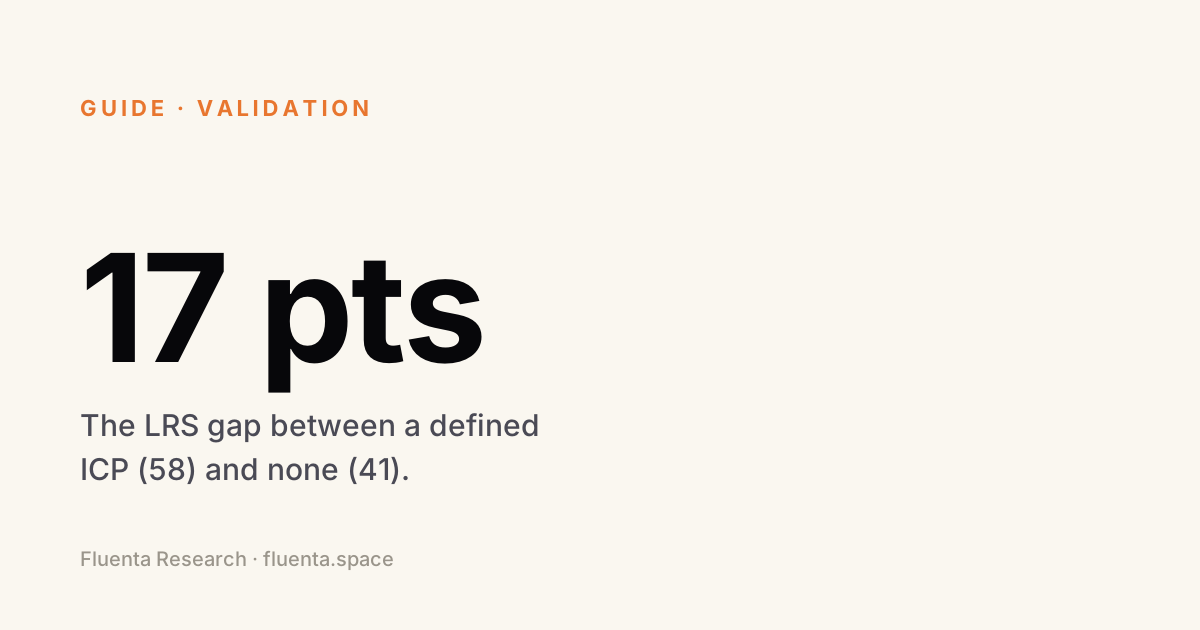
This matters. Ideas with more addressable segments have higher fundability. Only 12% of ideas we analyzed (n=16) had 5 or more distinct ICP segments. Those ideas had a median LRS-100 score of 58. Ideas with fewer than 3 segments (n=52) had a median score of just 41. That 17-point gap is significant. Multiple buyer types give you more paths to monetization and a larger potential market.
Don't fall in love with your first ICP. It's a starting point. Your initial profile might be mid-market. But competitor reviews could reveal an enterprise ICP with a higher willingness to pay. Or you might find a niche of underserved SMBs. Identify your primary ICP for your initial GTM. But keep a list of secondary and tertiary ICPs to explore next. See how we score and segment ideas on our public Ideas page.
How Fluenta uses data
Here's how Fluenta uses data. Every idea we score comes from a public report from sources like Forbes, McKinsey, a16z, or YC essays. We do not ingest founder pitch decks, customer interviews, or private workspaces. We do not have insider access to anyone's roadmap. When you score an idea in X-Ray, your input data is private to you and never used in our public datasets.
Your ICP is a hypothesis, not a fact, now go test it
The 30-minute ICP is a weapon. It's fast, cheap, and actionable. It gives you clarity to write a landing page for a specific person with a specific problem. It gives you keywords for your first ad campaign. It gives your first sales hire a concrete target. It is infinitely better than a vague persona, but it is still a hypothesis.
Your next job is to invalidate it. Run a small ad campaign targeting the job title and industry you identified. Does it convert? Use the language you scraped from Reddit in your ad copy. Does the click-through rate improve? Get on sales calls and listen for the trigger events you documented. Do they match reality? The market will tell you if your ICP is correct. Your job is to listen and iterate.
This process never ends. Your ICP will evolve as your product and market change. Re-run this 30-minute exercise every quarter. As you grow, layer in quantitative data from your own customer base. But the core principle is the same: stop inventing, start listening. A data-driven ICP is the fastest path from a generic product to a focused business. You can validate your ICP and idea with the Fluenta X-Ray. It analyzes your concept against dozens of live data feeds in about 20 minutes.
What would invalidate this analysis? If a Q3 2026 data re-run shows no score difference between ideas with 1-2 segments and those with 5+, our premise would be weakened. The premise is that more segments co-occurs with higher fundability. We will republish the results if that happens.
You finished the guide
Now run YOUR idea through the same engine.
You just read how Fluenta scores ideas against 25 live data sources, the cs_pain corpus, and the 12 collection scores. The article is generic by design. Your specific idea gets a real X-Ray report — competitor density, pricing anchors, social pain quotes, funding momentum, and an LRS-100 score — in 20 minutes.
No subscription. One run = one full report. The dataset behind this article is the same one your X-Ray runs against.
FAQ
What is an ideal customer profile?+
An ideal customer profile (ICP) describes the type of company, not person, that gets the most value from your product. It includes firmographics (industry, company size), technographics (software they use), and psychographics (pain points, buying triggers).
What is ICP in business?+
In business, ICP stands for Ideal Customer Profile. It's a data-backed definition of your most valuable customer segment. It focuses marketing, sales, and product efforts on accounts most likely to buy, stay, and grow.
How do you define an ICP for a SaaS product?+
For SaaS, define an ICP by analyzing your best customers or your competitor's customers. Identify common traits: company size, industry, revenue, and tech stack. Note the specific pain points your software solves for key decision-makers (e.g., VP of Sales, CTO).
What should be included in an ICP template?+
A good ICP template includes: Company Firmographics (industry, size, revenue), Technographics (tech stack), and Pain Points (the core problem). Also include Buying Triggers (search events), Success Metrics (their outcome), and Key Roles (decision-maker, champion, user).
Why is an ICP important for marketing?+
An ICP is critical for marketing. It stops you from wasting money targeting everyone. It forces focus on high-value prospects. This improves ad targeting, messaging, conversion rates, and customer lifetime value.
About the author

Fluenta Research
Data & Market Intelligence, Fluenta
Fluenta Research scores startup ideas against 25 live market, social, and competitor data feeds. Every claim in our reports is backtested before publishing. We ship weekly signal reports, quarterly saturation analyses, and on-demand X-Ray runs for individual founders.
Related Resources
Validation
TAM Explained: Calculate Total Addressable Market
TAM, SAM, SOM in plain English, triangulated with three methods and published as a range. Worked example from a 2.4-cent Fluenta run on an anonymized AI tool.
Founder Playbook
Customer Interview Questions: 12 Discovery Scripts (2026)
Customer interview questions that surface real demand, not polite lies: 12 copy-paste discovery scripts tested across 47 founder interviews.
SEO TOOLS · SMALL BUSINESS
Best SEO Tools for Small Business: What Each Does
The best SEO tools for small business, sorted by the job each one does, what they cost, and the one stage no tool covers: doing the work.
Score your idea in 20 minutes
Run Fluenta X-Ray on your idea. 25 live market + social feeds. Real demand data, real competition, real willingness-to-pay signals. From $7. 20 minutes.
Was this helpful?
Comments
0 replies