194 YC Spring 2026 Startups, Scored on Public Data

The 194 YC Spring 2026 startups below are scored on six public signals before Demo Day, not on hype. Almost half the batch builds tools for AI agents, and the highest score belongs to a company you should question hardest. Each row opens to the public-data read and the three questions to ask, the same lens we use to put any idea through a real demand test.
Key Takeaways
YC's Spring 2026 batch demos on June 16. We scored all 194 companies on public data before they walked on stage, and three things stand out. None of them is what the batch is selling.
One line holds the whole thing together. Almost half the batch is building tools for AI agents, and the highest score on the board belongs to a company you should question hardest.
See where every company landed
All 194, scored on six public signals, searchable, each with the three questions to ask its founder. Free and open below, no signup.
Jump to the board ↓The batch numbers beside the rest of the 2026 data: Startup Statistics 2026.
The shape of the batch
We split the 194 into four groups. None of them pulled away from the rest. Agent Infrastructure came out highest on average and the atoms group lowest, with the other two stacked in between. The whole class lives in a narrow band. There is no runaway here. (The group averages and the full ranking are in the chart and table below.)
What repeats is the bet. The batch made a single wager and made it over and over, mostly some flavor of building for agents or selling AI automation, and the duplicates pile up inside a group rather than across it. What also repeats is the verdict. The scoring kept telling companies to narrow down, and almost never told one to go wide.
Group 1: Agent Infrastructure, the monetization mirage
Fifty-five companies building the rails everyone else builds agents on: runtimes, sandboxes, memory, observability, agent payments and identity. Twenty-eight of them literally say "for agents" in the one-liner. Top of the group: Kuli at 65.5, Armature and Superlog at 63.2. Bottom: RentAHuman at 32.7.
Source · Fluenta, YC Spring 2026
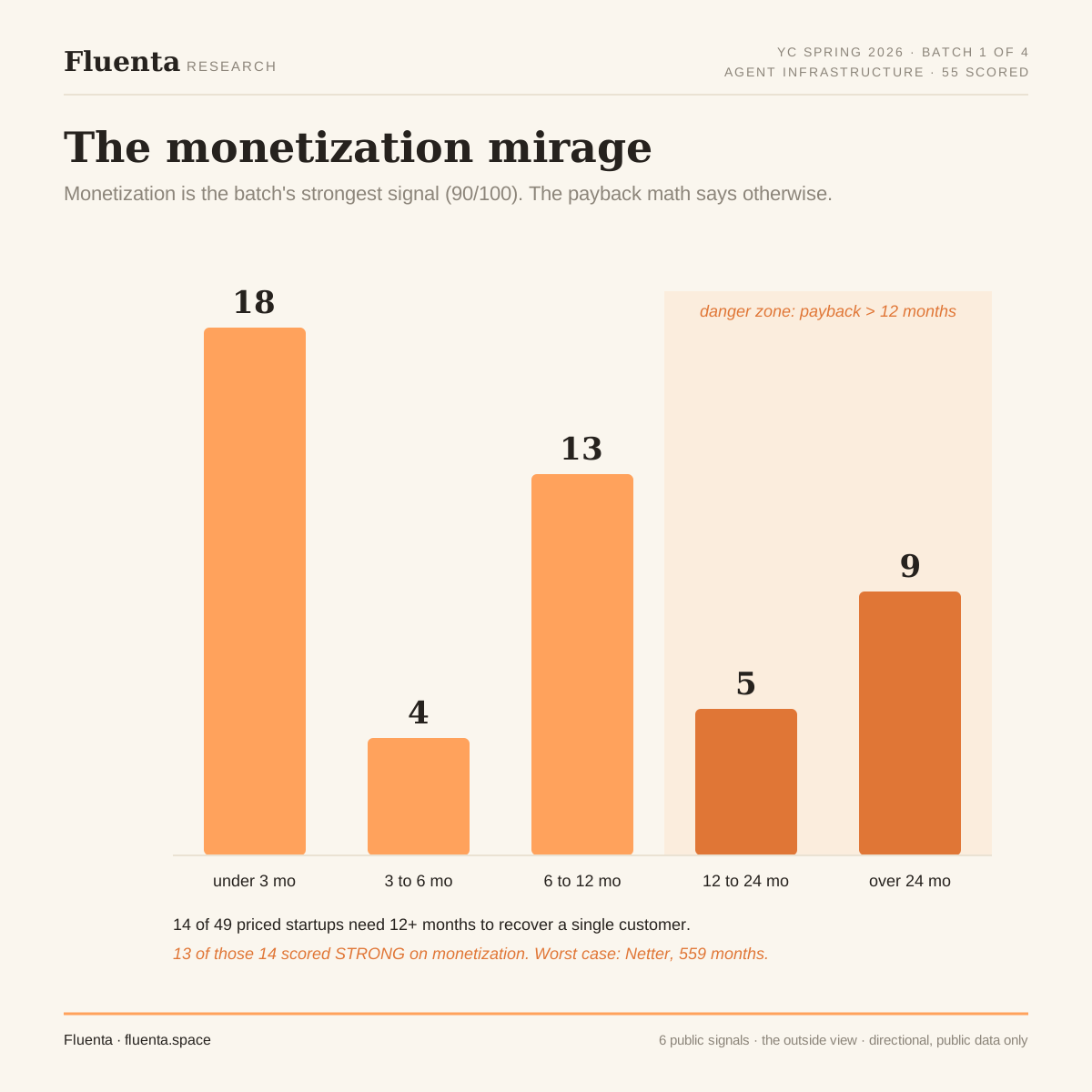
Monetization is the group's strongest signal, and that is the trap. On real CAC-versus-payback math, 14 of the 49 priced companies need more than a year to recover a single customer. Netter pencils out at 559 months, Amboras at 511, Replicas at 508, Incandor at 225. Thirteen of those fourteen scored "strong" on monetization. The lesson is blunt: do not underwrite the monetization score, underwrite the payback.
Source · Fluenta, YC Spring 2026
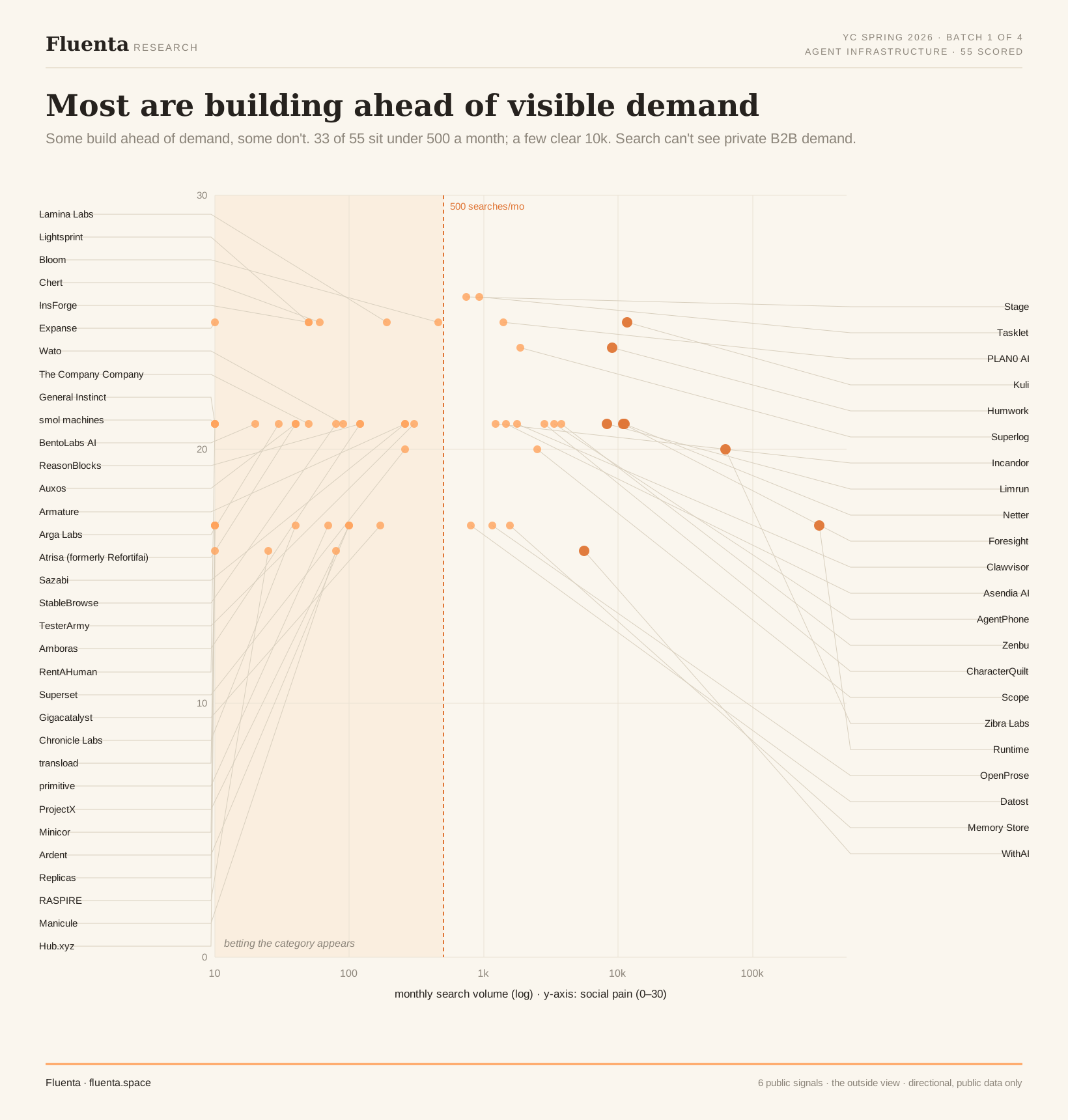
The other pattern is internal collision. Agent memory shows up three times in the same group. Agent sandboxes and testing show up four times. For those companies the first diligence question is not about the market. It is why you and not the others in your own cohort.
Group 2: The AI Workforce, the money already came
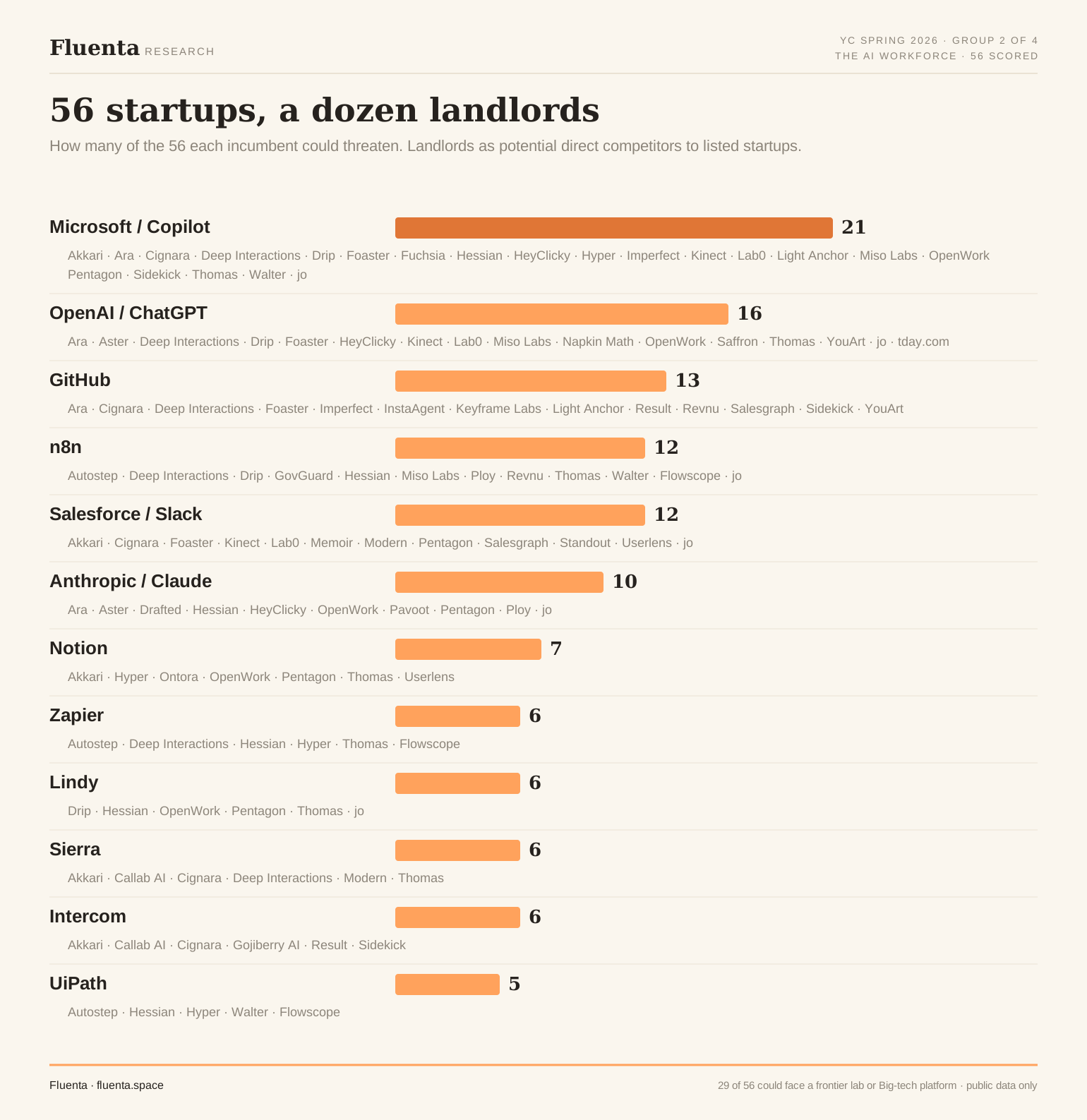
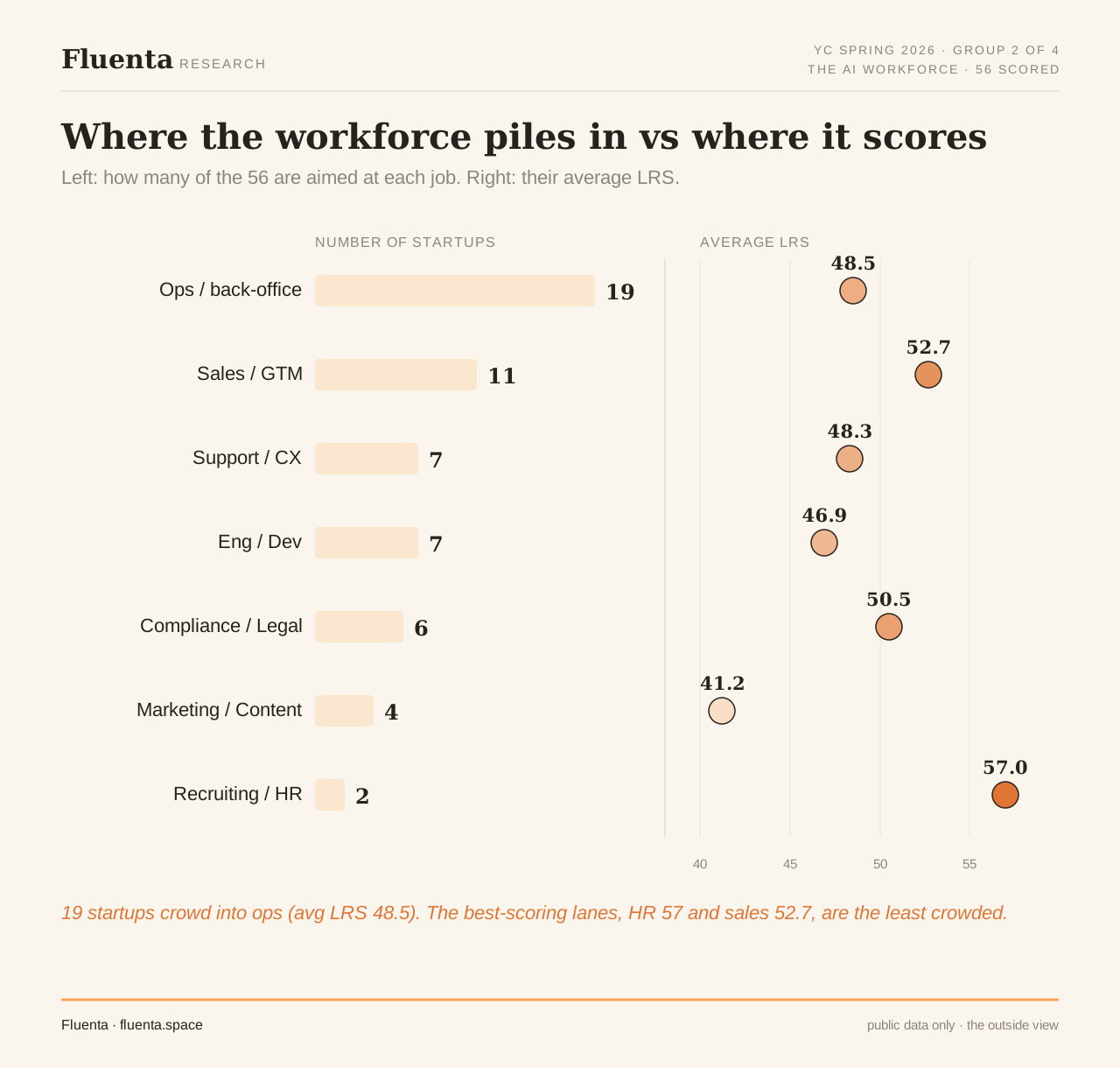
Fifty-six companies pointing agents at specific jobs: sales, support, recruiting, finance, back-office operations. Top: Saffron at 59.9, Pentagon at 59.5, InstaAgent at 58.8. Bottom: Drafted at 37.6.
Source · Fluenta, YC Spring 2026
Funding is the weakest signal for 32 of the 56, and not because the money is absent. It is because the money already came and left. Billions flowed into these categories and got absorbed rather than breaking out. The highest scorers sit in the white space the capital skipped, smaller raises in jobs the giants ignored. The investor read is the inverse of the usual one: a hot funding history here is a warning, not a green light.
Source · Fluenta, YC Spring 2026
The label itself is the tell. Every company in the group's bottom six is a vague "AI automation for X" play. Every company at the top owns one specific job. If the one-liner is "AI automation," the first question is which X they actually own, because the data says the vague ones do not score.
Group 3: AI Meets the Real World, where the unit economics are fiction
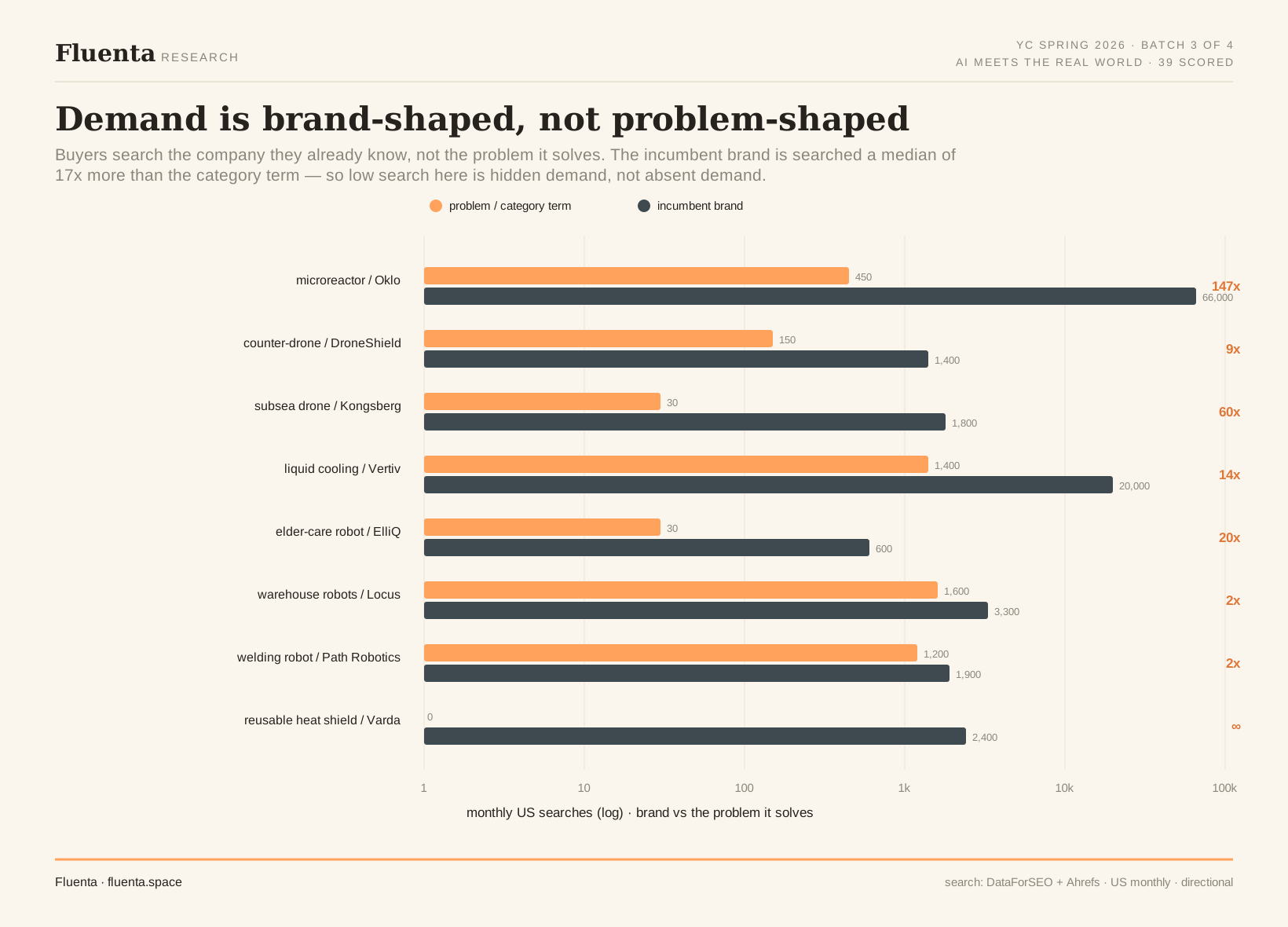
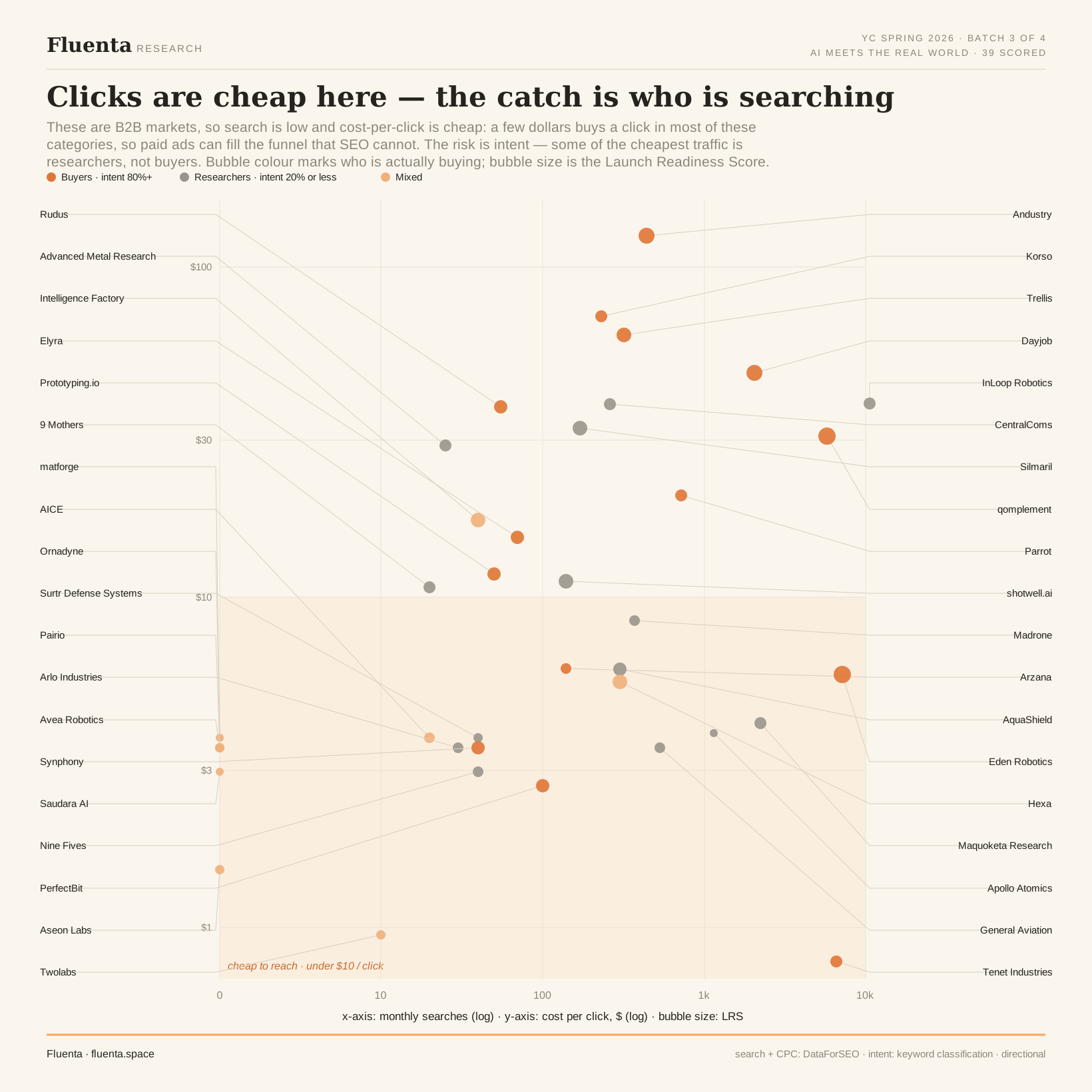
Thirty-nine companies that build in the physical world. One makes a nuclear reactor. Others make robots or drones, and a couple are defense plays. It scored lowest of the four groups, and that ranking is an artifact more than a finding. (Scores and the top and bottom names are in the chart and table below.)
Source · Fluenta, YC Spring 2026
Nobody googles a warehouse robot. Demand here looks dead on paper while the pain scores run hot, and that gap is the whole story. The buyer for a reactor or an industrial robot was never going to be findable by a keyword. Low search is a measurement failure, not a verdict on the problem.
Source · Fluenta, YC Spring 2026
The payback number is the one to throw out. The cards claim a hardware company recovers a customer in about a month, which no hardware company does. That is a SaaS model run on a capex business. It counts the software and ignores what it costs to build the machine and bolt it to a customer's floor. Ask these founders about gross margin per unit, and ignore whatever the card says about payback.
Group 4: Care and Capital, the capital got here first
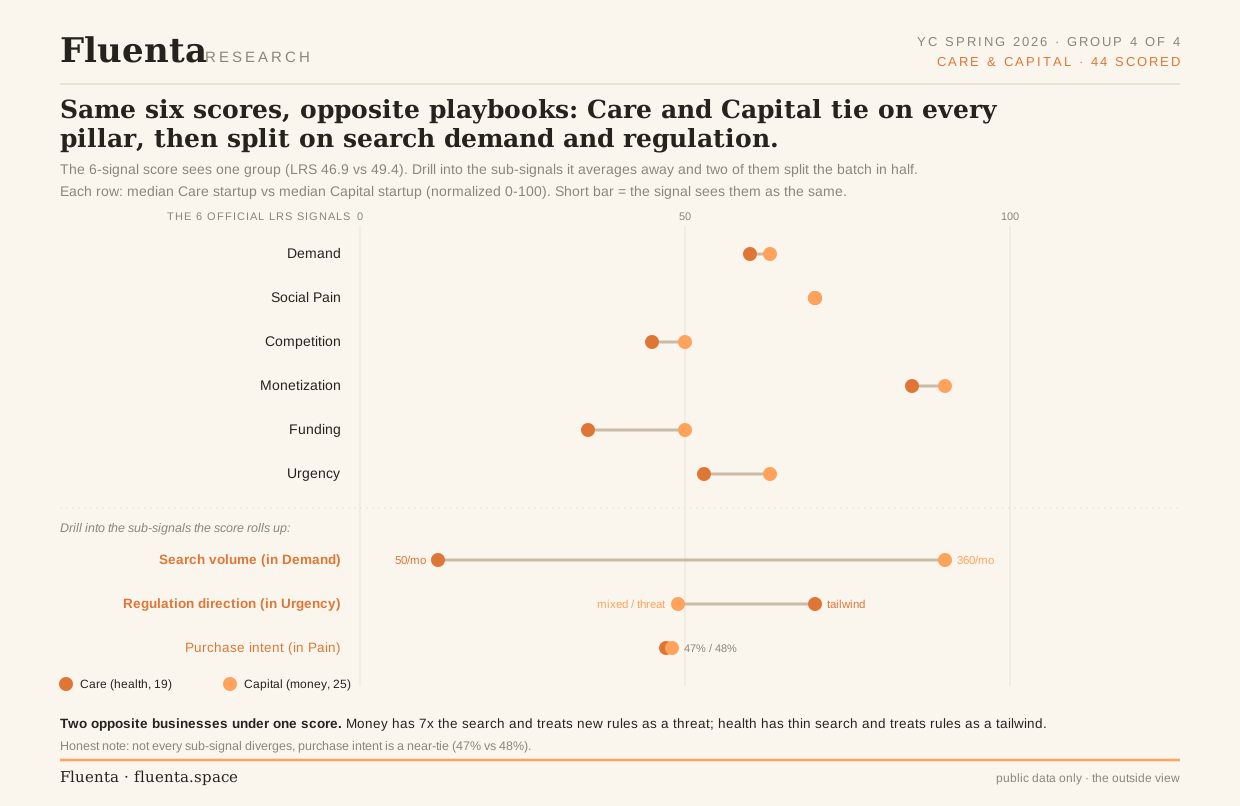
Forty-four companies in the two most regulated, most capital-intensive markets in venture: health and money. It is really two cohorts on one ruler, 19 in care and 25 in capital, and they fail for opposite reasons. Top: Taiga at 60.9, Gravy at 60.2, Arctic Health at 59.9. Bottom: Arden at 36.0.
Source · Fluenta, YC Spring 2026
Monetization is a non-question here. The pillar averages 89 percent, because health and money businesses make money by taking a slice of a transaction that already happens: a claim, a payment, a visit, a trade. So the two pillars that ask whether there is a way to make money stop discriminating. What separates the group is competition and capital.
Source · Fluenta, YC Spring 2026
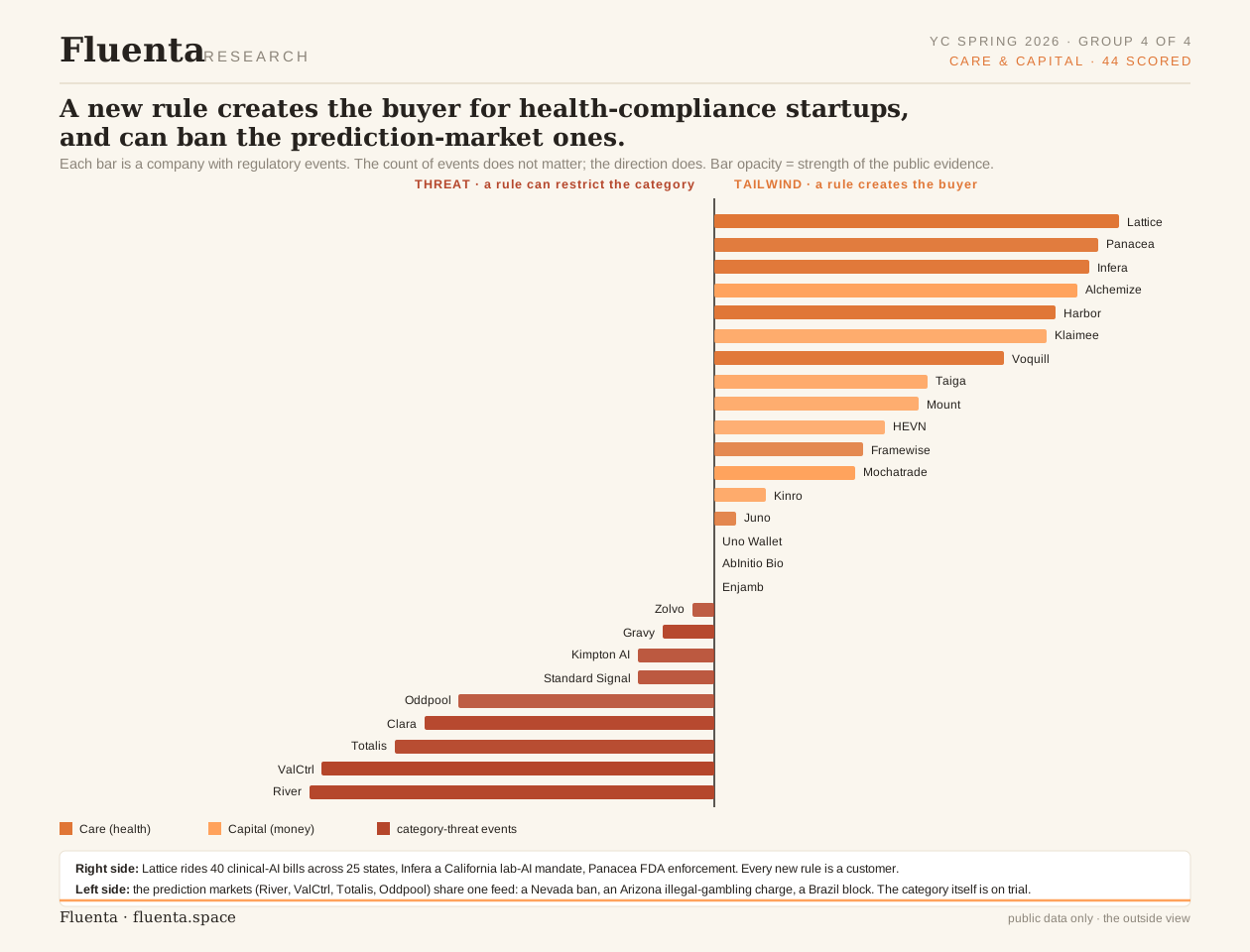
And the capital arrived years ago. Twenty-three of the 44 already face a competitor that raised more than 100 million dollars. Andco is up against EvenUp's 135 million. Clara is up against Forward, which raised 225 million and then shut down. Hedge is up against Nirvana's 100 million. Open lanes, common in the atoms group, are rare here. The care half hides a second problem the score cannot see at all: 18 of the 19 health companies carry an FDA, clinical-validation, or reimbursement barrier that no public signal measures.
Every company in the batch, scored
All 194 companies, searchable. Each row opens to the public-data read and the three questions a sharp investor would press on at Demo Day. Search by name, filter by group, and sort by score.
Below is the full board: every company in the batch, scored and searchable.
KuliAgent Infrastructure · Marketing & Sales Tech65.5›
What it does. automated influencer marketing
The public-data read. Real, transactional demand (11.6k/mo, 83% transactional, KD 32) and a genuine switching complaint on r/influencermarketing. But it is a knife fight against CreatorIQ, GRIN, impact.com and Aspire, all SEO-led, and the funded 2020-22 wave never cracked the category open. Monetization is the bright spot (0.7-month payback).
Three questions for Demo Day
- CreatorIQ, GRIN and impact.com already rank for these terms and already sell automation. What can you do in this workflow they cannot ship next quarter, and which single creator vertical do you own end-to-end first?
- Your sharpest signal is r/influencermarketing, "super manual, no way to track who replied." Tracking is a feature, not a category. Who is canceling GRIN to pay you, and at what team size does that switch happen?
- CreatorIQ raised $40M in 2022 and Glewee $9M the same year, yet brands still run influencer ops on spreadsheets. What did that funded wave misread about willingness to pay for automation that you have now validated?
ArmatureAgent Infrastructure · Developer Tools & Infrastructure63.2›
What it does. product analytics for agents
The public-data read. Almost no search yet (260/mo, KD 0) because "agent analytics" is a category you would have to create, while Pendo, Amplitude, Mixpanel and PostHog own human analytics. Pain reads neutral. The unit math is the worry: $2-49/mo against $156-519 CAC is a 14-month payback before any churn.
Three questions for Demo Day
- 260 searches/mo at KD 0 means nobody looks for "agent analytics" yet. Are you betting the category appears, and what is the wedge before Amplitude or PostHog ship an "agent sessions" view on the pipes they already own?
- At $2-49/mo on a dev tool teams rip out fast, the expansion story has to carry this, not the entry seat. Where does seat or usage growth come from inside an account once agent analytics is wired in, and what is your evidence any team has expanded rather than churned?
- Your top pain quote (Indie Hackers) is engineers debating PostHog vs Amplitude for normal product analytics, not agent observability. Where is the evidence teams feel acute pain measuring agents specifically rather than reusing what they have?
SuperlogAgent Infrastructure · Developer Tools & Infrastructure63.2›
What it does. self-healing logging
The public-data read. Decent intent (1,870/mo, 100% transactional) but you walk into Datadog, Dynatrace, New Relic and Splunk, the most concentrated, highest-CAC market in the batch ($580-1,932, CPC $58). Funded observability challengers got absorbed, not breakout. The pain quote is a vendor-comparison thread, not a fire.
Three questions for Demo Day
- "Self-healing logging" is a feature Datadog can ship in a sprint on data they already hold. What stops them, and why does a buyer add you instead of expanding their Datadog contract?
- Lumigo raised $29M in 2022 and ended up absorbed, not independent. In observability the funded outcome is acqui-hire. What is your path to escape velocity rather than becoming a Datadog feature acquisition?
- Your demand reads as a vendor-comparison thread, not a fire, and CAC runs $580-1,932 against a $58 CPC. Who actually sits at the $1,000/mo top of your band, and how many logos land at the $58 floor where the math breaks?
Memory StoreAgent Infrastructure · Productivity & Collaboration62.4›
What it does. memory layer for agents
The public-data read. Good intent (1,560/mo, 96% transactional, KD 20) and a clean switching signal on r/AI_Agents ("need better memory systems, not just bigger context windows"). But it is the most crowded thesis in AI infra (mem0, Zep, Letta, Cognee) and social pain reads thin (17/30).
Three questions for Demo Day
- mem0, Zep, Letta and Cognee are all building "the memory layer," several open-source. Why does a developer standardize on you, and what is defensible once the model providers ship native long-term memory?
- Your strong quote ("memory, not bigger context windows") is developers theorizing, not paying. Of your 39 mentions, how many are teams that ripped out a vector DB and paid for managed memory versus just venting about context limits?
- Agent-memory demand exists because models forget. If the next model generation ships durable native memory, does your category shrink? What part of the problem stays yours?
NetterAgent Infrastructure · Data & Analytics62.4›
What it does. data ops for mid-market
The public-data read. Strong demand (11.1k/mo, 94% transactional, KD 22) and a real "do we still need Python/ETL" anxiety on Quora. But "Palantir for mid-market" means fighting Databricks, Alteryx, Appian and C3, and the model's 559-month payback says the ACV assumptions are wrong.
Three questions for Demo Day
- Your $2-250/mo self-serve price cannot fund a "Palantir for mid-market" motion; mid-market data ops is five-to-six-figure ACV or nothing. What is your real ACV and sales cycle, because the entry price and the enterprise promise do not reconcile?
- "Palantir for mid-market" has been tried repeatedly, and Databricks and Alteryx are already moving down-market. What does a mid-market CFO buy you for over a Databricks SKU their team already knows?
- Your pain quote (Quora) is "do we still need Python/R when we have Tableau and PowerBI." That is a skills question, not a buying trigger. Who owns this budget in a 200-person company, and what breaks badly enough that they sign?
Eden RoboticsAI Meets the Real World · Robotics & Drones61.8›
What it does. Builds autonomous robots and an operating system for industrial work across logistics, manufacturing, and service operations.
The public-data read. Top LRS in the batch, carried entirely by the demand and economics pillars: 7,150 searches/mo at 100% transactional intent, KD 13, plus a perfect 20/20 monetization and HOT funding (Theker's $85M Series A on 2026-06-11, Darkhive $30M). But this is an atoms business, not bits, and the public-data lens flatters it badly. The competitor map reads "count 2" with no named players, which is low-confidence noise for a field that actually includes the funded peers in the dossier's own funding list; treat the FAVORABLE 21.6/24 competition score skeptically. Pain is the soft spot at CHRONIC 21/30, Medium evidence, and the quotes are abstract industry musing, not operators in budgeted pain: the top Quora thread literally asks "What are the current limitations and challenges facing the present robotics industry?" The 0.1-month payback on $58-194 CAC is implausible for a company that has to manufacture and physically deploy hardware priced "$16,000-$250,000 per robot" — the model is reading SaaS math onto a capex sale, so that payback figure should be discarded.
Three questions for Demo Day
- The dossier names four wedges (warehouse tote movement, line-side parts delivery, night-shift floor cleaning, retail back-of-house scanning); with competition scored as "2 named, none listed" - a low-confidence read for frontier hardware where Theker just raised $85M and Smart Robotics $10.5M - which single high-frequency workflow do you own first, and what stops a funded RaaS peer from underpricing you at the $10/robot-hour floor?
- The sharpest "pain" you have is a Yarbo HN launch post about modular outdoor robots and a Quora thread asking what's wrong with robotics generally - that's curiosity, not a buyer; the next move says "interview 15 operators and document the single most expensive repetitive task," so which operator, in which vertical, has already signed a paid site review?
- Your 0.1-month payback assumes SaaS CAC against hardware that lists at $16k-$250k per robot; on a robots-as-a-service contract, what is the real per-deployment cost-to-acquire-and-install, and where does the durable revenue sit once the robot is on the floor?
TaigaCare & Capital · Fintech & Payments60.9›
What it does. AI-native medical billing for independent practices, handling coding review, claim submission, denials, and patient billing.
The public-data read. This is the only PROMISING (Hot) idea in the batch and the demand quality is the reason: 370 searches/mo but 100% transactional intent and the lowest KD in the set at 12, with BURNING pain (24/30) and a clean budget-proof of 9/10 against a scraped band of $50-$6,000/mo. The standout is a genuinely on-topic, buyer-voiced pain quote from r/PrivatePracticeDocs: "I've been looking at AI agents bc no matter how much I train my clinicians to bill correctly, they still screw it up all the time," which is a practice owner with a budget describing the exact problem, not a curious bystander. The competitive set is serious incumbents (athenahealth, AdvancedMD, CureMD, Adonis) who own RCM today, so the wedge has to be "AI-native for independents" against suites that already bundle billing into the EHR. Category capital is legible and supportive of the space: Tebra ($72M, OS for independent providers), Heard ($15M, billing for therapists), and Practice Ignition ($50M, automated billing) are plausible adjacent comps, signaling real investor appetite for billing tooling aimed at small practices, though none is a pure AI-RCM twin. The sector tag reads Fintech but this is really healthcare RCM. The unscored layer is meaningful but manageable: medical billing touches HIPAA/PHI handling, payer-clearinghouse integrations, and coding-compliance liability (a miscoded claim is a real financial and audit risk), so trust and integration depth, not demand, are the moat.
Three questions for Demo Day
- athenahealth, AdvancedMD, and Adonis already bundle billing and denial management into platforms practices use daily; what makes an independent practice rip billing out of its EHR for a standalone AI vendor, and is Taiga's wedge defensible once athena ships its own AI coder?
- The r/PrivatePracticeDocs quote is the rare budget-holder pain (they still screw it up all the time); which practice type signs first (specialty, size), and when a Taiga-submitted claim gets denied or miscoded, who carries the compliance and clawback risk, the practice or Taiga?
- Medical billing requires HIPAA-compliant PHI handling, clearinghouse/payer integrations, and coding-accuracy accountability - what is the compliance and integration build, and does the funded cluster (Tebra $72M, Heard $15M, Practice Ignition $50M) signal that billing-for-independents is a real, investable lane?
GravyCare & Capital · Wealthtech & Personal Finance60.2›
What it does. AI money agent that links every account, auto-categorizes transactions and pushes real-time financial updates.
The public-data read. The headline 169,380 searches/mo looks enormous but it is at only 8% transactional intent (KD 58) - that is consumer informational traffic, people Googling "budgeting" and "track my money," not buyers shopping for a paid app, so the real demand is a small slice of a big number. The competitor set is brutal and named: Monarch Money, Copilot Money, Rocket Money and YNAB all already link accounts and categorize spending, and Plaid owns the aggregation rails everyone including Gravy must rent. The best pain quote is the r/mintuit lament after Mint died - "without [budgeting features] it's just a glorified checkbook register" - which shows churned Mint users are up for grabs, but the r/ynab quotes ("granite wall of a learning curve," reconciliation gaps) show the switchers are demanding and the post-Mint refugees already flowed to Monarch and Copilot. Funding is COOL (1.0/10) and the funding records are largely off-category noise (Stash, Pleo, Nuula, Tinvio are not direct personal-finance-agent competitors), so category capital is hard to read here. The scraped price floor of $7/mo is real but consumer personal-finance is a famously low-retention, high-CAC graveyard.
Three questions for Demo Day
- Monarch and Copilot already absorbed the post-Mint exodus and YNAB owns the committed budgeter - what does an agent do that their existing categorization and dashboards do not, enough to make a Monarch subscriber churn and re-link every account through Plaid again?
- The r/mintuit and r/ynab pain is about budgeting depth and reconciliation accuracy, not lack of automation - does the person who calls YNAB a granite wall actually want an autonomous agent, or do they want control, and which of those buyers pays $7+/mo after the free trial?
- Consumer fintech lives or dies on Plaid costs and retention, not licensing - given Mint itself shut down inside Intuit and category funding signal is unreadable from the noisy records here, what is the evidence that an AI wrapper changes the unit economics that killed the last generation of free trackers?
qomplementAI Meets the Real World · Mobility & Transportation60.1›
What it does. An agentic ERP for supply-chain operations that automates exception handling, replenishment, and procurement workflows.
The public-data read. The intent profile is excellent — 5,790 searches/mo at 100% transactional, an unusually low KD 2, and a fat $30.77 CPC signaling real budget — paired with STRONG 20/20 monetization and HOT funding (DualEntry $90M, Doss $55M). The weakness is the one the dossier flags itself: competition is TOUGH at 9.6/24 with 10 named incumbents, and they are heavyweights — Blue Yonder, IBM Supply Chain, Descartes, project44, Pando, Locus. The most useful pain quote is buyer-shaped and points straight at that wall: r/Warehousing, "Blue Yonder is going to be way more complex, expensive and difficult to implement." That's a switching opportunity gated by incumbent depth, not greenfield. Monetization shows no price and a "None" payback against a $308-1,026 CAC, so the unit economics are unanchored — the headline is intent, not proven ARPU.
Three questions for Demo Day
- Against Blue Yonder, project44, and Pando — all of whom sell AI-enabled supply-chain workflow automation into the enterprise — which of your four wedges (fleet-maintenance replenishment, mid-market 3PL PO automation, mobility service-center parts, EV-depot consumables) do you own end-to-end, and what can an agentic ERP block in a live exception workflow that Pando's agents cannot?
- Your own top quote is r/Warehousing saying "Blue Yonder is going to be way more complex, expensive and difficult to implement" — that buyer wants a lighter WMS, not necessarily an agentic ERP; who actually rips out their planning stack for you versus bolting an agent on top, and is the r/ERP steel-integration complaint a buyer or an integrator signal?
- The category is HOT (DualEntry $90M Oct 2025, Doss $55M Mar 2026) yet pricing is N/A and payback reads "None" on a $308-1,026 CAC; given a 2-week concierge pilot is the stated wedge, what ACV does one mid-market 3PL actually commit, and does that cover an enterprise-length sales cycle the CAC implies?
Arga LabsAgent Infrastructure · Developer Tools & Infrastructure60.0›
What it does. real-world agent testing
The public-data read. Near-zero search (30/mo), pure category creation, against a fast-growing eval cohort (Braintrust, Arize Phoenix, Promptfoo, Galileo). The r/AI_Agents pain ("what does your stress testing look like") is real curiosity, not budget yet.
Three questions for Demo Day
- 30 searches/mo means you educate the market or ride someone else's. Is agent testing a budget line yet, or the thing engineers skip under deadline? What proves teams pay before incidents, not after?
- Braintrust, Promptfoo and Arize already own eval/observability for agents, some free and open-source. What does "real-world testing" do that their harnesses do not, and is that a feature or a company?
- App-testing startups that raised in 2022 (Waldo $15M, TestBox $10M) never broke out as standalone testing layers. Why is agent testing a durable category rather than a feature of the eval tools?
Arctic HealthCare & Capital · Healthcare & Digital Health59.9›
What it does. Provider-credentialing service that gets healthcare providers in-network fast with two-day payer submissions.
The public-data read. This is the strongest entry in the group and it earns it on demand, not hype: 380 searches/mo at a remarkable 97% transactional intent, KD 19, trend up, across 4 countries, with the dossier flagging the only real risk as a crowded SERP. The pain is genuinely burning and well-sourced - r/Residency's "even small errors or missed deadlines can set credentialing back weeks, and most providers don't have the time to chase down every detail" and an r/CodingandBilling team describing "the pain of credentialing 800 providers/mo with thousands of tasks" - so the job-to-be-done is real and budgeted. The catch is the competitor wall: Availity, Symplr, VerityStream, CAQH, and especially the well-funded Medallion already automate credentialing and payer enrollment, so "two-day submissions" is a speed claim against incumbents, not a new category. The funding pillar is a middling 5.5/10; Apploi ($25M, healthcare hiring/onboarding) is a plausible adjacent comp while Headway and Ambience are different categories, so the directly-comparable capital is modest and the space is competitive rather than greenfield. The reimbursement/regulatory nuance the score misses: payer submission timelines are gated by the payers themselves and by NCQA/state rules, so a "two-day" promise is partly outside the startup's control - the bottleneck is often the payer's queue, not the paperwork.
Three questions for Demo Day
- Medallion already automates payer enrollment and credentialing with real funding, and Availity/Symplr/CAQH own the data rails - what does Arctic do in two days that Medallion cannot, and why does a provider group rip out an incumbent for a startup?
- The r/CodingandBilling post is literally another team building AI credentialing for "800 providers/mo" - in a SERP this crowded, who is the specific buyer (solo provider, group practice, health system) that switches to Arctic, and what do they pay versus the $1/mo the scraped price note shows?
- A "two-day payer submission" depends on the payer's own queue and NCQA/state credentialing rules - how much of that timeline does Arctic actually control, and what happens to the speed promise when the bottleneck is the payer, not the submission?
SaffronAI Workforce · HR, Hiring & Talent59.9›
What it does. AI-native technical assessments that score how engineers actually use AI, via session replay and "reliance scoring," rather than grading final code.
The public-data read. Top LRS in the batch, and the timing is genuinely sharp: demand growth is "leading" (+1.79 diff), 57% transactional intent, KD 20, and BURNING pain anchored to dead-on quotes, the r/ycombinator "what's your interview assignment for AI engineers" thread, r/csMajors on candidates cheating with Cluely, and the HN DevDay post ("we hire engineers like it's 2015"). The wedge, scoring AI-reliance, is a real 2026-native angle that HackerRank, Codility, HireVue, TestGorilla, SHL, and CodeSignal don't natively measure. But it's a crowded assessment market with 10 direct competitors, and the economics are thin in the SaaS case (18% churn, $14,400 avg annual revenue, $900 CAC at $20-99/mo entry); the API model's $6M-40M revenue case rests on aggressive 5,000-20,000 candidate volume.
Three questions for Demo Day
- Against HackerRank, Codility, and CodeSignal that own technical assessment distribution, what can you ship next quarter on session-replay + reliance scoring that they cannot retrofit, and which single role family (the file points to "AI engineers" specifically) do you own first before they copy the feature?
- The sharpest own-quotes are r/ycombinator hiring managers asking how to assess AI engineers and r/csMajors on rampant Cluely cheating, that's burning pain, but who pays, the SMB "3-person team with no AI/ML expertise" from r/recruiting, or enterprises, given 57% transactional intent and 18% churn in the SaaS case?
- Skillvue raised only $2.8M and category validation is 1/10 COOL (the file explicitly says choose the wedge for WTP, not venture narrative), is AI-assessment a category VCs are avoiding rather than a moat, and at $900 CAC on a $240/yr starter ARPU with 18% churn, where does the durable ACV come from, the $20k-75k/yr white-label/embedded tier into ATS partners?
CohesionCare & Capital · Accounting, Tax & Finance Ops59.8›
What it does. Agentic teammate for public-equities investment teams that tracks names across many differentiated datasets.
The public-data read. This is the strongest demand profile in the accounting-tagged set - 360 searches/mo, 60% transactional intent, KD 29 (very workable), budget-proof 10/10, and a 26/30 "burning" social-pain score - though note the sector tag is wrong; this is buy-side investment research tooling, not accounting/tax. The competitors are the real moat problem: AlphaSense, BamSEC, Quartr, and Koyfin already own filings search, transcripts, and analyst workspaces, and the dossier flags "Established players dominate SERP" as the top constraint. The most on-topic pain is the Quora thread asking whether AI can "really be used to trade legally the markets... with most accuracy," which exposes the buy-side trust problem more than a workflow gap - analysts distrust AI accuracy on names they are responsible for. The scraped $100/mo price and 60% intent suggest a real willingness to pay. Category capital is genuinely hard to read here: the funding records are badly contaminated (the extractor pulled OpenAI's $6.6B and First Brands, an auto-parts company), so do not treat those as competitors or as a category-capital signal - the only plausibly-relevant record is EnFi's $15M, which is too thin to draw conclusions from.
Three questions for Demo Day
- AlphaSense and Koyfin already integrate dozens of datasets with analyst-grade search and monitoring - what does an "agentic teammate" do across differentiated datasets that AlphaSense's enterprise search does not, when AlphaSense already owns the SERP and the enterprise relationships?
- The Quora pain quote is about whether AI can be trusted for accurate market decisions at all - on the buy-side, one hallucinated number on a name kills the account, so who is the first analyst that actually replaces their AlphaSense seat with this rather than running it as an unpaid side-tool?
- Public-data capital is uninterpretable here (the extractor pulled OpenAI and an auto-parts firm), so treat that as a signal that the category is noisy rather than as a competitor list - separately, if Cohesion ever touches trade-influencing recommendations or distributes research, what is the path on investment-adviser/research-distribution compliance and MNPI handling that an institutional buyer will demand before signing?
PentagonAI Workforce · Productivity & Collaboration59.5›
What it does. A workspace where teams of AI agents coordinate and complete work together for SMBs.
The public-data read. Highest demand pillar in the batch (30/35, leading growth diff +1.741), Funding HOT (8.5/10, $636M category total incl. Rippling $450M, Avoca $125M), and 10/10 budget proof (BCG: AI sales agents lifted free-trial signups 78%). But the cracks are structural: search is only 160/mo, Barrier to Entry 12/24 TOUGH, and the competitor wall is Microsoft, Slack, Glean, Monday, Asana, Dust, and Lindy, incumbents that will bundle multi-agent coordination for free. Social pain is the weakest in the batch (16/30 CHRONIC, Neutral), and the most telling quote is the inverse of the thesis: r/AI_Agents, "the agent collab platform might be the wrong bet... small elite teams that effectively utilize agents may not need AI Slack." The monetization line is alarming: a $6/mo price floor and a 127.2-month payback (the worst in the cohort), with CAC $282-939 against a $120-420 ARPU white-label model.
Three questions for Demo Day
- Microsoft Copilot, Slack, Glean, and Monday will all bundle multi-agent coordination into existing seats; what can Pentagon ship next quarter that an incumbent already inside the customer's workspace cannot, and which single team workflow (support ops? sales ops? internal research) do you own end-to-end before they catch up?
- Your own top complaint quote is r/AI_Agents arguing "the agent collab platform might be the wrong bet... small elite teams may not need AI Slack"; that questions the entire category, so who actually buys a dedicated agent-teams workspace versus just running agents inside Slack, and is the r/Startup_Ideas "do you struggle managing multiple AI agents" thread a buyer or a tinkerer signal?
- The category is HOT ($636M, Rippling $450M May 2025) yet no "workspace for AI agent teams" has broken out and incumbents are absorbing the feature; with a $6/mo floor and a 127.2-month payback, where is the premium tier or enterprise governance ACV that closes unit economics CAC ($282-939) cannot otherwise support?
Huscarl Inc.Care & Capital · Insurtech59.1›
What it does. Actuarial intelligence that helps corporate risk managers quantify exposures and optimize premium spend.
The public-data read. Strong demand and monetization profile - 1,440 searches/mo, a striking 100% transactional intent, budget-proof 10/10, monetization 20/20, and a "burning" 25/30 social-pain score - making this one of the better-scored ideas in the batch. The competitor field is thin but heavyweight: only Marsh McLennan and Verisk are named, and those are the global risk-advisory and risk-data incumbents whose actuarial models and corporate-risk tooling are exactly what Huscarl wants to disrupt - a thin list of giants is harder to dislodge than a long list of startups. The most on-topic pain is the r/projectmanagement thread on "actual quantifiable ROI for risk management," which signals the buyer struggles to justify risk spend - which is Huscarl's pitch - but the other pain quotes are generic Indie Hackers software-testing noise, so the social-pain score looks inflated by off-topic mentions. The scraped $50-$135/mo price plus 100% intent suggests a real, defined buyer (the corporate risk manager). Category capital is only partially readable: Equisoft ($125M, insurance/investment software) and Corgi ($108M) are plausibly adjacent, but Marshmallow (consumer digital insurer) and Inclined (policy-backed lending) are off-target, so the funding list overstates how directly comparable the capital is.
Three questions for Demo Day
- Marsh McLennan and Verisk already sell actuarial models and corporate-risk analytics to exactly this buyer - what does Huscarl's "proprietary algorithms tailored for mid-market" do that a mid-market risk manager cannot already get from a Marsh broker engagement or a Verisk data feed?
- The on-topic pain is "actual quantifiable ROI for risk management" from r/projectmanagement, not from a risk manager begging for better actuarial software - who is the corporate risk manager that actually swaps a Marsh relationship or Verisk subscription for a startup, and what makes the 100% transactional-intent searches translate into that switch?
- Equisoft raised $125M in insurance/investment software without becoming the category's runaway winner, which is a category signal that actuarial-software capital is patient and incumbent-dominated - separately, since Huscarl outputs actuarial risk quantification that drives premium and coverage decisions, what is its posture on actuarial-model validation, professional liability, and the data-licensing/regulatory constraints around the bureau data (e.g. Verisk/ISO) it would need?
DayjobAI Meets the Real World · Mobility & Transportation58.9›
What it does. AI scheduling and dispatch for short-haul trucking fleets.
The public-data read. Decent intent on thin volume — 2,040 searches/mo at 100% transactional, KD 28, with a strong $47.94 CPC — but this is a CROWDED-BUT-DOABLE field (13.2/24) against ten named TMS/dispatch players, including a genuinely threatening AI-first peer: TruckSmarter (free-to-start, chat-based, and freshly funded at $16M from Thrive), DispatchMVP (voice dispatch), Truckbase, and the enterprise wall of McLeod and Trimble. The killer is unit economics: a $12-$998/mo price (observed: TruckSmarter $49, Truckbase $290, DispatchMVP $12-$998) against a $479-1,598 CAC yields a 26.5-month payback — far too long for an SMB-fleet self-serve motion. Pain is also the weakest link: CHRONIC 20/30 at Neutral intensity, and the "top complaints" are off-target — Indie Hackers AI-bubble musing and an r/ProHVACR dispatch thread, not short-haul truckers in pain. The dossier has no founder wedges and a vague "build relationships with investors" next move, which is a tell that the vertical isn't yet sharpened.
Three questions for Demo Day
- TruckSmarter is free-to-start, chat-based, embedded, and just raised $16M (Thrive, Socium); DispatchMVP already does voice dispatch — what does AI scheduling specifically let Dayjob own for short-haul that a free incumbent can't bundle, and which fleet size do you win first?
- Your strongest on-vertical signal is the r/smallbusiness dump-truck operator asking for "a solution that can handle work/job flow" — a budget-constrained SMB; does that operator pay $290+/mo (Truckbase's anchor) for AI scheduling, or expect TruckSmarter's free tier to cover it?
- At a $12-998/mo price with $479-1,598 CAC, payback is 26.5 months — underwater for SMB self-serve; the funding flags SmartHop raised across 2020-21 ($16.5M total) and never broke out short-haul dispatch — is this a structurally crowded category rather than under-served, and where is the ACV that survives that payback math?
InstaAgentAI Workforce · Marketing & Sales Tech58.8›
What it does. Lets founders generate and A/B test personalized ad campaigns across hundreds of audience personas.
The public-data read. The standout number is 100% transactional intent on 380 searches/mo with a 0.2-month payback and CAC of just $27-90, the cleanest unit economics in this batch. But it lives against AdCreative.ai, Smartly.io, Pencil, Omneky, VidMob and Sprinklr, all funded ad-creative incumbents. Funding scores 2/10 COOL: the category's flagship, Pixis, raised $85M from SoftBank back in Sep 2023 and the space has gone quiet since. Social Pain is 21/30 but High evidence quality, with real switching-shaped complaints on r/FacebookAds ("low spend $125-200/day, just using one campaign") and r/AskMarketing. The risk is not economics, it's that "persona variation" is a feature AdCreative.ai can ship, not a company.
Three questions for Demo Day
- AdCreative.ai and Omneky already generate conversion-focused ad variants at scale; what does multi-persona orchestration let InstaAgent ship next quarter that they cannot bolt on, and which single buyer (an r/FacebookAds solo advertiser vs. a B2B demand-gen team) do you own first?
- The sharpest pain is r/FacebookAds: "We are low spend ($125-200/day) and are just using one campaign" - that is a budget-constrained operator; does a $125/day advertiser actually pay $10-820/mo for persona testing, or is this a feature they expect Meta's own tools to provide free?
- Pixis raised $85M from SoftBank Vision Fund 2 in Sep 2023 and the category has been COOL since; a well-funded leader that never broke out is a category signal - with payback at 0.2 months, what stops AdCreative.ai from owning this the moment it matters, and where is the expansion ACV beyond the $10 entry tier?
OpenWorkAI Workforce · Productivity & Collaboration58.5›
What it does. An open-source, self-hosted workspace for SMB teams to run AI agents with their own models, tools, and guardrails.
The public-data read. High intent on a near-empty search pool: 10/mo searches (US-only, 100% transactional, KD 5), so the report itself says validate with paid pilots and pre-sells, not content. Pain is real and well-sourced (21/30 CHRONIC, Frustrated) with strong HN/Reddit evidence: builders wanting agent attribution, control, and auditability ("you can't really control how they do it or what they're allowed to access. That's risky"), and an r/aiagents post about building a self-hosted multi-agent workspace. The competitive set is brutal company to keep: Anthropic, GitHub, plus OpenClaw, Eigent, and other framework players, in a market where open-source self-hosting is more often free than paid. Monetization is the weakest pillar (16/20 WORKABLE, $5-200/mo, 5.1-month payback), and the budget-proof comps (Buildkite, Azure self-hosted agents) are CI/CD infra, not agent workspaces, an adjacency stretch.
Three questions for Demo Day
- Anthropic and GitHub sit directly in your competitor set and the budget proof leans on Buildkite/Azure CI/CD self-hosting; what can a self-hosted agent workspace ship next quarter that those platforms cannot, and which single buyer (regulated-industry ops? security-conscious dev teams who need auditability) do you own first?
- Your sharpest quote is the HN/Open Ontology line "most AI agents are unpredictable... you can't really control what they're allowed to access. That's risky," plus an r/aiagents dev who already built a self-hosted multi-agent workspace; do those control-obsessed users pay $5-200/mo for hosted convenience, or self-host the open-source repo for free and never convert?
- /dev/agents raised $56M (Index, Alphabet, Nov 2024) and CopilotKit $27M (May 2026) into agent infra without a self-hosted-workspace breakout; with a 10/mo search pool, WORKABLE monetization, and a 5.1-month payback on $5-200/mo plans, where is the paid tier (compliance, SSO, managed hosting) that turns an OSS project into revenue?
UserlensAI Workforce · Productivity & Collaboration58.2›
What it does. AI-native customer-success signals that predict churn and surface engagement risk for mid-market B2B CS teams.
The public-data read. Strong intent profile, 1,140 searches/mo at 93.8% transactional, KD 19, with a BURNING 24/30 pain and "churn prediction software" rankable at KD 0. But the category is owned by Gainsight, ChurnZero, Planhat, Pendo, Mixpanel, Totango, and Vitally, and the most quotable pain is incumbent-hatred ("As a Gainsight admin of ~10 years, I hate this platform," "I hate ChurnZero CS ops"), i.e. a rip-and-replace opportunity gated by deep switching costs. The monetization line is alarming: $8/mo price against a $307-$1,024 CAC gives a 208 month payback, so the real business is clearly the file's $99-$60,000/yr model, not the headline price. Funding is COOL (1/10), and the r/CustomerSuccess "we're at $10M revenue and get along great just using HubSpot" quote is the real demand ceiling.
Three questions for Demo Day
- Gainsight, ChurnZero, and Vitally already own CS health-scoring; what AI-native signal can Userlens ship next quarter that a 10-year Gainsight admin would switch for, and which single vertical (e.g. PLG SaaS) does it own before the incumbents bolt on the same AI?
- The r/CustomerSuccess "I hate ChurnZero CS ops" and "I hate Gainsight" threads show loud dissatisfaction, but the same sub says "$10M revenue and we get along great just using HubSpot"; who actually switches off an embedded CS platform, and is hating the incumbent the same as paying to leave it?
- Funding is COOL (1/10, Enterpret $20.8M Dec 2024) and the file itself says "don't build this for venture-scale category creation"; given the headline $8/mo implies a 208 month payback, is the only viable model the $18k-$60k/yr enterprise tier, and does that ACV justify the heavy API-motion CAC?
tday.comAI Workforce · Marketing & Sales Tech58.1›
What it does. On-brand AI design partner that generates tailored, brand-consistent marketing content on an hourly cadence for SMBs.
The public-data read. This is a knife fight in the most crowded creative-software category alive: Canva, Adobe Express, Jasper, Writer, Typeface, Kittl, Piktochart, Ocoya. Demand is lukewarm and low-intent (480 searches/mo, 8.0% transactional, KD 38) and the funding is COOL (1.5/10). The pain is real and specifically anti-incumbent, the best signal being the r/canva exodus threads ("so tired of the new update... can't get anything done," "sad after 10 years having to search alternatives"), which is a churn opportunity not a greenfield. Pricing spans an absurd $1-$4,185/mo, so the "$18.40 CPC, $184-$613 CAC, 0.2 month payback" claim is unanchored. The "hourly on-brand content" cadence is the only real wedge and it's unproven.
Three questions for Demo Day
- Canva, Jasper, and Typeface all already ship brand-aware content generation; what does "hourly on-brand" output let tday do for one publishing-heavy segment (e.g. multi-location franchises, daily-deal e-commerce) that Canva can't, and which segment does it own first?
- The r/canva "tired of the new update" and "searching alternatives after 10 years" threads are the sharpest pain; do those frustrated Canva users actually pay a new vendor, or do they churn to Adobe Express/Kittl, and is brand-consistency the thing they'd switch and pay for?
- Funding is COOL (one $5.2M raise, GetWhys Apr 2026) and BlueOcean raised $30M back in Apr 2022 without breaking out "on-brand AI content"; is this a structurally capped category against Canva's gravity, and with a $1-$4,185/mo range where is the real ACV that justifies a $184-$613 CAC?
InthAI Workforce · Legal, Compliance & Govtech58.0›
What it does. Embeds privacy-compliance enforcement directly into the codebase for mid-market B2B companies.
The public-data read. 410 searches/mo at 100% transactional intent and HIGH evidence quality is genuine buying signal, but it sits against OneTrust, TrustArc, Securiti, DataGrail, Osano, Ketch, Transcend and BigID, a deeply entrenched privacy-compliance field (Barrier scored 10.8/24 TOUGH). The monetization is the worry: $135/mo headline but an Avg CPC of $32.58 driving CAC to $326-1,086 with a 6.5-month payback. Social Pain quotes are strong and switching-shaped ("What's the best OneTrust alternative for privacy," r/cipp; fintech buyers on r/fintech), which is real, but those buyers want a OneTrust replacement, not necessarily code-level enforcement. Recent funding is WARM but modest (Ankar $20M Dec 2025, Bayshore $8M Jun 2026).
Three questions for Demo Day
- OneTrust and TrustArc own the privacy-ops buyer with named enterprise logos; the differentiator is "code-level enforcement" inside the dev workflow - what can Inth block in a live codebase next quarter that a OneTrust consent-management suite cannot, and which regulated niche (fintech? healthcare?) do you own first?
- The sharpest quote is "I'm looking for a OneTrust alternative that's easier to use, cost-effective" (r/cipp), echoed on r/fintech - these are people actively shopping to switch; do they switch for code-level enforcement specifically, or just for cheaper consent management, and which is Inth actually selling?
- With a $135/mo price but CAC of $326-1,086 and a 6.5-month payback off a $32.58 CPC, self-serve math is underwater; the brief says "easy to buy without procurement" - where does the real ACV come from to cover that CAC, and does a code-embedded product survive a SMB self-serve motion at all?
RuntimeAgent Infrastructure · Developer Tools & Infrastructure57.9›
What it does. sandboxed agent runtime
The public-data read. Huge search (311k/mo) but KD 71, and most of that volume is generic "runtime," not your category. E2B, Daytona, Runloop and Modal are well-built and developer-loved. Pain is neutral.
Three questions for Demo Day
- 311k/mo at KD 71 is a mirage, most of it is generic runtime/JS you cannot rank or outbid Modal on. What is your actual addressable query, and your zero-CPC developer-adoption motion?
- E2B and Daytona already do sandboxed agent execution and ship fast. What is the durable wedge (cold-start, price, language support) rather than a benchmark you lead for one quarter?
- At $21-5,400/mo, the business only works if real money sits at the top tier, not with the $21 hobbyist who never pays. What share of usage actually converts to the $5,400 plan, and how concentrated is revenue across those accounts today?
AndustryAI Meets the Real World · Mobility & Transportation57.5›
What it does. Helps manufacturers discover and source suppliers for industrial goods.
The public-data read. The standout signal is pain — BURNING 25/30 at High evidence with switching-shaped quotes, the sharpest being r/AmazonSeller: "Does everyone source their products on Alibaba? Is there an alternative? It was fine for a while but we are looking into launching a new more expensive..." That's a real, frustrated, paying buyer hunting for an exit. But demand volume is tiny (440 searches/mo, though 100% transactional and a very high $124.78 CPC), competition is CROWDED-BUT-DOABLE (10.8/24) against Alibaba, GlobalSources, ThomasNet, TealBook, and Faire, and funding is COOL (1/10) with the nearest comps (Diagon $12M 2024, Sourceful $12.2M 2021) modest and old. The economics are the worry: a marketplace model at $39-$2,999/mo (MakersRow's anchor) against a $1,248-4,159 CAC gives a 2.2-month payback only if you believe the high-ARPU tier — at the $39 entry that math collapses.
Three questions for Demo Day
- Alibaba, ThomasNet, and TealBook already own supplier discovery at global scale; the dossier's wedges are narrow (low-MOQ PCB assembly, injection-molding/tooling, DTC packaging, mobility-accessory prototyping) — which one do you own first, and what does AI-assisted matching do that ThomasNet's US industrial database can't?
- Your sharpest quote is the r/AmazonSeller seller actively shopping for an Alibaba alternative for a "more expensive" product line — do they pay a $39-2,999/mo subscription for discovery, or just want a vetted shortlist, given the Indie Hackers note that "most SMB suppliers do not have IT teams to build those integrations"?
- Funding is COOL — Sourceful raised $12.2M back in 2021 and Diagon $12M in 2024 without a sourcing-discovery breakout; with a $1,248-4,159 CAC against a $39 entry price, the headline 2.2-month payback only holds at the $2,999 tier — who actually buys at that ceiling, and is this a structurally capped category against Alibaba's gravity?
PrismAI Workforce · HR, Hiring & Talent57.1›
What it does. AI-driven applicant screening plus proactive talent sourcing that builds a pre-vetted pipeline for mid-market B2B, without replacing the full ATS.
The public-data read. This is the rare warm one with real teeth: 17,020 searches/mo at 80% transactional intent and a low KD 14, plus BURNING pain (25/30) and 9/10 budget proof, the strongest evidence stack in the batch (Gem/Airbnb, Eightfold/Tesla, Greenhouse/Spotify, Findem/Boeing, Phenom/Walmart). The catch is it walks straight into Gem, hireEZ, Findem, Greenhouse, SmartRecruiters, Lever, Workday, and Phenom, all funded and entrenched. Monetization is strong ($720-14,995/mo, 2.4-month payback) but CAC is heavy at $645-2,152 on a $64.55 CPC, demanding an outbound, not PLG, motion despite the "PLG founder" label. The r/recruiting threads ("anything better than Greenhouse?", "ATS universally terrible") show real switching appetite.
Three questions for Demo Day
- Against Gem and hireEZ that already aggregate web profiles and Greenhouse/Workday that own the ATS system of record, what can you ship next quarter on screening-plus-sourcing that incumbents cannot, and which single hiring motion (the file points to high-urgency, compliance-sensitive roles) do you own first?
- The sharpest signals are r/Recruitment ("Sourcing is the worst part of recruitment"), r/recruiting hunting Greenhouse replacements, and the r/Recruitment thread noting AI-drafted resumes make screening data unreliable; who actually rips out their ATS for you versus bolting you on top, given complaint volume is high but Greenhouse switching is rare?
- Jobvite raised $200M (2019) and Mercor $100M (Felicis, 2025) yet category momentum scores only 2/10 COOL, with the file calling category pull the weakest signal; is the recruiting-tool category structurally crowded rather than under-served, and at CAC $645-2,152 with a $64.55 CPC, does the "PLG/self-serve" label survive contact with a 30-45 day outbound deal cycle?
KinroCare & Capital · Insurtech56.7›
What it does. AI assistant that helps businesses get insured by understanding coverage, comparing quotes, and reviewing policies.
The public-data read. The demand headline is the best in the batch - 1,850 searches/mo and 91% transactional intent, demand 30/35 - but the fundamentals beneath it are the worst combination here: KD is 68 (brutally hard to rank), the trend is sharply negative (-0.72), and the dossier flags "established players dominate SERP" as the top constraint. The competitor wall is dense and well-funded: Bold Penguin, Simply Business, Coverdash, Tarmika, and Next Insurance already own digital commercial-insurance comparison, quoting, and placement - the exact workflow Kinro describes. The most on-topic pain is the r/Insurance_Companies small-business owner realizing "i probably need proper commercial insurance instead of just hoping nothing bad happens," which is genuine top-of-funnel demand, but it is a buyer who needs guidance, not necessarily one who pays a SaaS fee versus just using a free broker. Category capital is real and on-topic: WithCoverage ($42M Series B), FurtherAI ($25M), Sixfold ($30M), and Liberate ($50M) are all AI-insurance-ops raises, signaling heavy money flowing into AI insurance automation. The regulatory reality the score ignores: "AI insurance broker" means Kinro likely needs a licensed producer/broker in every state it places business, plus carrier appointments and a commission/compliance model - or it is just a lead-gen front for licensed brokers, which is a much weaker, commoditized business.
Three questions for Demo Day
- Bold Penguin, Simply Business, Coverdash, and Next Insurance already do AI-assisted commercial quoting and placement - with KD 68 and incumbents owning the SERP, what is Kinro's wedge that ranks or wins when the entire funnel is already occupied by funded comparison platforms?
- The r/Insurance_Companies and r/smallbusiness pain is small owners who "need insurance but don't know what" - that buyer typically uses a free broker who is paid by commission, so who actually pays Kinro, the business (unlikely) or the carrier via commission (which makes Kinro a broker, not a SaaS)?
- WithCoverage raised $42M and is the same hard-to-place brokerage category without breaking out as the winner, which is a category signal that insurtech-brokerage capital is plentiful but slow to consolidate - separately, since Kinro acts as a broker, what is its path on state producer licensing, carrier appointments, and surplus-lines compliance, and does it carry the licenses itself or ride a partner's?
MemoirAI Workforce · Marketing & Sales Tech56.7›
What it does. Turns a technical team's product work into SEO content and inbound pipeline through a repeatable workflow.
The public-data read. The numbers are healthy where it counts: 380/mo searches at 60% transactional, KD median 5/100 (and an "inbound marketing software" term at KD 4), Funding 10/10 HOT ($223.2M across 5 raises incl. Hightouch $150M May 2026), and a stated 0.1-month payback. But the pain score is the softest part of the story: 21/30 CHRONIC at Neutral intensity, and the "top complaints" pulled from r/content_marketing and r/technicalwriting are about career advice and a Stack Overflow siesta bug, not buyers screaming for this. They are also wading into an agency-saturated lane: Animalz, Grow and Convert, Ironpaper, Directive, Column Five all sell content-to-pipeline today. CAC of $405-1,350 against a $113-$80,000/mo price range is wide enough to hide a real business or a services trap.
Three questions for Demo Day
- Animalz, Grow and Convert, and Directive already sell "technical content that drives revenue, not traffic" as services; what can a product ship next quarter that those agencies cannot, and which single technical ICP (devtools? data infra? security?) do you own the inbound motion for first?
- Your sharpest signal is an Indie Hackers builder writing "I turned creating content into an engineering problem to solve... we turn that transcript into content"; is that person a buyer of Memoir or a DIY competitor, and which technical team pays $6,000/mo rather than hiring a content engineer in-house?
- eMarketer says 80% of marketers already use AI for content and Adobe cites 7.1X ROI, so the category is validated but commoditizing fast; with the services path carrying 22% churn and 58% gross margin, where does the SaaS line ($82-90% margin) actually hold versus collapsing into another retainer agency?
TaskletAgent Infrastructure · Productivity & Collaboration56.5›
What it does. control center for agents
The public-data read. 930/mo but intent is LOW (8% transactional), people research agent platforms, they do not buy them. Up against Dust, Glean, Microsoft and Salesforce.
Three questions for Demo Day
- Intent is 8% transactional, the rest is researchers and tire-kickers. What turns "looking into agent platforms" into a paid seat, and what is your evidence anyone pays before building their own with n8n?
- Glean and Microsoft already sit on the enterprise's data and ship agent "control centers." Why does a company buy a standalone control plane from a seed startup over the one bundled with their suite?
- Your pain quote is generic CI best-practice, not agent ops. Where is the team that fired a person or tool because they could not coordinate agents, and what did that cost them?
HEVN, incCare & Capital · Fintech & Payments56.3›
What it does. Global banking and payments API/CLI that lets teams and AI agents open accounts and automate payroll, invoices, and payouts across borders.
The public-data read. This is the strongest demand profile in the payments cluster: 1,490 searches/mo at a striking 90% transactional intent and a soft KD 24, with a perfect 10/10 budget-proof and a scraped band that tops out at $31,000/mo. The problem is the competitive set is brutal and well-funded: Airwallex, Wise, Payoneer, and dLocal all sell multi-currency accounts with cross-border payout APIs, and the dossier's own top constraint flags that established players dominate the SERP. The best on-topic pain quote, from Indie Hackers, is honest and damning: "the hardest issues usually arise at the local level. A transfer may leave one country..." which is exactly the licensing-and-rails problem incumbents spent a decade and hundreds of millions solving. Among the category-capital records, NALA ($10M seed, cross-border payments/payroll) is a plausible direct comp; the others (Pagos, Teampay, CapitalOS) are spend-management or payments-intelligence and read as off-wedge noise. The unscored reality dominates everything: opening real bank accounts and moving payroll internationally requires money-transmitter or e-money licenses across multiple jurisdictions, so the "agent" framing is a thin layer on top of a regulatory mountain.
Three questions for Demo Day
- Airwallex, Wise, and Payoneer already offer cross-border account + payout APIs at scale; what does HEVN's agent/CLI surface unlock that a developer cannot already get from Airwallex's API, and is "for AI agents" a real wedge or a coat of paint on a commodity?
- The Indie Hackers quote pins the pain at the local-rails level ("a transfer may leave one country"); that is precisely what dLocal monetizes, so who actually rips out Airwallex or dLocal for a YC seed-stage vendor, and what happens to that buyer's payroll if HEVN's license coverage has a gap?
- Cross-border accounts and payroll mean money-transmitter/e-money licensing or sponsor-bank coverage per jurisdiction plus KYC/AML; are you building these or renting a partner's licenses (which caps margin and control), and what is the realistic path before you can legally hold and move customer payroll in your 4 launch geographies?
StageAgent Infrastructure · Developer Tools & Infrastructure55.9›
What it does. story-based code review
The public-data read. 740/mo, 100% transactional, but payment signal is WEAK and the lane is crowded (CodeRabbit, Qodo, Graphite, Greptile). EU AI Act is a weak "why now."
Three questions for Demo Day
- CodeRabbit and Graphite already do AI PR review and have distribution. "Story-based" is a UX choice, not a moat. Why does a team switch from CodeRabbit, and what is retention once the novelty fades?
- Your signal is 740/mo at 100% transactional but the payment intent reads weak at a $1-38/mo price, and developers expense review tools reluctantly. Is the buyer the individual dev or the eng manager, and what proof do you have that one dev pulls in a paid team seat?
- Your "why now" is the EU AI Act, which has little to do with PR readability. What is the real catalyst that makes teams adopt a new review layer this year instead of living with GitHub's?
IncandorAgent Infrastructure · Cybersecurity & Identity55.8›
What it does. label-free fraud detection
The public-data read. Solid intent (1,230/mo, 100% transactional) and a real tailwind ("pig butchering an emerging risk for financial institutions," Coinbase hiring identity ML). But Sift, SEON, Fingerprint and Signifyd are entrenched, and the 225-month payback signals broken CAC/ACV assumptions.
Three questions for Demo Day
- A 225-month payback at $1-699/mo with $458-1,526 CAC means the SMB price cannot fund the sale. Is this actually an enterprise six-figure fraud platform, and if so what is the proof you can land a bank against Sift?
- "Label-free" unsupervised fraud detection is a claim Sift and SEON also make. What is verifiably different in your false-positive rate, and how do you prove it without the labeled data you say you do not need?
- Pig-butchering and APP fraud are a genuine catalyst. Which regulated buyer (bank, PSP, exchange) feels it first, and do you have one design partner who will testify the existing tools miss it?
SupersetAgent Infrastructure · Developer Tools & Infrastructure55.3›
What it does. multi-agent coding orchestrator
The public-data read. Tiny search (260/mo) but an honest pain quote on Indie Hackers ("multi-agents produce code that doesn't fit together"). Brutal competition: Claude itself, plus Verdent, Zencoder, Claude Squad.
Three questions for Demo Day
- You orchestrate coding agents that Anthropic and OpenAI keep absorbing into their own products (Claude Code already ships parallel agents). What survives when the labs ship orchestration natively to drive token usage?
- Your own signal is "multi-agents produce code that doesn't fit together," which argues against multi-agent, not for an orchestrator. How do you prove orchestration beats one strong agent, with a benchmark a skeptical staff engineer believes?
- 260 searches/mo means almost no pull. Is "run 10 parallel agents" a workflow teams pay for or a power-user toy? What is your evidence of repeat paid usage past week one?
SazabiAgent Infrastructure · Developer Tools & Infrastructure55.2›
What it does. agent-era observability
The public-data read. 260/mo, KD 38, into Datadog, Sentry, Grafana and Axiom. The graveyard is loud: Observe ($50M, 2023), Observe.ai ($125M, 2022), Lumigo ($29M, 2022), all funded, none dislodged Datadog. SEC AI compliance is the "why now."
Three questions for Demo Day
- Observe ($50M), Observe.ai ($125M) and Lumigo ($29M) all raised in 2022-23 to challenge Datadog and none broke through. What is structurally different about "agent-era" observability that lets you win where $200M+ could not?
- Datadog and Grafana will add agent traces to what teams already run. Why does anyone adopt a separate observability tool for agents instead of a Datadog module?
- $3-25,000/mo is a four-order-of-magnitude range. Where do real dollars sit, and how many design partners are above $1k/mo today versus free-tier developers?
AutostepAI Workforce · Veterinary & Pet Health55.1›
What it does. Tool that finds and quantifies which repetitive veterinary-clinic tasks to automate, sitting on top of existing PIMS as a discovery layer.
The public-data read. The headline 3,090 searches/mo and leading growth are misleading: that volume is the generic "find what to automate" head term, while purchase intent is LOW at 8% and KD median is 57. Pain is the weakest in the batch at CHRONIC 16/30, and the one genuinely on-vertical quote is the r/Veterinary thread from a software engineer who "noticed the practice was slowed down" by their systems, which is observation, not a buyer in pain. The vet stack is crowded with Otto.vet, PetDesk, Vetstoria, Weave, IDEXX and Covetrus, and the "similar ideas" (Celonis, UiPath, Automation Anywhere, Zapier) reveal the deeper risk: process-mining for SMB clinics is a heavy enterprise concept squeezed into a $49-$1,000/mo SMB wrapper. Payback reads 0.2 months on a tiny $36-$120 CAC, which is implausible for a product that requires connecting to clinic systems.
Three questions for Demo Day
- IDEXX, Covetrus and PetDesk already own the vet operational stack and know clinic workflows; Celonis/UiPath own process discovery. What can Autostep ship next quarter that an incumbent PIMS cannot bolt on, and which single clinic role (the moat note says "one clinic role and one repeated pain") do they own first?
- The sharpest vet-specific signal is the r/Veterinary thread where an engineer observed a clinic "slowed down by their systems," not a clinic owner demanding to pay. With 8% purchase intent, who actually buys a diagnose-only tool that recommends automations it doesn't perform, versus a clinic that just wants Weave/PetDesk to do the work?
- Vet category funding is COOL/WARM (The Vets $40M in 2022, Digitail $23M, Hello Vet $20M), and none is a process-discovery tool, so the wedge has no funded proof. Given a discovery-layer product that hands ROI reports to vendors, where is the expansion revenue beyond the one-time audit if the actual automation (and the budget) goes to PetDesk/Otto?
ClawvisorAgent Infrastructure · Cybersecurity & Identity54.8›
What it does. access control for agents
The public-data read. Good intent (1,760/mo, 99% transactional, KD 9, easy to rank) and perfect timing ("Cisco rolls out tools to protect IT systems from AI agents"). But that headline is also the threat: Okta, Cisco and OneIdentity are moving in, and barrier-to-entry is TOUGH (10.8/24).
Three questions for Demo Day
- The same week your category got hot, Cisco and Okta shipped agent access control. You are a seed startup selling security to enterprises who buy from incumbents. What is your wedge before Okta bundles this for free?
- Your pain data is thin ("Hey all,"). Security buyers need a breach story. What is the concrete incident, an agent that over-permissioned and caused damage, that makes a CISO cut a PO this quarter?
- At $700-799/mo flat, this is priced like SMB but sold to enterprise security teams with six-month cycles and a $519-1,729 CAC. Does the pricing match the buyer, or is the GTM fighting itself?
HexaAI Meets the Real World · Mobility & Transportation54.8›
What it does. Agent-native autonomous operations software that plugs into existing ERPs for industrial distributors.
The public-data read. Strong pain (BURNING 25/30, High evidence) and a clean entry path (KD 7) on near-empty demand — just 300 searches/mo at 65% transactional. Competition is genuinely TOUGH (7.2/24): the named set is the full distribution-ERP wall — Epicor Prophet 21, Infor, Dynamics 365 BC, NetSuite, Acumatica, SAP S/4HANA — and the dossier even lists "Hexa" as agent-native plugging into those ERPs, which is the wedge. The recurring pain quote is the ERP-replacement lament on Quora: "Is there any similar ERP solution like SAP, which is cheaper, but not at all lower in quality?" The economics are split: CAC is low ($55-185), but the $1-$999/mo price (Cin7's $349-999 anchor) produces a 33.3-month payback — too long for the entry tier, so the real business is the high-ARPU distributor contract. The four wedges (industrial-parts quote-to-order, building-supply RFQ assist, foodservice reorders, auto-parts backorders) are sharp and the right altitude.
Three questions for Demo Day
- You plug into Epicor Prophet 21, NetSuite, and Dynamics 365 rather than replace them — but those vendors are shipping their own AI agents; which of the four distributor wedges (industrial-parts quote-to-order? auto-parts backorder deflection?) do you own before the ERP bundles the same agent for free?
- The pain quotes are ERP-cost complaints ("a similar ERP like SAP, cheaper but not lower quality") — those buyers want a cheaper ERP, not an agent layer on top of one; who actually pays for an overlay, and is the HN reseller "standing in thrift stores" quote even your buyer at all?
- CAC is low ($55-185) but payback is 33.3 months at the $1-999/mo price — only the high tier closes the math; the funding comps are all old autonomy-hardware raises (Outrider $73M 2023, Nuro $500M 2020) with no distributor-ops-software breakout — where does the durable per-distributor ACV come from?
WalterAI Workforce · AI & Automation54.8›
What it does. Document-processing agent that automates extraction, validation, approval routing, and ERP writeback for mid-market B2B.
The public-data read. Best raw demand in the batch, 5,360 searches/mo at 99.8% transactional, KD 15, leading growth, but the incumbents are the heaviest possible: UiPath, ABBYY, Rossum, Nanonets, Hyperscience, Kofax, Automation Anywhere, plus Azure Document Intelligence, and all eight budget-proof citations (Box, UiPath, NVIDIA, LlamaIndex) describe Walter's exact "read, validate, route, write-to-ERP" flow as already shipping. The fatal number is the headline: $25/mo (file body uses $1-$18,000/mo) against a $512-$1,708 CAC yields a 55.5 month payback. The honest model the file lands on, vertical at $18k-$96k/yr, is the only path. The r/QualityAssurance produce-distributor ERP story is the kind of narrow, costly workflow worth owning.
Three questions for Demo Day
- UiPath, Rossum, and Nanonets already do extraction-to-ERP and publish case studies for it; what one document workflow (the file's produce-QA/inventory example? KYC packets? freight BOLs) can Walter own end-to-end next quarter that the IDP incumbents won't bother to verticalize?
- The r/AI_Agents "I spend a lot creating documents at my job and it takes a lot of time" and the r/QualityAssurance ERP-data-entry story are the sharpest pains; who switches from an existing IDP/RPA vendor for a niche tool, and is the buyer a budgeted ops leader or an IC who can't sign a contract?
- The headline $25/mo against a $512-$1,708 CAC is a 55.5 month payback (commodity-priced into oblivion); the file admits you need the $18k-$96k/yr vertical model to survive, so where is the ACV, and given category funding is COOL (1/10, WorkFusion $45M, no recent raise) is IDP a mature, margin-compressed category rather than an opening?
ManiculeAgent Infrastructure · Developer Tools & Infrastructure54.7›
What it does. GEO for AI agents
The public-data read. Almost no search (80/mo) but a real emerging behavior (retailers building AI-scrapable sites, Shopmonkey hiring a GEO manager). Writesonic, Profound and Semrush are already pivoting to GEO. Best unit economics in the batch (0.2-month payback).
Three questions for Demo Day
- "Optimize my site for AI agents" is 80 searches/mo, you are early. Is GEO a budget line yet, and what share of a brand's traffic is agents today? Who already pays for this?
- Profound and Semrush are racing into GEO with audiences and data you do not have. What is the durable wedge, the proprietary signal or workflow, a content team cannot get from Semrush's GEO module?
- Your pain quote is an AI-tool-directory founder, not a brand losing agent traffic. Where is the brand that measured lost agent referrals and reallocated budget to fix it?
shotwell.aiAI Meets the Real World · Robotics & Drones54.6›
What it does. Automated, large-scale data labeling and synthetic data generation for robotics AI.
The public-data read. This is the soft one in the robotics cluster: demand is only 140 searches/mo at LOW 8% transactional intent (researchers, not buyers), pain is CHRONIC 17/30 at Neutral intensity, and funding is COOL (1/10). It walks into a brutal, well-funded data-labeling field — Scale AI, Labelbox, Roboflow, V7, Encord (which already owns 3D/LiDAR/sensor-fusion, exactly the robotics niche), Superb AI, SuperAnnotate. The most honest pain quote is generic: Quora's "What's hard about data labeling?" — that's a research query, not a budgeted complaint. Monetization looks fine on paper ($630/mo, 1.0-month payback, $112-373 CAC), but with 8% purchase intent and a 10-deep competitor wall led by Scale, the question isn't economics — it's whether "robotics-specific labeling" is a feature Encord and Roboflow ship rather than a company.
Three questions for Demo Day
- Encord already natively supports 3D, LiDAR, radar, and sensor-fusion data — the exact robotics wedge — and Scale/Roboflow own distribution; which of your four verticals (warehouse AMR QA, utility-inspection drones, construction robotics, ag sensor-fusion) do you own first, and what can you label that Encord can't?
- Your strongest signal is the Quora "What's hard about data labeling?" thread and an r/datascience post about messy data — research-stage curiosity at 8% purchase intent; who is the operator actually paying $630/mo, and has any robotics autonomy team signed the paid pilot the next-move section calls for?
- The 1.0-month payback on $112-373 CAC looks clean, but it sits on 140 searches/mo at 8% intent against Scale and Labelbox; funding is COOL with the nearest comps old (Synthesis AI $17M 2022, Covariant $40M 2020) — is robotics-data labeling a feature the incumbents absorb rather than a standalone category, and where does expansion revenue come from?
InsForgeAgent Infrastructure · Cloud & SaaS Infrastructure54.5›
What it does. backend for coding agents
The public-data read. Tiny search (50/mo) in a hot space (Supabase, Firebase, Convex, Appwrite, mostly free tiers). "Agent-native backend" is the wedge; the risk is Supabase ships agent primitives and you are a thin layer. Great payback (0.4 mo) if usage converts.
Three questions for Demo Day
- Supabase and Convex are adding agent/MCP support fast and developers already trust them. What does "agent-native" give that a Supabase plus a few MCP tools does not, and is it a company or a template?
- 50 searches/mo at 64% intent means almost no inbound. How do agents or devs discover you, and what pulls them off the BaaS they already use?
- Usage-priced backends ($0.026-3,730/mo) live or die on net revenue retention. What is your evidence agents drive expanding consumption rather than spinning up and abandoning sandboxes?
StandoutAI Workforce · HR, Hiring & Talent54.1›
What it does. AI talent agent that delivers warm job intros directly to candidates, bypassing job-board search and recruiter spam.
The public-data read. Demand is weak and the wrong shape: 90 searches/mo at only 8.0% transactional intent, KD 67, and the incumbents are the entire hiring internet (LinkedIn, Indeed, ZipRecruiter, Wellfound, Hired, Ashby). The pain is loud and real on r/recruitinghell and r/ITCareerQuestions ("applying on Indeed feels like a void of nothingness"), but that is candidate pain, and candidates don't pay; the file says employers pay, which is a two-sided cold-start. CAC $47-$155 with a 1-month payback looks great but rests on a $2-$250/mo price range so wide it signals no real ACV anchor. The "how to get job referrals" KD 1 keyword is the only crack worth probing.
Three questions for Demo Day
- LinkedIn, Hired, and SeekOut already monetize curated employer-candidate matching; what warm-intro outcome (reply rate, time-to-hire for one role type) can Standout prove next quarter that they can't, and which single vertical (e.g. early-career eng) seeds the referral graph first?
- The r/ITCareerQuestions "void of nothingness" and r/recruitinghell complaints are candidate-side, but the file says employers pay; who actually writes the check, and does candidate frustration convert to employer willingness-to-pay or just to free signups that never monetize?
- Eightfold raised $220M and Talent.com $120M years ago and the curated-intro category still hasn't displaced LinkedIn/Indeed; is "job intros, no search" a perennially capped category rather than a founder gap, and with prices spanning $2-$250/mo where is the durable ACV?
ForesightAgent Infrastructure · Data & Analytics53.9›
What it does. instant market insights
The public-data read. Strong demand (10.9k/mo, 93% transactional, KD 28) but a brutal incumbent set (Kantar, NielsenIQ, GWI, Attest). Funded challengers stalled: Zappi ($170M, 2022), GetWhy ($34.5M, 2024). The FTC-Instacart headline is unrelated.
Three questions for Demo Day
- Zappi raised $170M in 2022 to disrupt market research and enterprises still default to Kantar and Nielsen. What did the funded insurgents get wrong about why buyers do not switch research vendors?
- "Instant insights" competes with research buyers' need for methodological defensibility. Your pain quote is a PM asking how to gather insights, curiosity, not a switch. Who pays for speed over a name they can cite to their board?
- You have strong 10.9k/mo demand but market research is project-based and churny, and a flat $99/mo subscription assumes people keep paying between studies. What is your retention past the first study, and what brings a buyer back to a self-serve tool versus a one-off Kantar engagement?
LightsprintAgent Infrastructure · Developer Tools & Infrastructure53.8›
What it does. team coding with agents
The public-data read. 50/mo, MEDIUM intent, into the apex predators (Cursor, GitHub, Windsurf, Replit). "Make your team AI-native" is positioning, not a moat.
Three questions for Demo Day
- Cursor and GitHub Copilot own the AI-coding workflow and ship weekly. A "team layer on your existing codebase" is something Cursor can add. Why does a team buy a coordination layer instead of more Cursor seats?
- 50 searches/mo and only 28% transactional means almost no pull, mostly browsers. What is the wedge persona, and do you have a team that standardized on you over Cursor with retention data?
- Your pain quote is a generic "what are AI code review tools" explainer. Where is the multi-developer team whose agents collided and cost them a release, the pain you actually solve?
River MarketsCare & Capital · Wealthtech & Personal Finance53.8›
What it does. Prime brokerage for prediction markets offering professional execution across Kalshi, Polymarket and others.
The public-data read. This is the strongest-demand project in the group (Demand 30/35, 150 searches/mo at 50% transactional intent, rising trend, budget-proof 10/10), and unusually the funding records are real category signal: Kalshi's $185M, $300M and $1B raises are genuine and confirm institutional capital is pouring into the prediction-market venue layer - but read that as a CATEGORY signal (the rails River would broker on are exploding), not a competitor River must beat. The named competitors frame the ambition precisely: Polymarket (the venue), and traditional prime brokers Marex, Clear Street and TradeStation (the model River is porting). The single best pain quote is the r/arbitragebetting trader running automated Kalshi/Polymarket arbitrage who says "the main pain was always execution... detect the edge then by the time you've [acted it's gone]" - that is a real, specific, professional buyer with money. The scraped price band ($1 to $2M/mo) is uninterpretable. The unscored gating factor is enormous: prime brokerage for event contracts touches CFTC-regulated venues (Kalshi) and offshore crypto markets (Polymarket) simultaneously, so the licensing, custody and AML stack is the actual product, and it is the hardest part.
Three questions for Demo Day
- River is porting the Marex/Clear Street prime-broker model onto Polymarket and Kalshi - against Polymarket's own native execution and the arbitrage tooling traders already cobble together, what does "professional execution" deliver that the venues do not, and is the moat the tech or the regulatory plumbing?
- The r/arbitragebetting trader's pain is execution latency on manual cross-venue arbitrage - that person clearly pays, but how many of them exist beyond the dozens, and does River's $X/mo land with pro arbitrage desks or with retail who will never clear compliance?
- Kalshi raising $185M, then $300M, then $1B is the category telling you the venue layer is institutionalizing fast - the open question is the moat: brokering across a CFTC-regulated venue and an offshore crypto market at once is a custody/AML/licensing problem, so which authorizations does River hold, and does that compliance stack become the defensible asset rather than the execution UI?
SilmarilAI Meets the Real World · Space & Frontier Tech53.8›
What it does. A continuously self-improving firewall that defends AI applications against prompt injection across major agent SDKs.
The public-data read. Note the sector tag is misleading — this is AI security, not space/frontier; auto-tags are unreliable. Monetization is STRONG (19/20) and funding WARM (5.5/10, with Irregular's $80M Sep 2025 nearby), but demand is thin and low-intent: 170 searches/mo at just 8% transactional, KD 30. Competition is CROWDED-BUT-DOABLE (15.6/24) against a real AI-security field — Lakera, Prompt Security, Pangea, NeuralTrust, HiddenLayer, Rebuff. Pain is the weak pillar (CHRONIC 17/30, Neutral, and notably "payment None"), and the quotes are developer chatter, not budget holders — the most on-topic is an HN user asking "how... to prevent prompt injection attacks and trifecta attacks," which is a builder seeking a technique, not a buyer with a PO. The $49-$500/mo price (PromptLayer's anchor) against a $325-1,083 CAC gives a 3.2-month payback only at the high end.
Three questions for Demo Day
- Lakera and Prompt Security already sell enterprise prompt-injection defense, and Rebuff offers it as a lightweight open API; your wedge is "self-improving across agent SDKs" — what can you block next quarter that Lakera can't, and which of your four verticals (support copilots, healthcare admin AI, fintech back-office, SMB agent platforms) do you own first?
- Your dossier flags "payment None" and the pain quotes are HN developers asking how to prevent prompt injection — technique-seekers, not buyers; who signs the paid risk-screen the next-move section proposes, and does a security buyer pay $49-500/mo for a firewall or expect it bundled into Pangea's platform?
- The category drew real money (Irregular $80M Sep 2025, Smack $32M seed) yet no agent-firewall has broken out, and your demand is 170/mo at 8% intent; at a $325-1,083 CAC the 3.2-month payback only holds at the $500 tier — where is the enterprise ACV, and is prompt-injection defense a feature the model providers absorb?
ComplirAI Workforce · E-commerce & DTC53.7›
What it does. AI-driven global product-compliance platform that maps products to regulations and generates audit-ready documentation for SMB/DTC brands.
The public-data read. The best-balanced profile in the batch and one of few flagged "proceed": demand is WARM 25/35 with HIGH 50% purchase intent, HIGH keyword depth and strongly leading growth, plus BURNING social pain (25/30, "Frustrated") with 10/10 budget proof. Volume is thin at 270/mo, but the pain quotes are on-target, the r/fintech thread "most failures in compliance automation come from edge cases, silent UI changes, or missing context a human analyst would catch" and the r/AMLCompliance "processes are slow, repetitive." The competitor set is broad (Reglyr, Trace One, SGS, Compliance.ai, Hyperproof, Vanta, Credo AI), notably mixing security-compliance (Vanta) with product-compliance, which suggests Complir's true wedge (cross-border DTC product compliance) is less directly contested than the LRS competitor list implies. Funding is COOL (1.5/10; Compliance.ai $6M, Dataships $7M, Leapfin $12.2M). The $27-$90 CAC and 0.1-month payback are implausibly rosy and reflect the cheap $2.69 CPC, not the real enterprise-only pricing the file admits most vendors use.
Three questions for Demo Day
- Vanta and Hyperproof own SOC2/security compliance while Trace One and SGS own enterprise product compliance. What can Complir ship next quarter that those incumbents won't, and which single niche (the moat names cross-border DTC and regulated product categories) do they own before Vanta extends into product compliance?
- The sharpest pain is the r/fintech warning that compliance automation "fails on edge cases... missing context a human analyst would catch." For a regulated job where a miss means legal liability, who actually trusts an AI to generate audit-ready filings versus who keeps a consultant and uses Complir only for tracking?
- Category funding is COOL (Compliance.ai $6M, Dataships $7M) with no product-compliance breakout, and the file concedes most vendors are "enterprise sales only," contradicting the $12-$1,250/mo self-serve framing and the $27-$90 CAC. If the real motion is enterprise with implementation fees, where is the self-serve ACV, and does the 270/mo search head support content-led acquisition at all?
DripAI Workforce · Productivity & Collaboration53.6›
What it does. An AI assistant that books meetings automatically by learning your preferences, pitched to busy SMB founders.
The public-data read. Demand is LUKEWARM (19/35, 130/mo, 8.0% transactional) but the killer stat is KD median 75/100, this is one of the highest-difficulty keyword sets in the batch, sitting directly under Calendly, Chili Piper, Clara, Kronologic, Reclaim.ai, Howie.ai and Lindy. Funding momentum is COOL (1.5/10) yet budget proof is 10/10 with named payers (Calendly, Chili Piper, Reclaim, Motion, Clockwise), and payback is an implausible 0.1 months off a $5.79 CPC and $58-193 CAC. Notably the file shows Salesmsg and RevOps.ai already shipping "Booking AI Agent" features that integrate Calendly, the exact wedge, as add-ons inside existing products.
Three questions for Demo Day
- Against Calendly (plus Howie.ai and Clara, which already do AI back-and-forth scheduling), and given Salesmsg/RevOps.ai bundle a booking agent into their suites, what can a standalone meeting-booking agent ship next quarter that a calendar incumbent cannot just absorb, and which single meeting-heavy role do you own first?
- The sharpest signal is the urgency quote from r/AI_Agents: "my client's AI sales agent booked 0 meetings in 2 months" paired with "Just make sure you have rock-solid error handling." That is a reliability complaint about the exact category. Who switches to Drip because of that, and is broken-agent frustration a buying trigger or churn risk?
- With KD 75 against Calendly's SEO moat and a category that's only Warm ($11.2M, 2 raises) where the booking-agent feature is already commoditized inside Salesmsg and RevOps.ai, where is the standalone ACV when the payback math (0.1mo) implies the product is nearly free to acquire?
TrellisAI Meets the Real World · Short-term Rental & Hospitality53.5›
What it does. AI agents that run vacation-rental operations — handling guest communications and coordinating the team on autopilot.
The public-data read. The bright spot is BURNING pain (25/30, High evidence) with the most buyer-shaped quote in this cluster: r/AirBnBHosts comparing tools directly — "I've tried out Hospitable. They have much better UX and some better features. However they have their fair share of bugs as well." That's an active switcher. But demand is LUKEWARM (24/35, 320 searches/mo, though 100% transactional) on a hard-to-rank KD 48, and the competitor wall is deep and funded: Guesty, Hostaway (a $365M strategic raise in 2024), Hospitable, Breezeway, Lodgify, plus AI-native peers Host Buddy AI and Enso Connect. The economics are the alarm: a $1-$99/mo price (observed: Guesty/Hostaway at $1-9, Hospitable $5-99) against a $624-2,081 CAC produces a 187.8-month payback — the worst in this cohort and structurally fatal at the SMB tier, which the dossier itself concedes ("the economics at $9/mo are too thin").
Three questions for Demo Day
- Hospitable and Guesty already own automation-first STR management, and Host Buddy AI is the focused AI-messaging layer you'd compete with directly; which of your wedges (boutique 10-100-listing managers, dynamic pricing, turnover coordination, guest-issue triage) do you own first, and what does an agent do that Hospitable's automation can't?
- Your sharpest quote is the r/AirBnBHosts host weighing Hospitable vs Guesty on UX and bugs — a real switcher; do boutique managers pay a new vendor on top of the PMS they already run, and is "AI agent" the thing they'd switch for versus just better messaging?
- At a $1-99/mo price with $624-2,081 CAC the payback is 187.8 months — unviable for SMB acquisition; the dossier says go premium or higher-ARPU — what is that ARPU, and given Hostaway took a $365M strategic round in 2024 without an AI-agent breakout, is this category crowded rather than open?
ProjectXAgent Infrastructure · AI & Automation53.2›
What it does. GPU apps in cloud
The public-data read. Tiny search (100/mo) but KD 70, only 3 direct comps, in a market dominated by CoreWeave (raised $2.3B in 2023) and Lambda. Real niche pain on r/Cinema4D ("4K renders taking 7 hours"). Flat $9/mo with a 57-month payback.
Three questions for Demo Day
- CoreWeave raised $2.3B and Lambda is a giant, GPU cloud is a capital game. As a seed team, what niche (render farms?) lets you win without competing on raw GPU price against balance sheets you cannot match?
- Your flat $9/mo pricing for GPU apps sits against CoreWeave and Lambda who pass usage-based compute cost straight through. Is $9 flat even viable once GPU cost is loaded, or does every heavy render user lose you money?
- The render-time pain (r/Cinema4D, 7-hour stills) is real but niche. How big is the freelance/small-studio render market that cannot already use RebusFarm, and is it big enough to be a venture outcome?
ZenbuAgent Infrastructure · Developer Tools & Infrastructure53.2›
What it does. customizable agent IDE
The public-data read. Decent search (3,770/mo) but it is an interface on top of "the Pi coding agent," heavy platform dependency, against Cursor, Windsurf and Anthropic.
Three questions for Demo Day
- You are a "hackable interface for Pi." If Pi or Anthropic changes terms or ships its own UI, what is left? How much of your value is yours versus the underlying agent's?
- Cursor is already endlessly configurable and has the users. "Hackable" appeals to a tiny power-user slice. How many of the 3,770 monthly searchers want to customize versus just want it to work?
- Your whole pitch is "build it yourself" on top of Pi, which works only if power users stick. What is your retention curve, and how many of those 3,770 searchers churn back to Cursor once the novelty of customizing wears off?
Plena HealthCare & Capital · Healthcare & Digital Health53.1›
What it does. Runs background workflows like fax intake, patient calls, scheduling, and prior auth for specialty medical practices.
The public-data read. Top LRS in the batch (53.1) on the strength of 7,830 searches/mo at 100% transactional intent and a "BURNING" 25/30 social-pain score, though the headline search figure likely blends practice-admin and generic EHR queries. The named competitors are the heavyweight incumbents that already own this workflow: Athenahealth, DrChrono, Kareo (practice management/EHR) and Waystar (RCM + prior auth automation) - so Plena is automating tasks inside categories where billion-dollar vendors already sit. The most on-topic budget signal is the Indie Hackers note that "Startups specializing in AI-powered billing are quickly gaining traction among providers frustrated with manual claim workflows," confirming providers are actively frustrated and spending; the r/HealthTech integration-pain quote reinforces that wiring into existing systems is the hard part. Budget-proof drops to 7/10 (lowest credible in the batch) but the wide scraped band ($30-$6000/mo) fits a practice-level service sale. Category capital is partly readable: Kareo ($55M series C, "practice management," rel=0.97) is a direct legacy comp, and Emitrr ($4M, business text automation, rel=0.86) is a plausible adjacent - while Talkspace/Glooko are noise. That a direct incumbent like Kareo raised heavily yet the prior-auth/fax-intake pain still burns is a category signal that the work is genuinely hard, not unaddressed.
Three questions for Demo Day
- Athenahealth, Kareo, and DrChrono already bundle scheduling and intake, and Waystar already automates prior auth. Why does a specialty practice add Plena's background-workflow layer on top of the PM/EHR it already runs, rather than turning on the incumbent's own automation module?
- Indie Hackers reports providers "frustrated with manual claim workflows" are adopting AI billing startups - real budget signal. But which specific role at a specialty practice (office manager, billing lead, physician-owner) actually buys, and does fax-intake/prior-auth automation survive the deep EHR integration the r/HealthTech quote says is the real blocker?
- Prior auth and patient-call automation touch PHI and payer rules, so HIPAA plus payer-specific prior-auth requirements are a real moat the 6-signal score skips. Kareo raised $55M+ as a direct incumbent and the pain still burns, signaling category difficulty rather than open field - what is Plena's integration and compliance defensibility once Athenahealth or Waystar ships the same agentic automation natively?
Intelligence FactoryAI Meets the Real World · Robotics & Drones52.8›
What it does. Builds human-level intelligence systems for robots.
The public-data read. This is a frontier-hardware play where the public-data lens is almost useless and the numbers should be read with heavy discount. Demand is 40 searches/mo (the dossier flags "low search volume" as the top constraint), and the named competitor set is the most capital-saturated wall imaginable — Physical Intelligence (which just raised $1B in April 2026), Figure AI, Tesla Optimus, Boston Dynamics, 1X, Agility, Apptronik. Pain is CHRONIC 17/30 at Neutral, and the quotes are abstract Quora-grade ("What are some potential problems that can hamper the real-world use of robotics?") plus a deflating r/robotics thread titled "robotics industry is dead — a bad choice for jobs." Monetization is nominally STRONG with a 0.1-month payback on $172-572 CAC, but that is SaaS math pasted onto humanoid hardware priced "$20,000-$50,000" or sold via enterprise contract — discard the payback. The funding pillar scoring 10/10 HOT is really a category signal: a flood of capital ($1B + $405M + $500M + $110M among peers) chasing robot foundation models that haven't broken out commercially.
Three questions for Demo Day
- Physical Intelligence ($1B, April 2026), FieldAI ($405M), and Mind Robotics ($500M) are all building robot foundation models and software-first intelligence layers; "human-level intelligence for robots" is their exact pitch — which of your wedges (AMR navigation reliability, drone mission decisioning, humanoid pilot ramp, integrator intelligence layer) is defensible against a $1B-funded incumbent?
- Your strongest "pain" is a Quora thread on robotics limitations and an r/robotics post declaring the industry dead — that's sentiment, not a buyer; with 40 searches/mo, who is the integrator or operator that signs the 21-day validation sprint, and what specifically do they pay for?
- The 0.1-month payback assumes $172-572 SaaS CAC against intelligence that ships into $20k-50k humanoid hardware or enterprise contracts — implausible; and the 10/10 funding score reflects $1B+ pouring into peers with no commercial breakout, a category-overheating signal — where do you sell an intelligence layer that the foundation-model players aren't already giving their hardware customers?
FuchsiaAI Workforce · AI & Automation52.6›
What it does. Automates hardware compliance by mapping standards, drafting lab-ready documentation, and matching teams to vetted testing partners.
The public-data read. This is a rare "proceed" decision, demand WARM (26/35, 100% transactional) and social pain BURNING (25/30, 39 mentions across r/soc2, r/grc, r/regulatoryaffairs, r/hwstartups), but only 50/mo searches and a hardware-build penalty (LRS -2). The competitor set is the SOC2/ISO automation incumbents (Vanta, Secureframe, Sprinto, Drata, Hyperproof, AuditBoard, LogicGate), none of which own hardware/device certification specifically, which is the actual wedge. The glaring red flag is the monetization signal: price reads $1/mo with a 1,139-month payback against a $42.06 CPC and $421-1,402 CAC, the file itself flags this as broken and tells the founder to "prove a price floor far above $1/mo." Funding is COOL (3.5/10), category Hot ($77M, incl. Delve $32M Jul 2025).
Three questions for Demo Day
- Against Vanta and Drata (whose entire model is software-compliance evidence collection, not hardware/lab certification), what can Fuchsia ship next quarter that a SOC2 incumbent cannot, and which single device class or certification workflow (the file points at r/embedded, r/hwstartups) do you own end-to-end first?
- The sharpest pain quote is from r/soc2: "what's the difference between Drata, Vanta... they're 99% identical," plus the r/hwstartups ask "Building hardware with compliance in mind in the design would be a huge bonus." That signals commoditized software compliance but unmet hardware need. Who actually pays, the hardware founder or the compliance lead, and is "they're all identical" a switching opening or a price-floor problem?
- The file's own monetization is incoherent ($1/mo, 1,139-month payback). Setting that aside, Delve raised $32M (Jul 2025) and k-ID $45M (Jun 2024) in adjacent compliance, neither owning hardware, where does a defensible ACV land given the marketplace path quotes $18k-45k ARPU but 45-90 day deal cycles against a $421-1,402 CAC?
Standard SignalCare & Capital · Fintech & Payments52.6›
What it does. An AI hedge fund that trains frontier financial models to discover and trade on new market signals within risk limits.
The public-data read. On the 6 signals this looks like the batch's demand standout: 2,260 searches/mo, 48% transactional intent, the lowest KD in the cluster at 21, BURNING social pain (25/30), and an upward trend, with a scraped band up to $6,195/mo. But the framing is the catch: this is described as "an AI hedge fund," not a SaaS tool, and a hedge fund's "customers" are LPs allocating capital, which the search-volume lens does not measure at all. The competitor set makes the difficulty explicit: Two Sigma, AQR, Man Group, and XTX are among the most sophisticated quant shops on earth, and Numerai already productized the "AI-driven hedge fund" model, so Standard Signal is claiming to out-research firms with decade-plus head starts and billion-dollar compute budgets. The most on-topic pain quote, from r/algotrading, is sober: "Fully autonomous is possible, but most systems still need guardrails and monitoring. Markets change faster than models adapt," which is the central technical risk of the whole pitch. Category capital is hard to read cleanly: the records (Allasso options analytics, Nilus treasury, Arva AML, Utila digital-asset ops) are fintech-adjacent but not AI-hedge-fund comps, so public funding does not reliably map to this category. The unscored reality is decisive: running a fund means SEC investment-adviser registration, custody and audit infrastructure, and a multi-year track record before serious LPs allocate, none of which a search-demand score can see.
Three questions for Demo Day
- Two Sigma, AQR, and XTX already train systematic models with vastly more data, talent, and compute, and Numerai already crowdsources the AI-hedge-fund model; what edge lets a YC-stage team discover "new market truths" they have not, and is that edge defensible or just earlier in the same race?
- The r/algotrading consensus is that autonomous models decay as markets shift and still need human guardrails; for an actual fund the "buyer" is an LP, not a searcher, so what gets a sophisticated LP to allocate without the multi-year audited track record they normally demand?
- Operating a hedge fund triggers SEC RIA registration, qualified-custody, audit, and AML/KYC-on-LP requirements that no demand score captures; what is the fund structure and compliance timeline, and note the funded "comps" are off-category fintech tools, so public capital says little here and the real gating factor is regulatory plus track record, not competition.
HarborCare & Capital · Healthcare & Digital Health52.5›
What it does. Clinical-trial data-management software that auto-generates eCRFs and source documents for faster, compliant submissions.
The public-data read. Demand is thin and shrinking (90 searches/mo, KD 9, trend negative) but intent is pure (100% transactional), so the few people searching are buyers, not browsers. The named competitors are the entire entrenched CDMS oligopoly: Medidata, Veeva (Vault CDMS), Oracle (Clinical One), plus open-source REDCap and OpenClinica. The single sharpest pain quote is from r/clinicalresearch: "Veeva CDMS is one of the worst EDC systems I've used. coming from Medidata RAVE cades into the past. It's a horrid system" - real switching anger toward the incumbent, which is the wedge. Budget-proof is 9/10 with a scraped price band of $275-$3750/mo, and the buyer (pharma/CROs) clearly has money. The regulatory barrier is the real story the 6-signal score underweights: eCRF auto-generation has to survive FDA 21 CFR Part 11, audit trails, and sponsor validation - selling "faster, compliant" to risk-averse CROs is an 8-24 week (Fluenta's estimate) trust sale, and category capital is hard to read cleanly since the funding records (OpenEvidence, AKASA, Eleos) are adjacent-health megadeals, not direct EDC competitors.
Three questions for Demo Day
- Medidata, Veeva Vault CDMS, and Oracle Clinical One already own sponsor relationships and validated-environment lock-in. When a CRO is mid-trial on Veeva, what concretely makes them risk re-validating an eCRF workflow on Harbor rather than just suffering the "horrid system" they complain about?
- The r/clinicalresearch threads show people actively hunting "top systems other than Veeva Vault," yet they stay. Who is the first buyer who actually rips out their EDC for an unproven vendor - a Phase I micro-CRO, an academic site on REDCap, or a pharma sponsor - and which of those can sign without a 6-month vendor-qualification audit?
- The category-capital records here (OpenEvidence $250M, AKASA $120M) are adjacent health-AI, not EDC, so competition and capital are hard to read from public data alone. On the regulatory moat: what is the validation/audit-trail path that lets an auto-generated eCRF be accepted in an FDA submission, and who signs off that Harbor's generated source documents are Part 11 compliant?
PanaceaCare & Capital · Healthcare & Digital Health52.5›
What it does. Pairs an ex-FDA regulatory team with an in-house AI platform to accelerate FDA filings across 510(k), PMA, IND, and more.
The public-data read. Panacea has by far the highest demand in the batch - 19,510 searches/mo at 100% transactional intent, KD 19 - but that number is almost certainly the broad "FDA approval" informational query rather than buyers shopping for a regulatory-filing service, so treat the headline volume with caution. The named competitors are mostly miscast: Recursion, Insitro, and Generate Biomedicines are AI drug-discovery biotechs, not regulatory-filing services, with only Medidata being a plausible data adjacent - so the real competitive set (regulatory consultancies, CROs, Enzyme-style software) is under-represented. The most relevant quote is the brutal Quora reality check: "The FDA approval process for bringing a new pharmaceutical to market can span anywhere from 5-20 years" - which both proves the pain and exposes the risk that "accelerate" has hard regulatory limits no AI removes. Budget-proof is 9/10 but the scraped price ($40-$85/mo) is wildly mismatched to a service that should command consulting-grade fees, so monetization is unclear. Category capital is legible at the right end: Enzyme ($2M seed, "FDA compliance software for startups," rel=0.98) is the clean comp, and that this most-direct competitor only ever raised a small seed without breaking out is itself a category signal - FDA-filing software is a slow, services-heavy market - while the Tempus/Aidoc megadeals are noise.
Three questions for Demo Day
- The closest real competitor, Enzyme, raised only $2M and never broke out, while the listed "competitors" (Recursion, Insitro) are drug-discovery biotechs, not filing services. Against traditional regulatory consultancies and CROs that already place ex-FDA staff on filings, what does Panacea's AI-plus-ex-FDA-team model do that a top regulatory consultancy does not?
- The 19,510/mo search at 100% intent almost certainly captures "how does FDA approval work" informational traffic, not buyers shopping for a filing service. Where is the sourced complaint from an actual device/biotech sponsor about their current regulatory vendor, and who signs the contract - a 510(k) medical-device startup or a PMA-stage biotech with very different needs?
- The regulatory moat cuts inward here: Panacea's own product is bounded by FDA timelines (the Quora note cites 5-20 years), so "acceleration" claims have a hard ceiling. What is the defensible asset - is it the ex-FDA team (people who can walk), proprietary filing data, or the AI - and what stops a well-funded CRO from replicating it once the category is proven, given the most-direct comp (Enzyme) stalled at seed?
ReasonBlocksAgent Infrastructure · Developer Tools & Infrastructure52.5›
What it does. learning memory for agents
The public-data read. 120/mo, intent LOW (8%), the same crowded memory thesis as Memory Store and Wato in this batch (mem0, LangChain, LlamaIndex, Pinecone). Good payback (2.6 mo) if it converts.
Three questions for Demo Day
- You, Memory Store and Wato in this same batch all sell agent memory, against mem0, LangChain and Pinecone. What is your specific wedge ("learns how it solved problems"), and is reflection/caching defensible or a prompt pattern?
- 8% transactional means devs read about memory and roll their own. At what level of agent complexity does a team pay you instead of bolting Redis onto LangGraph?
- $1-5,000/mo is a huge spread. Who is actually at the top, and what consumption drags a hobbyist from $1 to a real bill?
AndcoCare & Capital · Legal, Compliance & Govtech52.4›
What it does. Speeds up personal-injury case workups by automatically retrieving police reports, insurance coverage, and medical records.
The public-data read. Demand is narrow but high-intent-of-a-different-kind: only 170 searches/mo at 8% transactional and the lowest KD in the batch at 7, so SEO is not the play; this is a partnerships-and-outbound motion into PI firms. The competitive picture is the headline risk: the named comps (Filevine, CASEpeer, Clio, Evisort) are case-management incumbents, but the category capital exposes the real threat: EvenUp ($135M series C) and Supio ($60M series B, plus an earlier $33M) are explicitly "AI platform for personal injury law firms," exactly Andco's lane and already massively funded, with Eve ($47M) adjacent for plaintiffs' firms. That trio is the most legible competitive-capital signal in the entire batch, and it says this niche is not white space; it is a funded arms race. The most on-topic pain quote, from r/LawFirm, is about case-management fit ("Started with casepeer... built for PI") rather than the specific record-retrieval pain Andco solves, so the social signal is adjacent, not bullseye. Monetization scores a perfect 20/20 and the scraped price ($79-$149/mo) is modest, which is suspiciously low for the value if it truly compresses case-workup time. The unscored layer is moderate: retrieving medical records means HIPAA-authorized PHI handling and navigating insurer/police-records gatekeeping, an operational moat more than a licensing one.
Three questions for Demo Day
- EvenUp and Supio have raised $135M and $90M+ respectively to do AI for PI firms; what does Andco's record-retrieval wedge do that EvenUp's platform does not already absorb, and why won't EvenUp ship retrieval as a feature and bury a single-purpose tool?
- The r/LawFirm threads debate case-management suites (CASEpeer, Filevine, Clio), not document-retrieval pain; who in a PI firm actually feels the workup-speed problem enough to buy a point solution at $79-$149/mo, and does that price survive contact with the value if it really shortens case cycles?
- Pulling medical records requires HIPAA-compliant authorization handling and persistent integrations with insurers and police-records systems; what is that retrieval-rails build, and treat the EvenUp/Supio/Eve funding stack as a category-capital signal that PI legal AI is an already-capitalized fight, not an open niche.
Gojiberry AIAI Workforce · Marketing & Sales Tech52.4›
What it does. Detects warm leads from buying signals, filters them by ICP, and runs personalized (LinkedIn-first) outreach to book demos for SMB sales teams.
The public-data read. Demand is LUKEWARM (23/35) but on a healthy 1,860/mo at the lowest competition difficulty in the batch (KD 10), though only 8.0% transactional, and it sits under a brutal incumbent stack: Apollo, Outreach, Salesloft, Reply.io, LeadIQ, Smartlead, Instantly, plus Warmly on intent. The standout is that Gojiberry has real traction proof, a published case study claiming "$33K Revenue in 4 Months" and "100+ customers in 60 days," plus 16 Trustpilot reviews at 4 stars, and Monetization scores a perfect 20/20 ($1-$1,999/mo, ~1.2mo payback). Funding is HOT (7/10) but the category comps (Rox $50M Nov 2024, Landbase $30M Jun 2025, Monaco $35M Feb 2026) show heavy capital already chasing "AI SDR."
Three questions for Demo Day
- Against Apollo, Outreach and Warmly (which already market intent/visitor-signal detection), what can Gojiberry ship next quarter that an incumbent with the data graph cannot, and given the file names SaaS and agencies, which single ICP and trigger-set do you own first?
- The sharpest pain quote is the urgency line from r/AI_Agents: "my client's AI sales agent booked 0 meetings in 2 months," against Gojiberry's own claimed "$33K in 4 months / 100+ customers in 60 days." Who pays after seeing peers' agents fail, and does that 100-customer claim reflect retained switchers or trial churn (the 4.5% monthly churn in the model)?
- Landbase raised $30M (Jun 2025) and Rox $50M (Nov 2024) for the same AI-SDR thesis 12-18 months ago without a clear category winner. With CAC at $426-1,420 against a $42.59 CPC, where is the expansion ACV beyond the $99-199/mo starter, and does the LinkedIn-first dependency survive a platform policy change?
ChertAgent Infrastructure · AI & Automation52.3›
What it does. iMessage outreach infrastructure
The public-data read. Tiny search (60/mo) into a crowded outreach stack (Apollo, Outreach, Salesloft, Reply) with a serious compliance shadow: iMessage/RCS "at scale" flirts with TCPA and Apple's terms, and Google just tightened RCS spam filtering.
Three questions for Demo Day
- "Deploy AI on iMessage to reach people at scale" runs straight into TCPA and Apple anti-spam enforcement, and Google just tightened RCS spam filtering. What is your consent and compliance model, and what happens to the business if Apple shuts the channel?
- Apollo and Outreach own multichannel outreach. Is iMessage a feature they add, or a wedge defensible enough to be a company once everyone has an iMessage connector?
- Your pain quote is a first-time cold-emailer asking for advice. Where is the team paying for an iMessage channel specifically, and what is the deliverability and ban rate that makes it durable rather than a gray-hat tactic?
Prototyping.ioAI Meets the Real World · Robotics & Drones52.3›
What it does. Autonomous manufacturing of custom mechanical parts.
The public-data read. Bottom of the cluster, and the public-data lens under-rates it in both directions — KD 0 and 100% transactional intent on a tiny 50 searches/mo (the top constraint is "low search volume"), against a TOUGH competition score (12/24) where the named wall is the entire on-demand-manufacturing field: Xometry, Protolabs, Fictiv, Hubs, Machina Labs, Formlogic. Pain is CHRONIC 17/30 at Neutral, and the quotes are textbook-generic — Quora's "What are problems faced in manufacturing processes that can be overcome by innovative designs" — not operators in budgeted pain. Funding is 10/10 HOT, but as a category signal: the comps are robotics-hardware raises (Pudu $150M, Mind Robotics $400M, Mytra $120M), none of them autonomous-machining-marketplace breakouts. Monetization is the giveaway of model-mismatch: a 164.3-month payback on $118-392 CAC, because SaaS math is being applied to a capex-heavy manufacturing operation with per-part pricing from "$1.94 to six figures per project." Discard the payback; the real question is whether autonomous machining can undercut Xometry's vetted-supplier network economics at all.
Three questions for Demo Day
- Xometry and Protolabs already run instant-quote, fully-digital on-demand manufacturing, and Machina Labs owns proprietary robotic forming hardware; what does "autonomous manufacturing" let Prototyping.io produce faster or cheaper than Xometry's vetted network, and which part category do you win first (the dossier lists no founder wedges - that gap matters)?
- Your pain quotes are generic Quora threads about manufacturing-process and 3D-printing limitations, not a buyer in pain - at 50 searches/mo, who is the customer ordering custom parts, and the next-move section still says "conduct further market analysis to identify valid customer pain points," so has the buyer even been identified?
- The 164.3-month payback is SaaS CAC math pasted onto capex manufacturing with parts priced "$1.94 to six figures" - meaningless as stated; with 10/10 funding really signaling capital flooding robotics hardware (Mind Robotics $400M, Pudu $150M) and zero autonomous-machining breakout, can you undercut Xometry's supplier-network cost structure, and where is the recurring revenue versus one-off part orders?
PLAN0 AIAgent Infrastructure · Data & Analytics52.2›
What it does. AI construction estimating
The public-data read. Good intent (1,400/mo, 82% transactional, KD 13) but the buyer is openly skeptical: r/estimators says "AI just isn't good enough yet." Togal, STACK, ProEst and Buildxact are entrenched.
Three questions for Demo Day
- Your own evidence (r/estimators) says "AI isn't good enough yet and customers don't know what to feed it." That is a trust wall. What accuracy do you hit on real takeoffs, and how do you get a skeptical estimator to stake a bid on you?
- Togal and STACK already do AI takeoffs and sell to GCs. What is the wedge (trade, region, accuracy) you own, and why does a contractor switch from the tool their PM already learned?
- $9-350/mo for software that, if wrong, costs a contractor a job. Is the price too low for the liability you carry, and who signs, the estimator or the owner?
TesterArmyAgent Infrastructure · Developer Tools & Infrastructure52.2›
What it does. no-script app testing
The public-data read. 305/mo, intent LOW (8%), into LambdaTest, Testsigma, Testim and Kobiton, and BrowserStack just hit unicorn status on $200M. Pain quote is a random Gradle build error.
Three questions for Demo Day
- BrowserStack just raised $200M and QA Wolf $36M in the same "AI testing, no scripts" lane. What do you do a funded incumbent cannot copy, and how do you win deals against a brand QA leads already trust?
- 8% transactional and a Gradle-error pain quote suggests you have not found the buyer. Who owns the QA budget, and what makes them replace their current suite versus add you?
- $83-9,000/mo is a wide band. Where is the revenue, and does the no-script promise hold on complex apps, or do you end up doing services to keep accounts?
AllowanceCare & Capital · Fintech & Payments51.7›
What it does. Gives AI agents rule-based wallets and spending power so they can transact without exposing your real credit card.
The public-data read. Demand is thin: only 75 searches/mo at 36% transactional intent and KD 39 (median), so this is a content-and-community slog, not a search play. The named competitors are heavyweight: Stripe and Ramp already ship programmable cards plus rule-based spend controls, and agent-native entrants Crossmint and Berkeley Payment are building exactly the "wallets + guardrails for autonomous software" pitch. The on-topic pain is real but generic ("What could happen if AI agents are deployed in production without proper guardrails?" on Quora), which reads as engineer anxiety rather than a budget holder begging for this specific product. Budget-proof is 9/10 and the scraped price band ($1-$1,850/mo) shows willingness to pay, but the category-capital records (Lava $6M, SolvaPay $3M, Ralio $2M, all explicitly "payment rails for AI agents") confirm a crowded pre-seed pile-up where nobody has broken out. The unscored killer here is regulatory: holding and moving customer funds drags in money-transmitter licensing, card-issuer/BIN-sponsor relationships, and KYC/AML, none of which the 6-signal score touches.
Three questions for Demo Day
- Stripe Issuing and Ramp already expose programmable virtual cards with rule-based limits to any platform builder; what does Allowance do at the agent-authorization layer that a team cannot assemble from Stripe plus a policy engine in a weekend?
- The sharpest pain quote is the Quora "deployed without proper guardrails" thread, which is risk-aversion from builders, not a buyer with a budget; who is the economic buyer who signs a contract, the developer shipping the agent or the CFO who owns the card, and which one actually churns today?
- Funds custody usually means money-transmitter licensing or a sponsor-bank/BIN arrangement plus KYC/AML; are you riding a partner like Crossmint's rails to skip that, and the cluster of sub-$6M agent-payment seeds (Lava, SolvaPay, Ralio) that never broke out reads as a category that cannot escape that compliance gravity, not as a single founder's miss.
Napkin MathAI Workforce · AI & Automation51.6›
What it does. A minimalist, AI-assisted food-logging app that surfaces eating-pattern trends without dense nutrition dashboards.
The public-data read. This is the rare consumer play with real top-of-funnel: 4,610/mo searches (highest demand in the batch), leading growth (diff +1.729), KD median 34 with "best food diary app" at KD 20, and a 0.4-month payback. But it is a consumer subscription bloodbath against MyFitnessPal, Lose It!, Cronometer, Noom, Yazio, and CalAI, and Funding is COOL (3.5/10, only $45M category total). The pain quotes are precise and usable, mostly price/friction gripes: r/nutrition complaining MyFitnessPal "entries don't have individual grams," an ADHD user on HN who "built my own calorie tracking app because every other app was just annoying," and Indie Hackers builders explicitly undercutting CalAI on price and accuracy. The unit economics are the worry: only 23.4% transactional intent and a brutal 28-42% annual churn in two of three models, which is the consumer-health-app death rattle.
Three questions for Demo Day
- MyFitnessPal, Cronometer, and CalAI already own "best food diary app" SERP and have years of food databases; what can a minimalist tracker ship next quarter that incumbents with massive food-entry datasets cannot, and which single user (ADHD logging? CrossFit macros? IBD/Crohn's tracking per the r/CrohnsDisease mention) do you own first?
- Your sharpest quote is the HN user who "built my own calorie tracking app because every other app was just annoying and way too complicated for my brain," and an IH builder beating CalAI on price; that proves people defect over friction and cost, so who pays $9-29/mo rather than churning to free Cronometer or building their own?
- Simple raised $35M (Kevin Hart's HartBeat, Oct 2025) and Noom/Zoe before it, yet the category stays COOL and no minimalist tracker broke MyFitnessPal's grip; with 23.4% transactional intent and 28-42% annual churn, where is the retention or B2B/API ACV that makes this more than a 4-month-LTV consumer app?
MountCare & Capital · Insurtech51.5›
What it does. Continuously scans AI agents for vulnerabilities and bundles instant insurance coverage for those deployments.
The public-data read. Demand is thin for a "Hot funding" project: only 480 searches/mo at 8% transactional intent (KD 13, easy but informational), and the trend is negative. The competitor wall splits into two species the dossier names: agent-security runtime players (Tigera, Noma Security, CyberArk, SailPoint, SentinelOne) and the actual insurance side, where the funding records are genuinely on-category and rich (Armilla AI $25M and Corgi $108M are real AI-liability/AI-native insurers, Pace $10M is agentic insurance ops, Sixfold $30M AI underwriting). The single best pain signal is the Quora line that an AI CI/CD agent "might decide the best solution is to delete your entire production database," which is a security fear, not an insurance purchase. Budget-proof is 9/10 with a scraped $960-30000/mo band, so enterprises will pay, but underwriting AI-agent risk means becoming (or partnering with) a licensed carrier or MGA, a regulatory lift the 6-signal score ignores entirely. The honest tension: this is a security product wearing an insurance hat, and insurance is the part that needs a balance sheet and a license.
Three questions for Demo Day
- Against Noma Security and Tigera, who already do agent discovery and runtime enforcement, what does Mount detect that they cannot, and why would a buyer who already runs SentinelOne or CyberArk add a second scanner instead of waiting for those incumbents to ship a coverage add-on?
- The buyer fear on Quora and Indie Hackers ("prompt injection is unsolved," agents deleting prod) is a security spend, not an insurance spend - which line item actually funds Mount, the CISO buying detection or a risk officer buying a policy, and which one signs first?
- Insuring AI-agent failures requires carrier/MGA licensing and reinsurance capacity, not just SaaS - is Mount underwriting risk on its own paper or fronting through a carrier, and how does its compliance path compare to Armilla AI, which raised $25M specifically to build AI-liability coverage as a licensed product?
GigacatalystAgent Infrastructure · Developer Tools & Infrastructure51.3›
What it does. embeddable app builder
The public-data read. 170/mo into Retool, Bubble, Superblocks and Appsmith. "White-label builder embedded in your SaaS" is a real but thin wedge. Appsmith ($41M, 2022) stalled.
Three questions for Demo Day
- Appsmith raised $41M in 2022 to be the embeddable low-code layer and never broke out. What did they misjudge about SaaS companies embedding a builder, and why does your wedge work now?
- 170 searches/mo means you sell outbound to SaaS platforms, not inbound. What is the proof a SaaS company hands its customers a third-party builder instead of building it themselves, the classic build-vs-buy that kills embed plays?
- Embed plays into SaaS platforms (you cite Retool and Superblocks as the lane) run on long platform deals. What is your actual sales-cycle length, and how many embedded partners are live and shipping to their own customers today?
RegbaseAI Workforce · Legal, Compliance & Govtech51.3›
What it does. A real-time global and local regulation tracker positioned as the single source of truth for mid-market B2B compliance teams.
The public-data read. Demand is thin but unusually pure: only 310 searches/mo, yet 100% transactional intent at KD 15, the buyers who search are buyers. The problem is the competitive set is heavyweight legal infrastructure, Bloomberg Law, LexisNexis, Thomson Reuters, IAPP, plus existing trackers from Simmons & Simmons (STRIDE) and White & Case, and the real-name domain regbase.com already exists in slot one. Social pain is only CHRONIC at Neutral intensity (21/30), and tellingly the quoted complaint is a B2B PM in r/ProductManagement asking how to keep up with customer regulatory standards, real, but operational, not desperate. CPC is a steep $75.99 (CAC $760-2,533), and monetization price is listed N/A, which is a gap. The r/gdpr thread, "OneTrust too complex and expensive for startups", is the actual wedge.
Three questions for Demo Day
- Against Thomson Reuters, LexisNexis, and law-firm trackers (Simmons & Simmons STRIDE, White & Case AI Watch) that already cover regulation, what can you ship next quarter that incumbents cannot, and which single niche (region, industry, or filing type, the file names "grant availability for companies selling to government") do you own first?
- The sharpest pain quotes are r/ProductManagement ("how do you keep up with regulatory standards your customers need to prove") and r/gdpr ("OneTrust too complex and expensive"), those are evaluators, not switchers, so who actually pays at 100% transactional intent but only 310 searches/mo, and is the buyer the compliance team or the GTM team?
- Bayshore raised $8M and the legaltech cohort (Antidote, Semeris, SingleFile) clusters at $3-8M with funding at 1.5/10 COOL and no breakout, is regulation-tracking a perennially-funded-but-never-scaled category dominated by incumbents, and with price listed N/A and CAC $760-2,533, what is the actual ACV that justifies a $75.99 CPC?
PavootAI Workforce · Marketing & Sales Tech51.2›
What it does. An AI agent that runs in-person events end-to-end, sourcing attendees, personalizing invites, capturing on-site, and syncing to pipeline.
The public-data read. Demand and pain are both strong: 6,610/mo searches (99.8% transactional, second-highest volume in the batch), 24/30 BURNING pain, and a 0.2-month payback. The problem is the bottom of the stack: Funding 1/10 COOL ($2M category total, the coldest in the entire cohort) and Barrier to Entry 12/24 TOUGH against entrenched event platforms Cvent, Bizzabo, Swapcard, Hubilo, plus the more on-thesis Vendelux and Lensmor (which already score exhibitors against ICP and automate event-to-pipeline outreach). The pain quotes are about CRM friction and Cvent alternatives ("Do you know any alternative to CVENT," "the learning curve of any CRM is hardest to adopt"), which is buyer dissatisfaction Pavoot can exploit but also a crowded switching market. A single quoted price of $7,552/mo with $243-810 CAC implies a fast-payback SMB motion, but the COOL funding says investors do not believe events-to-pipeline is venture-scale.
Three questions for Demo Day
- Vendelux and Lensmor already turn event activity into ICP-scored pipeline and Cvent owns enterprise event management; what can Pavoot's end-to-end agent ship next quarter that Vendelux/Lensmor cannot, and which single vertical where events directly create revenue (field marketing? trade-show exhibitors?) do you own invite-to-CRM first?
- Your sharpest signals are r/EventProduction "is anyone here actually using ai for events?" and the Quora "alternative to CVENT" thread; that is dissatisfaction with incumbents, but who rips out Cvent for a startup agent mid-event-season, and is "Cvent is hard" a switching trigger or just venting?
- The category is the coldest in the batch (1/10 funding, $2M total, Nowadays only $2M Dec 2024 from The House Fund) while Allseated raised $20M back in 2023 and never broke out; with $7,552/mo pricing and a fast payback but venture-cold signal, is this a profitable SMB-services business rather than a fundable platform, and where does expansion ACV come from?
ResultAI Workforce · AI & Automation51.2›
What it does. An AI platform that takes a founder from idea to launched business, validation, product, payments, incorporation, and launch marketing, in one workflow.
The public-data read. The strongest pillar stack in the batch on paper: Demand 30/35, Monetization a perfect 20/20, BURNING pain, and 9/10 budget proof, with 2,790 searches/mo at 95.6% transactional intent. But it also carries a TOUGH competition score (12/24), because "idea to launch" means competing simultaneously with Stripe, LegalZoom, Shopify, Bubble, Replit, and Deel, each of whom owns one slice deeply. The pain quotes are sharp and specific, the entire LLC-formation thread (LegalZoom "rip off," "always upselling," r/llc), which is a real, narrow wedge inside a sprawling promise. Economics look fine ($96-180/yr ARPU, 3.3-month payback, CAC $366-1,220) but the SaaS path carries a scary 28% annual churn, the signature risk of "do-everything" founder tools.
Three questions for Demo Day
- Against Stripe (payments), LegalZoom (formation), Shopify (storefront), and Bubble/Replit (build), each of which owns one launch step, what can you ship next quarter that no single incumbent can, and given "idea-to-launch" is inherently horizontal, which ONE step (the file's pain data screams LLC formation) do you own first?
- The sharpest quotes are the LegalZoom pile-on, "rip off," "always upselling," "cumbersome way of forming a company", plus the indie-hacker truth that "a platform is worthless without users", who pays you to replace LegalZoom versus who just wants cheaper formation, and does a 95.6% transactional intent survive a 28% annual churn?
- The category is funding-HOT ($3.5B across Nscale/Mind Robotics/AMI in Jun 2026) but that capital is flowing to AI infrastructure, not idea-to-launch platforms, is the "HOT funding" signal actually adjacent froth misattributed to this JTBD, and with 28% annual SaaS churn on a $96/yr ARPU, where is the expansion revenue (the consulting path shows $1,500-10,000 concierge) that makes payback durable?
AkkariAI Workforce · Customer Support & CX51.0›
What it does. Autonomous end-to-end customer-ops platform (first sales call through onboarding, support, success, expansion) aimed at AI-native startups.
The public-data read. Demand is lukewarm at 820 searches/mo, 40% transactional, KD median 20, but social pain is BURNING (24/30, 36 mentions) across r/CustomerSuccess, r/Zendesk and r/AI_Customer_Support, so the pain is real even if the search head is thin. The problem is the incumbent wall: 10 direct competitors led by Sierra, Decagon, Kore.ai, Cognigy, Intercom and Zendesk, with Zendesk publishing Robinhood/Brink case studies and Intercom citing Ramp/Notion as the exact AI-native buyer Akkari wants. Monetization reads STRONG ($132/mo headline but real plans $1,000-$8,000/mo + usage) yet the estimated payback is 58.4 months on a $1,423-$4,742 CAC, which means this only works at the enterprise ARPU ($24K-$120K), not self-serve.
Three questions for Demo Day
- Sierra, Decagon and Kore.ai already own autonomous CX with named Fortune-500-style logos. What can Akkari ship next quarter that a Decagon agent cannot, and which single vertical (the file suggests AI-native startups) do they own end-to-end before Intercom's Notion/Ramp accounts get cross-sold?
- The sharpest signal in the file is the r/CustomerSuccess thread "I've been chatting with ~100 CS folks to understand what's broken" plus the r/AI_Agents complaint that AI support "often feels frustrating" to customers. Who actually rips out Zendesk for an unproven autonomous operator, versus who just complains and renews?
- The only funded comp here is OpenCX at $7M (YC-led), and the category funding pillar scores 0/10. With a $1,423-$4,742 CAC against a 58.4-month payback, where is the real expansion ACV that makes the unit economics survive, given the enterprise model needs $120K ARPU just to clear CAC?
ElyraAI Meets the Real World · Food, Restaurants & Home51.0›
What it does. AI voice agents plus guest intelligence that automate restaurant operations from call handling to table management.
The public-data read. Pain is BURNING (25/30, High evidence) but the headline demand is the structural problem: 70 searches/mo (LUKEWARM 21/35) on 99.6% transactional intent, KD 13, $15.21 CPC — real buying signal on a near-empty pool, so SEO won't validate this. It walks into SoundHound AI (QSR voice infra), SevenRooms, Resy, Tablein, Eat App, Nory and Fourth, which is "crowded but doable" (14.4/24). The most on-vertical pain is the r/restaurant operator asking "where to put my marketing spend and the ROI from that spend" — that's a budget-conscious operator, not someone screaming for voice AI; several of the other "top" quotes are voice-AI builders (r/LLMDevs, r/AI_Agents) talking about how hard real-time voice is, which is a build-risk signal, not demand. Monetization is STRONG (18/20) at a credible $159–599/mo against named peers, CAC $152–507, 1.2mo payback — believable for software. Funding is COOL (3.5/10): Nory has stacked $58.7M across three rounds in back-office restaurant ops without owning the voice layer, so the money is in the category but next to Elyra's wedge, not on it. Weakest signal is demand velocity — 70/mo means direct outbound, exactly what the founder's "21-day paid concierge pilot" next move concedes.
Three questions for Demo Day
- SoundHound already owns large-scale QSR voice and SevenRooms/Resy own the reservation+CRM workflow - what can your combined "voice + smart table allocation" ship next quarter that they can't bolt on, and which single segment (the wedges name independent full-service vs. 3-10-location groups) do you own first?
- Your sharpest restaurant-native quote is the r/restaurant operator asking "where to put my marketing spend and the ROI from that spend" - that's an ROI-anxious owner, not a voice-AI buyer; does an independent full-service restaurant actually pay $159-599/mo for missed-call recovery, or expect their POS/reservation vendor to fold it in free?
- Nory has raised $58.7M (Accel, Kinnevik) building restaurant back-office intelligence and never shipped the voice layer - is that a category VCs have funded around your wedge rather than into it, and at 70 searches/mo with a 1.2mo payback, does the business survive on pure outbound when inbound discovery is effectively zero?
HumworkAgent Infrastructure · AI & Automation51.0›
What it does. human backup for agents
The public-data read. Big search (9,055/mo, KD 64) but it is "AI customer service," dominated by Intercom, Sierra, Cresta and ASAPP. The killer signal is r/ExperiencedFounders, "An AI Agent Just Destroyed Our Production Data." CAC is brutal ($985-3,282, CPC $98).
Three questions for Demo Day
- "Humans-on-call for agents via MCP" is a sharp wedge, but Intercom and Sierra already blend human handoff. Is human escalation a standalone company or a feature of the agent platform that owns the conversation?
- With a $98 CPC and $985-3,282 CAC, paid search cannot acquire your buyer at a $132/mo plan. What is the non-paid motion that actually lands customers, and what is the real ACV when this is sold into an enterprise?
- "An AI agent destroyed our production data" is your best signal. Do buyers respond by paying for human backup, or by restricting agent permissions, which is cheaper? What makes them choose your fix?
AraAI Workforce · Productivity & Collaboration50.9›
What it does. A self-driving autonomous coding IDE that plans, edits, debugs and ships code with developer review.
The public-data read. Demand is the strongest pillar at WARM 29/35, 430 searches/mo, 100% transactional, KD median 25 and leading growth, and the payback is the healthiest among the coding plays at 30.8 months on a $341-$1,135 CAC. But this is the most brutally funded category here: $1.2B across 5 raises, with Cursor ($60M, a16z/OpenAI), Augment Code ($227M), Codeium ($150M), Magic ($320M) and Cognition ($400M) already shipping, plus GitHub Copilot, Claude Code, JetBrains Junie and Amazon Q Developer. Social pain is only CHRONIC 17/30, and the complaints (r/cursor "Cursor has been damn near unusable... massive slowdowns," r/ChatGPTCoding price gripes) are about existing tools' reliability, not an unmet need.
Three questions for Demo Day
- Cursor, Claude Code and Copilot already do autonomous multi-file editing with massive funding and distribution. What can Ara ship next quarter that Cursor cannot, and which single developer workflow (the moat note says "one painful coding workflow") do they own before the incumbents close the gap?
- The file's own complaints are switching-fatigue quotes: r/cursor "is Claude Code more reliable" and r/ChatGPTCoding "price is ridiculous, much less customizable." These are users already paying for a competitor and grumbling. Who actually churns from Cursor/Copilot to an unproven self-driving IDE, versus who tries it free and reverts?
- Cognition raised $400M in Sep 2025 and the category is $1.2B deep, yet no autonomous-IDE entrant has dethroned Cursor/Copilot. That is a category-saturation signal, not a founder gap. Given a 30.8-month payback on $341-$1,135 CAC and 3.5% monthly churn in the average case, where is the durable retention that justifies entering against five funded incumbents?
ArcherAI Workforce · Marketing & Sales Tech50.9›
What it does. AI that automatically sends personalized physical gifts to prospects to book meetings and drive referrals.
The public-data read. Pain is BURNING (25/30, 39 mentions, "Frustrated") across r/b2b_sales, r/CRM, r/ExecutiveAssistants and r/automation, and purchase intent is HIGH at 97.6%, though volume is a thin 660/mo. The standout pain is the r/automation thread "HALO has been frustrating lately, so I started researching simpler automated gift-sending platforms" plus the r/CRM "would you spend $20k on gift cards, trade shows" question, both showing budget and switching intent. But the category is owned: Sendoso, Reachdesk, Postal, Alyce, PFL and Goody, with Reachdesk already marketing "AI-powered gifting... track revenue influence in CRM," which is precisely Archer's pitch. The funding pillar is COOL (1/10): Sendoso raised $100M in Sep 2021 (SoftBank) and Reachdesk $43M the same month, then the category went quiet for ~4 years.
Three questions for Demo Day
- Reachdesk already ships AI-personalized gifting with CRM revenue attribution, and Sendoso/Postal/Alyce own the fulfillment rails. What can Archer ship next quarter that Reachdesk cannot, and which single high-spend segment (where a meeting is worth tens of thousands) do they own first?
- The sharpest quote is r/automation: "HALO has been frustrating... I started researching simpler automated gift-sending platforms." That is a user actively shopping for a switch. Does Archer win that switcher on price/simplicity, or is the r/SaaS skeptic right ("how many companies will actually pay for AI-generated sentiment")?
- Sendoso's $100M (2021) and Reachdesk's $43M (2021) are 4.5 years old with no category breakout since, a CATEGORY signal that gifting-for-meetings has a ceiling. The file's payback reads an implausible 0.1 months. If the real economics are enterprise ($24K ARPU, 60-day cycles), where does expansion revenue come from once a buyer plateaus on gift volume?
KlaimeeCare & Capital · Insurtech50.9›
What it does. Certification, financial guarantees, and liability insurance for autonomous AI agents.
The public-data read. This is the most speculative bet in the batch - genuinely novel but very early: 50 searches/mo, only 8% transactional intent, KD 5, a sharply negative trend (-0.73), and a demand score of 21/35 tagged COLD, even as social-pain (25/30) and monetization (20/20) score high. The competitor list is a mismatch that reveals the problem: ElevenLabs, Cognigy, NiCE, Zywave, and Salesforce are AI-agent and insurance-workflow vendors, not AI-agent insurers - the one genuinely relevant comparable (ElevenLabs' AIUC-1-backed policy for AI voice agents) appears as a feature buried inside a competitor, which suggests the category does not yet really exist. The most on-topic pain is the r/AI_Agents thread on needing to authenticate, authorize, and log AI agents in enterprise - a security/governance pain that is real but is a step short of "buy insurance for my agent." The scraped $990/mo price plus 10/10 budget-proof suggests serious willingness to pay if the need crystallizes. Category capital here is actually the most legible and on-point signal: Armilla AI ($25M Series A, "AI liability coverage," rel=1.0) is a direct competitor that has already raised real money, and FurtherAI/Avallon/Corgi cluster around AI-insurance - so the category is forming and funded, with Klaimee a fast-follower, not a first mover despite its "first-mover" claim.
Three questions for Demo Day
- Armilla AI already raised $25M specifically for AI liability coverage and ElevenLabs shipped an AIUC-1-backed policy for voice agents - Klaimee's edge claims "first-mover advantage," so what does it have that Armilla does not, given Armilla has the capital and a head start in the exact category?
- The r/AI_Agents pain is about authenticating and logging agents (governance/security), not about buying a liability policy - with only 8% transactional intent and 50 searches/mo, who is the buyer that actually purchases agent insurance today rather than just asking for audit logs, and what loss event have they already suffered?
- As an actual insurance/financial-guarantee product, Klaimee must price a brand-new, undefined risk with no actuarial loss history - what is its path on carrier/reinsurance backing, certification-standard credibility (is AIUC-1 the standard, and does Klaimee control it?), and the insurance licensing needed to write financial guarantees and liability cover?
ZolvoCare & Capital · Banking, Credit & Lending50.8›
What it does. AI servicing infrastructure for factoring and commercial lenders that automates invoice verification, reconciliation, and collections.
The public-data read. This has the cleanest demand signal in the lending set - 130 searches/mo, an exceptional 88% transactional intent, KD 8 (wide open), and the dossier flags "search velocity shows active demand + intent" as the top constraint rather than a weakness. The competitors are infrastructure incumbents - LoanPro, TurnKey Lender, and M2P Fintech - who already do servicing, billing, and collections automation, so Zolvo's wedge has to be the factoring/invoice-verification niche specifically. The most on-topic pain is the r/automation thread asking whether anyone has "successfully automated invoice or PO processing without having to build rigid templates," which is exactly Zolvo's job and a strong signal the manual pain is real. Budget-proof is 9/10 and the buyers (commercial lenders, factoring companies) clearly have wallets. Category capital is genuinely supportive and on-topic here: Growfin ($8M), Tesorio ($17M), Receeve ($16M debt-recovery), Billie ($30M) and Finally ($95M) are all plausibly adjacent AR/collections/lending companies, signaling real category money - though most are AR-collections tools, not factoring-servicing, so the precise niche is less crowded than the funding list implies.
Three questions for Demo Day
- LoanPro, TurnKey Lender, and M2P already sell end-to-end servicing including collections - what specifically about factoring and invoice verification is unserved by them, and is "factoring servicing" a big enough wedge or just one underwriting module the incumbents bolt on?
- The r/automation pain is about template-free invoice/PO automation, and an r/Netsuite user is already rage-switching off Tipalti - which of these buyers is the factoring lender Zolvo actually sells to, versus the AP/AR generalist that Growfin and Tesorio already serve, and who writes the first check?
- Finally raised $95M for SMB lending and never broke out as a category winner, which is a category signal that lending-infra capital is patient but slow to consolidate - separately, since Zolvo touches loan servicing and collections, what is the licensing and compliance posture (state debt-collection licensing, FDCPA, lending/servicing rules) that a regulated commercial lender will require before outsourcing collections to an AI?
CharacterQuiltAgent Infrastructure · Developer Tools & Infrastructure50.7›
What it does. end-to-end campaign agents
The public-data read. 2,830/mo but intent LOW (8%), into ActiveCampaign, HubSpot, Salesforce and Braze, with a TCPA shadow over AI marketing. Pain quote is an SMB comparing platforms (switching-curious).
Three questions for Demo Day
- HubSpot and Braze are bolting AI agents onto the stacks marketers already pay for. Why does a marketing team buy autonomous campaign agents from a startup instead of turning on HubSpot's?
- 8% transactional means lots of looking, little buying. What is the wedge segment (SMB? one vertical?), and your evidence of paid retention past the first campaign?
- AI-driven outbound intersects TCPA and CAN-SPAM. What is your compliance posture, and how do you avoid becoming a spam vector that platforms and regulators shut down?
AgentPhoneAgent Infrastructure · AI & Automation50.5›
What it does. phone numbers for agents
The public-data read. 3,350/mo, 68% transactional, into Twilio plus the voice-agent wave (Vapi, Retell, Bland). The worst CAC in the batch ($1,056-3,521, CPC $106).
Three questions for Demo Day
- Twilio already gives agents phone numbers and Vapi, Retell and Bland own voice agents. What is the layer you own that they do not, and what stops Twilio shipping "agent numbers" as a SKU?
- A $106 CPC and $1,056-3,521 CAC make paid search a dead end below the top tier. Who is the customer that actually pays $2,000/mo, and what is your non-paid acquisition channel?
- The signal "I just want AI to make phone calls for me" is consumer-grade desire. Is the paying buyer a business (compliance, volume) or a hobbyist, and which are you building for?
Kimpton AICare & Capital · Fintech & Payments50.5›
What it does. AI-native investment research platform that proposes portfolio-grounded trade ideas for hedge funds, family offices, and RIAs.
The public-data read. Demand is moderate but qualified: 690 searches/mo at a healthy 57% transactional intent and KD 33, selling to a high-value buyer (funds, family offices, RIAs) where the price field is N/A but willingness-to-pay in this segment is well established. The competitive wall is the story: Hebbia, AlphaSense, and FactSet are entrenched, deep-pocketed incumbents, and LinqAlpha is a near-identical "multi-agent investment research for hedge funds" pitch already in market, so Kimpton is entering a knife fight, not an empty room. The most on-topic pain quote is the Quora "What are some alternatives to Bloomberg terminals?" thread, which confirms appetite to escape incumbent pricing but also that the comparison set is Bloomberg/FactSet, a brutal anchor; note that two of the four pain quotes (a C printf bug, an IT asset-management thread) are off-topic noise, so the social-pain score is thinner than 39 mentions suggests. Category capital is only partly legible: Finster AI ($15M series A, "AI fintech research") is a plausible comp, but Saturn, Paygentic, and Natural are advisory/payments-adjacent and read as off-category, so competition is real but the funding picture is hard to read cleanly from public data. The unscored layer is lighter here than for the execution plays (research/recommendation, not custody), but proposing "trades" to regulated funds still raises investment-advice and data-licensing questions that the score ignores.
Three questions for Demo Day
- LinqAlpha already sells multi-agent investment research to hedge funds and asset managers, and AlphaSense/Hebbia own the document-interrogation workflow; what is Kimpton's wedge against LinqAlpha specifically, and why would a fund add a fourth tool rather than expand its AlphaSense seat?
- The Quora thread shows the buyer benchmarks everything against Bloomberg and FactSet; when a family office trials Kimpton, what existing line item gets cut, and does "portfolio-grounded trade proposals" survive a PM's trust test versus their existing analyst workflow?
- Selling trade proposals into RIAs and funds can brush against investment-adviser rules and almost certainly requires expensive market-data licensing (the FactSet/Bloomberg cost base); what is the data-rights and compliance posture, and the presence of a funded near-twin in LinqAlpha is itself a category signal that this wedge is already capital-contested.
AquaShieldAI Meets the Real World · Proptech & Real Estate50.3›
What it does. Water intelligence that helps commercial and residential property operators detect leaks early.
The public-data read. This is a hardware-flavored play where the public-data lens visibly under-rates the atoms: demand is 300/mo but only 8% transactional (WARM 21/35, mostly researchers), and the "0.3-month payback" on a $61–202 CAC is implausibly short for anything that requires installing sensors and shutoff valves on a property — treat that as a SaaS-only artifact that ignores hardware cost and install friction. The competitor wall is consumer/prosumer hardware: FloLogic, Phyn, StreamLabs, Flo by Moen, Flume, Rheem — the named "AquaGuard Pro" portfolio player is the only one pointed at the commercial-portfolio buyer the founder wants. Pain is CHRONIC 21/30 but High-evidence and switching-shaped: the r/homeassistant "Moen Flo vs StreamLabs vs MCS Meter" comparison ("No real leak detection unless programmed… needs advanced programming and lots of testing") shows buyers actively dissatisfied and shopping. Funding is the genuinely weak signal at NONE (0/10) — the lone record is Wint's $35M Series C from Aug 2023, a well-funded commercial-leak player that raised long ago and never broke out, which reads as a category that absorbed capital rather than a greenfield. Monetization is STRONG on paper but the headline price ($199–799 consumer to enterprise-quote) and CAC don't anchor a clean commercial-SaaS motion.
Three questions for Demo Day
- FloLogic, Phyn and Flo by Moen own consumer leak hardware and "AquaGuard Pro" is the only named competitor aimed at large real-estate portfolios - what does multifamily/HOA water intelligence let you do next quarter that a Phyn deployment can't, and which wedge (slab/riser leaks for property managers vs. common-area HOA leaks) do you own first?
- Your sharpest quote is the r/homeassistant comparison thread where buyers say leak detection "needs advanced programming and lots of testing" and the r/Plumbing owner asked to "provide proof we have leak detection installed" for insurance - is the actual buyer the property-ops lead chasing avoided damage, or an insurer-driven compliance checkbox, and which one signs the contract?
- Wint raised $35M (Insight Partners) for commercial water-leak detection back in 2023 and never broke out, and funding scores 0/10 here - is this a category that already swallowed capital without a winner? And given a sensor-install product is being credited a 0.3-month payback on $61-202 CAC, what does the real payback look like once hardware and install labor are counted?
joAI Workforce · AI & Automation50.3›
What it does. A no-setup, zero-config AI life assistant that handles everyday tasks instantly out of the box.
The public-data read. A "proceed" decision riding 16,530 searches/mo at 99.1% transactional intent and a 0.1-month payback. But that volume is a mirage: the competitor wall is ChatGPT, Gemini, Claude, plus Lindy, Reclaim, Motion, Superhuman and Saner, and the keyword "best personal ai assistant" (KD 9) is the most contested phrase in consumer AI. Social Pain is only 17/30 CHRONIC and Neutral, and the HN evidence is a parade of competing launches (Sova AI, Native AI, ZAI Shell), meaning the loudest voices are other founders building the same thing. Funding is 7/10 HOT (Kai $125M Jun 2026, Oro Labs $100M Jun 2026). The "no-setup" wedge is a UX claim, not a moat, against products users already pay OpenAI and Google for.
Three questions for Demo Day
- ChatGPT, Gemini, and Claude are the literal top three competitors and already do "everyday tasks"; what does "no-setup" let jo do next quarter that Lindy or Reclaim cannot, and which single budgeted user segment (the brief: "one specific kind of user") do you own before a frontier lab ships it natively?
- The sharpest signal is r/ProductivityApps "I tried 10 AI personal assistants" noting Saner "needs setup, but clears a lot of small boring stuff", buyers are comparison-shopping ten tools; who churns off Saner/Reclaim to jo, and is "no setup" a reason to pay or just a reason to try?
- Kai raised $125M and Oro Labs $100M in Jun 2026 into this exact space; that capital is funding well-resourced competitors who can also remove setup friction, with the assistant category being where ChatGPT and Claude already win, what is jo's durable edge beyond onboarding UX, and where does ARPU expand past the $8 entry tier?
ModernAI Workforce · AI & Automation50.2›
What it does. AI-native ITSM platform that automates IT service requests end-to-end with policy workflows and audit logs for mid-market B2B.
The public-data read. This one has the cleanest budget proof in the batch (10/10, ServiceNow named a 2025 Gartner Leader, plus Console/Serval/Ravenna validating AI-native ITSM) and HIGH intent (480/mo, 66.7% transactional, 0.1-month payback). The catch is Barrier to Entry at 10.8/24 TOUGH, the lowest in the cohort: this is a head-on fight with ServiceNow, Atlassian, Freshworks, Ivanti, Moveworks, plus fresh AI-natives Serval ($47M, just valued at $1B Sequoia-led), Atomicwork, and Rezolve. Social pain is only 17/30 CHRONIC and Neutral. The standout demand quote (r/ITManagers: "No ticket, no human. Is anyone using an AI ITSM tool that actually resolves things instead of just routing them?") is the whole thesis in one line, but the geo is UNKNOWN (0/5 countries with meaningful volume) and these are 4-7 month enterprise sales cycles at $18K-60K CAC.
Three questions for Demo Day
- ServiceNow ships an AI Native Service Desk and Serval just hit a $1B valuation in the same category; what can Modern resolve end-to-end next quarter that ServiceNow's incumbency and Serval's funding cannot, and which single IT workflow (identity/access? SaaS onboarding? device support?) do you own as a beachhead?
- Your sharpest pain quote is r/ITManagers asking for "an AI ITSM tool that actually resolves things instead of just routing them"; that is a complaint about existing AI tools, so who rips out ServiceNow for a startup, and does the mid-market buyer switch or just bolt an agent onto what they already run?
- The category raised $95M+ (Aisera $90M back in Aug 2022 never produced a category-defining ITSM breakout, Serval/Console/Risotto only landed in 2025-26); with TOUGH entry, UNKNOWN geo demand, and 4-7 month cycles at $18K-60K CAC, where is the expansion/ACV that justifies fighting ServiceNow rather than reselling on top of it?
OpenProseAgent Infrastructure · Developer Tools & Infrastructure50.2›
What it does. AI session programming
The public-data read. 1,160/mo but intent LOW (8%) and urgency very low (3.1/10), a developer-philosophy product against Anthropic, Cursor and Aider. The pain quote literally asks "is this a widespread pain or just my bubble?"
Three questions for Demo Day
- Your own r/ContextEngineering quote asks "is this a real pain or just my bubble?" That is the question. What is the evidence durable "session contracts" are a paid need rather than a clever abstraction devs admire and do not buy?
- Anthropic and Cursor define how AI sessions work and keep changing it. A language on top of their runtime is exposed. What is yours if they ship structured session control natively?
- Low intent plus low urgency plus dev-tool pricing ($5-200/mo) is a hard combination. Who is the first paying team, and what did they replace?
AstraeaCare & Capital · Healthcare & Digital Health50.1›
What it does. Agentic AI that automates the clinical-trial lifecycle from protocol design to FDA submission.
The public-data read. The scores show the classic enterprise-healthcare shape: burning social pain (25/30) and strong monetization (18/20) sitting on near-zero discoverable demand - 15 searches/mo, KD 43, though intent reads 100% transactional, meaning the few who search are buyers. The competitor list is a wall of incumbents (IQVIA, Medidata, Veeva Systems, Saama, Clario), and the standout pain quote names them directly: an r/clinicalresearch user says "it's awful, i prefer medidata and medrio over veeva which is not user friendly," which is real switching frustration but also proof these systems are deeply embedded. Unlike most entries, the funding records here read as genuine category capital and validate the thesis: Grove AI ($5M seed, "agentic AI for clinical trial management," rel 0.98) and Triomics ($22M Series B + $15M Series A, oncology trial AI, rel 0.95) are direct, recent, well-vetted peers - this is a hot, contested category, not noise. That cuts both ways: Astraea is late to a space VCs are already funding, and the 4G Clinical $230M "later" round is the cautionary CATEGORY signal - large capital poured into trial-execution software that never produced a breakout, suggesting the category absorbs money without escaping incumbent gravity. The barrier the 6 signals cannot price: "automate to FDA submission" means an agent generating regulatory deliverables, where a single hallucinated endpoint or compliance miss is catastrophic - validation, auditability, and 21 CFR Part 11 compliance are the entire product, and that is a multi-year trust build.
Three questions for Demo Day
- Grove AI and Triomics are already funded for agentic clinical-trial automation while IQVIA, Medidata, and Veeva own the system-of-record - what is Astraea's wedge that those five do not already cover, and which part of the lifecycle do you win first?
- The r/clinicalresearch quote shows users hate Veeva but still run on it next to Medidata/Medrio - given that switching costs in CTMS are enormous, who is the specific sponsor or CRO that rips out an incumbent for an agent, and what makes them trust automation on a regulated workflow?
- 4G Clinical raised $230M to speed trial execution and never broke out the category - what does that tell us about how much capital trial-ops software absorbs without escaping IQVIA/Veeva gravity, and how does an FDA-submission agent clear 21 CFR Part 11 and auditability before a sponsor will let it touch a filing?
RudusAI Meets the Real World · Proptech & Real Estate50.0›
What it does. AI-powered material takeoffs for concrete contractors.
The public-data read. A sharply narrow wedge with the best monetization in this tier (20/20 STRONG, $30–3,990/mo, 0.5mo payback) and BURNING pain (25/30), but the evidence quality is only Medium and the demand is thin: 55 searches/mo (LUKEWARM 24/35) at 100% transactional intent, KD 30, and a very high $37.83 CPC that signals real commercial value per click. The competitive set is dense and funded — Beam AI, Togal.AI, STACK, CountBricks, Kreo, Handoff AI, Autodesk Takeoff, PlanSwift — "crowded but doable" (14.4/24), with Autodesk's ecosystem the structural threat. Be candid that the social-pain mining badly misfired here: of six "top" quotes, four are Final Fantasy / JRPG boss-fight threads (r/FinalFantasy, r/FFVIIRemake) and one is an unrelated HN Zig thread — only the Quora takeoff-vs-estimate explainer is on-topic, so the 35-mention BURNING score rests on almost no genuine concrete-estimator pain and should be treated as low-confidence. Funding is HOT (7/10) but it's adjacent construction-tech (Attentive.ai $30.5M, Buildots $60M, XBuild $19M Jan 2026), not concrete-takeoff specifically — a category signal that capital is in construction AI, not proof of this wedge. The CAC of $378–1,261 implies an outbound sales motion, not the SEO-led path the score assumes, on a 55/mo search pool.
Three questions for Demo Day
- Beam AI and Togal.AI already do fast AI takeoffs and Autodesk Takeoff owns the ecosystem - what can concrete-specific takeoff ship next quarter that a horizontal estimator can't (rebar/slab/formwork logic?), and which wedge (concrete subs bidding commercial slabs vs. GCs self-performing) do you own first?
- The pain evidence here is weak - the only on-topic source is a Quora takeoff-vs-estimate explainer while the rest are Final Fantasy boss-fight threads - so where is the real concrete-estimator demand, and does a regional concrete estimator actually pay up to $3,990/mo, or is the buyer the multi-branch specialty contractor?
- Construction AI is HOT (Buildots $60M, Attentive.ai $30.5M, XBuild $19M Jan 2026) but none of that capital went to concrete takeoff specifically - is that white space or a sign the niche is too small? And with CAC at $378-1,261 against 55 searches/mo, does the "SEO-led survivable" framing hold, or is this a pure outbound business?
WealorCare & Capital · Wealthtech & Personal Finance50.0›
What it does. AI-native platform for wealth managers that captures client signals, reconstructs households and automates advisor workflows.
The public-data read. This is the only project scoring FAVORABLE on Barrier/Comp (20.4/24) - notably because the dossier found just 3 named competitors, not 10 - paired with 450 searches/mo at 8% intent (KD 14, easy) and a strong CHRONIC pain pillar; but Funding is a flat 0.0/10 (NONE) and the one funding record, Range's $28M Series B for AI-powered wealthtech (rel 0.92), is the rare on-category signal worth heeding. The named incumbents are formidable and embedded: Advisor360°, Envestnet, Addepar, Orion and InvestCloud already own the advisor desktop, data aggregation and reporting. The best pain quote is the r/CFP "tech stack deep dive" where an advisor breaks down "cost, how essential it is... and whether we're considering replacing it" - this is gold, an advisor actively auditing which tools to swap, the exact replacement moment Wealor needs. Budget-proof is 9/10 with a $1-3000/mo band. The regulatory reality is lighter than the trading projects but not zero: capturing client signals and reconstructing households touches RIA/broker-dealer data-privacy, Reg S-P and recordkeeping obligations, so the compliance bar is about data handling, not licensing to trade.
Three questions for Demo Day
- Addepar and Envestnet already aggregate household data and Orion/Advisor360° own workflow - what does "reconstructing households from client signals" do that their existing data layer cannot, and why would an advisor add Wealor rather than wait for the incumbent suite to ship the same AI feature?
- The r/CFP advisor auditing their stack for "what we're considering replacing" is the perfect buyer - but advisors are famously sticky and compliance-bound, so which specific tool does Wealor rip out at $X/mo, and who in the firm (advisor vs home office vs compliance) signs off?
- The category signal here is Range's $28M Series B for AI wealthtech against Wealor's 0/10 funding - well-capitalized incumbents and a funded direct peer can outspend a newcomer into the same advisor base, so beyond a lighter Reg S-P/recordkeeping data-handling bar, what is the durable moat once Envestnet ships AI household reconstruction?
SherpaAI Workforce · AI & Automation49.9›
What it does. Autonomous AI that analyzes funnels, designs pages, and runs A/B tests for SMBs without manual intervention.
The public-data read. 19,020 searches/mo at 94.4% transactional and KD 40 is genuinely warm intent, but this is a fortress: Optimizely, VWO, Kameleoon, Dynamic Yield, AB Tasty, and Adobe Target already publish case studies (Canva +20%, Sephora +18%, Trello +15%) for exactly this "self-running optimizer" pitch. At $495/mo with a $330-$1,098 CAC and a claimed 1.8 month payback the math closes fast, but the social pain is thin and generic. The sharpest real CRO complaint, on r/conversionrate, asks for tools that "fix revenue leaks faster" and "make client reporting less painful," which sounds like an agency-reporting wedge, not autonomous page design.
Three questions for Demo Day
- Optimizely, VWO, AB Tasty, and Adobe Target already ship "autonomous A/B testing" with named enterprise logos; what can Sherpa run end-to-end next quarter that they cannot, and which single SMB vertical (Shopify checkout? SaaS pricing pages?) does it own before they notice?
- The r/conversionrate "go-to tool" thread wants leak-fixing and less painful client reporting, not autonomous redesign; do the people complaining there actually switch and pay $495/mo, or are they agencies who'd churn the moment the AI ships an off-brand page?
- Funding here is COOL (one $19M Lace AI raise) and the category's biggest comp MoEngage raised $25M back in 2020 yet never broke autonomous CRO open; is this a structurally capped category, and even if the claimed 1.8-month payback holds, where does expansion revenue come from beyond a single $495 seat?
Deep InteractionsAI Workforce · AI & Automation49.8›
What it does. Turns a business's intent into a built-to-order AI product embedded in the team's existing workflows, sold mostly to SMBs.
The public-data read. Search is a thin 1,100/mo at just 14.1% transactional and KD 24, so this is not a keyword-discovery business, yet social pain reads BURNING (25/30, 31 mentions across r/n8n, r/msp, r/automation, Hacker News). The competitor wall is real and branded: Zapier, Workato, n8n, Microsoft Copilot Studio, Relevance AI, Lindy, plus Sierra and Moveworks on the customer-proof side. Monetization is the strength (20/20, $10-$8,000/mo, est. CAC $242-806, ~2.6mo payback), but the catch is that "built-to-order AI" is the most copied pitch of 2026 and the services path that pays best (deal cycles 30-90 days, 22% churn) is the one that doesn't scale.
Three questions for Demo Day
- Against Zapier's AI Copilot, Microsoft Copilot Studio, and Lindy all shipping the same "describe your workflow, get an agent" promise, what can a built-to-order studio deliver next quarter that a platform with distribution cannot, and which single vertical (the file lists r/Netsuite, r/logistics, r/manufacturing/PLC) do you own end-to-end first?
- The sharpest pain quote here ("the production bugs were integration bugs, wrong field names between services, mismatched Redis keys" from Indie Hackers) is about integration breakage, not model quality. Who actually pays to make that pain go away, the operator or the dev, and is that a complaint or a switching signal?
- Replit raised $400M (a16z, Sep 2025) and Parloa $350M in the same category validation set, both 6-18 months out and neither owning "custom AI products" as a category. If abundant capital hasn't produced a category winner here, what tells you the wedge is a founder-execution gap and not a category that stays fragmented?
Lattice HealthCare & Capital · Healthcare & Digital Health49.8›
What it does. AI governance as a managed service that monitors every clinical AI model in a hospital for drift, fairness, and safety.
The public-data read. This is the most defensibly-timed idea in the group: 655 searches/mo at 99% transactional intent with low KD (7), riding the regulatory wave of hospitals being forced to govern deployed AI. It is also explicitly the most crowded ("CROWDED BUT DOABLE," Barrier/Comp 14.4/24). Named competitors split into two camps: clinical-AI vendors Aidoc and Viz.ai (who monitor their own models) and horizontal MLOps governance player Fiddler AI (drift/bias/explainability) - the risk is being squeezed between them. The best quote is a genuine buyer-pain cry from r/HealthTech: "I'm stuck a bit with a healthcare AI integration problem and genuinely don't know if I'm missing something... We need to integrate" - integration friction is exactly the wedge for a monitoring layer. Budget-proof is 9/10 but the scraped price ($1-$60/mo) looks mismatched to an enterprise hospital managed-service sale, so pricing is unclear. Category capital is thin and hard to read: Fairly AI ($2M pre-seed, AI risk/governance, rel=0.96) is the only clean comp, while the OpenEvidence and Pave records are noise - so competition/capital cannot be reliably sized from public data here.
Three questions for Demo Day
- Aidoc and Viz.ai already monitor the performance of the models they sell, and Fiddler AI offers horizontal model observability. What stops a hospital from relying on each clinical-AI vendor's own monitoring plus a general MLOps tool, instead of paying Lattice for a dedicated cross-model governance layer?
- The r/HealthTech quote shows real pain in healthcare-AI integration, not specifically in governance/monitoring. Who in the hospital actually owns this budget - the CMIO, compliance, or IT - and which of them has been burned badly enough by a drifting model to fund a net-new managed service?
- The capital picture is unreadable from public data (only Fairly AI's $2M pre-seed is a clean comp; the rest are noise), so the real moat question is regulatory: as the FDA and ONC formalize clinical-AI monitoring requirements, does Lattice need to become a validated/certified part of the hospital's quality system, and what credential or clinical-validation makes a health system trust it to watch life-affecting models?
Asendia AIAgent Infrastructure · HR, Hiring & Talent49.6›
What it does. cloned best recruiters
The public-data read. 1,470/mo, 99% transactional, KD 64 (hard), into Paradox, HireVue and Fetcher. Urgency very low (2.3) and CAC brutal ($1,027-3,424, CPC $103).
Three questions for Demo Day
- Paradox and HireVue own AI recruiting and sell to the same TA leaders. "Clone your best recruiter" is a pitch they can make too. What is the wedge, and your win rate against an incumbent in a bake-off?
- HR tools churn with hiring cycles, and your CAC reads $1,027-3,424 on a $103 CPC. What is your real ACV, and what does net retention do for a customer that goes through a hiring freeze?
- Urgency scores 2.3, hiring AI recruiters is not on fire and TA budgets are getting cut. Why is this a now-purchase rather than a postponed one, and which buyer has budget today?
DatostAgent Infrastructure · Data & Analytics49.5›
What it does. always-on AI analyst
The public-data read. 800/mo, intent LOW (8%), payment signal NONE, into ThoughtSpot, Domo, Tableau and PowerBI. r/dataanalysis fears the role becoming obsolete (cultural, not buying).
Three questions for Demo Day
- Your payment signal came back NONE, the weakest in the batch, people want a free AI analyst, not to pay for one. What is the wedge where a team pays versus uses the PowerBI Copilot they already own?
- Microsoft (PowerBI Copilot), Tableau and ThoughtSpot all ship "ask your data in English." Why does a company buy a standalone AI analyst over the one inside the BI tool their data already lives in?
- 8% transactional and a "will this career become obsolete" discourse means curiosity, not budget. Who signs, and what report or decision is valuable enough to pay for on a schedule?
ArdentAgent Infrastructure · Developer Tools & Infrastructure49.4›
What it does. sandboxes for agents
The public-data read. 100/mo, intent LOW (8%), overlaps Runtime in this batch plus E2B, Modal, Northflank and Docker. Senator Cruz's "AI sandbox" headline is a regulatory pun, not a tailwind.
Three questions for Demo Day
- You and Runtime in the same batch both sell agent sandboxes, against E2B and Modal who are ahead. What is your specific edge ("database sandboxes"), and is that a feature E2B adds next sprint?
- 100 searches/mo at 8% transactional is barely a category. Which team pays for ephemeral DB sandboxes for agents today versus spinning up Docker themselves?
- Your pricing runs $3 to $5,400/mo, so the cheap spin-ups dominate volume. What concretely converts a free sandbox user into a $5,400 account, and how many have you done it for?
AsterAI Workforce · Productivity & Collaboration49.3›
What it does. An AI-run research lab that automates research workflows for SMBs and founders.
The public-data read. This is the most mispositioned idea in the batch. Demand is 330/mo with only 8% transactional purchase intent and a brutal KD median of 71, and the "competitors" are literally frontier labs: DeepMind, AI2, OpenAI, Anthropic, Cohere, Mistral and Cognizant AI Lab. Funding scores 10/10 HOT ($3.7B category, Thinking Machines Lab $2.0B, AMI Labs $1.0B, Humans& $480M), but that capital is flowing to foundation-model labs, not an SMB research SaaS, so the "validation" is a mirage. Social pain is only CHRONIC 17/30 and the most telling signal is the r/MachineLearning thread "Has 'AI research lab' become completely meaningless," which questions the category's coherence. Monetization at $200/mo with a 2.2-month payback looks clean, but selling a $200 "research lab" against names like DeepMind is a positioning problem, not a pricing one.
Three questions for Demo Day
- The named competitors (DeepMind, OpenAI, Anthropic, AI2) are not SMB SaaS rivals; they are model providers. What can Aster ship next quarter that a founder cannot already do with ChatGPT/Perplexity (a cited proof shows 51% of B2B buyers now start research in an AI chatbot), and which single research workflow do they own first?
- The sharpest pain quote is r/MachineLearning's "Has 'AI research lab' become completely meaningless." That is the market rejecting the category label itself. Who actually pays $200/mo for an "AI research lab" versus an operator who just opens Perplexity, and what JTBD makes them switch?
- The $3.7B in category funding (Thinking Machines $2.0B, AMI Labs $1.0B) is going to frontier labs, not SMB research tooling, so it is a category-mislabel signal rather than validation for this product. Given 8% purchase intent and KD 71, where is the willingness-to-pay that converts curiosity into a paid pilot before the $200 ARPU gets crushed by free chatbots?
PerfectBitAI Meets the Real World · Space & Frontier Tech49.3›
What it does. Builds verifier-grounded training data with frontier-model teams to push model capabilities.
The public-data read. First, a tagging caveat the data lens got wrong: PerfectBit is an AI training-data company, but it's filed under "Space & Frontier Tech" with a space-themed funding record (Fleet Space $100M) and space-mission "founder wedges" that don't match what it does — so the funding (NONE, 0/10) and wedge fields are mis-mapped and low-confidence; read them skeptically. The real competitive set is the brutal one: Scale AI, Labelbox, Surge AI, Toloka, Appen, Snorkel AI, Encord — all funded, entrenched data vendors (CROWDED BUT DOABLE 13.2/24). Demand is WARM (19/35), 100/mo searches at 87.5% transactional, KD 21, with a low $2.69 CPC suggesting little commercial competition on the term. The social-pain mining also misfired: the "top" quotes are E2E/integration-testing Indie Hackers posts and unrelated HN threads (HLS, OpenSign, Home Assistant), none about RLHF/verifier data demand — so CHRONIC 20/30 at Annoyed intensity rests on off-target evidence. The genuine wedge — "verifier-grounded" data, i.e. RL/verification-reward data rather than generic labeling — is a real 2026-native angle Scale/Surge don't natively own, but it's selling into a handful of frontier labs, which is a tiny, relationship-gated buyer set, not a search-led market. Monetization reads STRONG ($1–5,000/mo, $27–90 CAC, 1.0mo payback) but those are self-serve numbers that don't fit a frontier-lab enterprise sale.
Three questions for Demo Day
- Scale AI, Surge AI and Snorkel already supply frontier labs with RLHF and programmatic data - what does "verifier-grounded" data let you ship next quarter that they can't retrofit, and which buyer do you own first given the real customer set is a dozen frontier-model teams, not the satellite/space wedges in the brief?
- The pain evidence here is off-target - the cited "top complaints" are software E2E-testing posts, not labs asking for verifier data - so where is the real demand signal, and who actually pays: a frontier lab on a bespoke contract, or the $1-5,000/mo self-serve tier the monetization line implies?
- The funding record is mis-tagged (a $100M space raise that has nothing to do with training data), so category-funding signal is unreadable here; against Scale AI's scale, what stops a frontier lab from building verifier-data pipelines in-house, and does a $27-90 CAC / 1mo payback survive contact with an enterprise, relationship-led sale?
Lamina LabsAgent Infrastructure · Developer Tools & Infrastructure49.2›
What it does. idea-to-explainer video
The public-data read. 190/mo but urgency very low (1.6/10), and Google just "got into the whiteboard business" while Vyond, Animaker, Powtoon and HeyGen own explainer video.
Three questions for Demo Day
- Google entering whiteboard video and HeyGen/Vyond owning AI explainers squeezes you top and bottom. What is the wedge, and what stops this being a feature of a tool teams already pay for?
- Urgency 1.6 is the lowest tier, explainer video is a nice-to-have. Who needs this on a deadline (onboarding? training?), and what is the recurring use versus one-and-done?
- Explainer video tends to be one-and-done after a launch or onboarding push, and Vyond/Powtoon buyers churn once the burst passes. What is your month-two retention, and which monthly-recurring trigger keeps a team back versus a single project?
transloadAgent Infrastructure · Cybersecurity & Identity (mis-tagged; it is warehouse vision)49.2›
What it does. warehouse camera vision
The public-data read. Near-zero search (10/mo) but a concrete, expensive problem (pallet/parcel dimensioning) with installed competitors (vMeasure, Basler, Zivid) selling $4k-25k+ systems. "Use existing cameras, no new hardware" is the real wedge.
Three questions for Demo Day
- vMeasure and Zivid sell certified dimensioning hardware, your pitch is "use existing security cameras." Accuracy is everything in billable dimensioning. Can software-only cameras hit certifiable accuracy, and will carriers and 3PLs accept it for billing disputes?
- 10 searches/mo means nobody googles this, it is a field-sales motion to warehouse operators. What is your GTM into 3PLs, and do you have one paying site that replaced a hardware vendor?
- Pricing spans $50/camera/mo to $25k installed projects. Are you SaaS or a systems integrator? The two have completely different margins and scaling. Which model, and why?
SynphonyAI Meets the Real World · Robotics & Drones48.7›
What it does. Builds robots and software for farm automation.
The public-data read. This is the clearest case in the tier of the public-data lens under-rating atoms: monetization scores STRONG (17/20) with a 0.1-month payback on a $35–117 CAC, which is absurd for a company whose own price anchor is "$18,000 entry-level to $200,000+ advanced AI systems" — the CAC/payback fields are a SaaS artifact and should be ignored for a capital-heavy ag-robotics build. Demand is WARM (25/35) but on just 40 searches/mo at 100% transactional intent (KD unscored), and competition is genuinely TOUGH (10.8/24) against Carbon Robotics (laser weeding), Verdant, FarmWise, Naïo, Aigen and Bonsai. Pain is the weakest pillar — CHRONIC 17/30 at Neutral intensity, Medium evidence — and the mining is badly off: the "top" quotes are HN macro-economics/Fed arguments and a ChatGPT-bias thread; the only relevant signals are the r/robotics "robotics industry is dead, a bad choice for jobs" thread and an r/BEEPTOOLKIT FarmBot critique about "difficult integration with external devices" — neither is a farmer in buying pain. Funding is COOL (3.5/10) but the comps are real and large (Carbon $70M Series D, 4AG $29M, 80 Acres $115M) — capital is in ag-robotics, but it has pooled around specific outcomes (laser weeding, vertical farms), which is the lesson: undifferentiated "farm automation" is the trap, a single-crop ROI wedge is the path.
Three questions for Demo Day
- Carbon Robotics owns laser weeding and FarmWise/Naio own mechanical weeding - what specific crop-and-task outcome does Synphony deliver that they don't, and which wedge (specialty-veg row weeding vs. orchard/vineyard inspection vs. greenhouse tray movement) do you own first before you've shipped hardware?
- The on-vertical pain here is thin - the closest real quote is r/robotics arguing "the robotics industry is dead" and a FarmBot critique about "difficult integration with external devices," not a grower demanding automation - so who is the buyer that puts down a deposit, and does a labor-constrained specialty farm actually pay $18k-200k for a Synphony unit over hiring?
- Ag-robotics funding has pooled into specific outcomes (Carbon $70M for laser weeding, 80 Acres $115M for vertical farms) rather than general "farm automation" - is undifferentiated robotics the funded category's graveyard? And given the 0.1-month payback is a SaaS artifact that ignores hardware cost, what does real unit payback look like on a $200k machine?
YouArtAI Workforce · AI & Automation48.7›
What it does. Creator-first platform to generate AI video/image content and monetize it via subscriptions, fan funding, and a marketplace.
The public-data read. Fluenta's engine rates this strong_build, but the read is more cautious: 1,250 searches/mo at 100% transactional and BURNING 25/30 pain, yet KD 64 (hard to rank) and the competitors are funded video-model heavyweights (Runway, Pika, Luma, Kling, OpenArt, Pixverse, Hailuo), so this can't win on generation, only on distribution and payment rails. The pain is real but two-faced: r/StableDiffusion ("monetizing AI art is hard... many are strongly opposed to AI") and r/rpg show monetization friction AND active hostility to AI art, a demand-side headwind. Pricing $7-$300/mo with a 19.3 month payback is rough; the file's own models cluster at $9.99/mo with weak LTV ($120-$238).
Three questions for Demo Day
- Runway, Pika, and Luma own the generation layer and have enterprise logos (Lionsgate, Madonna); YouArt's own brief says win on distribution not tech, so which single creator niche (e.g. AI short-film makers, faceless YouTube) does it own first, and what payment/IP rail can it ship next quarter that the model players won't?
- The r/StableDiffusion "monetizing AI artwork is hard... many strongly opposed to AI" and r/rpg "ok to use AI art when you can't pay artists" quotes reveal both monetization friction and audience hostility; who actually pays creators for AI output today, and does the platform monetize creators (subscriptions) or take a cut of fan revenue that may never materialize?
- Category funding is HOT ($296M; Replit $250M Aug 2024) but concentrated in generation, not creator monetization, where YouArt's own raise is just $5M; with a 19.3 month payback and $9.99/mo ARPU yielding $120-$238 LTV, where is the durable take-rate or marketplace revenue, and is "monetize AI creations" a real category or a feature the model providers (see Sora revenue-sharing) absorb?
Zibra LabsAgent Infrastructure · AI & Automation48.7›
What it does. low-cost AI compute
The public-data read. Huge search (62,830/mo, KD 71) but it is the GPU-cloud knife fight (RunPod, Vast, Lambda, CoreWeave, NVIDIA), capital-intensive and race-to-the-bottom on price. "Cheapest across providers" is thin-margin arbitrage.
Three questions for Demo Day
- GPU compute is a balance-sheet game (CoreWeave $2.3B, Lambda huge) and Vast/RunPod already arbitrage idle GPUs. As a seed team, what is defensible besides price, which a better-funded player undercuts tomorrow?
- "Cheapest compute" implies near-zero gross margin. What is your actual take rate, and how does this become more than a low-margin reseller?
- The 62,830/mo at KD 71 is dominated by NVIDIA and CoreWeave brand terms you cannot rank for or outbid, so the headline demand is not yours to capture. What is your real acquisition channel for a price-shopping buyer with zero loyalty, and what proof that channel works?
SmartbaseAI Workforce · AI & Automation48.6›
What it does. Turns chaotic purchase orders from metal-finishing shops into ERP-ready data with human-in-the-loop exception handling.
The public-data read. The most legitimately differentiated entry here: a BURNING 25/30 pain score, 100% transactional intent (180 searches/mo, KD 15), and a razor-narrow vertical wedge. Competitors are real but mostly horizontal PO-automation (Workist, Canals AI, WizCommerce, Orderful) plus Steelhead in the metal-finishing ERP lane specifically. Monetization is strong: $99-$399/mo, a tiny $27-$90 CAC, 0.3 month payback. The catch is medium evidence confidence and a pain corpus polluted by off-topic Linux/aviation threads; the on-target r/Netsuite quote ("processing orders like it's 1999") is the real signal. Category funding is HOT ($225M, Oro Labs $100M + Kai $125M Jan 2025).
Three questions for Demo Day
- Workist, Canals AI, and Steelhead Technologies already touch PO-to-ERP for manufacturers; what can Smartbase ship for metal-finishing intake (coating specs, tolerance checks, fax/scan ingestion) next quarter that horizontal players won't, and does it truly own metal finishing before expanding?
- The r/Netsuite "processing orders like it's 1999" thread is the sharpest pain; do those shop operators actually switch off paper/fax for a $99-$399/mo tool, or is the buyer a shop owner who tolerates the manual pain because rekeying is "free"?
- Oro Labs ($100M) and Kai ($125M) raised into adjacent PO/procurement automation in Jan 2025; is that HOT capital a category tailwind or a signal that well-funded incumbents will commoditize extraction, and with a 0.3 month payback where does Smartbase find ACV beyond the first $399 seat (volume overages, multi-site)?
KorsoAI Meets the Real World · AI & Automation48.4›
What it does. AI agents that automate quoting, purchase orders, and supplier communication for manufacturers.
The public-data read. The best demand profile in this tier — WARM 26/35, 230 searches/mo at 100% transactional intent, KD 20 — and a very high $71.00 CPC that screams real budget per click. But it's a head-on procurement fight: Arkestro, Precoro, Tradogram, Coupa, Ivalua and SAP Ariba (CROWDED BUT DOABLE 14.4/24), where Coupa/Ariba own the enterprise system of record. The most useful pain quote is the Indie Hackers note that "most SMB suppliers do not have IT teams to build those integrations… they need something that connects without a six-month implementation" — a real wedge against enterprise source-to-pay — but pain overall is only CHRONIC 21/30 at Neutral intensity on Medium evidence, and another "top" quote is an AI-agent builder warning "an AI agent automates the wrong logic… that is operational risk," which cuts against trusting agents with POs. Monetization is STRONG (17/20, $225–999/mo vs. named peers, 2.6mo payback) but the CAC is heavy at $710–2,367, demanding an outbound motion despite the "SEO-led survivable" framing. Funding is COOL (3.5/10): the comps are agent-infra (Relevance AI $24M, Stack AI $16M, both May 2025), not procurement breakouts — capital is in the agent layer, not proven in manufacturing procurement. Note the dossier has no founder wedges and a notably thin "next move," so the segment focus is undefined.
Three questions for Demo Day
- Coupa and SAP Ariba own enterprise procurement and Arkestro owns predictive negotiation - what can an AI agent layer ship next quarter that they can't, and which single manufacturing segment do you own first, given the dossier lists no founder wedge at all?
- Your sharpest pain is the Indie Hackers line that "most SMB suppliers have no IT teams... they need something that connects without a six-month implementation," but another top quote warns "an AI agent automates the wrong logic... that is operational risk" - does an SMB manufacturer actually let an agent send real POs and supplier comms, and who signs off, the ops lead or procurement?
- Funding comps are agent-infra plays (Relevance AI $24M, Stack AI $16M), not procurement breakouts - is manufacturing procurement a crowded incumbent category rather than under-served? And with CAC at $710-2,367 on a $225-999/mo price and a $71 CPC, does the "SEO-led" path survive, or is this an outbound deal-cycle business?
InterfazeAI Workforce · Developer Tools & Infrastructure48.3›
What it does. A deterministic AI model for developer tasks — OCR, scraping, classification, speech-to-text and web search — built to return predictable, reliable outputs in production instead of the variance of a general LLM.
The public-data read. On paper this is one of the strongest demand profiles in the batch: 34/35 on demand against ~1.85M searches/mo, 100% transactional intent, a median KD of 9, and a market the model reads as under-served, with monetization a perfect 20/20 (SaaS, $300–$350,000/mo, budget proof 10/10 and an estimated payback of 0.1 months). The catch is the pain pillar at 3/25: social pain is labeled BURNING (25/30, 33 mentions) but the buyer-weighted cut is only 2.3/30 — the complaints are mostly suppliers building OCR and scraping tools, not buyers bleeding from flaky outputs, so the pain reads inflated. The competitor wall is the heaviest kind: 10 direct competitors that are the cloud primitives and the model labs themselves — AWS Textract, Google Cloud Vision, AssemblyAI, Deepgram and Diffbot, plus OpenAI, Anthropic and Cohere. Capital is hot (funding momentum 8.5/10, $725M across three recent raises including Replit's $400M), and Fluenta's own verdict is strong_build at high confidence — but the whole thing hinges on positioning: "predictable AI for developers" is broad, and the 1.85M searches are head terms (98.7% US) like "developer tools platform," not one sharp, expensive workflow failure a team will rip out a vendor to fix.
Three questions for Demo Day
- Your 10 direct competitors are the substrate itself — AWS Textract, Google Vision, Deepgram and AssemblyAI on the task side, OpenAI, Anthropic and Cohere on the model side. The day one of the labs ships structured-output or OCR reliability as a flag, what does a developer get from Interfaze that they can't get by adding a parameter to a call they already make?
- Demand scores 34/35 but buyer-weighted pain is 2.3/30 — the BURNING social signal is mostly suppliers building scraping and OCR tools, not buyers losing money to non-determinism. Who is the buyer who has already been burned badly enough to switch, and what did that flaky-output failure actually cost them in dollars?
- The price band is $300–$350,000/mo — a 1,000x spread that says you don't yet know if this is self-serve PLG or enterprise. Given the promise spans OCR, scraping, classification, speech-to-text and search at once, which single deterministic workflow do you own first, and at what price, before incumbents already ranking for "developer tools platform" arbitrage the head-term traffic?
AnoriaCare & Capital · Fitness & Wearables48.2›
What it does. Wearable that reads your emotions to help you understand and improve your interactions.
The public-data read. The tag (Fitness & Wearables) is a loose fit; this is an emotion-AI / "EQ" wearable, not a fitness/recovery band. Demand is lukewarm-to-real: 1,460 searches/mo at 40% transactional intent (KD 45), the best intent/volume combination among the consumer plays here, but the trend is flat and geo is thin. The competitor set the dossier names is almost entirely emotion-AI software, not wearables: Affectiva, Realeyes, Hume AI, Cogito and Sentiance are emotion-recognition engines, which signals the hard part (reading emotion accurately) is a software race Anoria would have to win against specialists, while the funding records point to the real wearable bar - Oura's $100M and Whoop's $200M show what it costs to win a consumer band, and Affectiva's $12M is on-category emotion-AI. The most honest pain quote is the r/apple wearable-fatigue note that the killer flaw was "the 1-way nature... I could see notifications but to do anything with them I [had to take out my phone]" - a warning that single-purpose wearables get abandoned. The Quora quote even concedes the AI "shall not be as accurate as you wish" early on, which is the whole product risk in one line. Budget-proof is 9/10 at a $99/mo price. No trading/licensing exposure here, but there is a real privacy/consent surface in continuously inferring a wearer's (and bystanders') emotional state.
Three questions for Demo Day
- Affectiva, Hume AI and Realeyes already lead emotion recognition as software - is Anoria's edge the sensor hardware or the inference, and if it is inference, why does it beat specialists who have spent a decade on exactly that, and if it is hardware, how does it clear the Oura/Whoop-scale bar that $100-200M raises imply?
- The r/apple wearable-fatigue quote ("1-way... abandoned it") plus the Quora admission that accuracy will disappoint early are both demand-killers for a novel single-purpose band - who keeps wearing an EQ tracker past month two, and who pays $99 for emotion feedback that the user already concedes may be wrong?
- There is no trading license here, but continuously sensing emotion creates a real consent/privacy exposure (the wearer plus people they interact with) - what is Anoria's data-handling and consent posture, and given Oura/Whoop-scale capital defines the consumer-wearable category, is a single-signal emotion band defensible or a feature an incumbent ring/band absorbs?
HedgeCare & Capital · Insurtech48.2›
What it does. Specialty insurance company placing hard-to-place commercial E&S risks with fast turnaround and named broker access.
The public-data read. This is not a software bet, it is an insurance distribution/carrier bet, which changes everything about how to read it. Demand looks healthy on paper - 870 searches/mo, KD 15, budget-proof 9/10 - but intent is only 38% transactional and the trend is negative (-0.45), and the 25/35 demand score is tagged LUKEWARM. The competitors are an existential problem for a startup: Ryan Specialty, AIG Lexington, Burns & Wilcox, Amwins, and RT Specialty are the entrenched wholesale/E&S giants whose entire moat is carrier relationships and broker access - the exact "exclusive broker access" Hedge claims as its edge. The most on-topic pain is the r/InsuranceProfessional underwriter saying "carriers are painfully slow to give quotes... 2 weeks... give at minimum 30 days," which validates the speed wedge precisely. Category capital is real and on-topic: Corgi ($108M), Nirvana ($100M Series D), WithCoverage ($42M), and Sixfold ($30M) are all AI-native hard-to-place/E&S insurers, so the category is extremely well-funded - which is as much a threat as a validation. The hard truth the 6-signal score ignores: as a "specialty insurance company," Hedge needs MGA/carrier or surplus-lines broker licensing, capacity from reinsurers, and surplus-lines compliance in every state - this is a balance-sheet and regulatory build, not a PLG SaaS, and the "PLG / self-serve" channel tag is therefore nonsensical for this business.
Three questions for Demo Day
- Ryan Specialty, Amwins, and Burns & Wilcox win precisely on carrier relationships and broker access - what carrier capacity has Hedge actually secured, and why would a retail agent route a hard-to-place risk to a startup over an Amwins relationship they have used for years?
- The r/InsuranceProfessional underwriter quote ("2 weeks... give at minimum 30 days") validates the speed pain - but speed in E&S is gated by underwriter capacity and carrier appetite, not software, so who is the first wholesale broker that actually moves a book of business to Hedge, and is the buyer the retail agent or the carrier?
- Corgi ($108M) and Nirvana ($100M Series D) are AI-native E&S insurers that have already raised carrier-scale capital - treat that as a category signal that this space requires nine-figure balance-sheet money - so what is Hedge's path on surplus-lines broker/MGA licensing, reinsurance capacity, and multi-state E&S compliance before it can place a single bound risk?
CentralComsAI Meets the Real World · Proptech & Real Estate48.1›
What it does. AI agents for property management.
The public-data read. Monetization is maxed (20/20 STRONG, $50–3,990/mo, 3.1mo payback — an honest payback for once) and funding is HOT (7/10), but the demand is the soft spot: LUKEWARM 20/35, 260 searches/mo at only 8% transactional intent (mostly researchers), KD 9, with a high $38.47 CPC. The "AI agents for property management" one-liner walks straight into EliseAI (deep multifamily leasing automation, and a direct funded peer at $75M), Super (virtual receptionist), AppFolio, Yardi, Entrata, RealPage and Buildium — incumbents that own the PMS system of record and can bundle agents into existing seats. Pain is CHRONIC 20/30 at Neutral on Medium evidence, and the mining is off-vertical: the "top" quotes are a hotel PMS/channel-manager Quora post and unrelated HN threads (an OS-vs-app argument, a holiday-park PMS "Show HN," a Wayland gripe) — none is a property manager in buying pain. The funding wall is the real category tell: EliseAI $75M, Guesty $130M, Vantaca $300M (Oct 2025), Juniper Square $130M, Buena $49M — enormous capital already in proptech ops, much of it pointed at exactly this workflow, so the honest read is a well-funded, incumbent-heavy category, not white space. The founder's own conclusion concedes weak search + low intent mean SEO won't validate it.
Three questions for Demo Day
- EliseAI ($75M) already owns multifamily leasing automation and AppFolio/Yardi own the PMS system of record - what can CentralComs ship next quarter that they can't bundle into an existing seat, and which single workflow (the wedges name maintenance triage vs. delinquency follow-up vs. resident inbox) do you own first?
- The pain evidence here is off-vertical - the cited quotes are a hotel PMS Quora post and HN OS/Wayland threads, not property managers in pain - so where is the real buyer signal, and at 8% transactional intent who actually pays $50-3,990/mo: an independent PM firm, or does the multifamily owner just wait for AppFolio to add it?
- Proptech ops is HOT but already saturated with capital (EliseAI $75M, Vantaca $300M Oct 2025, Guesty $130M, Buena $49M) aimed at this exact category - is that a funded-but-crowded graveyard rather than under-served? And given low purchase intent rules out SEO-led growth, does the 3.1mo payback survive a concierge-pilot, deposit-first sales motion?
LimrunAgent Infrastructure · AI & Automation48.1›
What it does. cloud Xcode for agents
The public-data read. Decent search (8,290/mo, 99% transactional) but it rides Apple ("remote Xcode/iOS simulators"), and Apple owns Xcode Cloud and the toolchain. r/iOSProgramming pain ("Xcode cloud build times ridiculous") is real.
Three questions for Demo Day
- Your whole product depends on Apple's Xcode licensing in the cloud, legally gray and Apple-controlled. What is your standing if Apple enforces or ships its own agent Xcode Cloud, and how exposed are you?
- 8,290/mo is real, but it is iOS devs wanting faster builds, not "agents building apps." Is the buyer a human dev (then you fight Xcode Cloud) or an agent platform (tiny today)? Which, and what is the proof?
- At $20-200/mo in a narrow iOS-dev niche, build minutes alone look like a small ceiling. How large is the buyer pool that would pay you over Apple's Xcode Cloud, and what is the expansion beyond per-seat build minutes?
WatoAgent Infrastructure · AI & Automation48.1›
What it does. team agent memory
The public-data read. 90/mo, the third memory play in this batch (mem0, Zep, Letta, Supermemory). Good payback (1.6 mo). Pain quote is generic ML.NET anomaly detection, off-target.
Three questions for Demo Day
- Wato, Memory Store and ReasonBlocks in this batch all sell agent memory, plus mem0, Zep and Letta. What is the wedge ("shared team memory"), and is multiplayer memory defensible or a permissions layer on the same vector store?
- Your pain quote is about CPU/memory monitoring, not agent memory, the evidence does not match the product. Where is the team that lost work because agents did not share context, and what did it cost?
- 90 searches/mo means no pull. At what agent-maturity threshold does a team pay for shared memory versus each dev using their own context?
BioStack PlatformsCare & Capital · Healthcare & Digital Health48.0›
What it does. Provides novel preclinical and medical datasets plus causal inference to fine-tune and deploy healthcare AI models.
The public-data read. The data is contradictory in a telling way: demand is thin (15 searches/mo, KD 50, 40% transactional) yet this is the only entry with a perfect 20/20 monetization AND a 10/10 HOT funding pillar - meaning the model captures value well and capital is flowing, but almost nobody is searching for it, so growth will be sales-led against a small set of sophisticated buyers. The competitors are the serious real-world-data incumbents (Flatiron Health, Truveta, Nference, Aetion), which already aggregate de-identified records and sell regulatory-grade evidence, so BioStack's wedge has to be the "novel/proprietary" and "causal inference" angle rather than dataset breadth, where incumbents dominate. The sourced pain is weak and off-center - the closest real quote is a Quora student asking "I have to do a final year project on Data Mining for healthcare... I am finding it difficult to get a data set," which signals data scarcity but not enterprise buying pain. The funding records actually support the HOT pillar with plausible recent peers: Dandelion Health ($14M Series A, healthcare AI data/analytics, rel 0.93) and Enzo Health ($20M Series A, rel 0.88) are real category capital, while the Caring and Scarlet Therapeutics entries are noise - net, this is a genuinely funded, genuinely contested data-supply category. The barrier the score discounts: proprietary clinical datasets live or die on data provenance, de-identification compliance (HIPAA/IRB), and exclusivity of source agreements, and incumbents like Truveta and Flatiron already locked up large health-system data partnerships - the moat is who you signed, not your model.
Three questions for Demo Day
- Flatiron, Truveta, Nference, and Aetion already hold large health-system data partnerships and sell regulatory-grade evidence - what dataset does BioStack have exclusive access to that those four cannot get, and how durable is that exclusivity?
- The strongest "pain" you surfaced is a student struggling to find a healthcare dataset, not a buyer - who actually pays for preclinical datasets plus causal inference (pharma, AI-model builders, payers), and what makes them choose a new entrant over an incumbent's locked data?
- Dandelion and Enzo just raised Series A rounds in exactly this healthcare-data-for-AI category - given capital is already flowing to vetted peers, what is BioStack's source-agreement and HIPAA/IRB compliance moat that prevents a better-funded competitor from replicating the dataset?
ReplicasAgent Infrastructure · Developer Tools & Infrastructure48.0›
What it does. async coding agents
The public-data read. 10/mo search, intent LOW, against the platforms themselves (Jules from Google, GitHub, Cursor, OpenAI). Honest skepticism on r/AI_Agents ("so-called async agents are really just long-running sync workflows"). Absurd 508-month payback.
Three questions for Demo Day
- "Background coding agents" is exactly what Google Jules, GitHub and OpenAI ship for free with the model. What is left for an independent when the labs give this away to drive token usage?
- Your own signal says async agents "are really just long-running sync workflows," devs are skeptical it is real. What proves genuine async value, and who pays for it today?
- With 10 searches/mo and LOW intent there is almost no audience to buy through paid channels at $5-200/mo. Is there an enterprise ACV that carries the cost of sales, or is paid acquisition simply off the table for this product?
ThomasAI Workforce · AI & Automation48.0›
What it does. Autonomous AI that helps SMBs start, run, and grow companies end-to-end, an always-on company-building assistant.
The public-data read. Fluenta's own engine flags this kill_broad, and rightly: 75 searches/mo, 8.0% transactional, UNKNOWN geo, and the competitors (Lindy, cofounder.ai, twin.so, Gumloop, Zapier, n8n, Make, Stack AI) are general agent-orchestration platforms that this can't out-horizontal. Funding is HOT (10/10, category $465M; Axiom Math $200M, Oro Labs $100M Jan 2026), which is a flashing "well-capitalized incumbents" warning, not an opening. Monetization is technically 20/20 ($10-$8,000/mo) but payback is 9.5 months and the pain corpus is mostly off-target (Palantir valuation, MongoDB outages). The honest meta-signal is the r/automation founder ("not sure if the opportunity is as big as some make it seem") and the HN "AI-native business" experiments, which read as hype, not jobs-to-be-done.
Three questions for Demo Day
- Lindy, Gumloop, and Zapier Agents already let non-developers build operational agents; "build companies" is too abstract to win, so which single budgeted job-to-be-done and buyer does Thomas narrow to next quarter, and what's the non-SEO distribution edge the file says it needs?
- The r/AI_Agents "need something that doesn't require code but is still powerful" and r/automation "not sure the opportunity is as big as some make it seem" quotes are the sharpest signals; who pays $10-$8,000/mo for autonomous company-building versus just buying Zapier/n8n, and is anyone actually switching?
- Category funding is HOT at $465M with Axiom Math ($200M) and Oro Labs ($100M) both landing Jan 2026; does that capital flooding agentic automation mean a sub-scale "AI that builds companies" gets steamrolled, and with a 9.5 month payback where is the expansion ACV beyond a single founder seat?
OntoraAI Workforce · AI & Automation47.9›
What it does. AI runs parallel employee interviews to capture tribal knowledge and turn it into a live operational map for mid-market B2B.
The public-data read. The budget proof is strong (10/10, with named manufacturing case studies: Tulip/Bosch, Augmentir/Lincoln Electric, Poka/Tesla, Guru/IBM) and intent is 100% transactional, but demand is tiny (140/mo, geo UNKNOWN) and the pain is diffuse: 21/30 CHRONIC, Neutral, with off-topic complaint quotes (interview anxiety, web archiving in Markdown) that suggest the scraper struggled to find people actually hurting over tribal-knowledge loss. The strongest real signals are an r/msp thread ("we're struggling with how scattered our troubleshooting info has become") and an HN founder noting Glean is "the pricey one aimed at big companies." The killer is the monetization math: stated price is only $100-250/mo, but Avg CPC is $101.9 driving CAC to $1,019-3,397 and payback to 15.8 months, by far the worst CAC-to-price ratio in the batch. Competitors (Skan, Poka, Tulip, Augmentir, Guru, WorkRamp) are mostly manufacturing connected-worker platforms, not the horizontal mid-market B2B tool Ontora describes.
Three questions for Demo Day
- Tulip, Poka, and Augmentir already capture operator tribal knowledge for Bosch/Tesla/Lincoln Electric on the shop floor; what can Ontora's parallel-interview approach ship next quarter that connected-worker incumbents cannot, and which single tribe (MSP troubleshooting? RevOps? a manufacturing line) do you own before going horizontal?
- Your sharpest quote is r/msp's "we're struggling with how scattered our troubleshooting info has become," and r/humanresources asking how orgs handle "that one guru on the team"; is scattered-knowledge a paid switching trigger, and does that MSP buyer pay $100-250/mo or just expand their existing Guru/Notion?
- Tana ($25M) and NeoCognition ($40M Mar 2025) raised into adjacent knowledge tooling without a tribal-knowledge-mapping breakout; with CAC at $1,019-3,397 against a $100-250/mo price and a 15.8-month payback, where is the seat expansion or enterprise contract that makes the unit economics survive that CPC?
ParrotAI Meets the Real World · AI & Automation47.9›
What it does. AI back office for collision-repair shops that handles supplier calls, insurance paperwork, and record updates.
The public-data read. The most defensible wedge in this tier: BURNING pain (25/30, High evidence) on 720 searches/mo at 100% transactional intent with a remarkably low KD 4 — meaning this is rankable, unlike most of the cohort. Competition is TOUGH (12/24) but the named set — Tekmetric, Mitchell, Solera, CCC Intelligent Solutions, AutoPoint, Audatex — are broad shop-management/estimating platforms and insurer-data giants, not back-office automation specialists, so there's a genuine gap. The pain quotes are real and shop-native: r/AutoShopOwners ("I love tekmetric and shopware but they offer more than I need… one man mobile operation"), r/Autobody shop owners giving feedback on estimating software, and r/mechanics asking for "free or affordable software… for a one man shop" — these are operators who find incumbents too heavy, which is exactly Parrot's lane. Monetization is STRONG (16/20, $1–439/mo vs. Tekmetric, 2.3mo payback) with CAC $204–679 — believable for a software back office. Weakest signal is funding (NONE, 0/10): the only comps are auto-AI infra (Kinetic Automation $21M, Helm.ai $31M), so there's no proof capital has flowed into collision back-office specifically — white space or unproven appetite. The CCC/Mitchell insurer-data lock-in is the structural risk, since insurance paperwork runs through their rails.
Three questions for Demo Day
- CCC Intelligent Solutions and Mitchell own insurer-shop workflow connectivity and Tekmetric owns shop management - what can Parrot's back office do on supplier calls and insurance paperwork next quarter that those rails can't, and which wedge (independent collision shops' estimate follow-up vs. supplement/insurer documentation) do you own first?
- Your sharpest quotes are r/AutoShopOwners ("tekmetric and shopware offer more than I need... one man mobile operation") and r/mechanics asking for "affordable software for a one man shop" - those are owners rejecting heavy incumbents on price; does a one-to-two-bay collision shop pay $439/mo for a back-office agent, or is the real buyer the multi-estimate shop manager?
- Funding is 0/10 - the only comps are auto-AI infra (Kinetic $21M, Helm.ai $31M), nothing in collision back-office - is that untapped white space or unproven category appetite? And since insurance paperwork flows through CCC/Mitchell's rails, what stops them from closing the integration that Parrot's $204-679 CAC math depends on?
RASPIREAgent Infrastructure · Cybersecurity & Identity47.9›
What it does. mobile runtime protection
The public-data read. 25/mo but KD 53, into Appdome, Promon, Digital.ai and Doverunner, mature mobile-RASP vendors. The Beijing security-software headline is noise for your buyer.
Three questions for Demo Day
- Appdome and Promon own no-code mobile app shielding and sell to the same security teams. What is verifiably better in your protection or integration, and how do you win a security bake-off as an unknown?
- 25 searches/mo means enterprise field sales, not inbound. Who is the buyer (mobile security lead at a bank or fintech?), and do you have a logo that chose you over Appdome?
- Flat $2,000/mo feels underpriced for enterprise mobile security and the sales effort it takes. Is pricing matched to the six-figure security budgets you are selling into?
InLoop RoboticsAI Meets the Real World · Robotics & Drones47.6›
What it does. Provides robotic workers that staff warehouses.
The public-data read. The standout is the headline 12,370 searches/mo — by far the largest demand pool in this tier — but it's a trap: only 8% transactional (LUKEWARM 27/35), KD 10, $38.73 CPC, i.e. a huge generic "warehouse automation" research term, not buyers. The monetization line is the loudest tell that public data under-rates atoms: a $29/mo price (pulled from canvas.io) against a 72.3-month payback and $387–1,291 CAC — that is the worst payback in the tier and obviously wrong for warehouse robots that sell as RaaS at five-to-six figures; the $29 SaaS anchor is a mismatch and the whole monetization read is unreliable. Competition is genuinely TOUGH (9.6/24) against a wall of funded, deployed players — Locus Robotics, Geek+, Symbotic, Exotec, AutoStore, inVia, 6 River, Berkshire Grey. Pain is the weakest pillar (CHRONIC 17/30, Neutral, Medium evidence) and the mining is off: the "top" quotes are a r/robotics career-advice thread and HN posts on ROS2 frustration, GPIO, and robotics cost — engineering gripes, not warehouse operators in buying pain. Funding is HOT (10/10) but it's the category tell, not a tailwind: Sereact $110M, Pudu $150M, Fortem $25M, UVify $42M, NODA $25M — all 2026, all pouring into robotics, meaning InLoop would be raising into a richly funded, incumbent-dense field where capital is the table stakes, not the edge. The dossier lists no founder wedge and a vague next move.
Three questions for Demo Day
- Locus Robotics and Geek+ run mature RaaS fleets with large installed bases and Symbotic/AutoStore own high-density systems - what can InLoop's "robotic workers" do next quarter that they can't, and which single warehouse task do you own first, given the dossier defines no founder wedge?
- The 12,370/mo search pool is 92% non-transactional research, and the real pain quotes are engineers complaining about ROS2 and robotics costs on HN - not warehouse operators in buying pain - so who actually signs a deal, and at what contract value, given the $29/mo anchor and 72.3-month payback are clearly the wrong unit model for warehouse robots?
- Robotics funding is white-hot (Sereact $110M, Pudu $150M, both 2026) - but that means InLoop raises into an incumbent-dense, capital-saturated field where money is table stakes; what is the durable edge against deployed RaaS fleets, and what does real RaaS payback look like once you drop the implausible $29/mo SaaS framing?
KelAICare & Capital · Fintech & Payments47.4›
What it does. An autonomous AI quant that runs investment research all the way through to executing live trades.
The public-data read. The headline demand (2,060 searches/mo) is misleading because purchase intent is only 8% transactional, meaning the searches are mostly curiosity ("can AI trade the markets?") rather than buyers, and that intent gap is the real signal here. The competitor set spans true heavyweights (WorldQuant, Numerai) and infra (Alpaca, QuantConnect), so KelAI is squeezed between firms that already run autonomous systematic strategies and the API/backtesting rails a sophisticated user would self-assemble. The most on-point pain quote, from r/Daytrading, captures the skepticism directly: "most still need a human to confirm orders. Has anyone actually removed themselves from the process completely?" which is both the wedge and the warning, because the honest answer in the threads is no. Budget-proof is 9/10 and the price band runs to $4,800/mo, but the category capital is hard to read as a competitive threat: the records (Rogo, Daloopa) are research-and-data tools, not autonomous-execution funds, and Numerai's $25M is a crowdsourced-model hedge fund, a different model entirely, so public capital says "research AI is funded" not "autonomous trade execution is winning." The unscored regulator looms largest: executing trades for others implicates broker-dealer/RIA registration, SEC/FINRA oversight, and custody rules, and "fully autonomous" execution is exactly what regulators scrutinize.
Three questions for Demo Day
- WorldQuant and Two Sigma already run autonomous systematic strategies internally, and Alpaca/QuantConnect give builders execution and backtesting rails; who is KelAI's actual customer, the retail trader who self-serves on Alpaca or the fund that would never outsource alpha generation to a YC startup?
- The r/Daytrading and r/algotrading threads repeatedly say autonomous systems still need human confirmation and that "a profitable model and a fully autonomous trading system are two very different problems"; given only 8% of the 2,060 searches are transactional, who pays for end-to-end autonomy rather than a human-in-the-loop tool, and do they stay once a drawdown hits?
- Trading on others' behalf or running pooled capital triggers broker-dealer or RIA registration and SEC/FINRA custody/best-execution rules; what is the regulatory wrapper (RIA? signals-only to avoid execution liability? self-directed?), and note that the funded comps (Rogo, Daloopa) all deliberately stop at research, which itself is a category signal that the execution step is where the regulatory wall sits.
HeyClickyAI Workforce · AI & Automation47.3›
What it does. A Mac-native, screen-aware AI buddy that watches your screen and takes voice commands to finish desktop tasks in-flow.
The public-data read. 670 searches/mo with only 8% transactional intent and a median KD of 12 is a thin, low-purchase-intent top of funnel sitting underneath Apple Intelligence, Microsoft Copilot, Raycast Pro, and Rewind. Social Pain scores 25/30 BURNING across r/MacOS, r/macapps, and r/ProductivityApps, but the loudest quotes ("I'm looking for a list app with intuitive voice commands," r/productivity) are feature wishes, not budget commitments. Monetization looks clean on paper ($15-204/mo, payback 2.6 months, CAC $105-350), yet the only direct startup peer, Littlebird (raised $11M Mar 2026), is doing the identical "AI that watches your screen" pitch. The 8% intent number, not the BURNING pain, is the tell.
Three questions for Demo Day
- Apple ships Apple Intelligence and Microsoft ships Copilot at the OS layer for free; what can HeyClicky do for a r/macapps power user next quarter that Raycast Pro's AI commands cannot, and which single screen-heavy job (the brief says "one painful Mac workflow") do you own before Littlebird does?
- The sharpest demand quote, "I'm looking for a list app that has intuitive voice commands... add milk to my grocery list" (r/productivity), is a $0 feature request; who actually opens a wallet here, an ADHD developer from r/ADHD_Programmers or an SMB operator, and does that person currently pay anyone?
- Littlebird raised $11M in Mar 2026 for the exact screen-aware-companion pitch and hasn't broken out; if a freshly funded direct twin hasn't proven the category, what tells you the buyer exists rather than just the curiosity, given 8% transactional intent?
ExpanseAgent Infrastructure · Waste & Circular Economy47.0›
What it does. reclaim wasted GPUs
The public-data read. 10/mo, intent LOW, into NVIDIA, CoreWeave, Vast and Rescale, and Vast already runs an idle-GPU marketplace. The r/MachineLearning insight ("idle GPUs just sitting there") is real. Flat $50,000/mo pricing is odd.
Three questions for Demo Day
- Vast.ai already monetizes idle GPUs and so does RunPod. What is your specific wedge (supply source? enterprise idle capacity?), and why does a GPU owner list with you over the established marketplace?
- A flat $50,000/mo price makes no sense for a marketplace that should take a cut of GMV. What is the actual model and take rate, and who is the buyer paying $50k/mo to reclaim idle GPUs?
- 10 searches/mo means both supply and demand need sourcing. Where does liquidity come from first, and what is your evidence either side shows up before the other?
StableBrowseAgent Infrastructure · AI & Automation47.0›
What it does. agent web navigation
The public-data read. 80/mo in a hot, crowded lane (Firecrawl, Browserbase, Apify, Browse.ai), and Google "AI that takes over computers" is a platform threat. Pain quote shows devs already combining Firecrawl + Apify (solved).
Three questions for Demo Day
- Firecrawl and Browserbase already do agent web extraction and devs love them, and your own pain quote shows teams happily combining Firecrawl + Apify. What gap remains, and is "knowledge graphs of sites" a moat or a feature?
- Google and Anthropic are shipping computer-use/browsing natively. What is your value when the model can drive a browser itself, and where do you sit that the foundation models do not?
- 80 searches/mo and devs already have a stack. What makes a team replace their Firecrawl pipeline with you, and your evidence anyone has?
HyperAI Workforce · Productivity & Collaboration46.9›
What it does. A "self-driving brain" that autonomously monitors, decides, and executes enterprise operations workflows.
The public-data read. 90 searches/mo (but 56.2% transactional, KD 13) against Pega, ServiceNow, UiPath, Automation Anywhere, Celonis and Appian, a wall of entrenched enterprise automation incumbents. Funding scores 1/10 COOL with the comps dated to 2020 (Postman $150M, Notion $50M, Front $59M), meaning capital left this exact "autonomous ops" framing years ago. The killer is the monetization math: $25/mo headline price but a 14.1-month payback and CAC of $130-432, while the consulting+tooling model assumes $120k-250k ARPU. That is a $25 SaaS marketed against a six-figure enterprise sale. Social Pain is only 17/30 CHRONIC and Neutral, with complaints drifting into self-driving cars and airline pilots rather than ops software.
Three questions for Demo Day
- UiPath, ServiceNow, and Automation Anywhere already own the enterprise-automation buyer with deployed customer galleries; what can Hyper execute autonomously next quarter that a Celonis-plus-UiPath stack cannot, and which one operational workflow (the brief's "single operational wedge") is the beachhead?
- The strongest urgency signal is r/AI_Agents asking "How are you building TRULY autonomous AI agents that work like digital employees not just AI workflows" - that is a builder venting, not a buyer; which budgeted ICP feels this pain weekly, and have they ever paid to fix it versus just complaining?
- Funding momentum is COOL with the named rounds all from 2020; a category where the money already came and went is a category signal - given the consulting model implies $120k+ ARPU on a $25/mo headline price, where is the real ACV, and does that make this a services firm wearing a SaaS costume?
AlchemizeCare & Capital · Wealthtech & Personal Finance46.7›
What it does. AI customs brokerage that automates regulation research and entry filing for SMB importers.
The public-data read. The sector tag (Wealthtech & Personal Finance) is wrong; this is TradeTech / customs brokerage. The demand picture is almost invisible (10 searches/mo, KD None) but with 47% transactional intent and a $3,586/mo scraped price, the few people searching are buyers, not browsers. The named competitors are credible and entrenched: AI-native challengers Digicust, iCustoms and Anker, plus the giants Descartes Systems Group and Livingston International who already own importer relationships. The sharpest on-topic pain is the r/CustomsBroker request for "a platform that offers strong automation capabilities, supports applicable tariff stacking, includes compliance tools like dashboards," which is exactly the buyer Alchemize wants and exactly the buyer the incumbents already serve. Budget-proof is 9/10. On capital, the funding records are mostly noise (Higgsfield AI video, Emergent app-builder, Volante bank payments are not customs competitors); only OnePort 365's $5M seed for freight/customs digitization is plausibly on-category, so competition and capital are hard to read cleanly from public data. The unscored reality is licensing: filing customs entries in the US requires a licensed customs broker and a CBP/ACE filer relationship, so Alchemize is selling into a regulated profession, not disrupting it freely.
Three questions for Demo Day
- Descartes and Livingston already hold the importer accounts and the broker licenses - does Alchemize replace the broker or sell software to brokers, and against AI-native Digicust and iCustoms who pitch the same "automated declaration" line, what is the wedge beyond being newer?
- The r/CustomsBroker buyer explicitly wants tariff stacking plus compliance dashboards - is that person an importer or a brokerage, and which one actually signs the $3,586/mo, given that a misfiled entry is the brokerage's legal liability, not the software vendor's?
- US customs filing runs through licensed brokers and CBP/ACE - is Alchemize a licensed broker itself or a tool sitting on top of one, and how does that compliance posture gate which entries it can legally file without a human broker of record?
InferaCare & Capital · Healthcare & Digital Health46.4›
What it does. An operating system for laboratories covering protocol validation, experiment preview, lab ordering, and data analysis.
The public-data read. Search looks healthier at 1050/mo but intent collapses to 8% transactional and the trend is steeply negative, so most of that volume is informational, not buyers - the sector tag "Healthcare & Digital Health" is also slightly off, since this is really research/biotech LIMS, not clinical care. Named competitors are the established LIMS/informatics stack: LabWare, LabVantage, Clinisys, Benchling, and Sapio Sciences, all of which already do sample tracking and ELN/LIMS. The only sourced pain quote is weak and old (r/sysadmin on LIMS storing multiple orders and EMR integration), which undercuts the "BURNING" social-pain label. The scraped price note shows enterprise reality - $10k-$50k for small implementations up to $100k-$1M+ - which means budget exists but so does a long procurement cycle. Category capital is partly legible: Elea AI ($4M seed, pathology labs, rel=0.95) is a plausible adjacent player, while the OpenEvidence series (A/B/C) records are clinical-search noise, not lab-OS competitors.
Three questions for Demo Day
- Benchling already owns the cloud R&D-workflow mindshare and LabWare/LabVantage own regulated-lab LIMS. What does an all-in-one "OS for the lab" do on day one that forces a lab to displace Benchling for ELN or LabWare for sample tracking, rather than bolt on yet another tool?
- The only real complaint sourced is a years-old r/sysadmin note about LIMS multi-order storage and EMR integration - thin evidence for "BURNING" pain. Where is the live, repeated complaint from actual lab managers, and which lab type (academic core, biotech R&D, clinical diagnostics) is desperate enough to switch its system of record?
- The funding signal here is muddy: Elea AI's $4M seed is a real pathology-lab adjacent, but the OpenEvidence raises are clinical-search noise that does not validate a lab-OS category. Given enterprise LIMS deals run $100k-$1M+ with long validation cycles, what is the wedge that lets a seed-stage team win a regulated lab's procurement before the cash runs out?
SalesgraphAI Workforce · Marketing & Sales Tech46.4›
What it does. AI "deal-advancing agents" that act across CRM, calls, and Slack to push stalled deals forward so nothing slips through the pipeline.
The public-data read. Demand is LUKEWARM and weak, 260 searches/mo at only 8% transactional intent, KD 25, so search is a slow, competitor-heavy path against Salesloft, Outreach, Apollo, Gong, Clari, 11x, Artisan, and Conversica. Social pain is CHRONIC but Neutral (21/30) and the quoted threads are diffuse marketing-automation gripes, the one sharp signal is r/CRM ("workflow automation tools are breaking our CRM... over-triggering and unclear workflow ownership"), which is actually an argument against another autonomous agent. Monetization scores 19/20 yet the listed price range is $0-0/mo, a data gap that undercuts the score, with CAC $213-709 on a $21.26 CPC.
Three questions for Demo Day
- Against 11x and Artisan (autonomous outbound agents) and Gong/Clari (deal intelligence), what can you ship next quarter on cross-system deal-advancing (CRM + calls + Slack) that those single-surface incumbents cannot, and which one sales motion (the file names outbound follow-up or deal rescue) do you own first?
- The sharpest own-quote is r/CRM ("automation tools are breaking our CRM... over-triggering, unclear workflow ownership"), which is a complaint about agents like yours, so who actually trusts an autonomous agent to touch live deals and pays for it, versus the buyers burned by automation sprawl?
- Apollo.io raised $100M (Bain, 2024) and the category clusters at $43-100M yet funding scores 2/10 COOL with no breakout deal-advancing agent, is autonomous sales-agent a category absorbing capital without a winner, and with price listed $0-0/mo and CAC $213-709 against 8% transactional intent, what is the real ACV that makes a slow SEO-led PLG motion pay back?
CignaraAI Workforce · Customer Support & CX46.3›
What it does. Enterprise-grade AI voice and chat agents that use customer data and policy rules to resolve support issues end to end.
The public-data read. This is the softest demand profile among the support plays: LUKEWARM 17/35, 1,630 searches/mo but only 8% transactional and lagging growth. Pain is CHRONIC 21/30 and genuinely "Frustrated," with strong evidence quality, the best quote being the r/customerexperience thread "when does automating customer support actually [help]" and the r/FedEx complaint "the AI bot fails to understand basic requests and repeatedly disconnects... the worst." Critically, the r/customerexperience thread "need honest feedback on Decagon, Sierra, Fin AI" shows buyers actively comparison-shopping the incumbents, not Cignara. The competitor wall is everyone at once: Intercom, Zendesk, Cognigy, Ada, Decagon, Sierra, PolyAI, Kore.ai. Funding is COOL (1.5/10, only GuruSup $1.4M). Monetization shows a clean 1.4-month payback on a tiny $35-$117 CAC, but the real plans are $2,000-$15,000/mo enterprise with 2-5 month deal cycles, so the SMB CAC math is fiction.
Three questions for Demo Day
- Decagon, Sierra, Ada and Intercom already resolve support end-to-end with named logos, and buyers are openly comparing them (r/customerexperience "honest feedback on Decagon, Sierra, Fin AI"). What can Cignara ship next quarter that Decagon cannot, and which single costly-support vertical do they own before the incumbents land the deal?
- The sharpest pain is the r/FedEx quote: AI bot "fails to understand basic requests and repeatedly disconnects... the worst." That is a complaint about deployed AI support failing, not demand for more of it. Who switches to an unproven enterprise agent versus who blames AI support entirely and keeps humans?
- The only category raise is GuruSup at $1.4M, and the file is competing against a wall of well-funded incumbents (Sierra, Decagon, Ada). With 8% purchase intent and lagging growth, and a real 2-5 month enterprise deal cycle, where does a sub-$117-CAC self-serve motion actually exist, or is the only viable ACV the $72K-$180K enterprise path that contradicts the PLG positioning?
9 MothersAI Meets the Real World · Space & Frontier Tech46.2›
What it does. Builds AI-powered, low-cost autonomous counter-drone defense systems for the FPV-drone era.
The public-data read. A defense-hardware play where nearly every public-data signal is the wrong instrument for the category. Demand is LUKEWARM (19/35) at 20 searches/mo, 8% transactional, KD 19 — but counter-drone defense is sourced through direct relationships and procurement, not search, so low volume is expected and not disqualifying (the founder's own conclusion says exactly this). Monetization scores STRONG (19/20) with a 0.1-month payback on a $108–358 CAC, which is implausible against its own price anchor of "sub-$1,000 to $50,000 low-end, up to £125k–£2.5M+ military-grade" sold via enterprise/defense sales — the SaaS CAC/payback fields don't apply to a defense-hardware build. Competition is TOUGH (12/24) and the named set is the heavyweight defense primes: DroneShield, Dedrone by Axon, Anduril (Lattice), Epirus, BlueHalo, RTX, Rafael, IAI — credibility- and contract-gated incumbents. The genuinely on-topic pain is sharp and well-targeted: r/NonCredibleDefense and r/LessCredibleDefence threads on cost-vs-payload ("the problem is cost and payload… decreased payload leads to decreased effectiveness") and saturation ("drone defense systems… can be overwhelmed") — real doctrinal critiques of cheap C-UAS, though from defense enthusiasts, not procurement buyers. Funding is WARM (5.5/10) on a single but enormous data point: CHAOS Industries $510M Series D (Nov 2025) — capital is flooding C-UAS, which is both validation and a warning that well-funded primes are racing the same low-cost thesis.
Three questions for Demo Day
- DroneShield and Dedrone own deployed C-UAS detection and Anduril owns the full-stack Lattice software layer - what does "low-cost autonomous" defeat give 9 Mothers that the primes can't match on price, and which wedge (critical-infrastructure perimeters vs. airport incursion vs. port/substation logging) do you own first?
- Your sharpest on-topic pain is r/NonCredibleDefense on "cost and payload... decreased payload leads to decreased effectiveness" and r/LessCredibleDefence noting drone defense "can be overwhelmed" - these are doctrinal critiques of exactly your cheap-system thesis; who is the actual paying buyer (an industrial-plant security team vs. a defense-procurement office), and does a low-cost system survive the saturation objection?
- CHAOS Industries just raised $510M (Valor, Nov 2025) into this exact space - capital is flooding C-UAS, so the well-funded primes are chasing the same low-cost FPV-defeat thesis; is that validation or a sign you're racing balance sheets you can't match? And since the 0.1mo payback / $108-358 CAC are SaaS artifacts that don't fit defense-hardware procurement, what does a real deployment and sales cycle actually cost?
AuxosAgent Infrastructure · AI & Automation46.2›
What it does. synthetic customer research
The public-data read. 40/mo, intent LOW (11.6%), into SyntheticUsers, GetMinds, Ditto and Qualtrics. The validity question is existential: do "AI customer clones" produce research buyers trust?
Three questions for Demo Day
- "AI clones of real customers" lives or dies on whether the output is trusted enough to decide on. What is your evidence synthetic responses correlate with real behavior, and which buyer has staked a decision on it?
- SyntheticUsers already does exactly this and Qualtrics is adding AI. What is your wedge, and does "synthetic research" survive the first time a clone gives a confidently wrong answer?
- 40 searches/mo at 12% transactional, the market is curious and skeptical. Who pays versus runs one free test and walks, and what is your repeat-usage proof?
Callab AIAI Workforce · AI & Automation46.2›
What it does. AI voice agents that replace legacy phone menus for SMB support, sales and scheduling.
The public-data read. Demand looks healthy on paper: WARM 26/35, 3,470 searches/mo, 49.8% transactional, and an unusually low KD median of 2 ("automated customer service" KD 2 is genuinely rankable). But social pain is only CHRONIC 17/30, and the most credible signals are builder cautionary tales, not buyer demand: the Indie Hackers post "5 lessons from building a voice AI product nobody warned me about" (latency, silence detection) and the warning that a bot "mishearing 111-222-97 as 111-222-57 isn't a problem, it's a disaster." The category is brutally crowded with Retell AI, Poly.ai, Bland, Vapi, Synthflow, Cognigy, Cresta and Decagon, several of which are infra layers a new entrant would build on. Funding is COOL (3.5/10, only VoiceLine $10M). The payback estimate of 137.2 months on a $507-$1,689 CAC confirms this only works at vertical ACV, not the $20/mo floor.
Three questions for Demo Day
- Retell AI, Vapi and Bland already provide the voice-agent infrastructure, and PolyAI/Cognigy/Cresta own the enterprise contact center (British Airways, BMW, T-Mobile). What can Callab ship next quarter that isn't just a wrapper on Vapi/Retell, and which single vertical (the moat names clinics, logistics, home services) do they own end-to-end first?
- The sharpest pain is the builder warning that a voice bot mishearing a phone number "isn't a problem, it's a disaster," and r/Comcast/r/Futurology users describing AI reps as robotic scripts. Who actually pays to put an AI on their main support line given that reliability fear, versus who pilots and pulls it after one bad call?
- Category funding is just VoiceLine's $10M, while the real money sits with infra incumbents, a signal that thin voice-agent wrappers don't break out. With a 137.2-month payback on a $507-$1,689 CAC, where is the vertical ACV ($18K-$42K in the vertical model) and what stops Retell/Vapi from selling the same vertical directly?
Enjamb LabsCare & Capital · Healthcare & Digital Health46.2›
What it does. Agentic workspace for R&D teams that accelerates literature review, methodology, analysis, grants, and drafting.
The public-data read. The Healthcare tag here looks misapplied - the product, competitors, and pain are all general scientific R&D tooling, not clinical/regulated healthcare, so the "compliance-aware founder / partnerships-first" framing inherited from the sector tag overstates the regulatory angle. Demand is very thin (10 searches/mo, KD unrecorded) though intent is a healthy 59% transactional, and the competitor field splits into two camps: heavy lab-data incumbents (Benchling, Labguru, LabArchives) and fast-moving AI research assistants (SciSpace, Elicit), meaning Enjamb is squeezed between sticky systems-of-record and free-to-cheap AI tools. The one genuinely on-topic pain quote is sharp and useful - r/labrats says "LabArchives is pure jank. It runs like crap... OneNote has problems but it's far superior" - real incumbent dissatisfaction Enjamb could exploit, but it points at lab-notebook UX, not literature/grant drafting. The funding records are real category capital and read clean: Elicit ($9M seed, rel 0.98), Hebbia ($30M Series A, rel 0.95), and Solve Intelligence ($12M, rel 0.92) are direct AI-research-acceleration peers, so this is a funded, contested space - but the funding pillar at 1.5/10 plus a broad "agentic workspace" scope suggests Enjamb is undifferentiated against tools that already each own one job. The real barrier (not regulatory, despite the tag) is focus and switching cost: R&D teams already live in Benchling or Elicit, and an all-in-one "workspace" must beat both at their own job to earn the switch.
Three questions for Demo Day
- Elicit and SciSpace own literature review while Benchling and Labguru own the lab system-of-record - which single job does Enjamb win first, and why does an R&D team adopt one "workspace" instead of stacking the best-of-breed tools they already use?
- The r/labrats quote trashing LabArchives is about notebook UX, not grants or lit review - is that actually Enjamb's wedge, and if so who is the buyer (PI, lab manager, institution) that pays to replace an entrenched ELN versus tolerating "jank"?
- Note the sector tag reads Healthcare but the product is general research tooling - given Elicit and Hebbia already raised real rounds in this exact category, what stops a focused, better-funded competitor from out-executing a broad "agentic workspace," and where is the defensible moat beyond UI?
AbInitio BioCare & Capital · Healthcare & Digital Health46.1›
What it does. Foundation models that score a biologic's manufacturability from day one to de-risk and speed up drug production.
The public-data read. This is a thin-demand, deep-moat play: only 50 searches/mo at 40% transactional intent and KD 13, so SEO will never carry it - the dossier's own top constraint flags content-and-partnership as the only route. The named competitors (Recursion, Insitro, Sana Biotechnology) are not SaaS sellers but capital-heavy AI-biotech platforms, which tells you the real game is winning pharma partnerships, not closing inbound. The strongest on-topic pain signal is a Quora thread asking about "drug candidates that were very promising from a biological perspective, but failed due to formulation or manufacturing problems" - genuine, but it is a research-curiosity question, not a buyer with budget. The 9/10 budget-proof and 19/20 monetization scores reflect that pharma will pay for de-risking, but the funding pillar is only 4.0/10 and the cleanest comparable, Quris ($9M seed, patient-on-a-chip), is a tiny round; the Sanofi Ventures $625M and Vida Health records are category noise, so competition/capital is hard to read from public data here. The unscored risk the 6 signals ignore: a "manufacturability model" is only as good as its validation against real CMC outcomes, and biologics teams will not trust a prediction without wet-lab proof, so the clinical/regulatory credibility bar gates adoption long before pricing does.
Three questions for Demo Day
- Recursion and Insitro already run automated wet-labs and sell de-risking to pharma off proprietary data - what does AbInitio's manufacturability model see that an Insitro partnership does not, and why would a pharma buy a point tool over an incumbent platform?
- The best buyer-pain you found is a Quora question about promising candidates that died in formulation - who in a pharma CMC org actually owns that failure cost today, controls budget for it, and would swap a contract CRO or internal team for a model-driven score?
- A manufacturability prediction is a regulatory-adjacent claim - what is your validation path to show CMC and FDA reviewers the model's predictions hold against real production outcomes, and how many wet-lab cycles before a pharma partner trusts it for a go/no-go decision?
BloomAgent Infrastructure · AI & Automation45.8›
What it does. brand layer for agents
The public-data read. 460/mo into Jasper, Writer, Typeface and Brandwell, AI-brand-content tools that have struggled to retain. Pain quote is generic Squarespace/Zapier, off-target.
Three questions for Demo Day
- Jasper and Writer raised big to be the AI brand-content layer and both have churn problems. What did they get wrong about brands paying for "on-brand AI," and how is "brand layer for agents" different from a style guide in a prompt?
- 460/mo and your pain quote is about website builders, not brand consistency for agents. Where is the company that pays because agents went off-brand and it cost them?
- $1-50,000/mo is a five-order range. Who is the real buyer (brand team? agency?), and what is the ACV that is not a $1 hobby account?
KinectAI Workforce · AI & Automation45.8›
What it does. AI shopping copilots and adaptive product pages embedded into e-commerce stores to lift discovery and conversion.
The public-data read. The monetization line is the alarm: a 110-month payback. The headline SaaS price band is $1-10/mo while CAC runs $244-812 off a $24.37 CPC, so the consumer-priced framing is fundamentally broken (the brief itself says "$2-10/mo will not support expensive acquisition unless you sell B2B"). It competes with Bloomreach, Constructor, Nosto, Coveo, Gorgias and Tidio, established commerce-search incumbents. Budget proof is genuinely strong (10/10): Nosto's 66% consumer-openness stat, the Alibaba field experiment (+3% sales, -12.55% returns), and Shopify's Jan 2026 ChatGPT Instant Checkout onboarding. But demand is LUKEWARM (8% transactional) and funding is 4/10 with category validation Cool. Real business hides in the API/white-label tiers ($12k-250k/yr), not the consumer SaaS pitch.
Three questions for Demo Day
- Bloomreach, Constructor, and Nosto already sell AI site-search and product discovery to retailers; what does Kinect's copilot do next quarter that Nosto's personalization suite cannot, and which single store type (the brief: "one store type, one high-pain job") do you own before Shopify's native ChatGPT checkout absorbs it?
- The sharpest signal is r/AI_Agents "Are AI shopping assistants just a gimmick, or do they fail" alongside "Shopping on AI is broken... brand concierge layer" - the buyers themselves doubt the category; which merchant pays for a copilot tied to a measurable KPI (conversion, basket size), and is that a switch from Gorgias or net-new spend?
- The 110-month payback at the stated $1-10/mo price is disqualifying for self-serve; the brief admits the only path is B2B, so where is the real ACV (the API model implies $12k-60k/yr), and given category funding is Cool ($10M, Qeen.ai), is the retailer budget actually there or is Salesforce/Microsoft going to give this away?
Maquoketa ResearchAI Meets the Real World · Robotics & Drones45.7›
What it does. Builds the intelligence software layer for autonomous drones.
The public-data read. A bifurcated profile: pain is BURNING (25/30) and monetization scores STRONG (17/20), but demand is LUKEWARM and the intent is the giveaway — 2,230 searches/mo at only 8% transactional, KD 48, which is researchers and hobbyists, not buyers. The competitor wall is the entire defense-autonomy A-list: Palladyne AI, Shield AI, Anduril, Skydio, ModalAI, plus AeroVironment and Quantum Systems — a "10" count that for frontier hardware is the low-confidence default, but here the named players are real and well-armed. The sharpest own-quote is weak as a buying signal: r/explainlikeimfive asking "Surely they can't be using GPS for positions just a few feet apart... how quickly can they respond to wind?" — that's curiosity, not procurement. Monetization reads SaaS up to ~$4,188/yr with a 0.1-month payback on a $42-139 CAC, which is implausibly fast for an autonomy software layer that defense buyers acquire via enterprise contract — the public-data lens is pricing this like self-serve SEO SaaS when the real motion is integrator sales. Funding is COOL (1/10): Skydio's $100M Series C was July 2020 and the category has not produced a software-layer breakout since.
Three questions for Demo Day
- Against Palladyne AI's SwarmOS and Shield AI's Hivemind, which already own multi-drone autonomy as a stack rather than a layer, what can a software-only intelligence layer ship next quarter that an Anduril or Skydio cannot absorb into their integrated hardware, and which single vertical (the dossier's own next move says "narrow to a specific vertical") do you own first?
- Your top complaints are r/explainlikeimfive and r/UAVmapping survey-grade-elevation questions - curiosity and prosumer-mapping, not defense procurement; given 8% transactional intent on a 2,230/mo head term, who is the actual paying buyer, and is the r/drones "Ukraine/Russia jammer bypass" thread a customer or a war-news reader?
- The 0.1-month payback on a $42-139 CAC is the self-serve-SaaS lens misreading an atoms-and-integration business; if the real motion is enterprise contracts with no public list price (as the competitor set is), what is the actual ACV and sales cycle, and does the SEO-led entry path the LRS rewards survive contact with a defense procurement gate?
Miso LabsAI Workforce · AI & Automation45.6›
What it does. Expressive, low-latency voice foundation models with one-shot cloning for voice agents.
The public-data read. The wedge is emotion plus latency, and the pain is genuine and specific: 25/30 BURNING with r/LocalLLaMA users saying clones are "missing the emotional part" and r/ElevenLabs calling Resemble "robotic and monotone." Demand is thin but high-intent (170/mo, 100% transactional, leading growth) and KD median is a brutal 72/100, so SEO is a wall. The real problem is who they are standing next to: ElevenLabs (raised $180M, a16z), Cartesia, Resemble, plus OpenAI, Azure Speech, and Amazon Polly as commodity baselines. This is a foundation-model knife fight where the incumbent just out-raised them 10x. CAC $81-270 and a 0.4-month payback look great, but the enterprise-licensing path assumes $150K ARPU on 6-9 month cycles against players with research budgets they cannot match.
Three questions for Demo Day
- ElevenLabs ($180M raised), Cartesia, and OpenAI's realtime API already ship expressive low-latency voice; what can Miso ship next quarter on emotion fidelity that a model lab with 10x the capital cannot fast-follow, and which single latency-sensitive vertical (games NPCs? sales dialers? interactive media?) do you own first?
- Your strongest quote is an r/LocalLLaMA user: "very accurate on recreating a voice but it's missing the emotional part," and another wants CPU-runnable low-latency cloning; do those builders pay for a hosted model, or do they self-host open weights, and who is the buyer that switches off ElevenLabs specifically for emotion?
- ElevenLabs ($180M Jan 2025) and PlayAI ($21M) prove capital flows to the category but also that one player is pulling away; with KD 72 blocking SEO and enterprise deals running 6-9 months, where is the distribution edge that lets a small team reach $150K-ARPU accounts before incumbents bundle expressiveness for free?
JunoCare & Capital · Healthcare & Digital Health45.5›
What it does. An AI health assistant that helps people with chronic illness track symptoms, spot patterns, and prepare doctor-ready reports.
The public-data read. This is a consumer/patient play (130 searches/mo, only 8% transactional, flat trend) with the weakest funding signal in the group (1.0/10) and the lowest social-pain score (17/30, "CHRONIC" not "BURNING"). Named direct competitors are few but real: Bearable (symptom/mood/med tracking with clinician sharing) and Guava (longitudinal health-record organizing) - both already do "track symptoms, share with doctor." The best on-topic quote is from r/ChronicIllness recommending an existing tool: "I really enjoy PainScale, a head to toe pain tracker that tracks mood & diet" - which is the problem: patients have already found free trackers they like. Budget-proof reads 9/10 but the scraped price is consumer-tier ($6-$78/mo), and chronically ill patients are a notoriously hard-to-monetize, churn-prone segment. Category capital is readable but cautionary: Superpower ($30M series A, AI health risk detection, rel=0.72) and Kiddo ($16M, pediatric chronic conditions, rel=0.83) are plausible adjacents - the pattern of large raises in consumer chronic-care that have not produced a breakout winner is itself a category warning, not a founder gap.
Three questions for Demo Day
- Bearable and Guava already let patients log symptoms and share doctor-ready views, and r/ChronicIllness users are happily recommending PainScale for free. What does Juno's "AI pattern-spotting" do that a patient who already uses a free tracker will pay $6-$78/mo to switch for?
- The strongest sourced signal is a patient praising an existing free tracker, not complaining about a gap. Who actually pays here - the chronically ill patient (low willingness, high churn) or the provider - and if it is the provider, why is the GTM listed as SEO-led/partnerships rather than a clinical sale?
- Consumer chronic-care has absorbed real category capital (Superpower $30M, Kiddo $16M, Patient21 $108M) without a clear breakout, suggesting the category, not the product, is the hard part. What clinical or reimbursement hook (RPM/CCM billing codes, payer contracts) turns "doctor-ready reports" from a nice-to-have consumer app into something a health system pays for?
Playabl.aiAI Workforce · Creator Economy & Content45.5›
What it does. No-code AI chat that turns plain-language prompts into publishable, browser-playable web games for creators.
The public-data read. The demand floor is the problem: only 80 searches/mo at just 8% transactional intent and KD 24, so this is a content-and-community bet, not a search-capture one, despite the 100k beta-tester claim. Social pain is genuinely BURNING (25/30, 32 mentions across r/gamedev, r/godot, r/NoCodeSaaS, Quora), but it sits against entrenched builders, Rosebud.ai, Replit, Unity, GDevelop, Construct, GameMaker, that already convert the same hobbyists. Monetization is the redeeming pillar ($15-300/mo SaaS) but the math is ugly, CAC $209-698 on a 9.4-month payback against $20.93 CPC, which is brutal for a hobbyist ARPU.
Three questions for Demo Day
- Against Rosebud.ai and SEELE shipping the same prompt-to-web-game flow, what can you ship next quarter that Unity Muse and GDevelop structurally cannot, and which single creator niche (the file flags classrooms/educators via the Indie Hackers "teaching kids to develop games with AI" thread) do you own first?
- The Quora complaint says state management and complex logic are the hard ceiling of no-code AI game generation, and r/gamedev wants to "rekindle an old hobby"; who actually opens a wallet here versus who just plays for free, given the 8% transactional intent?
- SPARQ raised $8.5M (a16z scout) and the category still shows 0/10 funding traction with no breakout, is that a category-demand ceiling, and if CAC is $209-698 on a 9.4-month payback, where is the ARPU expansion (marketplace take-rate? education licensing at $5k-50k?) that makes the unit economics survive churn?
ScopeAgent Infrastructure · AI & Automation45.5›
What it does. make products agent-ready
The public-data read. 2,510/mo, 100% transactional, but the competitors are platforms (Microsoft, Salesforce, Kore, Zapier) and "make your product discoverable to agents" is very early. Okta's "secure agentic AI blueprint" is the why-now.
Three questions for Demo Day
- "Make your product usable by AI agents" assumes agents are meaningful SaaS usage today. What share of your design partners' usage comes from agents now, and what trigger makes "agent experience" a budget line?
- Zapier and Microsoft are building the agent-to-app connective layer (MCP, connectors). Why does a SaaS company buy "agent-readiness" from you versus exposing an MCP server themselves?
- Your pain quote is about CodeT5 setup complexity, unrelated. Where is the product team that lost agent-driven usage and paid to fix discoverability?
BentoLabs AIAgent Infrastructure · Education & Upskilling (mis-tagged; it is agent observability)45.4›
What it does. agent traces & evals
The public-data read. 20/mo, intent LOW, into LangChain, Langfuse, Arize and Datadog, and it overlaps Sazabi and Armature in this same batch. Pain quote ("alternatives to SNMP") is off-target.
Three questions for Demo Day
- Langfuse (open-source), Arize and Datadog already own agent tracing and evals, and you overlap Sazabi and Armature in your own batch. What is the specific wedge, and why pay you over free Langfuse?
- 20 searches/mo, OpenTelemetry-native is a developer's nice-to-have. At what threshold does a team pay for managed agent evals versus instrumenting with OTel plus Langfuse free?
- In a category anchored on free Langfuse and OTel, what is the concrete trigger that converts a free OSS user into a paid BentoLabs account, and how many have actually converted so far?
TakeCareOSAI Workforce · AI & Automation45.4›
What it does. AI operating system for home-care agencies covering participant tracking, staff scheduling, billing, and compliance.
The public-data read. Real budget and regulation tailwinds (HOT funding 7/10; Commure $70M Jun 2026, ExaCare AI $30M), 320 searches/mo at 100% transactional intent, but the competition is labeled TOUGH and entrenched: AlayaCare, AxisCare, WellSky, Axxess, MatrixCare, and Careswitch, the last already branding itself "the AI-powered operating system for home care," i.e. TakeCareOS's exact positioning is taken. The killer is the monetization math: $37/mo price against a $274-$914 CAC yields a 20.1 month payback, which is venture-fatal at SMB price points. The r/nursing "I absolutely cannot stand Axxess... we're moving software companies" quote is the genuine switching wedge.
Three questions for Demo Day
- Careswitch already calls itself the AI OS for home care and AlayaCare/AxisCare ship AI scheduling and EVV; what compliance-grade workflow (EVV validation? Medicaid billing) can TakeCareOS own end-to-end next quarter, and which single agency segment (e.g. IHSS, 24/7 home care) does it win first?
- The r/nursing "cannot stand Axxess, moving software companies" and r/RunAHomeCareAgency "bare-bones scheduling is probably enough" quotes pull in opposite directions; who actually rips out an incumbent EMR/billing system mid-compliance-cycle, given that's the scariest switch in healthcare?
- With a $37/mo price and $274-$914 CAC the payback is 20.1 months, which never works at that ARPU; where is the real ACV (per-caregiver seats, billing take-rate, EVV add-ons), and does the HOT category funding (Commure $70M, ExaCare $30M) signal incumbents will simply out-spend a $37/mo entrant on the same buyers?
Advanced Metal ResearchAI Meets the Real World · Robotics & Drones45.2›
What it does. Builds welding-automation robots and an open robotics stack for American manufacturing.
The public-data read. This is a hardware play the public-data lens structurally under-rates: monetization is STRONG (16/20) with real budget proof (turnkey welding cells cluster at $50k-300k, multi-robot lines $600k-1.2M+), yet demand reads WARM only because search is a near-dead 25/mo at 8% intent. Pain is CHRONIC, not burning — and the most honest quote, r/Welding's "Production welding is vulnerable to automation, but there are many situations that a robot cannot adapt to. And robots can't replace a welder," is the buyer telling you why automation stalls, not begging for it. The competitor set is the industrial-robotics establishment — Path Robotics, Novarc, FANUC, ABB, KUKA, Yaskawa, Kawasaki, Daihen — with a TOUGH 9.6/24 barrier score that is real, not the soft "10" default. The 0.1-month payback on a $288-960 CAC is absurd for a six-figure capital-equipment sale and should be ignored. The dossier's own founder wedges are the right read: high-mix MIG/TIG job shops, 1-10 cell fab shops, integrators. Funding is COOL (1/10): Path Robotics raised $56M back in May 2021 and AI welding has not broken out since.
Three questions for Demo Day
- Path Robotics already sells AI/computer-vision weld programming and FANUC/ABB/Yaskawa own the installed base and integrator channel; for the "high-mix MIG/TIG job shop needing faster changeovers" wedge in the dossier, what can your robot or open stack do on a live cell next quarter that Path can't, and does "open robotics stack" help you win or just commoditize your own hardware?
- The r/Welding quotes cut both ways - "where's my robot welders?" alongside "robots can't self-correct like a human welder, you have to bake in parameters"; given CHRONIC (not burning) pain and 25/mo search, who actually signs a $50k-300k cell purchase, and is the dossier's "21-day paid diagnostic on one live cell" the only credible way to prove WTP before building?
- Path Robotics ($56M, 2021), Mujin ($85M, 2023) and Neura ($55M) all raised into robotic automation years ago without a welding breakout, a category signal that capital came and got absorbed; ignoring the fictional 0.1-month payback, what is the real cell-level ROI math and deployment time (r/EngineeringPorn notes weld robots "take time to dial in"), and does a six-figure capital sale survive without direct, proof-led selling?
Chronicle LabsAgent Infrastructure · AI & Automation45.2›
What it does. pre-launch agent testing
The public-data read. 40/mo, into RPA giants (Tines, UiPath, ServiceNow, Automation Anywhere) plus overlaps Arga (agent testing) in-batch. Pain quote (config drift) is real ops pain but not agent-specific.
Three questions for Demo Day
- Chronicle and Arga both pitch agent testing in this batch, and RPA incumbents own enterprise automation testing. What is your wedge, and why is pre-launch agent testing a company rather than a feature of the agent platform?
- 40 searches/mo, and testing is famously the thing teams skip under deadline. What forces a team to pay for agent testing before an incident, and do you have proof they do?
- "Config drift" is a real quote but a DevOps pain, not agent-specific. Who owns the budget for agent QA, and what incident makes them buy?
HessianAI Workforce · AI & Automation45.0›
What it does. Embeds AI agents into an SMB's existing tools to automate the operational tasks that block growth, hands-on, done-for-you.
The public-data read. Demand is the highest-volume in the batch (5,190/mo) but rated only LUKEWARM (25/35) because it's just 10% transactional with KD 23, and competition is TOUGH (10.8/24) against the heaviest incumbent wall here: UiPath, Workato, Celonis, Appian, Automation Anywhere, Power Automate, ServiceNow and SAP. The fatal monetization signal: price reads $2-$25/mo while CPC is $59.98 (the highest in the batch) and CAC $600-1,999, producing a 65-month payback, so the file pivots to a $3,000-12,000/mo concierge/services motion, which is consulting, not software. Funding is HOT (8.5/10, $625M incl. Mind Robotics $500M Jun 2026), but that capital validates the category, not Hessian.
Three questions for Demo Day
- Against UiPath, ServiceNow and Power Automate (which already own ops automation inside the enterprise tool stack), what can a hands-on agent shop ship next quarter that a platform incumbent cannot, and which single ops lane (the file lists r/logistics, r/Warehousing, r/Netsuite) do you own before they ship the same agent layer?
- The sharpest pain quote is from r/AI_Agents: "the reality of AI ROI is settling in... there's a space where AI ROI is immediate and measurable: SMB phone answering" plus the Reuters headline "Starbucks scraps AI inventory tool across North America." That signals ROI skepticism. Who pays Hessian's $3k-12k/mo retainer after watching enterprise AI tools get scrapped, and is that a switching signal or a reason to wait?
- The file shows a $59.98 CPC and 65-month payback at the stated $2-25/mo price, so you pivoted to a $3k-12k/mo concierge retainer that reads as consulting; with $625M flooding the category (Mind Robotics $500M, LayerX $100M) and none owning SMB ops, what specific productized component of that retainer becomes repeatable software, and what would the ACV be once you strip the human services?
RevnuAI Workforce · Marketing & Sales Tech44.8›
What it does. An AI "growth team on autopilot" for DevTools startups, finding customers, testing ideas, and learning across channels.
The public-data read. The demand is a trap: only 80 searches/mo at a punishing KD 59 (the highest in the batch), so the high 83% transactional intent is on a near-empty well. It competes against Clay, Apollo, HubSpot, Salesloft, Drift, Demandbase, and 6sense, all funded and entrenched in growth/RevOps. The "payback 0.1 months" figure is suspect (CPC $5.26 producing CAC $53-175 is implausibly cheap for this buyer) and budget proof is the weakest credible pillar at 3/10 Faint, resting on a single HubSpot stat. The pain quotes are generic SaaS gripes plus HubSpot-is-too-complex threads; the genuinely useful signal is r/SaaS ("a tool that connects ICP to actual acquisition channels could save tons of wasted ad spend"), which is the real wedge.
Three questions for Demo Day
- Against Clay and Apollo (data + enrichment) and HubSpot/Salesloft (workflow), what deal can you ship next quarter that those entrenched growth stacks cannot, and which single growth job for which single segment (the file insists on one motion before expansion) do you own first?
- The sharpest own-quote is r/SaaS ("connect the ICP to actual acquisition channels could save tons of wasted ad spend") alongside repeated HubSpot-too-complex complaints, those are wishlist gripes, not switching events, so who fires their growth contractor to pay you, given KD 59 means you cannot win them on search?
- Budget proof is 3/10 Faint on a lone HubSpot stat and category funding is 1/10 COOL (Coho AI $8.5M, no breakout), is "AI growth team" a category VCs have already passed on rather than a green field, and is the quoted 0.1-month payback / $53-175 CAC believable for a DevTools growth buyer, or does the real CAC look more like the $900 in the SaaS unit-economics table?
Tenet IndustriesAI Meets the Real World · Robotics & Drones44.8›
What it does. Low-cost, mass-produced attack drones.
The public-data read. The demand signals are unusually loud for hardware — 6,600 searches/mo at 100% transactional intent, KD 6, BURNING pain, and Funding HOT (10/10, with Allen Control Systems' $200M and Firestorm's $82M Series B both landing in 2026) — yet monetization is the glaring weak spot at UNCLEAR (13/20). The competitor set is the defense prime tier — AeroVironment, Anduril, Shield AI, General Atomics, Elbit, plus loitering-munition specialist UVision and attritable-jet maker Kratos — a wall where a YC-stage startup competes on price and production scale, not technology. The most relevant quote is r/CredibleDefense: "Western militaries would face significant hurdles in attempting to replicate Ukraine's rapid drone production and innovation, due to slower..." — which names the exact thesis and the exact obstacle (procurement velocity, not engineering). Pricing anchors to ~$35k per one-way drone ($20k-80k Shahed-class), with a CAC of $8-26 and 0.1-month payback that is meaningless here: these are government contracts, not transactions, and the $0.79 CPC / 100% intent profile is search demand for cheap consumer drones bleeding into a defense-procurement product. The real risk is that "mass-produced attack drone" is a manufacturing-and-procurement problem the dossier itself flags as needing a narrower buyer.
Three questions for Demo Day
- Against Anduril, AeroVironment and Kratos - who already hold the contracts, ITAR posture and prime relationships - what does a low-cost attritable drone win on besides unit price, and which of the dossier's wedges (defense-integrator white-label chassis vs. direct government LRIP pipeline) do you own first, given price-competition with no software moat is the worst position in defense?
- Your sharpest signal is r/CredibleDefense naming the West's drone-production-velocity gap, but the 6,600/mo 100%-intent search is largely consumer "best drone under $100" demand (r/drones), not procurement; who is the actual buyer writing the check, and does a deposit/LOI from a real procurement office (the dossier's "15 buyers in 10 days" test) exist before any hardware?
- Funding is HOT and recent - Allen Control Systems $200M (Jun 2026), Firestorm $82M (Apr 2026) - meaning the capital is flooding in and the category is being defined right now by the well-funded; with monetization UNCLEAR and a CAC/payback that doesn't apply to government contracting, what is the real per-unit margin at $35k and the contract path, and how do you avoid being a sub-scale price-taker against primes who just raised nine figures?
AmborasAgent Infrastructure · AI & Automation44.7›
What it does. self-running online store
The public-data read. 120/mo, MEDIUM intent, into Shopify itself plus GenStore, RunnerAI and ShopSOS. "AI builds and runs your store" is a crowded 2024-25 thesis. Absurd 511-month payback.
Three questions for Demo Day
- Genstore, RunnerAI and ShopSOS are already "AI-native store builder" plays, and Shopify ships its own AI/automation features. What can Amboras do next quarter that a Shopify app cannot, and which single store type (the moat note says "one buyer type") do they own before Shopify absorbs the feature?
- The file's sharpest pain is the r/ecommerce thread where AI-generated automation dropped the production database. Given store owners' top fear is autonomy breaking their revenue, who actually hands their live storefront to a self-running agent versus hiring a VA (the literal Quora answer: "the best way is to hire VAs")?
- The only category raise is Quince at $500M (Iconiq, Jun 2025), which is a vertical DTC brand, not a self-running-store tool, so the platform thesis has no funded breakout. With a $189-$629 CAC against a 511-month payback, where does retention or upsell come from in a market where Shopify is the default?
KlarifyCare & Capital · Healthcare & Digital Health44.7›
What it does. A compliant AI assistant for therapists that handles clinical notes, treatment plans, and admin work.
The public-data read. Demand is tiny (30 searches/mo, KD 41, negative trend) but 93% transactional, so the handful of searchers are real buyers in a crowded behavioral-health-documentation space. The named competitors are formidable and specific: Upheal and Eleos Health (both therapist-specific AI note tools), Freed (AI scribe), and the incumbent EHRs SimplePractice and TheraNest - meaning Klarify is entering a field where the system-of-record vendors are already shipping AI notes. The most revealing quote is the anti-AI backlash from r/therapists: "I am looking for a way to take notes that has no connection with AI whatsoever. Therapynotes now suggests that I use their AI to write notes" - a real segment of the buyer base is actively hostile to the category. Budget-proof is 9/10 but the scraped price is low ($1-$99/mo) against a buyer (solo/small-practice therapists) that is famously price-sensitive. Category capital is legible and crowded: DeepScribe ($30M series A, rel=0.95) and the very recent Kin Health ($9M seed, 2026, rel=0.9) confirm money is flowing into AI medical/therapy notes - which cuts both ways as validation and as a "you are late" signal.
Three questions for Demo Day
- SimplePractice and TheraNest already own therapists' system of record and are bolting AI notes onto it, while Upheal and Eleos are purpose-built. Why does a therapist add a standalone Klarify instead of clicking the AI-notes toggle inside the EHR they already pay for?
- r/therapists shows a vocal cohort that wants notes with "no connection with AI whatsoever" plus skepticism that AI scribes are "gimmicky." Given that, who is the therapist who switches and pays - and is the addressable buyer the AI-curious minority rather than the whole 30/mo search pool?
- HIPAA plus clinical-note medico-legal liability is the real moat the 6-signal score skips: therapy notes are discoverable in court and subject to state licensing boards. What is Klarify's BAA, data-handling, and clinical-accuracy validation story, and how does it differentiate on compliance when DeepScribe ($30M) and EHR incumbents already have it?
WithAIAgent Infrastructure · AI & Automation44.6›
What it does. investment agents deployed
The public-data read. 5,590/mo, 99% transactional, but barrier-to-entry is the batch's toughest (9.6/24), into brokerage infra (Interactive Brokers, Alpaca, Tradier) and heavy regulation. The JPMorgan AI headline is the tailwind.
Three questions for Demo Day
- Selling AI agents into asset management means SEC, fiduciary liability, and incumbents (Interactive Brokers, BlackRock's Aladdin) with deep moats. What is your regulatory path, and why does a regulated firm trust a seed startup's agents with capital decisions?
- Asset managers buy from names they can defend to an investment committee. What is the wedge that gets you past procurement and compliance versus the platforms they already run?
- Your top tier is $4,800/mo into the batch's hardest-to-enter buyer. Who is actually at the top tier today, and what is the real, honest sales cycle to close a compliance-bound asset manager?
ArzanaAI Meets the Real World · AI & Automation44.5›
What it does. AI agents that automate front-office operations — quoting, order entry, purchasing — for US manufacturers and distributors.
The public-data read. The cleanest software profile in this cohort: monetization STRONG (18/20) with real anchored pricing ($10-2,990/mo from Salesforce and Parsio), a believable 1.4-month payback on a $61-203 CAC, and BURNING pain at 100% transactional intent. The catch is demand is thin (140 searches/mo, LUKEWARM) and it carries a -2 manufacturing build-complexity penalty. Competitors are a CROWDED-BUT-DOABLE 14.4/24: Salesforce Manufacturing Cloud, Plex, Epicor-adjacent Kinetic, ServiceMax, L2L, MasterControl, plus email-parsing player Parsio — incumbents that own the ERP/CRM system of record this product has to integrate around. The on-target quote is r/automation: "I'm looking for recommendations for business process automation tools that hit the sweet spot between ease of use and reliability" — real switching appetite, though several of the dossier's top complaints (HN finance threads, r/gamedev) are off-vertical noise. Funding is WARM (5.5/10), but the named raises — Factory $150M, Hadrian $260M, Nominal $80M — are AI-coding and defense-manufacturing infra, an adjacency stretch, not direct quoting-automation comps.
Three questions for Demo Day
- Salesforce Manufacturing Cloud and Plex already own the manufacturer system of record, and Parsio already does no-code email-to-structured-data extraction; for the dossier's "mid-market discrete manufacturer order-entry + exception handling" wedge, what can your agents do end-to-end that an incumbent inside the ERP can't bolt on, and which single sub-vertical do you own before they ship the same agent?
- The r/automation "ease of use and reliability sweet spot" quote is the real buyer signal (the other top complaints are off-vertical); at 140 searches/mo and 100% intent, who actually pays - and does a job shop's admin team buy a $10-2,990/mo agent, or does the dossier's "fixed-scope paid pilot in one sub-vertical" have to prove WTP first because the head-term demand is too small to lead?
- With a believable 1.4-month payback on a $61-203 CAC the unit economics actually work here - so the risk is distribution, not margin; given the manufacturing build penalty and a crowded ERP-integration surface, where does durable ACV come from beyond the $10 entry tier, and is the real expansion path quoting -> order entry -> purchasing inside one account, or one-and-done point automation?
GovGuardAI Workforce · Legal, Compliance & Govtech44.5›
What it does. Automates government FOIA and public-records request handling, intake, search, PII redaction, and statutory response drafting, for public-sector teams.
The public-data read. Demand is the weakest scored pillar here (15/35, just 40/mo, 8.0% transactional, KD 14), so the file explicitly says "your fastest path to signal is not SEO; it is direct sales," contradicting its own SEO-first 30-day plan. Competitors are the entrenched FOIA stack (NextRequest, FOIAXpress, JustFOIA, GovQA, plus Granicus/Laserfiche), and the buyer is government agencies with 3-6 month deal cycles. Funding is COOL (1/10) with small, old comps (Luminai $16M, City Innovate $12.4M). Budget proof is 9/10 and the per-request economics are real, but the implied 0.2-month payback off a $3.50 CPC is a mirage given public-sector sales cycles.
Three questions for Demo Day
- Against NextRequest and GovQA (the default FOIA-management incumbents already inside agencies), what can GovGuard ship next quarter, AI redaction and statutory drafting, that the incumbents cannot bolt on, and which single regulated buyer type (the file points at r/foia, r/govcon, r/govcontracting) do you own end-to-end first?
- The sharpest pain quote is the r/smallbusiness line: "GovDash looks interesting but still expensive for what we need... Avoid at all cost," paired with r/automation's "Dealing with portals that have no API is a total nightmare." That's a price-and-integration complaint. Who actually pays, the agency records officer or the contractor, and is "avoid at all cost" a switching signal or just budget resistance?
- Luminai raised $16M and City Innovate $12.4M in govtech automation without breaking out, and the category is Cool (1/10). With 40 searches/mo, a 3-6 month government deal cycle, and procurement security hurdles, where does the ACV come from, the file's own model shows just 6-18 agencies/year, and does the per-request fee ($50-250) survive against incumbents' bundled pricing?
ClaraCare & Capital · Healthcare & Digital Health44.4›
What it does. AI-powered primary care doctor available 24/7 that explains symptoms, remembers details, and guides care.
The public-data read. Clara has the most real consumer demand in the group on paper - 190 searches/mo at 47% transactional intent, KD 27, across 4 countries - but the trend line is sharply negative (-0.74), the single biggest red flag here, suggesting interest in "AI doctor / symptom checker" framing is cooling even as the dossier optimistically tags demand as "active." The competitor set is crowded and well-capitalized (Doctronic, Curai Health, Transcarent, plus health-system Cedars-Sinai Connect), and the funding records confirm a graveyard-adjacent category: K Health ($50M later, rel 1.0), Ada Health ($90M Series B), Infermedica ($30M), and notably Forward Health ($225M, membership primary care) - that last one is the cautionary CATEGORY signal, a quarter-billion raised into always-on primary care that shut down, telling you the category eats capital. The most honest pain quote actually argues against the product: a Quora physician says "90% of diagnosis is done by how the patient sounds and looks. The other 10% need to come into the office," which is the core skeptic case a symptom-chat tool must overcome. At a scraped $12/mo with 7/10 budget-proof, consumers will pay a little, but the regulatory wall the score ignores is severe: an "AI primary care doctor" that "guides care" brushes against the practice of medicine, state licensure, and liability for missed diagnoses - the legally safe version is a triage tool, and triage is exactly where Ada and Infermedica already saturate.
Three questions for Demo Day
- K Health, Curai, Ada, and Infermedica already do AI symptom triage with $30M-$90M behind them - what does Clara's "remembers details / guides care" do that those incumbents do not, and how is it not just another symptom checker in a crowded field?
- A physician on Quora argues 90% of diagnosis is how the patient "sounds and looks" - given that skepticism and a declining search trend, who is the consumer that pays $12/mo for an AI doctor, and what makes them stick rather than just calling a telehealth line?
- Forward Health raised $225M for always-on primary care and still collapsed - what does that category-capital failure say about willingness to pay for "AI primary care," and how does Clara stay on the legal side of practice-of-medicine and liability when it "guides care" rather than just triages?
FlowscopeAI Workforce · AI & Automation44.4›
What it does. AI agents that shadow employees to learn their workflows, then automate them on top of existing systems for SMBs.
The public-data read. Demand is WARM (23/35) with a notable 100% transactional purchase intent and KD 29 on 1,320/mo, the cleanest buying signal of the automation cluster, but social pain is only CHRONIC (16/30, the weakest pain score in the batch) and competition is rated TOUGH against UiPath, Automation Anywhere, Blue Prism, Workato, IBM, Relevance AI, Gumloop and n8n. The deal-breaker is monetization math: price is pinned at $25/mo while CPC is $24.35 and CAC $244-812, producing a 26.4-month payback, you spend a year-plus of revenue to acquire a customer. Funding is COOL (1/10), the largest comp (Workato $200M) is from Nov 2021 and never reset the category.
Three questions for Demo Day
- Against UiPath and Automation Anywhere (whose whole pitch is process discovery plus RPA, and who publish Chevron/Shell case studies), what can a learn-then-automate agent ship next quarter that an RPA incumbent cannot, and which single workflow do you own before they ship the same "shadow and automate" loop?
- The sharpest pain quote is the repeated HN comment: "the biggest problem with OpenClaw and other AI agents is that the use-cases are still being discovered... AI agents are largely perceived as workflow automation tools." If even deployers of "several hundred" agents say use-cases are unproven, who pays $25/mo today, and is that exploration or commitment?
- With a 26.4-month payback at $25/mo against a $24.35 CPC, and Workato's $200M (Nov 2021) and Bardeen's $15.3M (Jun 2022) both old and non-breakout, where does the real ACV or expansion come from, because $25/mo cannot survive an $812 CAC?
FoasterAI Workforce · AI & Automation44.1›
What it does. Maps a company's workflows and interviews employees to guide tailored enterprise AI adoption.
The public-data read. Demand is LUKEWARM (19/35) on a tiny 80/mo (50% transactional, KD 22) with geo UNKNOWN (0/5 countries with meaningful volume), so there is essentially no organic discovery, yet it lists a PLG/GitHub launch plan that contradicts its own enterprise reality. The "competitors" are Accenture, Deloitte, BCG, IBM, PwC, KPMG and Capgemini, i.e. you are wedging against the Big 4 consultancies, and the monetization paths quote $30k-$250k/yr enterprise licenses with 3-6 month deal cycles and CAC of $18k-28k. Funding is COOL (3.5/10) though the category is Hot ($57M), with Whatfix ($90M, Jun 2021) and FortressIQ ($30M, 2020) as the cautionary comps.
Three questions for Demo Day
- Against Accenture, Deloitte and BCG X (who already sell AI-adoption transformation programs), what can a productized adoption tool ship next quarter that a Big 4 firm with the CIO relationship cannot, and which single adoption bottleneck plus one buyer persona do you own first?
- The sharpest pain quote is from r/artificial: "Transformation fails not because the tech is weak, but because the system using it is broken... remained stalled in pilot phase," echoed by the Reuters headline "AI promised a revolution. Companies are still waiting." Who pays to fix stalled pilots, the line operator or the CIO, and is pilot-failure frustration a purchase trigger or a reason to distrust new vendors?
- Whatfix raised $90M in Jun 2021 and FortressIQ $30M in 2020, both adjacent adoption/discovery plays that never became the category default. With 80 searches/mo, geo UNKNOWN, and 3-6 month enterprise deal cycles against $18k-28k CAC, where does the expansion ACV come from to justify the sales motion?
AdialanteCare & Capital · Healthcare & Digital Health43.6›
What it does. Brings affordable, mobile, diagnostic-grade MRI imaging directly into clinics.
The public-data read. Demand is effectively absent online - 10 searches/mo at 8% transactional intent (KD unrecorded), the weakest intent in the group - so this is a field-sales and partnerships motion, not a discoverable one. The named competitors are entrenched mobile-imaging operators (RAYUS Radiology, MXR Imaging, DMS Health, Interim Diagnostic Imaging) that already lease OEM-certified Siemens/GE/Philips trailers, so Adialante is entering a logistics-and-capital business, not a software niche. The scraped price note is the most useful signal: consumer self-pay scans run roughly $285-$750 and mobile-MRI equipment leases run $18K-$50K+/mo, which both confirms real money moves here and exposes how capital-intensive the model is. The truest pain quote is from r/AskEngineers - "MRI machines are wildly complex... a modern one costs millions and millions of dollars... they need all kinds of special equipment" - which is exactly the cost wall Adialante claims to beat, and exactly why the funding pillar at 3.5/10 is worrying for a hardware play. The funding records (Subtle Medical, Rad AI) are AI-imaging software companies, not mobile-MRI hardware peers, so true category capital is hard to read from public data. The barrier the 6 signals undercount: a "diagnostic-grade" mobile MRI is an FDA-cleared medical device plus state radiology licensing plus reimbursement coding, a multi-year regulatory path that no content strategy shortens.
Three questions for Demo Day
- RAYUS, MXR, DMS Health, and Interim already put OEM-certified mobile MRI at clinics - is Adialante building cheaper hardware or just re-renting the same Siemens/GE/Philips systems, and what makes a clinic drop an incumbent fleet contract?
- The r/AskEngineers thread frames MRI as million-dollar machines needing special siting - which clinic actually buys "affordable mobile MRI," at the $18K-$50K/mo lease band the price note shows, and how do they get scans reimbursed rather than self-pay at $285-$750?
- Diagnostic-grade imaging is an FDA device-clearance and reimbursement question before it is a market question - what is the 510(k)/clearance status of the scanner, and what is the path to a CPT reimbursement code that makes the unit economics work for a clinic?
ImperfectAI Workforce · AI & Automation43.5›
What it does. An adaptive AI endurance coach that reshapes cycling, running, and swimming plans around real-life schedule, fatigue, and travel.
The public-data read. 1,030 searches/mo but only 8% transactional and a brutal KD median of 44, sitting against TrainerRoad, TrainingPeaks, Runna, TriDot, Humango and FinalSurge, all of whom already sell "adaptive" coaching. Monetization reads STRONG (1.2-month payback, $11-135/mo, CAC $58-192) but the subscription model's own table shows 28% monthly churn average case, which is a leaky bucket no SEO funnel survives. Social Pain is 21/30 CHRONIC, yet the cited quote, a Strava user whose "ChatGPT adaptive running coach" broke, shows the pain is already being half-solved for free inside ChatGPT.
Three questions for Demo Day
- Runna already markets a personalized AI running coach and TriDot covers triathlon (run+swim); what does "life-aware" (travel-aware, fatigue-aware) let Imperfect ship next quarter that Runna cannot copy in a sprint, and which single discipline or athlete segment do you own first?
- The sharpest quote is a r/Strava user saying "ChatGPT adaptive running coach not able to see [my data]" - they are coaching themselves with a free LLM; who abandons ChatGPT and pays $19-39/mo, and is that a switching signal or just a broken-toy complaint?
- The subscription model assumes 28% monthly churn in the average case; with an 8% transactional-intent top of funnel and CAC $58-192, where does the LTV come from, given the freemium path's own table needs 4,000-18,000 customers/year to work?
primitiveAgent Infrastructure · AI & Automation43.5›
What it does. agent email infrastructure
The public-data read. 70/mo, MEDIUM intent, into AgentMail, Nylas, Mailgun and Mailtrap. Grammarly acquiring Superhuman signals email consolidation. Great unit economics (CPC $3.50). The r/AI_Agents quote is the exact use case but niche.
Three questions for Demo Day
- AgentMail already does "email for agents" and Mailgun and Nylas own email infra. What is your wedge, and is "agent email" a durable category or a thin wrapper on existing SMTP/IMAP APIs?
- 70 searches/mo, the r/AI_Agents quote shows the use case but it is early. How many agents need their own email today, and what is the growth driver that makes this more than a side-feature?
- Cheap to acquire (CPC $3.50) but $5-278/mo and consumption-light. What is the expansion path, and does an agent's email volume ever generate a real bill?
Atrisa (formerly Refortifai)Agent Infrastructure · Developer Tools & Infrastructure43.4›
What it does. analog circuit copilot
The public-data read. 40/mo, KD 64, urgency very low (2.1), into AI-EDA tools (Flux, SnapMagic, Quilter, JITX). Neuralink hiring analog IC engineers shows the talent is scarce and expensive. Real pain on r/electricalengineering (LLMs cannot design circuits).
Three questions for Demo Day
- Your own evidence (r/electricalengineering) says LLMs produce unusable circuit output, and analog design is unforgiving. What is your accuracy on real designs, and how do you earn trust from engineers who have watched AI fail at this?
- Quilter and JITX already do AI circuit design, and the talent to build this (analog IC engineers) is so scarce Neuralink is hiring hard for it. Can you hire the team to win, and what is your edge over funded EDA-AI players?
- 40 searches/mo and urgency 2.1, EDA is a slow, conservative buyer. Why now, and who is the first design team that pays versus uses free KiCad plus ChatGPT?
ValCtrlCare & Capital · Banking, Credit & Lending43.3›
What it does. Intelligent prediction market that connects real-world claims, evidence, dependencies, and prices in a single world model.
The public-data read. The sector tag (Banking, Credit & Lending) is clearly wrong - this is a prediction-market / forecasting product, and the data reflects it: only 10 searches/mo, 8% transactional intent, and a 22/35 demand score that the dossier flags as low-velocity. The named competitors are formidable and well-capitalized - Polymarket, Manifold Markets, PredictIt, and Limitless already own the prediction-market category, with Polymarket especially dominant. The most on-topic pain is the r/slatestarcodex user looking for "an alternative to dying Predictit" and asking how reliable Polymarket is - that is real demand, but it is demand for trustworthy liquid markets, not for a "connected world model," which is a research-y wedge users have not asked for. Budget-proof is only 7/10 and intent is 8%, so willingness-to-pay is the weakest in this batch. Category capital is real and heavy here: Polymarket raised $300M and Opinion Labs $20M Series A (both plausible competitors), which signals the category attracts serious money but is consolidating around liquidity leaders, not novel market structures.
Three questions for Demo Day
- Polymarket ($300M raised), Manifold, and Limitless already have the liquidity and users - prediction markets live or die on liquidity, so why would traders bring volume to ValCtrl's "connected claims" model instead of the venues that already have the order flow?
- The r/slatestarcodex pain is "PredictIt is dying, is Polymarket reliable" - that is a demand for legal, liquid, trustworthy markets, not for an evidence-graph; who is the user that pays $1-$150/mo for a world model when the actual job-to-be-done is placing a bet on a deep market?
- EDGE Markets' $29M Series A was specifically for "banking for prediction-market and gambling payments," which is a category tell that the hard part is payments/regulatory rails - in the US, prediction markets sit under CFTC scrutiny (Polymarket needs a VPN, Kalshi fought for legality), so what is ValCtrl's regulatory posture: CFTC-registered, offshore, or pure-info-tool with no real-money settlement?
KugelAudioAI Workforce · AI & Automation43.0›
What it does. GDPR-compliant, EU-data-residency text-to-speech across 40+ languages for mid-market B2B.
The public-data read. 28,370 searches/mo at 94.8% intent looks huge, but that is generic TTS volume the company will fight ElevenLabs, Cartesia, Deepgram, WellSaid Labs and Resemble for on KD-49 terms, and the wedge (GDPR) is a slice of it. The damning data point: Cartesia already announced GDPR compliance (cited in the file's own budget proof), so the single differentiator is being copied by a better-funded incumbent in real time. Funding is 1/10 COOL with the flagship ElevenLabs round dated Jun 2023 ($19M). Social Pain is the weakest in this batch at 16/30, Neutral, and the quotes are generic TTS-shopping ("what's the best text-to-speech AI tool," r/3CX). Payback is fast (0.8 months) but the model is increasingly commoditized.
Three questions for Demo Day
- ElevenLabs and Cartesia own TTS quality and distribution, and Cartesia already shipped GDPR compliance; what can KugelAudio enforce in a regulated voice workflow (IVR, consented outbound) next quarter that Cartesia cannot match, and which single compliance-exposed use case do you own first?
- The sharpest demand is generic: "What's the best text-to-speech AI tool you're using?" (r/3CX) and "non-robotic TTS for internal training" (r/instructionaldesign) - nobody is quoted demanding GDPR specifically; who feels legal exposure acute enough to switch from ElevenLabs and pay for it, versus just wanting a better voice?
- Funding is COOL with ElevenLabs' comp dating to Jun 2023 and Cartesia already matching the GDPR pitch; if the model is "increasingly commoditized" (the file's words) and the one differentiator is being copied, where does durable ACV live, the $25k-250k enterprise license, and is "EU-first trust" a moat or a marketing line incumbents add in a week?
Nine FivesAI Meets the Real World · Robotics & Drones42.9›
What it does. Makes simple, networked, driverless RF test equipment.
The public-data read. A weak demand-and-pain core propped up by hardware budget proof. Pain is only CHRONIC (17/30) at Neutral intensity, demand is LUKEWARM on a near-empty 40 searches/mo at 8% intent, and the competitor set is the test-and-measurement oligopoly — Rohde & Schwarz, Tektronix, Keysight, National Instruments, Anritsu, VIAVI, Yokogawa, Cobham — a genuinely TOUGH 9.6/24 with decades of installed base. The top complaints aren't even on-product: r/embedded "what scope are people using these days?" and r/ElectroBOOM "good oscilloscope for my uncle" are general-purpose-instrument shopping, not demand for driverless RF test. The 0.1-month payback on a $30-99 CAC is the public-data lens misreading a capital-equipment category where used high-end analyzers run to $185k. Funding is WARM (6.5/10) but the named raises — Darkhive $30M, WaiV $7.5M, Paladin $17M — are drone companies, not RF-test comps, so the wedge has no funded validation. The dossier's wedges (drone/robotics OEM pre-cert RF workflows) are the only credible path.
Three questions for Demo Day
- Rohde & Schwarz, Keysight and Anritsu own RF/wireless test with enterprise relationships and certification credibility; for the "drone OEM pre-certification RF test workflow" wedge, what does "simple, networked, driverless" deliver that a Keysight modular setup can't, and does automating test workflow win a buyer who already trusts incumbent measurement accuracy?
- Your top complaints - r/embedded and r/ElectroBOOM shopping for general oscilloscopes - aren't this product's buyer at all; with CHRONIC/Neutral pain and 40 searches/mo, who actually buys driverless RF test gear, and is the dossier's "paid 2-week concierge pilot instrumenting their existing RF workflow" the only way to find a real validation lead?
- The 0.1-month payback on a $30-99 CAC can't be true for a category where instruments cost up to $185k - the lens is pricing atoms like SaaS; what is the real hardware BOM, gross margin and sales cycle, and given the funded comps are all drone companies (no RF-test breakout), is there any funded category signal that this is a venture-scale wedge rather than a niche tool?
MadroneAI Meets the Real World · Robotics & Drones42.6›
What it does. Develops hyper-efficient cooling to maximize data-center compute. (Sector tag is auto-generated and wrong — this is data-center thermal infra, not robotics.)
The public-data read. Rides the strongest macro tailwind in the cohort — AI data-center heat — but the public-data signals are middling: pain CHRONIC (21/30), demand LUKEWARM (370/mo, 8% intent, KD 24), monetization WORKABLE (15/20). Crucially, the payback here is honest at 6.3 months on an $85-284 CAC — the longest in this group and a refreshing contrast to the implausible 0.1-month numbers elsewhere, which signals the lens actually found real enterprise-sales pricing ($10k-90k/rack, projects over $10M). The competitor wall is the thermal establishment — Vertiv, Schneider Electric, CoolIT, Submer, LiquidStack, Boyd, Airedale/Modine, Johnson Controls — TOUGH and capital-intensive. The genuinely on-vertical quotes are real demand-side confusion: r/datacenter's "liquid cooling" alternatives thread and r/ArtificialInteligence asking "why do data centres consume so much water" — though several top complaints (r/aviation aircooled-vs-watercooled engines) are off-topic. Funding is COOL (3.5/10): JetCool $17M (2023, Bosch/In-Q-Tel), Accelsius $24M, Corintis $25M — modest Series A's, no breakout, meaning capital is testing the category but no winner has emerged.
Three questions for Demo Day
- CoolIT owns direct-to-chip, Submer and LiquidStack own immersion, and Vertiv/Schneider own the full-stack relationship and global service; what is Madrone's specific cooling architecture and what efficiency delta does it deliver next quarter that those incumbents can't match, and which buyer (hyperscaler retrofit vs. greenfield AI build) do you win first?
- Your real on-vertical signals are r/datacenter's liquid-cooling alternatives thread and r/datacenter "why so much water" - demand-side awareness, not a buyer in pain; who signs a $10k-90k/rack (or >$10M project) purchase, and given the data-center cooling decision sits with facilities + procurement, what proves a startup's thermal claim to a buyer who can't risk downtime?
- This is the one entry with an honest 6.3-month payback - so the question isn't whether the lens overrates the economics, it's whether they clear the bar: JetCool ($17M, 2023), Accelsius ($24M) and Corintis ($25M) all took modest Series A's with no breakout, a category signal that thermal capital is cautious; what is the real deployment cost, payback for the data-center operator, and the moat against Vertiv simply acquiring the winning approach?
MochatradeCare & Capital · Wealthtech & Personal Finance42.6›
What it does. Offers global traders compliant leveraged trading of top US stocks at up to 20x leverage.
The public-data read. Demand data is effectively absent (0 searches/mo, KD None) despite a high 53% transactional intent reading on whatever sliver exists, and the $135/mo scraped price suggests a subscription wrapper over brokerage. The named competitors are heavyweight and licensed: Interactive Brokers, IG and CMC Markets already offer leveraged global-equity and CFD access in regulated markets. The most on-topic pain is the r/CryptoExchange complaint that "it's frustrating how restrictive the US is" on leveraged/futures access - which is real demand for offshore leverage but also a giant flashing regulatory warning, because 20x leverage on US stocks for "global traders" is precisely the CFD/offshore-margin product that is banned for US persons and tightly licensed everywhere else. The other quotes (Indie Hackers API reliability, r/PersonalFinanceCanada free platforms) are off-topic noise. Funding is WARM but the records are noise (Rogo is generative-AI-for-finance, NewRetirement and PINA are planning tools, none are leverage-trading competitors), so capital and competition are hard to read from public data. The entire premise rests on threading securities/derivatives licensing across jurisdictions, the exact thing the 6-signal score never priced.
Three questions for Demo Day
- Interactive Brokers, IG and CMC already deliver leveraged global-equity and CFD exposure under real licenses - what is Mochatrade's wedge beyond higher leverage, and is "up to 20x on US stocks" a regulated margin product or an offshore CFD that incumbents deliberately avoid offering certain jurisdictions?
- The r/CryptoExchange pain is "US restrictions are too tight" - that buyer is by definition seeking access regulators restrict, so who is the legal customer, which jurisdictions can Mochatrade actually onboard, and does any of them pay $135/mo for leverage they cannot otherwise get?
- Offering 20x leverage on US equities to a global retail base is a broker-dealer/derivatives-licensing and KYC/AML problem before it is a product problem - which regulator's authorization underpins this, and how does Mochatrade avoid the offshore-margin trap that keeps IB and CMC fenced out of exactly these customers?
Arlo IndustriesAI Meets the Real World · Robotics & Drones42.1›
What it does. Builds passive aerial sensing mesh networks for defense and surveillance.
The public-data read. Monetization scores STRONG (19/20) and Funding is HOT (7.0/10) on the back of defense capital — but both are category-level mirages here. Pain is only CHRONIC (17/30) at Neutral intensity, demand is a near-dead 30 searches/mo at 8% intent, and the competitor set is the air-defense and counter-UAS elite: Anduril, Dedrone by Axon, MARSS, L3Harris, Thales, Shield AI, AeroVironment, Skydio. The monetization "anchor" is contaminated — the public pricing it found ($7.99-24.99/mo software, $29.99-399.99 hardware) is the consumer Arlo home-security brand, not a defense sensing mesh, so the 19/20 STRONG score and 0.8-month payback on a $35-117 CAC are a name-collision artifact and should be discarded. The on-vertical quotes are thin: r/LessCredibleDefence's "Anduril gets benefit of the doubt compared to L3 Harris" is industry chatter about the competitors, not a buyer in pain. Funding HOT is real but it's everyone else's — Anduril's $2.5B and CHAOS Industries' $275M (2025) — a category signal that capital is flooding defense sensing, with no passive-mesh breakout among it.
Three questions for Demo Day
- Anduril, Dedrone/Axon and MARSS already own AI-driven aerial detection and sensor fusion for defense; what does a passive sensing mesh do that active counter-UAS systems can't, and for the dossier's "small/mid base perimeter" or "utility substation" wedge, which single deployment do you own before a prime bundles passive sensing into an existing contract?
- Your monetization score is built on the consumer Arlo home-camera brand's pricing - a name collision, not your buyer - and the sharpest "pain" quote (r/LessCredibleDefence on Anduril vs L3Harris) is industry gossip; with 30 searches/mo and Neutral pain, who is the real defense/critical-infra buyer, and does the dossier's "paid site audit + pilot" produce a procurement-budgeted customer?
- Funding HOT is Anduril's $2.5B and CHAOS's $275M - capital pouring into defense sensing with no passive-mesh winner, a category signal not a tailwind for you; ignoring the consumer-brand-contaminated 0.8-month payback, what is the real per-site contract value and procurement cycle, and how does a seed-stage mesh avoid being out-integrated by primes who just raised hundreds of millions?
FinalDoseCare & Capital · Healthcare & Digital Health42.1›
What it does. Builds programmable DNA-based therapeutics designed to find and eliminate cancer.
The public-data read. This is a therapeutics biotech wearing a software-style dossier, and the framework barely fits it - lowest LRS in the group (42.1) with the lowest urgency (2.2/10), because there is no near-term buyer, no SEO motion (20 searches/mo, KD 15), and no product to sell for years. The named competitors are real oncology biotechs (Geneos Therapeutics for DNA-based personalized immunotherapy, BioNTech, Cybrexa, Imanis), confirming a legitimate but brutally hard scientific category rather than a market with switchable buyers. The sourced pain quotes are essentially patient/public hope and curiosity - r/Futurology on CRISPR selectively destroying cancer cells, r/explainlikeimfive worrying "it seems like a very difficult thing to test, modifying DNA and hoping there are no bad side effects" - which is sentiment, not demand, and the "who pays" monetization fields (patients/insurers per therapeutic) are speculative given nothing is approved. Funding looks plausibly on-category: FoRx Therapeutics ($50M Series A + $10M seed, DNA-repair-stress cancer therapeutics, rel 0.95) and TwoStep/DNA Therapeutics are real-ish peers, but the modest seed sizes and a 3.5/10 funding pillar tell you this is early, capital-hungry science where a single $50M round barely starts the work. The barrier the 6 signals fundamentally cannot capture: this is a multi-year, multi-hundred-million-dollar FDA path through preclinical, IND, and Phase 1-3 trials with binary clinical risk - everything about the demand/SEO/monetization scoring is the wrong lens for a preclinical drug program.
Three questions for Demo Day
- Geneos Therapeutics and BioNTech are already advancing DNA-based and molecular cancer immunotherapies with clinical programs and far more capital - what is FinalDose's specific scientific edge in programmable DNA therapeutics, and why does it win against incumbents with trials already running?
- The "pain" here is r/Futurology and ELI5 hope about curing cancer, not a buyer - so the only real customers are eventually patients/payers via reimbursement after approval: what is the lead indication, and what preclinical proof-of-concept exists today versus narrative?
- This is a preclinical therapeutics program, not a SaaS - what is the IND timeline and the capital required to reach a first-in-human Phase 1, and given FoRx needed $50M+ just to push DNA-repair oncology forward, how is FinalDose funded through the multi-year FDA path before any revenue exists?
General AviationAI Meets the Real World · Space & Frontier Tech41.7›
What it does. Builds satellite-based air traffic control connecting every aircraft and drone to a global network.
The public-data read. The most capital- and regulation-intensive idea in the cohort, and the signals reflect it: Funding scores NONE (0/10) — the lens found exactly one relevant raise (Frontier Aerospace $10M, 2023) — which for space ATC is a flashing warning that the category is either nascent or dominated by incumbents who don't raise venture. Pain is CHRONIC (17/30) Neutral, demand LUKEWARM (530/mo, 8% intent). The competitor set is the aerospace/ATM establishment plus the one real space-ADS-B player: Aireon, Skykraft, L3Harris, Thales, Viasat Iris, Honeywell, Northrop, Saab. The genuine on-vertical quote is real and structural — r/flying's "we have to do something about ATC staffing" and the Quora thread on "the difficulties of upgrading the FAA's aging networks" — burning systemic pain, but pain felt by a government regulator, not a self-serve buyer. The 0.4-month payback on a $35-117 CAC is meaningless against estimated $500k-5M+ annual enterprise contracts; this is an RFP-and-constellation business the public-data lens cannot price.
Three questions for Demo Day
- Aireon already operates the established space-based ADS-B constellation (via Iridium) and Skykraft is building next-gen ATM; what does a new global-network ATC offer that Aireon can't, and given satellite ATC requires a constellation and regulatory certification, which narrow wedge from the dossier (remote-route business aviation? medevac track continuity?) is reachable before a full network exists?
- Your sharpest pain - r/flying ATC-staffing and the FAA aging-network Quora thread - is real and systemic, but the customer is the FAA/ANSP, a multi-year-RFP government buyer, not the operators who search; who actually pays first, and does the dossier's "one-page route-risk audit to 30 operators" surface a commercial buyer with budget before any government contract?
- Funding scores a literal zero - one $10M raise in the whole space - which for satellite ATC signals incumbents (Aireon, Honeywell, Northrop) own it via government programs rather than venture; with estimated $500k-5M+ annual contracts that the 0.4-month payback can't model, what is the realistic capital and time to a first revenue contract, and is this venture-fundable at YC stage or inherently a deep-infra bet?
PloyAI Workforce · AI & Automation41.3›
What it does. AI that builds and then continuously optimizes SMB websites on autopilot, an always-on growth layer rather than a static builder.
The public-data read. Volume looks healthy at 46,030 searches/mo, but only 8% is transactional at KD 40, so the headline demand is mostly informational against Wix, Framer, Hostinger, Lovable, Durable, and Unbounce, all of whom already own "AI website builder." Social pain is only CHRONIC (20/30) and the quoted threads are tellingly low-stakes: r/Entrepreneur side-hustlers asking what to charge for Wix sites, and users praising B12 and Hostinger, this is a switching-cost-zero, commoditized job. Payback is the bright spot at 4.8 months with CAC $187-623, but the real signal is the funding graveyard. The "continuous optimization" wedge is the only non-commodity angle.
Three questions for Demo Day
- Against Wix, Framer, and Durable that already generate sites from prompts, the differentiator is continuous post-launch CRO/SEO optimization, what can you ship next quarter on the optimization loop that those builders cannot, and do you own agencies, local service chains, or promo-heavy SMBs first?
- The sharpest pain quotes are r/website ("big AI website builders lock basic features behind a monthly subscription") and r/Entrepreneur founders happily switching to B12/Hostinger, that is a price complaint, not a switching trigger, so who churns off Wix to pay you, and for which revenue-critical job?
- Builder.ai raised $250M (twice) and Coframe $9.3M (Khosla) yet funding scores 1/10 COOL with no breakout in this category, is "AI websites" a category that swallows capital without producing a winner, and at $35-45/mo ARPU where does the white-label/API tier ($500-5,000/mo per partner) actually come from?
Framewise HealthCare & Capital · Healthcare & Digital Health40.9›
What it does. Creates clinically validated, personalized patient discharge-education videos in 75+ languages within minutes.
The public-data read. Framewise has the weakest profile in the group (LRS 40.9, lowest demand pillar at 16/35) - 45 searches/mo, KD 11, 44% transactional - so demand is low but the keyword is easy to rank, which fits the SEO-led, partnerships-first plan if hospitals can be reached at all. The competitor data is noisy: the dossier lists Framewise itself as competitor #1, then Aidoc (radiology AI) and Augmedics (AR surgical navigation), neither of which is a patient-education peer, so the similar-ideas extraction misfired and the real competitive set is hidden. The funding records are more informative than the competitor list: Mytonomy ($32M, "cloud patient education video platform," rel 0.9) is a direct, well-funded incumbent doing exactly this, which is the key CATEGORY signal - patient-education video is an established, funded niche, not greenfield, and Framewise must beat Mytonomy on speed and language coverage. None of the sourced pain quotes are on-topic (an ebike chainring thread, a copyright question, a bilingual-upbringing debate) - the noise filter failed here, so there is no credible buyer-pain evidence in this dossier, which is itself a yellow flag. At a scraped $200/mo and 9/10 budget-proof the unit pricing looks SMB-friendly, but the barrier the score ignores is real: "clinically validated" discharge education touches patient-safety liability and health-system procurement, and hospitals buy through slow committees, so the partnerships-first plan is correct but the sales cycle is the true constraint.
Three questions for Demo Day
- Mytonomy already raised $32M as a cloud patient-education video platform - what does Framewise's "75+ languages in minutes" do that Mytonomy cannot, and why does a hospital pick a startup over a funded incumbent already integrated into health systems?
- The dossier surfaced zero on-topic pain quotes (ebikes, copyright, bilingual parenting) - so where is the actual evidence that discharge nurses or hospital admins feel this pain enough to buy, and who in the hospital owns and pays for the discharge-education budget?
- "Clinically validated" multilingual patient education carries patient-safety and translation-accuracy liability and sells through slow hospital procurement - what is the validation/accreditation process for the medical accuracy of an AI-generated video in 75 languages, and how long is the real health-system sales cycle?
AICEAI Meets the Real World · Robotics & Drones40.8›
What it does. Builds swarms of autonomous subsea drones to monitor and protect critical underwater infrastructure.
The public-data read. A timely thesis — subsea cable/pipeline protection — with the weakest demand surface in the group: 20 searches/mo, though notably MEDIUM intent (33.3% transactional, KD 0), and pain only CHRONIC (20/30) Neutral. Monetization is WORKABLE (14/20), the lowest-confidence here, with the lens admitting pricing is mostly RFP-based ($7k commercial subsea robots up to tens of thousands) and a 0.1-month payback on a $38-125 CAC that is fiction for defense-grade subsea hardware. The competitor set is the naval-defense and subsea-robotics elite: Thales, Saab, Sonardyne, Kongsberg, L3Harris, Anduril, HII, Bluefin Robotics — a TOUGH wall with shipbuilding-scale relationships. None of the top quotes is a buyer: r/NuclearPower on underwater SMRs, r/ecology on drones for invasive species, r/submarines on a navy career — these are tangential curiosity, not procurement pain. Funding is COOL (3.5/10): Vatn Systems $13M (Lockheed Ventures, 2024), Swarmer $15M — small defense-adjacent seeds, no breakout.
Three questions for Demo Day
- Kongsberg and Bluefin own proven long-endurance AUVs, Sonardyne owns subsea acoustic positioning, and Anduril brings software-first autonomy; what does a low-cost subsea swarm deliver that those incumbents can't, and for the dossier's "port/harbor perimeter intrusion" wedge, which buyer do you win before a prime adds swarm autonomy to an existing AUV?
- None of your top complaints is a buyer in pain - r/NuclearPower, r/ecology and r/submarines are curiosity threads; with 20 searches/mo (33% intent, KD 0) the demand surface is essentially empty, so who actually has a budgeted underwater-intrusion problem, and does the dossier's "ask about the last intrusion, false alarms, current patrol gaps" discovery find a real paying operator?
- The 0.1-month payback on a $38-125 CAC is the SaaS lens misreading defense subsea hardware that runs from $7k into the tens of thousands and sells via RFP; Vatn ($13M, Lockheed Ventures) and Swarmer ($15M) are small seeds with no breakout - a category signal capital is curious but unconvinced - so what is the real unit cost, mission ROI versus crewed patrol, and procurement path for a subsea swarm?
Lab0AI Workforce · AI & Automation40.8›
What it does. Turns consulting-heavy enterprise software implementation into a weeks-long self-serve rollout platform.
The public-data read. Only 60 searches/mo (the thinnest top of funnel in this batch) at 93.3% intent, and it lists Accenture, Deloitte, IBM Consulting, ServiceNow, Salesforce, Microsoft, Moveworks and Kore.ai as competitors, i.e. it is selling against the Big Four consultancies whose entire business model is the slow implementation Lab0 wants to kill. Barrier is 9.6/24 TOUGH and channel is sales-led. The monetization contradiction is glaring: a $10-220/mo SaaS band against a 9.9-month payback, CAC $421-1,402, and a real business model (API/white-label) at $25k-250k/yr with 90-120 day deal cycles. Social Pain is 21/30 with strong, on-target ERP-pain quotes (r/ERP "people dread ERP implementation").
Three questions for Demo Day
- Accenture, Deloitte, and IBM Consulting earn their margin on the lengthy implementations Lab0 promises to compress; what can a self-serve rollout tool ship next quarter that ServiceNow's own implementation ecosystem cannot, and which single enterprise workflow is the wedge against the SIs?
- The sharpest quote is r/ERP "people dread ERP implementation and why these softwares get a bad rep" - that pain is real and visceral; but who in the enterprise buys the fix, the IT manager or the line-of-business owner, and is dread a switching signal when the incumbent relationship is the consultancy itself?
- CopilotKit ($27M, May 2026) scores the category Cool on validation; with a $10-220/mo price the SaaS framing looks too thin to fund a 90-120 day enterprise sales motion, so does the real business sit in the $25k-250k white-label ACV, and does a 60-searches/mo, sales-led, SI-dominated market support a venture-scale company at all?
SidekickAI Workforce · AI & Automation40.8›
What it does. Text/SMS-based frontline helpdesk that answers worker questions about shifts, SOPs, and HR policy from company documents.
The public-data read. This one is demand-starved: 20 searches/mo, 44.4% transactional, so there is no SEO channel to win despite the file insisting on a GitHub/Dev.to PLG motion that contradicts a frontline-ops buyer. Competition is brutal and adjacent (ServiceNow, Aisera, Rezolve.ai, Zendesk, Intercom, plus Axonify for frontline enablement). Pricing of $132-$200/mo with a $33-$111 CAC and 1.4 month payback looks cheap, but the file's own economics show a $2,000 average CAC and 18% churn in the SaaS-sub case. The honest signal from r/Rag, "very easy to get to about 75% accuracy, getting to 90%+ is very, very difficult," is the real product risk for an SMS bot answering safety/HR questions.
Three questions for Demo Day
- Rezolve.ai, Aisera, and Axonify already sell frontline employee answers to enterprises; given only 20 searches/mo, which specific industry (multi-site restaurants? field service?) and ticket type does Sidekick own via paid pilots, since there is no keyword to rank for?
- The r/Rag complaint ("90%+ is very, very difficult") and the r/msp note that "Zendesk can pretty much do this" both point at the moat problem; who actually rips out their existing helpdesk to text a bot, and is the buyer a frontline ops lead with budget or a curious sysadmin who never pays?
- Your file carries two very different acquisition-cost reads (a low CPC-derived number versus a ~$2,000 modeled CAC with 18% churn and a 30-60 day cycle); which is real on your live pilots, and where is the multi-site expansion ACV that survives that churn against a $132-200/mo seat?
PairioAI Meets the Real World · AI & Automation40.6›
What it does. AI maintenance assistant for industrial teams that speeds troubleshooting, boosts uptime, and preserves expert knowledge.
The public-data read. The clearest case in the cohort of strong economics undercut by zero discoverable demand: monetization is STRONG (19/20) with real anchored CMMS pricing ($8-355/mo from MaintainX, Fiix, Brightly) and a credible 2.0-month payback on a $35-117 CAC — but demand is COLD (16/35) on literally 0 searches/mo, the worst in the group, dragging the LRS to last. Pain is CHRONIC (21/30) Neutral. The competitor set is CROWDED-BUT-DOABLE (14.4/24): MaintainX, Fiix, Brightly, IBM Maximo, LLumin, plus sensor-AI players Augury and Tractian and analytics player Uptake — and critically, MaintainX already ships AI copiloting inside its mobile CMMS, putting an incumbent directly on Pairio's wedge. The best quote is a live buying moment: r/maintenance, "We're looking for a CMMS for our plant. We've looked at MaintainX, Zoidii, and Limble... I want to hear what [others use]" — real shopping, but shopping for a CMMS, not a standalone AI assistant. Funding is WARM (5.5/10) but the named raises (Skild AI $1.4B, Mind Robotics $500M, Landing AI $57M) are robotics/CV foundation plays, not maintenance-software comps.
Three questions for Demo Day
- MaintainX already ships an AI copilot inside its mobile CMMS and Augury/Tractian own sensor-driven machine diagnostics; for the dossier's "forklift maintenance at 20-200 employee warehouses" wedge, what does a standalone AI assistant do that MaintainX's built-in copilot can't, and why does a buyer add a second tool instead of using the AI in the CMMS they already own?
- Your sharpest signal is r/maintenance actively shopping ("MaintainX, Zoidii, Limble... want to hear what others use") - but they're shopping for a CMMS, not an AI assistant layer; with 0 searches/mo for this specifically, who pays for a knowledge-preservation assistant, and does the dossier's "collect the top 10 failure modes and downtime cost in one vertical" prove a buyer will pay before any code is written?
- The 2.0-month payback on a $35-117 CAC is genuinely workable - so the problem is pure discoverability (0 searches/mo), not unit economics; the WARM funding is all robotics/CV foundation money (Skild $1.4B), not maintenance-software comps, meaning the category has no funded SaaS validation - given that, is "AI maintenance assistant" a feature MaintainX absorbs, and where is the standalone expansion ACV beyond a single failure-code-lookup use case?
TotalisCare & Capital · Wealthtech & Personal Finance40.5›
What it does. Platform for building leveraged parlays across prediction markets on anything.
The public-data read. The sector tag (Wealthtech & Personal Finance) is wrong; this is a prediction-market / betting product. The demand signal is mixed and a little suspicious: 440 searches/mo at a flat-out 100% transactional intent (KD 44), which reads more like a generic "parlay" gambling query than dedicated demand for cross-market parlays, and budget-proof is a weak 3/10 with a $1-150/mo price band - the lowest budget-proof in the group. The named competitors are on point: Polymarket (the underlying market), Novig (peer-to-peer sports prediction trading) and Robinhood (now pushing event-based trading to the mainstream). There is essentially no usable pain quote - the only one captured is a Stack Overflow Python error ("ValueError: X has 1 features, but SVC is expecting 3") that is pure noise, so the social-pain pillar has no real on-topic voice here, a meaningful gap. Funding is COOL and the records are off-category wealth-planning tools (Facet, Dezerv, Personal Capital, HyperNorm AI), not parlay/prediction competitors, so capital is unreadable. The dominant unscored reality: "leveraged parlays on anything" is a gambling product by another name, and parlays plus leverage is exactly the structure that draws CFTC, state gaming, and responsible-gambling scrutiny.
Three questions for Demo Day
- Robinhood is already mainstreaming event-based trading and Polymarket/Novig own the underlying markets - what stops them from offering multi-market combinations, and what is Totalis's defensible edge beyond a parlay-builder UI on top of someone else's liquidity?
- The social-pain evidence here is effectively empty (the one captured quote is an unrelated Python error), so where is the demonstrated demand from real bettors, and who actually pays $1-150/mo to build leveraged parlays rather than just betting on Polymarket directly?
- "Leveraged parlays across prediction markets on anything" is structurally a high-risk gambling/derivatives product - which framework does Totalis live under (CFTC event contracts, state sports-betting, or something untested), and does any regulator currently permit leveraged cross-market parlays to US persons?
smol machinesAgent Infrastructure · AI & Automation40.4›
What it does. single-file local VMs
The public-data read. 0 search (COLD), into Firecracker (free, open-source), UTM and Parallels. A developer-elegance product with a weak payment signal.
Three questions for Demo Day
- 0 monthly searches and a weak payment signal, this is a beloved-by-few dev tool. Is there a paying market, or is this a popular open-source project that never monetizes the way Firecracker did not?
- Firecracker is free and owns microVMs, and containers cover most isolation needs. What does single-file packaging unlock that is worth paying for versus Docker or a free microVM?
- $8/mo for developer infra with no search demand. Who is the buyer beyond the founder's network, and what is the path past a hobbyist base?
TwolabsAI Meets the Real World · Robotics & Drones40.4›
What it does. Builds humanoid robots for elder care.
The public-data read. This is deep-atoms eldercare hardware, and the public-data lens treats it harshly — search is just 10/mo and urgency is LOW (3.5/10), but that's exactly what you'd expect for a humanoid-robot company whose buyers are facility operators, not Googlers. Pain is real but only CHRONIC 17/30, and the most honest signal is that the loudest sentiment is against the thesis: a Quora respondent argues "robots should never be used in nursing homes where elder care is being administered... elderly people need the human touch." The competitor wall is serious and well-funded — Intuition Robotics (ElliQ), Labrador Systems, Apptronik (Apollo), SoftBank Robotics, UBTech — and Apptronik just raised a $350M Series A (Feb 2025), so capital in humanoids is not the constraint, distribution and a real job are. Monetization is the suspicious part: the report's own comps put care robots at $20,000–$250,000+ enterprise ACVs, yet it prints a $9–32 CAC and 0.1-month payback, which is the default placeholder and implausible for a robot you have to physically deploy and service. The weakest signal is urgency; the strongest is that eldercare budgets are demonstrably real. Treat the competitor count of 10 and the sub-month payback as low-confidence artifacts of an atoms business the public lens can't see.
Three questions for Demo Day
- Against ElliQ (non-humanoid proactive companion) and Labrador Systems (task-oriented assistive robots) - both of which deliberately avoid the full humanoid form - what does a *humanoid* buy you in a memory-care facility that a wheeled task-robot doesn't, and which of your four wedges (night-shift rounding? resident check-ins?) do you sell first?
- Your own evidence shows the dominant care-recipient sentiment is "elderly people need the human touch" (Quora) - so the buyer isn't the resident, it's the operator: which facility role signs the PO for night-shift rounding and alert triage, and have any of your 15-20 target operators put a number on what a missed overnight round costs them today?
- Comps in your own report run $20K-$250K+ per care robot via enterprise sales, yet the model shows a 0.1-month payback on a $9-32 CAC - that's the SaaS default, not a robot's economics; what is the real installed cost and service overhead per unit, and at enterprise ACVs how many facilities does one pilot-to-paid cycle actually take?
LumiusCare & Capital · Healthcare & Digital Health40.3›
What it does. An accessible 3D ultrasound device aiming to become a "3D camera for the body."
The public-data read. This is the only hardware/regulated-device bet in the group and it shows the weakest profile - low demand (40 searches/mo, 8% transactional, KD 63 the hardest in the batch) and merely "WORKABLE" monetization (15/20). Named competitors are mostly the wrong category: Styku, Fit3D, and BodySpec are fitness/wellness body-composition scanners, while SimonMed Longevity and TrueScan are whole-body MRI/CT screening services - none is a true accessible-3D-ultrasound peer, so the competitive set is fuzzy. The most on-topic pain quote is brutal and about the incumbent consumer device: r/withings "The Body Scan was hands down the worst consumer electronics purchase I've ever made. Expensive, slow, and inaccurate. Mine is back in its box" - plus an Indie Hackers note that "a mere 5-degree tilt results in a 2-3cm error," flagging that 3D body capture accuracy is genuinely hard. Budget-proof is 9/10 with a wide scraped band ($87-$3899/mo), consistent with a device + software model. Category capital is partly readable: Sonair ($7M seed + $6M series A, 3D ultrasonic sensing, rel=0.95) and Q Bio ($27M, full-body scanner, rel=0.9) are plausible adjacents - and the fact that well-funded full-body-imaging plays exist without a clear consumer winner is a category-difficulty signal, not a founder question.
Three questions for Demo Day
- The listed competitors are split between fitness scanners (Styku, Fit3D, BodySpec) and MRI/CT screening centers (SimonMed, TrueScan), none doing accessible 3D ultrasound. Who is the actual incumbent Lumius displaces, and if the honest comparison is a $30k clinical ultrasound cart, what makes a provider buy an unproven device instead?
- The sharpest signals are accuracy complaints - r/withings calling a consumer body scanner "slow and inaccurate" and an Indie Hacker showing a 5-degree tilt causing 2-3cm error. Given 3D body capture is hard to get accurate, who pays for a new device before it has published accuracy data, and is the first buyer a clinic, a gym, or a researcher?
- As an ultrasound imaging device this is almost certainly an FDA-regulated medical device (510(k) at minimum) - a barrier the 6-signal score ignores entirely. Well-capitalized imaging adjacents (Q Bio $27M, Quibim $50M) have not produced a breakout, which reads as category difficulty. What is the regulatory clearance and clinical-validation path, and how long until Lumius can legally market diagnostic claims?
Surtr Defense SystemsAI Meets the Real World · Industrials / Defense39.9›
What it does. Builds open infrastructure and an operating system for counter-drone defense interoperability.
The public-data read. This is a frontier-defense play where a low public score is almost guaranteed and almost meaningless: 40 searches/mo at 8% transactional intent reflects that NATO program offices and defense primes don't shop on Google, not that demand is absent. The signals that do matter are strong — monetization is 18/20 STRONG and pain is CHRONIC 21/30 with clear payment intent, and the most relevant complaint is the builder-truth from Indie Hackers: "It's easy to call an API. It's far harder to build real infrastructure than many founders realise... Founders want to ship so rush to deliver." That cuts both ways for an "operating system for interoperability." The competitor set is the entire defense establishment — Anduril, Leonardo DRS, Raytheon, Lockheed Martin, CACI — plus narrower players Picogrid, D-Fend, and Dedrone, which is exactly the wall a connective-infrastructure layer has to either ride or get crushed against. The reported $38–125 CAC and 1.4-month payback are unrealistic against contracts the report itself pegs at $30K–$2B with government RFP cycles; the real CAC is a multi-quarter capture motion, not a paid click. Weakest signal is urgency (4.5/10 MEDIUM); the bet rests on procurement timing nobody can rush.
Three questions for Demo Day
- Anduril sells a deeply integrated *fielded* stack and Picogrid is already "narrowly focused on connective infrastructure" - what does an *open* interoperability OS do that a prime's closed integration won't, and which single wedge (NATO cross-platform compliance checks? coalition test-range certification?) gives you a beachhead before a prime bundles the interface layer?
- Your sharpest pain quote warns "it's far harder to build real infrastructure than many founders realise" - for counter-drone interoperability specifically, who inside a NATO program office or a systems integrator actually holds the budget line for an interoperability layer, and what does a failed coalition-integration test cost them today?
- True Anomaly raised a $600M Series C and the named primes operate on $3M-$2B deals, so capital and incumbents are both saturating defense - given RFP cycles measured in quarters, how does the "21-day paid-signal test / 14-day interoperability audit" convert into a contract, and what is the real time-to-first-dollar versus the 1.4-month payback the model implies?
Aseon LabsAI Meets the Real World · Robotics & Drones39.3›
What it does. Deploys robotic stations across cities that clean, charge, and inspect autonomous vehicles to keep them on the road.
The public-data read. Aseon scores low on the public lens for a structural reason — 0/mo search volume — but its non-demand signals are the strongest in this group: monetization 20/20 STRONG, funding 10/10 HOT, and CHRONIC 21/30 pain with clear payment. The funding signal is genuinely category-defining: Waymo's $16B raise (Feb 2026), Waabi's $750M, Wayve's $1.3B, Shield AI's $2B — the AV fleets that would buy depot-in-a-box stations are flush. The most on-point pain is a Hacker News commenter describing AV charging centers that "currently only have security guards there. The logistics of having cleaning [stations]" being unsolved — which is precisely Aseon's wedge, observed in the wild. But the competitor list is a tell that the map is low-confidence: it names Waymo, Zoox, Cruise, Pony.ai — the *fleet operators themselves*, who are potential customers, not competitors, and lists Aseon as its own competitor. So competition 12/24 is noisier than it looks. The $15–50 CAC with 0.1-month payback is the implausible-default again for a business that pours concrete and installs robotic hardware city by city. Weakest real signal is urgency (4.6/10); the existential question is build-vs-buy — do flush AV operators in-house this?
Three questions for Demo Day
- Your "competitors" are mostly Waymo, Zoox, and Cruise - the fleet operators who'd be your customers; given each is vertically integrated and cash-rich (Waymo just raised $16B), why don't they build depot-in-a-box in-house, and which of your wedges (airport ground-support fleets? warehouse/yard AVs?) is least likely to be insourced?
- The sharpest real signal is the HN observation that AV charging centers "only have security guards there" and cleaning/servicing logistics are unsolved - who at an AV or airport-fleet operator owns vehicle-downtime cost today, and have any of your 15 target operators quantified what an out-of-service vehicle-hour costs them?
- Funding in the category is HOT to the tune of billions (Waymo $16B, Waabi $750M, Wayve $1.3B) - that's money flowing to the *autonomy*, not to ground servicing; with a model showing $15-50 CAC and 0.1-month payback that can't survive physical station deployment, what is the real capex per station and utilization needed to break even on a single city?
Keyframe LabsAI Workforce · AI & Automation39.3›
What it does. Turns video calls into real-time, photorealistic AI-generated experiences via an embeddable/API product.
The public-data read. The only Cold rating here, and the budget proof tells you why: 4/10 Faint, with essentially one generic Google Cloud citation backing paid demand. It faces HeyGen, D-ID, Synthesia, Tavus, Uneeq and Pickle, all established AI-avatar players, on a KD-69 keyword ("how to improve video call quality"). The economics are punishing: Avg CPC of $48.75 drives CAC to $488-1,625, and the easiest path to revenue (white-label) needs $10k-100k/yr enterprise licenses with a long sales cycle, not the PLG motion the plan recommends. Demand is 24/35 WARM at 96.7% intent, but on only 640 searches/mo with Faint budget proof, this looks like a tech demo chasing a use case.
Three questions for Demo Day
- Tavus and Pickle already do real-time AI avatars in live calls and HeyGen/Synthesia own the rendering stack; what can Keyframe ship next quarter that Tavus's funded API cannot, and which single niche justifies photoreal live calls over a recorded avatar?
- The sharpest quote is "Is there any AI avatar software that could be used to virtually join meetings?" (r/overemployed) plus r/videoconferencing embed requests - these are curiosity and edge-case use; who pays $29-1,000/mo for this, and is sending a fake-you to meetings a paid job or a novelty?
- Budget proof is Faint (4/10) on a single Google Cloud citation and Runway's $315M raise hasn't produced a video-calls winner; with the real money sitting in $10k-100k white-label deals, is the recommended PLG motion viable, and which buyer has already budgeted for photoreal live calls?
Light AnchorAI Workforce · AI & Automation39.1›
What it does. AI agents run a consumer brand's marketing, sourcing, operations, and support end-to-end as a single operating layer.
The public-data read. This is among the weakest signals in the batch and the data shows why: 0/mo direct searches (53.3% transactional), no demand surface beyond Google, so there is zero pull and validation has to come from cold pilots. The pain is real (25/30 BURNING, 39 mentions across r/MachineLearning, r/marketing, Hacker News, Indie Hackers) but the loudest quotes are anti-AI disillusionment ("the greatest swindle of all time," "0 paying customers") rather than demand for an agent-run brand. They are walking into a fully-staffed category: Zowie, Gorgias, Octane AI, Triple Whale, Pencil, Daydream all ship today with marquee logos (Allbirds, Sephora, Decathlon). The monetization math is the tell: $35-117 CAC looks fine until you see the stated 95-month payback and a $1/mo floor price signal, while the SaaS model assumes $4,500-6,500 CAC against $1,500 ARPU.
Three questions for Demo Day
- Daydream already serves Fortune 500 brands like Unilever with AI-run marketing and sourcing, and Gorgias/Zowie own support deflection; what can an agent-operated brand ship next quarter that those incumbents structurally cannot, and which single vertical (not "consumer brands") do you own first?
- Your own r/MachineLearning top complaint is "overreliance on AI without human oversight can lead to errors," and the HN thread calls enterprise AI overpriced; given that, who actually fires their marketing team to let agents run the brand, and is that a complaint signal or a switching signal?
- Three category raises totaling $725M (Quince $500M, Oro Labs $100M, Kai $125M) landed Jun 2025 with no agent-operated-brand breakout; with a stated 95-month payback and a $1/mo price floor, where is the ACV that makes the unit economics close, and why is the SaaS model assuming a price tier the demand signal does not support?
Avea RoboticsAI Meets the Real World · Robotics & Drones39.0›
What it does. Ultra-low-latency teleoperation software that lets companies remotely operate and scale robot fleets from anywhere.
The public-data read. Avea is the rare entry here that's actually *software*, so its low LRS is harder to wave away — but 0/mo search still reflects an emerging B2B category, not dead demand, and intent is the highest in this group at 53.3% transactional. Competition is the most crowded of the cohort at 13.2/24 (CROWDED BUT DOABLE), against a genuinely deep teleop field: Formant, Tangent Robotics, InOrbit, teleop, Extend Robotics, plus Phantom Auto's prior $95M raise. Pain is only CHRONIC 17/30 at Neutral intensity, and tellingly the "top complaints" are off-target — Quora threads about software-vs-mechatronics careers and "robot manipulator control problems," with the closest real signal being an r/PLC integrator on "recurring, compounding problems... estimation misses" on large robot projects. That's adjacent, not a buyer screaming for teleop. Funding is COOL (3.5/10) — Phantom Auto raised $95M and didn't break out teleop as a standalone category, which is a category caution flag, not a founder one. The $35–117 CAC / 0.1-month payback is more plausible here than for the hardware entries but still optimistic for enterprise robotics sales. Weakest signal is funding-as-category-momentum.
Three questions for Demo Day
- Formant already bundles teleop into a broader robotics-ops platform and InOrbit owns fleet orchestration - what does ultra-low-latency teleop-as-a-standalone win that a platform incumbent can't fold in, and which wedge (warehouse AMR exception-handling? security-robot remote intervention?) do you own before Formant adds latency parity?
- Your strongest real pain is an r/PLC integrator describing recurring, compounding problems and estimation misses on large robot projects - that's a systems integrator, not a fleet operator; who actually pays for teleop, the robot OEM, the end operator, or the integrator, and what does a single onsite truck-roll for an exception cost them today?
- Phantom Auto raised $95M on teleoperation and never broke it out as a standalone category, and your funding signal reads COOL at 3.5/10 - given none of your comps (Formant, InOrbit) publish teleop pricing, what recurring ACV do you have a signed pilot to support, and is standalone teleop structurally a feature rather than a company?
Uno WalletCare & Capital · Crypto & DeFi39.0›
What it does. AI wallet that automatically picks the best payment card to use at checkout to maximize rewards.
The public-data read. The Crypto & DeFi tag is a misfire; the product and every direct competitor (Fina, MaxRewards, CardPointers, Curve, Bilt) are mainstream credit-card-rewards optimizers, not DeFi. Demand is weak and declining: 70 searches/mo, a downward trend, and a 39.0 cold LRS, with the dossier's own constraint flagging low search volume requiring heavy content/community work. The competitive set is the real problem: MaxRewards and CardPointers already do exactly "which card to use at checkout," and Curve already ships a physical card that switches the funding source after purchase, so Uno is entering a solved consumer category with established apps. The social-pain quotes are mostly off-topic noise (a SaaS-business-model thread, a payment-processor testing thread, a finance-class rant), and the closest relevant one, r/personalfinance on not saving cards on file, is about security habits, not reward optimization, so the pain signal is genuinely thin. The scraped price band ($1-$250,000/mo) is nonsensical and unreliable. Category capital is hard to read: the records (AI Pay With Crypto, MORPHO DeFi lending, SignalPlus crypto trading) are crypto-noise from the mistaken tag and are not real comps for a card-rewards app, so public funding tells us nothing useful about this category. The unscored layer is the quiet killer for consumer card apps: monetizing usually means affiliate/issuer referral economics or card-linked-offer data, which raises consumer-data-privacy and card-network-rules questions, and the affiliate model has thin, fragile margins.
Three questions for Demo Day
- MaxRewards and CardPointers already tell users which card to use at checkout and Curve already switches funding source post-purchase; what does Uno do that these incumbents do not, and why would a rewards-optimizer user, a notoriously low-retention segment, switch apps?
- None of the pain quotes are on-topic (they are about SaaS models, payment-processor testing, and a finance class); where is the actual demand evidence that consumers will install yet another rewards app, and given a declining search trend, who realistically pays versus uses a free incumbent?
- Consumer card-recommendation apps typically monetize via affiliate/issuer referral or card-linked-offer data, which is margin-thin and governed by network rules and consumer-data-privacy law; what is the revenue model and its compliance/data posture, and note the "funding records" here are crypto mis-tags, so public capital is uninformative and competition must be read from the live incumbents (MaxRewards, CardPointers, Curve) instead.
PopsAI Workforce · Creator Economy & Content38.7›
What it does. Short-form social AI games that friends create, remix, and share, a "TikTok for UGC games" consumer play.
The public-data read. This is among the coldest files in the batch (WEAK SIGNAL) and the demand is almost nonexistent, 40 searches/mo, so this lives or dies on virality, not search. The saving grace is the only genuinely consumer-scale economics here: CAC $27-90, a 1.7-month payback, and benchmarked ARPU of $8.50-14 against Roblox, Discord, Fortnite, Rec Room. But social pain (21/30) is muddied, the quoted "complaints" are a grab-bag of PS4 boot errors and "I have too many friends to play with," not a sharp wedge, and the r/sandbox quote is the real threat: "market getting filled with billions of AI slop." Funding is HOT (8.5/10, Status AI $17M/a16z, Born $15M/Bessemer), which here reads as category froth more than validation.
Three questions for Demo Day
- Against Roblox, Discord, AI Dungeon, and Hidden Door that already own social/UGC gameplay and distribution, what viral loop can you ship next quarter that they cannot, and is the first wedge a single platform-embedded format (Twitch/Discord) rather than a standalone app?
- The r/sandbox complaint says AI slop is drowning out indie games' discoverability and the Quora thread warns AI-generated games get rejected by Steam and can't be copyrighted, given those are creator-side fears not player demand, who actually pays the $6-15/mo premium versus playing free?
- Born raised $15M (Bessemer) for social AI companions and the broader category shows $79M across 4 raises yet nothing has broken out into a consumer hit, is "social AI gaming" a VC-funded category still searching for a product, and at 40 searches/mo can paid acquisition ever substitute for the virality this fundamentally depends on?
Hub.xyzAgent Infrastructure · Developer Tools & Infrastructure38.2›
What it does. real-world AI datasets
The public-data read. 0 search, into data-labeling giants (Scale AI, Appen, iMerit) for physical-AI data. The robotics-data-shortage narrative is real (r/robotics: "too little real-world data"). A crypto/contributor-network model adds quality and consent friction.
Three questions for Demo Day
- Scale AI (raised billions) and Appen own data collection and labeling. What is your wedge in egocentric/physical-AI data, and why does a robotics lab buy from a contributor network over Scale's managed pipeline?
- 0 searches/mo, the buyers are a handful of robotics labs with big budgets and long cycles. Who are they, and do you have one paying for your data today?
- A crowd/contributor network for real-world data raises quality, consent and consistency questions, exactly what Scale solved with managed ops. How do you guarantee quality at the bar a robotics team needs?
The Company CompanyAgent Infrastructure · AI & Automation38.2›
What it does. autonomous company operations
The public-data read. 50/mo but barrier-to-entry 8.4/24 (among the most copyable, i.e., no moat), and "AI runs your whole company" is a maximalist claim against Microsoft, Salesforce and UiPath. Doability is the issue.
Three questions for Demo Day
- "AI runs engineering, sales, marketing, finance and ops" is a claim every incumbent is making with more resources. What is the one function you actually run autonomously today, with a customer who cut headcount because of it?
- Barrier-to-entry scored 8.4/24, the most copyable in the batch. If this works, what stops a better-funded team or Microsoft from doing it? Where is defensibility beyond being early?
- 50 searches/mo and you are asking companies to hand over core operations to agents. What is the wedge, the single painful workflow, that gets a foot in the door before the grand vision?
General InstinctAgent Infrastructure · Developer Tools & Infrastructure38.0›
What it does. physical-AI deployment layer
The public-data read. 0 search, barrier-to-entry 9.6/24, into the silicon/edge giants (NVIDIA, Intel, Edge Impulse, Hailo). CES physical-AI momentum is the narrative. Very early, no pricing data.
Three questions for Demo Day
- "Run any frontier model on any edge device" competes with NVIDIA's stack and Edge Impulse/Hailo, and NVIDIA owns the developer mindshare and tooling. What is your wedge that does not get crushed by CUDA/Jetson, and why does it stay yours?
- 0 searches and the category is "narrative momentum at CES," not budget. Who deploys frontier models to the edge at scale today, and what is the first real paying use case (robotics? cameras?)?
- Barrier-to-entry 9.6/24 and no pricing yet. What is the defensibility and the business model, because a "deployment layer" between models and chips is exactly where platform owners squeeze margin to zero?
MinicorAgent Infrastructure · Developer Tools & Infrastructure37.7›
What it does. self-healing desktop agents
The public-data read. 0 search, barrier-to-entry 9.6/24, into RPA incumbents (UiPath, Microsoft, Automation Anywhere, Blue Prism). r/rpa shows fierce UiPath loyalty, and NVIDIA shipping proactive consumer-PC agents is a direct threat.
Three questions for Demo Day
- RPA is owned by UiPath and Microsoft, and r/rpa shows fierce incumbent loyalty ("go with UiPath"). "Self-healing desktop automation" is precisely what UiPath markets. What gets a buyer to leave UiPath, and what is your moat when Microsoft ships this in Windows?
- 0 searches/mo and NVIDIA/Microsoft are pushing proactive desktop agents for free. Why does this category have room for a startup, and who is the buyer in enough pain to switch?
- Legacy-system automation is real pain but a slow, services-heavy sale. Is this a product or a consulting business, and what is the wedge that scales?
DraftedAI Workforce · AI & Automation37.6›
What it does. Generates custom home blueprints in seconds with instant PDF and CAD export, aimed at SMB builders and homeowners.
The public-data read. This is a WEAK SIGNAL (Cold) for a reason: only 40/mo direct searches at 8.0% transactional, so there is effectively no demand surface to capture, even though social pain scores BURNING (25/30, 36 mentions). The named field, Swapp, Graphisoft Archicad, Snaptrude, Planner5d, RoomSketcher, Chief Architect, is mature and SEO-led, and budget proof came back 0/10 (no validated spend). Drafted itself raised $16M (May 2026, Buckley Ventures, YC, Ben Silbermann) while comparable Maket raised only $3.4M back in 2023 and never broke out, which is a category caution flag.
Three questions for Demo Day
- Against Swapp (BIM-to-construction-ready plans with code compliance) and Chief Architect, what can Drafted ship next quarter that an incumbent with existing CAD/BIM pipelines cannot, and is the first vertical small developers, ADUs, or custom-home builders?
- The strongest pain quote is the Quora ethics thread: "Architects are legally stamping complex, AI-generated blueprints they cannot fully reverse-engineer. If the algorithm miscalculates a load..." That points at liability, not convenience. Who pays despite that liability risk, and does the r/Homebuilding floor-plan complaint represent a buyer or a hobbyist?
- Maket raised $3.4M in Mar 2023 and never broke out while the category stays Cool; with budget proof at 0/10 (no validated spend) and 40 searches/mo, what validated paid pilot can you point to, and where does real ACV come from when no one is searching to buy?
OddpoolCare & Capital · Wealthtech & Personal Finance37.4›
What it does. Search engine for prediction markets that compares real-time Kalshi vs Polymarket odds and surfaces arbitrage.
The public-data read. The sector tag (Wealthtech & Personal Finance) is wrong; this is a prediction-market / betting tool. This is the coldest project in the group - Demand 10/35, only 10 searches/mo at 8% transactional intent, negative trend - so almost nobody is searching for an "odds comparison engine" by name. The named competitors are directly on point: Polymarket itself, OddsJam (already does cross-book arbitrage for sports), and SportsDataIO (the odds-feed API), meaning the arbitrage-comparison playbook already exists in the sports-betting world. The strongest pain quote is genuinely informative - the r/PredictionMarkets note that "Kalshi dominates sports volume (~85%+), Polymarket dominates politics/crypto... if you only use one platform you're missing half the picture" - which validates the cross-market thesis even if search demand does not. Budget-proof is only 7/10 and the price band ($30-3795/mo) is wide and uncertain. Funding is COOL and the records are off-category noise (Myne, HyperNorm AI, WealthReach, Seeds, RockFi are all wealth-advisor tools, not prediction-market infra), so category capital is unreadable here. The regulatory wrinkle: a pure comparison/search tool is low-risk, but the moment "surfaces arbitrage" becomes order routing it inherits prediction-market and state-by-state gambling licensing exposure.
Three questions for Demo Day
- OddsJam already runs cross-book arbitrage detection and SportsDataIO already sells the odds feed - what stops either from adding Kalshi/Polymarket coverage, and why would the handful of monthly searchers pick Oddpool over the incumbent arbitrage tooling they already use?
- The r/PredictionMarkets "you're missing half the picture" insight is real, but it describes a behavior, not a wallet - who pays $30+/mo for odds comparison versus just opening both Kalshi and Polymarket tabs for free, and does that user want data or execution?
- A read-only comparison search engine sidesteps licensing, but the "arbitrage" promise pulls toward execution - at what point does Oddpool need money-transmitter, CFTC-event-contract, or state sports-betting authorization, and what keeps it on the safe side of being a tool versus a broker?
SoriaCare & Capital · Fintech & Payments37.3›
What it does. AI-native financial terminal for healthcare that aggregates live data from 125+ sources for banks and hedge funds.
The public-data read. The sector tag (Fintech & Payments) is misleading; Soria is a vertical financial-data terminal for healthcare investors, closer to AlphaSense/Koyfin than to anything in payments. The demand signal is effectively absent: 0 searches/mo and KD None, which is why the LRS is the coldest in the batch at 37.3; this is a partnerships-and-outbound motion, not a discoverable category. The named competitors (Koyfin, AlphaSense, BamSEC) are general financial-research platforms, so Soria's bet is that healthcare-specific aggregation beats horizontal tools, but the dossier shows no funded healthcare-finance-terminal comp at all ("no funding records"), which cuts both ways: either a genuine white space or a market too small for anyone to have funded. The best on-topic pain quote is the Quora "inexpensive or free alternative to EIKON and Bloomberg terminal" thread, confirming the perennial appetite to escape terminal pricing, though the other quotes are about healthcare data engineering/integration, a different (harder) problem than market intelligence. Budget-proof is 9/10 but the scraped price is only $100/mo, which is wildly under terminal-economics for a bank/hedge-fund buyer and suggests the pricing is unsettled. With no public category capital, competition and capital are genuinely hard to read from public data, so the honest stance is uncertainty, not a competitive verdict.
Three questions for Demo Day
- Koyfin and AlphaSense already serve investors broadly and have begun verticalizing; what stops AlphaSense from covering healthcare deeply enough that a hedge fund never needs a dedicated terminal, and why is "125+ sources for healthcare" a durable moat rather than a data-licensing checklist?
- The only on-topic pain quote is the generic "cheap Bloomberg alternative" Quora thread, and search demand is literally 0/mo; if no one is searching for this, which specific desks at which banks have said they will pay, and is the scraped $100/mo even in the right universe for an institutional buyer?
- Aggregating 125+ live healthcare data sources is a perpetual licensing-and-compliance cost (data redistribution rights, possibly PHI-adjacent feeds), and there are zero funded comps in this exact niche; treat that absence as a category-capital signal that the healthcare-finance-terminal TAM may be too narrow to support a venture outcome, and ask what evidence contradicts that.
matforgeAI Meets the Real World · AI & Automation36.8›
What it does. Builds AI scientists that discover new materials for the semiconductor industry, compressing lab-to-fab timelines.
The public-data read. Mislabeled "AI & Automation," matforge is really deep-tech materials discovery, and the public lens predictably under-rates it: 0/mo search and Neutral-intensity pain understate a field where buyers are fab R&D teams, not search users. The signals that count are healthy — monetization 20/20 STRONG, funding 7/10 HOT, and intent 66.7% transactional, the highest in this group. Funding is a real category tailwind: CuspAI's $100M Series A and Periodic Labs' $200M (a16z, both 2025) show AI-for-materials is being capitalized hard right now. The competitor field is the most crowded of the cohort at 15.6/24 — Citrine Informatics (mature enterprise), Mat3ra, Materials Zone, Kebotix, QDX — meaning materials-informatics is established turf, not greenfield. The honest weak spots: pain is only 20/30 at Neutral, the top quote is a generic "Why is it so hard to manufacture semiconductors?" (Quora) rather than a buyer in acute pain, and the pricing anchor is literally $0–$0/mo with a null payback — there's no real WTP data, which is the single biggest gap. The weakest signal is pain intensity; the bet is that fab budgets convert curiosity into contracts.
Three questions for Demo Day
- Citrine Informatics is a mature enterprise materials-informatics platform and Kebotix already runs closed-loop AI-plus-experiment automation - what can an AI scientist for semiconductors do next quarter that Citrine can't, and which wedge (dielectric/interconnect formulation? thermal-interface qualification in advanced packaging?) do you own before the incumbents point their platforms at chips?
- Your strongest pain signal is a generic Quora why is it so hard to manufacture semiconductors - not a buyer in pain; among fab materials-R&D teams, who owns the budget for a materials-discovery tool, and can any of your 15 target buyers name the last three materials decisions that cost them real time or a failed qual?
- CuspAI ($100M) and Periodic Labs ($200M, a16z) are absorbing the AI-for-materials capital right now, and your own pricing anchor reads $0-$0/mo with no payback computed - before building, what's the willingness-to-pay evidence (a signed LOI or deposit on a concierge pilot) that a fab will pay for discovery rather than treat it as a free research collaboration?
VoquillCare & Capital · Healthcare & Digital Health36.5›
What it does. A real-time AI scribe that drafts pathology reports by voice and routes findings into any LIS or IMS.
The public-data read. The coldest entry in the batch (LRS 36.5, "WEAK SIGNAL") with effectively no measurable demand - 0 searches/mo, KD None, funding 0/10 - so the entire thesis rests on a narrow specialty (pathology) that simply does not generate keyword volume. The named competitors are the heavily-funded ambient-scribe field: Suki AI, DeepScribe, Nabla, Ambience Healthcare, and Commure - all general clinical scribes, which means Voquill's only real differentiation is the pathology/LIS-routing niche the generalists ignore. The most on-topic quote is the buyer's true decision criterion from r/healthcare: "The integration with your specific EMR matters more than raw accuracy - a 98% accurate tool that requires manual copy-pasting is worse than a 95" - which validates the "routes into any LIS/IMS" wedge as the thing that actually matters. Budget-proof is 9/10 with a low scraped price ($7-$70/mo), and 47% transactional intent on the tiny query base hints the few who search are serious. Category capital is barely readable: the only sourced record is Proscia ($50M, digital pathology platform, rel=0.97) - a plausible pathology-adjacent whose scale signals the category has real money but also an entrenched platform Voquill must integrate with or around.
Three questions for Demo Day
- Suki, DeepScribe, Nabla, Ambience, and Commure are all far better funded and could add pathology templates and LIS routing if the niche proves valuable. What is Voquill's durable advantage in pathology-specific voice-to-LIS that a general scribe cannot copy once it sees traction?
- The r/healthcare quote says integration beats accuracy - "a 98% accurate tool that requires manual copy-pasting is worse than a 95." Given pathologists are a tiny, specialized buyer pool with 0/mo search, who is the first pathology lab that actually pays, and does "routes into any LIS or IMS" survive contact with the real, fragmented LIS install base?
- With 0 search demand and 0 funding signal, the category itself is the question, not the founder. Proscia ($50M) shows digital-pathology capital exists but concentrates in platforms, not point scribes - so does Voquill have a path to becoming a feature inside a pathology platform (LIS/Proscia) rather than a standalone product, and what regulatory/accuracy bar must a pathology-report drafter clear before a lab director signs?
ArdenCare & Capital · Accounting, Tax & Finance Ops36.0›
What it does. AI audit-intelligence engine that automates SOX ITGC and BPC testing, pulling evidence and producing reviewer-ready workpapers.
The public-data read. Demand is the killer here: 0 searches/mo, KD None, 47% transactional intent, and a 12.0/35 demand score that the dossier itself flags as the top constraint. The competitor wall is real and entrenched - AuditBoard, Workiva, Caseware, DataSnipper, and Trullion all own the evidence-extraction and workpaper workflow Arden wants to automate. The sharpest pain signal is an r/InternalAudit buyer literally comparing incumbents ("I have implemented workiva and AB... Workiva is also cheaper than AB. I hate AB"), which tells you the budget exists but the switching decision is already a two-horse incumbent race, not a greenfield. Budget-proof scores 9/10 and pain mentions hit 38, so the wallet is there; the question is discovery, since a SEO-led GTM into 0 search volume means nobody is looking for this category by name. The scraped $1/mo price note is clearly partial/placeholder, funding is 0/10, and the two "category capital" records (Antithesis, Evidence) are software-testing and dev-analytics companies, not audit competitors, so category capital is effectively unreadable from public data here.
Three questions for Demo Day
- AuditBoard and Workiva already sit inside the auditor's daily workflow and DataSnipper/Trullion already do AI evidence extraction - what does Arden do at the ITGC/BPC testing layer that makes a team rip out a tool they have already implemented, given the r/InternalAudit thread shows switching is decided on price and helpdesk, not AI features?
- The strongest on-topic pain is an r/InternalAudit comparison thread, not a complaint about manual workpapers - who is the actual buyer (external audit firm vs internal SOX team), and which of them has ever paid to replace evidence pulls rather than just licensing AuditBoard/Workiva more cheaply?
- With 0 searches/mo and a SEO-led plan, how does Arden get discovered at all - and given audit is a trust-and-liability sale, what is the path to a SOC 2 / firm-level sign-off that lets a Big-4 or mid-tier firm put AI-generated workpapers in front of a PCAOB inspection?
Saudara AIAI Meets the Real World · AI & Automation34.1›
What it does. AI agents that source Indonesian manufacturers by scanning factories, verifying certifications, and prepping quotes within 48 hours.
The public-data read. Saudara is a vertical sourcing-automation play whose low LRS comes mostly from 0/mo search — but unlike the frontier-hardware entries, this is a software/marketplace category where zero search is a more genuine demand warning, which the report flags by saying "you will need outbound proof, not passive demand." The real pain is solid (CHRONIC 20/30, Clear payment) and on-target: an r/startups founder "looking for a domestic manufacturer to create a large volume of custom designs... I do not know where to start," and r/manufacturing noting "communication and lead times can be a challenge... you'll need to vet suppliers more carefully." Competition is CROWDED BUT DOABLE (12/24) against incumbents that are mostly *human* services — Sourcing Indonesia, Cosmo Sourcing, Dragon Sourcing — plus marketplaces Alibaba, MFG, Global Sources; the wedge is automating the agency. Monetization is WORKABLE with a believable 2.1-month payback and $30–99 CAC — the most credible economics in this group precisely because it's a software business, not atoms. The funding badge (HOT 10/10) is noise here: the records are Databricks, Cyera, Nscale — generic a16z/Sequoia mega-rounds with nothing to do with sourcing. Weakest signal is search demand; the question is whether buyers trust an agent over a human sourcing agent for a high-trust transaction.
Three questions for Demo Day
- Your real competitors are human sourcing agencies - Cosmo Sourcing, Dragon Sourcing, Sourcing Indonesia - that sell trust and on-the-ground verification; for a transaction where a wrong factory means a ruined PO, what makes a buyer trust a 48-hour AI shortlist over a human agent, and which wedge (garment importers? CPG contract manufacturing?) do you win first?
- Your sharpest pain is the r/startups founder who needs a large volume of custom designs and does not know where to start - that's a first-timer; do repeat importers (the buyers with budget) actually have this problem, and who pays a subscription versus a per-deal success fee like the agencies charge?
- Your CAC/payback ($30-99, 2.1 months) is the most believable in this group, but the HOT funding badge is just generic Databricks/Cyera mega-rounds unrelated to sourcing - so with zero search volume and no funded category comp, what's the outbound conversion evidence from your 100-buyer test that demand exists at all before you build the agent?
Apollo Atomics, Inc.AI Meets the Real World · AI & Automation33.8›
What it does. Designs and builds ultra-compact nuclear reactors for power generation.
The public-data read. This is the clearest case in the cohort of the public lens punishing atoms: it's a nuclear-reactor company mislabeled "AI & Automation," carrying a −4 build-complexity penalty, and it still has the *highest* search demand here at 1,150/mo. That said, intent is LOW (8% transactional, KD 48) and pain is the weakest of all nine at MILD 13/30 — the top "complaints" are genuinely neutral curiosity ("Why do nuclear power plants need to be retired after ~50 years?" / "nuclear reactors can't explode... incredibly safe," both Quora/Reddit), which is people learning about nuclear, not buyers in pain. Funding is HOT (8.5/10) and real: Oklo, X-energy ($700M Series D, Nov 2025), Last Energy ($100M), Radiant ($300M), Aalo Atomics — microreactors are deeply capitalized and the competitive field is formidable. The monetization line is absurd for the category — a $400/mo price scraped from GE's site and a 0.3-month payback for a *nuclear reactor* — pure artifact; real comps are utility/industrial power deals measured in years and hundreds of millions of capex. Weakest signal is pain; the honest read is that this is a capital-and-regulatory marathon the demand lens simply cannot measure, where the right question is licensing and offtake, not search.
Three questions for Demo Day
- Oklo, X-energy ($700M Series D), and Last Energy are all chasing compact/microreactors with standardized designs - what is Apollo's specific design or deployment edge (siting? fuel? form factor) versus those funded leaders, and which buyer wedge (utility load-growth planning? on-site industrial power?) gets you a first signed offtake?
- Your pain signals are neutral curiosity - why are plants retired after 50 years, reactors can't explode and are incredibly safe (Quora/Reddit) - not buyers in pain; among utilities and industrial manufacturers, who actually signs a power-purchase or siting agreement, and what does a single LOI require given NRC licensing timelines?
- The category has absorbed enormous capital - X-energy $700M, Radiant $300M, Last Energy $100M - without a deployed commercial microreactor breakout yet; that's a regulatory/timeline signal about the category, so what milestone (design certification? first offtake? fuel supply) de-risks Apollo specifically, and how many years to first revenue versus the model's nonsensical $400/mo, 0.3-month payback?
DispatchAI Meets the Real World · Space & Frontier Tech32.9›
What it does. A space-logistics company building low-cost, reusable heat shields for high-frequency cargo return from orbit.
The public-data read. Dispatch is the deepest-frontier entry and the public lens is essentially blind to it — 0/mo search, no CPC, urgency LOW (3.2/10), no pricing or CAC data at all — which says far more about a pre-revenue space-hardware company than about its prospects. The signals that exist are mixed-positive: CHRONIC 17/30 pain and CROWDED BUT DOABLE competition (13.2/24). The genuinely on-target pain is technical and well-sourced — Quora threads asking "what issues do they face with the heatshield tiles on Starship" and "how can we design a reusable spacecraft that doesn't need heat-shield tiles" — real engineering pain, though it's discussion, not procurement. The competitor field is serious and adjacent: Varda Space ($187M Series C), Inversion Space ($50M, a16z/Gigafund), Space Forge, Outpost, Canopy Aerospace, Stoke, and SpaceX itself — most of these own the *whole* reentry vehicle, so Dispatch's reusable-TPS-as-a-layer thesis must prove it isn't just a component the integrators build themselves. Monetization is the weakest signal — literally N/A price, null CAC, null payback — meaning there is no WTP evidence whatsoever; the entire bet is on reuse economics nobody has yet validated. The competitor count of 10 and the absent unit economics are both low-confidence artifacts of a category with almost no public surface.
Three questions for Demo Day
- Varda and Inversion build whole reentry/return vehicles and SpaceX/Stoke own end-to-end reusable launch - what makes reusable heat shields a standalone product rather than a subsystem your competitors (really potential customers) build in-house, and which wedge (TPS qualification turnaround? reuse cost-modeling for small launchers?) is your entry?
- Your real pain is engineering discussion - what issues do they face with the heatshield tiles on Starship, design a reusable spacecraft that doesn't need tiles (Quora) - not a buyer with budget; among reentry-test providers and small launch companies, who actually pays for faster heat-shield refurbishment decisions, and what does a slow post-flight inspection cost them per vehicle today?
- The category is funded but un-broken-out - Varda $187M, Loft Orbital $170M, Inversion $50M - all building return vehicles, none a standalone reusable-TPS supplier, which is a category signal that this may not be a separable product; with literally no price, CAC, or payback in the data, what's the first paid proof (a refurbishment/qualification contract) that reuse economics are real to a buyer, not just to you?
RentAHumanAgent Infrastructure · Marketplaces & Platforms32.7›
What it does. real-world tasks marketplace
The public-data read. 0 search, demand 11/35 (lowest in batch), into marketplaces with massive liquidity moats (TaskRabbit, Upwork, Fiverr, Thumbtack). "Agents hire humans" is a clever inversion but unproven.
Three questions for Demo Day
- 0 searches and the lowest demand score in the batch, this is a two-sided marketplace with neither side present yet. How do agents (demand) and humans (supply) both show up, and which comes first? Marketplaces die in this gap.
- TaskRabbit, Upwork and Fiverr have a decade of liquidity, and agents can already post to Upwork via API. What is the durable reason a human or an agent uses you over the incumbents?
- "Agents pay humans via escrow for real-world tasks" raises payment, fraud and accountability questions the incumbents spent years solving. What is worth rebuilding all of that, and is agent-initiated task volume real today?
OrnadyneAI Meets the Real World · Robotics & Drones31.2›
What it does. Builds bird-like robotic drones for surveillance.
The public-data read. Lowest LRS in the group, and demand is the bluntest reason — 0/mo search and a COLD demand rating (18/35), the only COLD in this cohort — but for a stealth-surveillance hardware product the buyers are security integrators and infrastructure teams who never search "robotic bird drone," so cold public demand badly understates a real but invisible market. Pain is actually CHRONIC 21/30 at Frustrated intensity with clear payment, and the most relevant signal is honestly a *limitation* of the concept: a Quora respondent notes "small drones might be part of a surveillance effort, but they lack the 'long stare' needed to surveil a subject" — i.e., the very thing biomimetic drones must overcome. The competitor field is real and well-funded: The Drone Bird Company (production biomimetic hardware), Shield AI, Skydio, Percepto, BRINC, Saildrone — and funding is HOT (10/10) with Firestorm $82M, Advanced Navigation $111.9M, Fortem $25M, all 2025–26. So capital in autonomous/defense drones is abundant; the question is why bird-shaped specifically. Monetization is WORKABLE with a 1.9-month payback and $38–125 CAC, but the only concrete price anchor is a $145 consumer toy bird drone — not a real enterprise signal, so the unit economics are unanchored and the competitor count of 10 is the low-confidence default. Weakest signal is demand; the bet is that discretion is worth a hardware premium to one specific buyer.
Three questions for Demo Day
- The Drone Bird Company already ships production-grade biomimetic hardware and Skydio/Percepto own autonomous surveillance with proven navigation - what does bird-shaped form give a buyer that a quiet quadcopter doesn't, and which wedge (critical-infrastructure perimeter? low-disturbance wildlife monitoring?) justifies the biomimetic premium first?
- Your own evidence flags the core weakness - small drones lack the long stare needed to surveil a subject (Quora) - so for the surveillance job, who buys (private security integrators? infrastructure security teams?), and what does their current workaround (helicopters, fixed cameras, quadcopters) cost per perimeter today?
- Drone funding is HOT - Firestorm $82M, Advanced Navigation $111.9M, Fortem $25M - but it's flowing to autonomy and defense platforms, not biomimetic form factors, and your only real price anchor is a $145 consumer toy; what's the enterprise ACV evidence behind the $38-125 CAC and 1.9-month payback, and does any funded buyer pay a premium specifically for the bird disguise?
Tip: add this page to your home screen to use the board offline at Demo Day.
How we scored
Now the method, since you have seen what it found.
Six signals, fixed weights. Demand is worth 35 points, social pain 30, competition 24, monetization 20, funding 10, urgency 10. Each signal is built from a named public source. Search volume and purchase intent drive demand. Complaint threads on Reddit, Hacker News, Quora and the review sites drive pain. The count and concentration of direct competitors drive competition. Real pricing and payback comparables drive monetization. Dated funding rounds drive capital. News and hiring posts drive urgency. The six roll up to a single 0 to 100 Launch Readiness Score.
The score is a prior, not a verdict. A low score often means the demand is private, signed pilots and design partners that public data cannot see, not that the problem is fake. So the number is not the point. The three questions per company are.
What this is, and what it is not
This is the outside view and nothing more. Public data only, no interviews, so a quiet company with signed pilots can score low. Some sector tags are auto-generated and a few are wrong, flagged inline where they matter. The CAC, payback and gross-margin figures are model output, useful as a flag, not cited as fact. The funding extractor is noisy, so we cite only vetted competitor raises and treat unreadable records as "capital is hard to read here," never as a headline number.
The point of publishing it is not the scores. It is the questions. Every founder in the batch can find the three they will most likely get asked and prepare them. Every investor can find where to dig. And anyone can run the same six-signal read on their own idea inside Fluenta (fluenta.space).
FAQ
What is the YC Spring 2026 batch?+
YC's Spring 2026 batch is 194 companies that demoed on June 16, 2026. Fluenta scored every one on six public signals before Demo Day.
How were the 194 companies scored?+
Each company is rated 0 to 100 on a Launch Readiness Score built from six public signals: demand, social pain, competition, monetization, funding, and urgency.
Which YC Spring 2026 company scored highest?+
Kuli, an agent-infrastructure company, scored highest at 65.5 out of 100. No company broke 66, and no group averaged above 50.3.
What are the four groups in the batch?+
Agent Infrastructure (55), AI Workforce (56), Care and Capital (44), and AI Meets the Real World (39). All four cluster in a tight 46 to 50 average band.
Is the YC Spring 2026 data free?+
Yes. The full board of all 194 companies is free and searchable, with the public-data read and three questions to ask each founder.
Cite this article
Researchers and journalists: this article is freely citable. Click to copy the academic-format reference for your bibliography or footnote.
Ivanov, O. (2026). 194 YC Spring 2026 Startups, Scored on Public Data. Fluenta. Retrieved from https://fluenta.space/resources/reports/yc-spring-2026-batch-scored.
About the author

Oleg Ivanov
Co-founder & CEO, Fluenta
Oleg is co-founder and CEO of Fluenta. He spent the last decade shipping products across fintech, commerce, and AI tooling, and now leads Fluenta's work scoring startup ideas against 25 live market and social data feeds.
Related Resources
Demand Spike Trackers
Demand Spike Trackers: 47 Trending Business Ideas
47 trending business ideas from Exploding Topics, Idea Browser and 3 more tools, scored on six signals. The average came back 47 of 100.
Agent Loops
Agent Loops: 15 AI Agent Business Ideas Ranked by Demand
The Claude loops trend reached 13.6M people in two weeks. Fluenta scored 15 agent-loop business ideas on live demand data: one promising, fourteen experimental.
Validation
12 Bad Business Ideas the Data Killed in 2026
Bad business ideas, scored: we ran 2026's most-hyped startup ideas through Fluenta's six live signals. These 12 fell below LRS 32. The data and the pattern.
Score your idea in 20 minutes
Run Fluenta X-Ray on your idea. 25 live market + social feeds. Real demand data, real competition, real willingness-to-pay signals. From $7. 20 minutes.
Was this helpful?