Law Firm SEO: Get Found by Clients and AI

When someone needs a lawyer, the first move is almost never a phone call to a friend. It is a search box. In a 2025 study of 1,052 US adults, 86.7% said they would use Google to research an attorney, and the behavior that used to sit quietly in second place has now become a channel of its own: 28.1% said they used ChatGPT to research a lawyer, a figure that tripled from about 9% two years earlier. For any firm that still treats AI-driven search as a novelty, that is the number to sit with. Law firm SEO is no longer only about ranking on Google. It is about being found by a client and by the machine that client now asks first.
Check AI visibility for my website
Free. No subscription, no card. 24 hour turnaround, checked by a human analyst.
The stakes are unusually high in legal. A single new matter can be worth thousands of dollars in fees, which is why the competition for attention is brutal and why the cost of being invisible is measured in cases, not clicks. This guide covers how clients actually search today, why legal keywords are the most expensive real estate in all of search, how the local pack and reviews decide who gets the call, and the newer and larger problem: why most law firms never appear in the AI answers their prospects increasingly trust. A free way to measure that last gap for a specific firm sits at the end, in the form of a Fluenta Magnet audit.
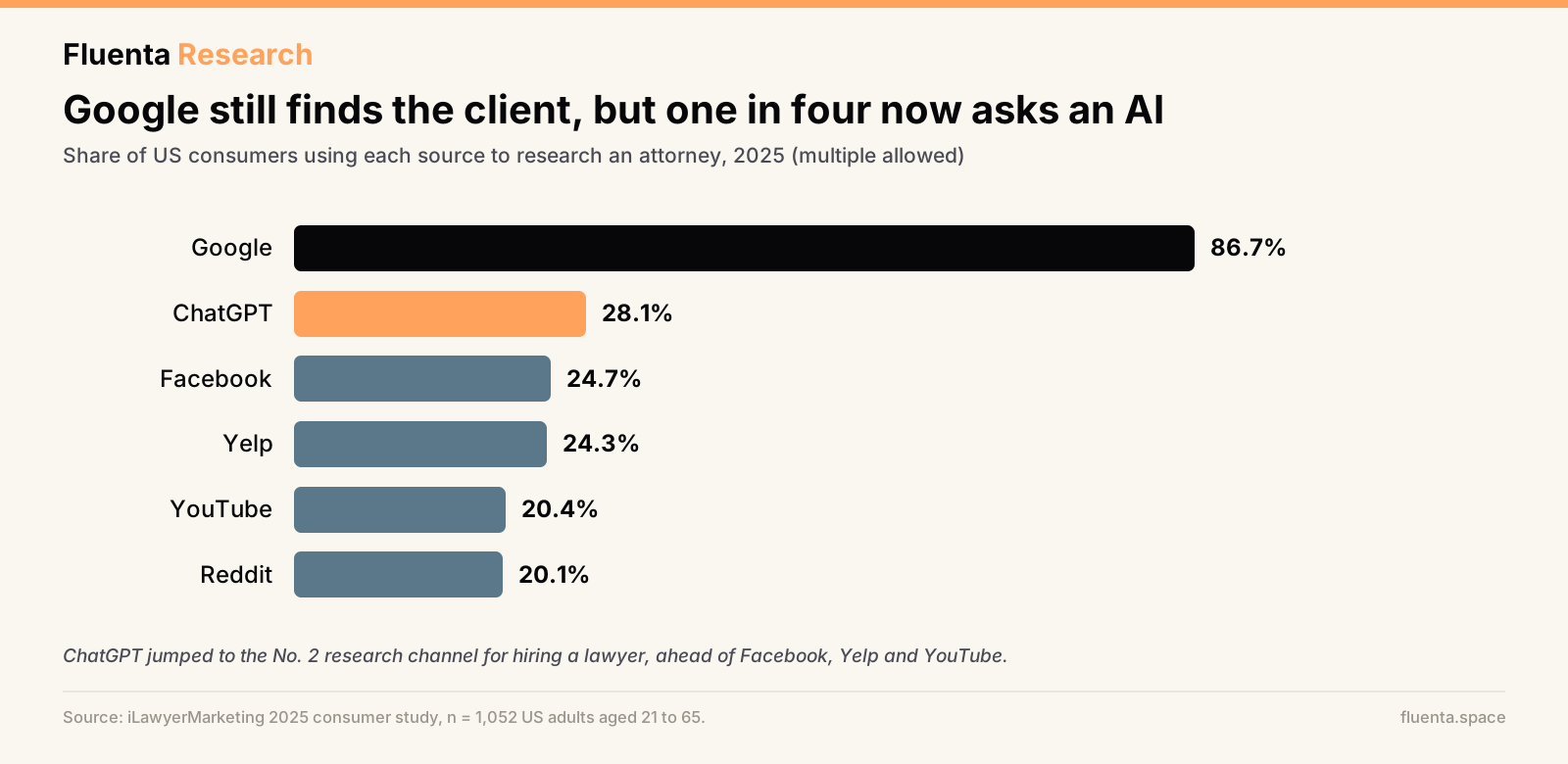
Source · iLawyerMarketing 2025 consumer study, n = 1,052
Two facts hide inside that chart. Google is still the front door, so classic search visibility remains non-negotiable. But the second, third, and fourth sources are no longer a rounding error. ChatGPT already outranks Facebook, Yelp, and YouTube as a place people go to shortlist an attorney. The same study found that 45% of respondents trust traditional search engines more, 25% trust answer engines more, and 30% have no preference, which means a meaningful slice of prospective clients now weigh an AI recommendation as heavily as a Google result. Reassuringly for firms that have invested in Google, 94% of people who used ChatGPT to research a lawyer still cross-checked what they found on Google. The pattern is not replacement. It is ask the AI, then verify on search, then decide.
Key Takeaways
Legal keywords are the most expensive real estate in search
Nothing exposes the value of a legal client like the price advertisers pay to reach one. The keywords a firm competes on are among the most expensive terms in the entire search economy, because the lifetime value of a case justifies bids that would be absurd in almost any other industry.
| Keyword | US searches / mo | Cost per click | Organic difficulty |
|---|---|---|---|
| seo for lawyers | 5,200 | $50 | 0 (very low) |
| law firm seo | 9,100 | $40 | 21 (low) |
| law firm marketing | 8,300 | $20 | 19 (low) |
| personal injury attorney | 136,000 | competitive | 65 (hard) |
| criminal defense attorney | 62,000 | competitive | 68 (hard) |
The table above uses live Ahrefs data for the United States. The phrase "seo for lawyers" carries a cost per click near 50 dollars, and "law firm seo" sits around 40 dollars, which places these terms in the top tier of paid search anywhere. Client-facing practice terms tell the same story from the demand side: "personal injury attorney" draws roughly 136,000 US searches a month and "criminal defense attorney" around 62,000, with organic difficulty scores of 65 and 68 that signal years of entrenched competition. The lesson is not that a firm should outbid everyone on ads. It is that when the paid route costs this much, durable organic and AI visibility becomes the highest-leverage marketing asset a practice can build, because it keeps returning traffic long after an ad budget is spent.
Commercial intent also concentrates the opportunity. A person typing "dui lawyer near me" or "wrongful termination attorney" is not browsing. They have a problem, a deadline, and a willingness to hire today. Ranking for those moments, in both the classic results and the AI summary sitting above them, is worth more than a hundred top-of-funnel blog visits.
The local pack still decides who gets the call
Most legal demand is local. A client wants a lawyer who can appear in their county courthouse, which means the Google local pack, the map with three business listings that sits near the top of local results, remains one of the most valuable positions in legal search. Ranking there is governed by three broad factors that Google has described consistently: relevance, distance, and prominence.
Relevance is how well a firm's Google Business Profile and website match the search. A profile with the correct primary category, such as personal injury attorney rather than a generic "lawyer," and practice-specific service pages will match more queries. Distance is proximity between the searcher and the firm, which a firm cannot change but can work around by earning enough prominence to widen its effective radius. Prominence is the sum of signals that tell Google a firm is established and trusted: review volume and quality, citations across legal directories, links from local and legal publications, and the age and consistency of the firm's information across the web.
For a multi-location or multi-practice firm, the mechanical work matters more than any clever tactic. Every office needs its own optimized profile and landing page. Name, address, and phone number must be identical everywhere they appear. Practice areas should map to dedicated pages rather than a single overloaded services page, because a page written specifically about, for example, motorcycle accident claims will out-rank and out-convert a generic personal injury page for that query, and it gives an AI engine a cleaner, more quotable answer to pull from. These are unglamorous tasks, and they are exactly what separates firms that appear in the pack from firms that do not. Depth beats breadth: one thorough page that answers the real questions around a single matter type is worth more than five thin pages that mention it in passing.
Reviews and response time are ranking factors and hiring factors
Reviews do double duty in legal search. They feed the prominence signal that lifts local rankings, and they are the single strongest persuasion asset on the page. In a 2025 survey of 3,000 US adults conducted with the research firm Dynata, nearly 60% said online reviews carry more weight than a personal recommendation from someone they know, and more than half said they would not even consider a firm rated below four stars. For a category built historically on referrals, that is a structural shift: the referral still opens the door, but the reviews decide whether the client walks through it.
Speed compounds everything. The same survey found that 72% of prospective clients will move on if they do not hear back within 24 hours, and more than half said they would not hire a firm that offers no way to chat online. Presence signals matter too: 49% of respondents, concentrated among Gen X and older clients, treat a neglected social media presence as a red flag before they ever pick up the phone. A firm can win the ranking, win the click, and still lose the case to a competitor who answered first or simply looked more alive online. Search visibility and intake responsiveness are not separate problems. They are two halves of the same conversion, and a review profile that is strong, recent, and responded to is the connective tissue between them.
Why most law firms are invisible to AI
Here is the part almost no legal marketing plan accounts for yet. Ranking on Google and being cited by an AI engine are two different achievements, produced by two different mechanisms, and success at one predicts surprisingly little about the other. An Ahrefs analysis of 15,000 prompts found that, on average, only about 12% of the links cited by ChatGPT, Gemini, and Copilot also appear in Google's top 10 organic results for the same query. AI answers draw from a different pool of sources than Google ranks.
That gap sits on top of a demand curve that keeps steepening. Using an AI assistant to research an attorney tripled in two years, and the broader referral data shows how fast the ground is moving.
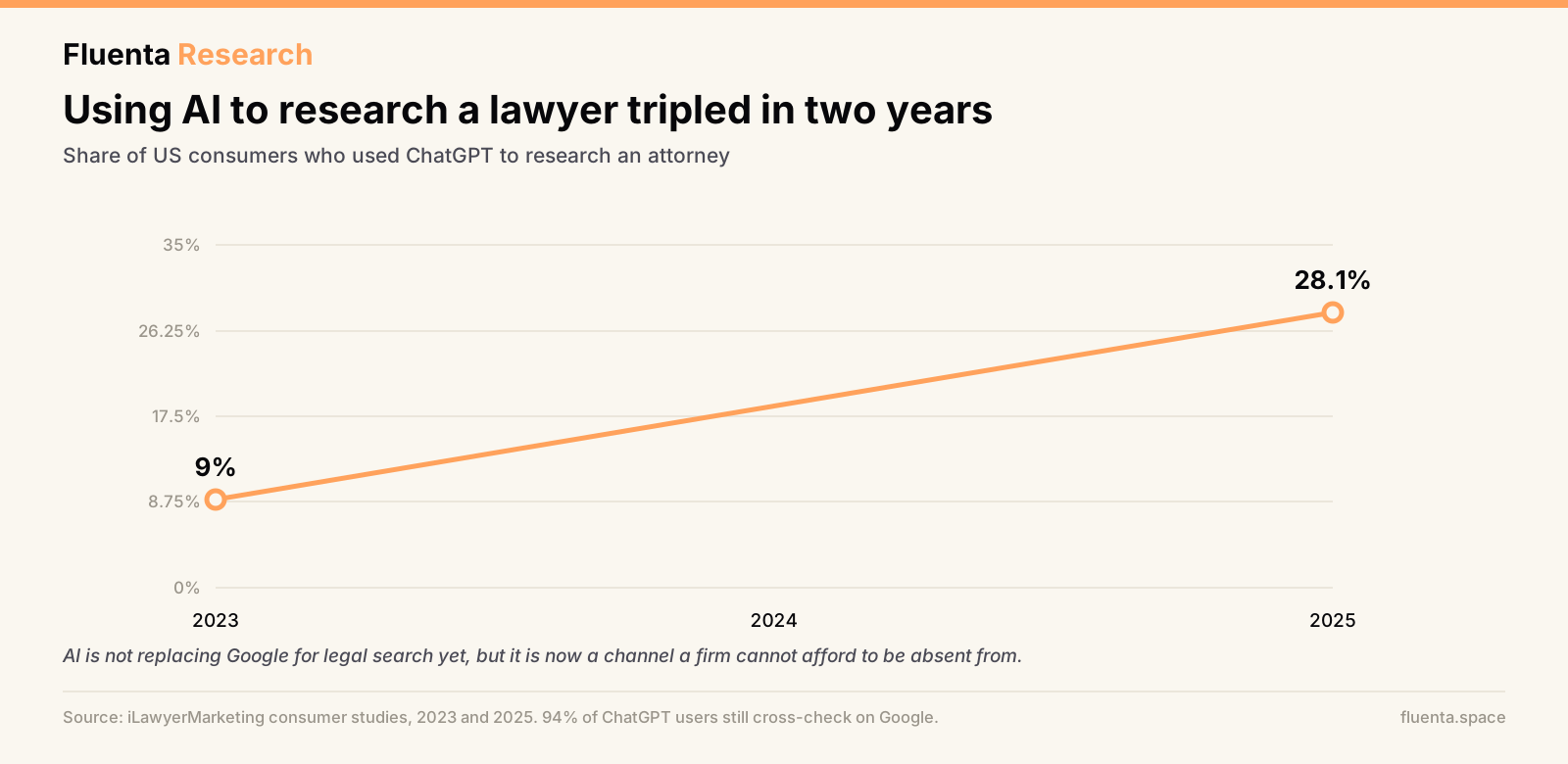
Source · iLawyerMarketing consumer studies, 2023 and 2025
The reason this matters is that generative engines are opaque by design. A firm cannot see or control when its content is chosen for an answer. The Princeton research team that first formalized Generative Engine Optimization put the problem plainly.
“Given the black-box and fast-moving nature of generative engines, content creators have little to no control over when and how their content is displayed.”
The consequence for law firms specifically is now measured, not hypothetical. In Victorious's Q2 2026 Quarterly Search Report, which tested 175 brands across five verticals including legal, 96% of brands were described accurately when an AI engine was asked about them directly, yet 89% never appeared when the same engine was asked a category research question such as "who are the best options for this problem." Recognition and recommendation are different operations. A model can know a firm exists and still never volunteer its name to a searching client.
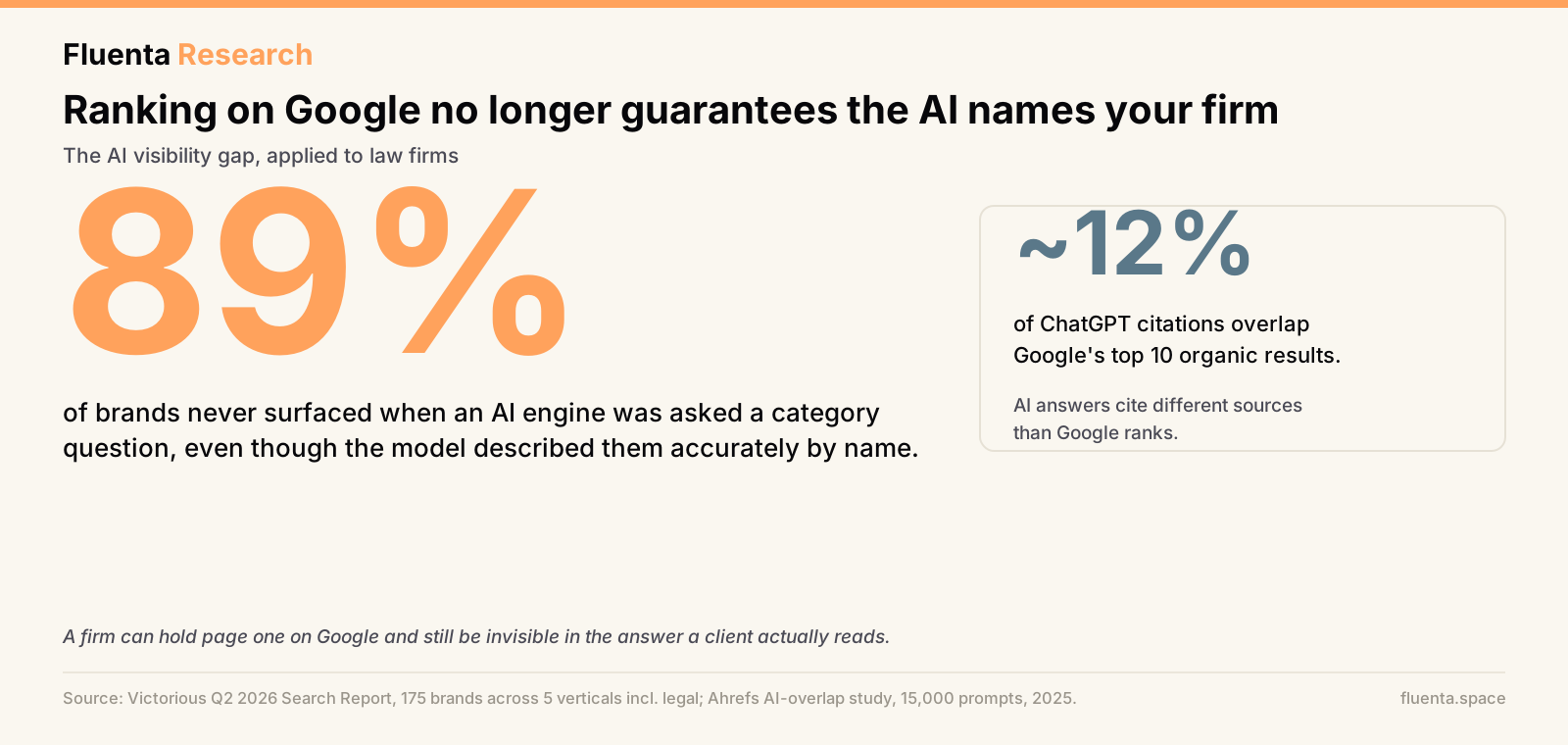
Source · Victorious Q2 2026 Search Report; Ahrefs AI-overlap study, 2025
Why does this happen to firms that rank perfectly well on Google? Because the signals that move AI citation are not the signals that move rankings. Analysis across roughly 75,000 brands found off-site brand mentions correlated with AI visibility at about 0.664, while traditional backlinks correlated at about 0.218, meaning unlinked mentions predicted AI citation roughly three times more strongly than links. And the destination of those citations is almost never the firm's own site: studies of AI answers find the overwhelming majority of citations point to third-party sources such as directories, review platforms, legal publications, and community threads. A firm that has poured its budget into its own website, and nothing else, has optimized for the one place AI engines are least likely to quote.
What a firm actually does about it
The fix is not a new secret. It is a deliberate widening of where a firm's expertise appears and how it is structured, so that both Google and the answer engines have something to grab. The click economics alone justify the effort.
“for every 1,000 searches on Google in the United States, 360 clicks make it to a non-Google-owned, non-Google-ad-paying property.”
Start with the content on the firm's own pages, because it still anchors everything. Controlled experiments in the Princeton GEO study found that adding relevant statistics to a page lifted its citation visibility in generative engines by up to 34%, and adding direct quotations from credible sources lifted it by up to 41%, while old-style keyword stuffing reduced visibility by roughly 8%. In practice this means legal content should answer real client questions in plain language, cite named sources and data, and include quotable expert statements from the firm's own attorneys. Question-led pages that mirror how people actually ask, closer to answer engine optimization than to classic keyword pages, are the ones that get pulled into AI summaries. The distinction between answer engine optimization and traditional SEO is exactly the distinction between being quoted and being merely ranked.
Then work outward, because that is where AI citations actually come from. Complete and consistent listings across the major legal directories, active and well-reviewed profiles on the platforms clients check, contributed commentary in legal and local publications, and genuine participation in the community discussions that AI engines increasingly cite: these off-site mentions are the ones that move the AI needle, precisely because unlinked brand mentions outweigh backlinks as a predictor of citation. Entity clarity ties it together. A firm should make it unambiguous, everywhere it appears, who it is, where it practices, and what it specializes in, so that a model can connect the dots between a category question and the firm's name. That work of making a brand legible to machines is what entity and AI-citation optimization is built to do.
None of this is measurable by staring at a Google rankings dashboard, which is why the first practical step is simply to test what the AI engines already say. Ask ChatGPT, Gemini, and Perplexity the category questions a real client would ask, in the firm's own city and practice area, and record whether the firm is named, described accurately, or absent entirely. That single exercise usually reveals a gap no keyword tool would ever surface. A structured version of that test, run across multiple engines and prompts, is what an AI visibility check provides.
The firms that will own the next five years of legal search
The mechanics of legal search have not been replaced. They have been extended. Google is still the front door, the local pack still decides who gets the local call, and reviews and fast intake still convert the click into a client. What changed is that a second, parallel discovery layer now sits above all of it, and it runs on different rules. A firm can hold page one on Google and still be missing from the answer a client reads before they ever reach a search result.
The firms that win the next several years will be the ones that treat these as one connected system rather than two competing budgets: strong local SEO to be found, credible reviews and instant response to convert, and a deliberate off-site and structured-content footprint so that when a prospective client asks an AI engine who the best options are, the model has a reason to say the firm's name. The gap between recognition and recommendation is where most of the market is currently losing cases it never knew it was in.
Measuring that gap is free and takes minutes. Fluenta Magnet runs a firm through the same AI engines a client uses and reports exactly where it shows up and where it disappears.
Check AI visibility for my website
Free. No subscription, no card. 24 hour turnaround, checked by a human analyst.
FAQ
What is law firm SEO?+
Law firm SEO is the practice of making a firm's website, Google Business Profile, and off-site presence rank in search and appear in the local pack for the terms prospective clients use. In 2026 it also includes AI visibility: being cited by engines like ChatGPT and Google AI Overviews when someone asks a category question.
How do clients find lawyers in 2025 and 2026?+
Most start with a search. In a 2025 study of 1,052 US adults, 86.7% used Google to research an attorney, 28.1% used ChatGPT, and Facebook, Yelp, YouTube, and Reddit each drew about 20 to 25%. Reviews then heavily influence the final choice.
Why are law firm keywords so expensive?+
Because a single case can be worth thousands in fees. Live Ahrefs data shows 'seo for lawyers' near $50 per click and 'law firm seo' near $40, among the highest cost-per-click terms in any industry, which makes durable organic and AI visibility especially valuable.
Does ranking on Google mean an AI will recommend my firm?+
No. An Ahrefs analysis of 15,000 prompts found only about 12% of AI citations overlap Google's top 10. A 2026 Victorious study found 89% of brands never appeared in AI category answers even though 96% were described accurately when asked about by name.
What moves AI visibility for a law firm?+
Off-site brand mentions, structured and quotable on-page content, and clear entity information. Across roughly 75,000 brands, unlinked mentions predicted AI citation about three times more strongly than backlinks, and adding statistics or quotations lifted citation visibility by up to 34% and 41% in the Princeton GEO study.
How can a firm check its AI visibility?+
Ask ChatGPT, Gemini, and Perplexity the category questions a real client would ask, in the firm's city and practice area, and record whether the firm is named. A free structured version of that test is available through Fluenta Magnet at /magnet.
Cite this article
Researchers and journalists: this article is freely citable. Click to copy the academic-format reference for your bibliography or footnote.
Ivanov, O. (2026). Law Firm SEO: Get Found by Clients and AI. Fluenta. Retrieved from https://fluenta.space/resources/guides/law-firm-seo.
About the author

Oleg Ivanov
Co-founder & CEO, Fluenta
Oleg is co-founder and CEO of Fluenta. He spent the last decade shipping products across fintech, commerce, and AI tooling, and now leads Fluenta's work scoring startup ideas against 25 live market and social data feeds.
Related Resources
AI SEO SERVICES
AI SEO Services: Done-For-You AI Visibility (2026)
AI SEO services get a brand cited by ChatGPT, Perplexity, and Google AI, not just ranked. What done-for-you AI visibility includes, and who should buy it.
AEO VS SEO
AEO vs SEO: What's the Difference? (2026)
AEO vs SEO: SEO ranks a page for the click, AEO gets a brand cited inside AI answers. How they differ, why SEO alone is not enough, and what to do.
ANSWER ENGINE OPTIMIZATION
What Is AEO? Answer Engine Optimization Explained (2026)
Answer engine optimization (AEO): how a brand gets cited inside AI answers from ChatGPT, Perplexity, and Google AI, why it matters, and how to do it.
Find out if AI recommends your business
Fluenta Magnet checks whether ChatGPT, Perplexity and Google AI Overviews name your business or your competitor, then ships the fixes. Free, human-checked, in 24 hours.
Was this helpful?