AI Visibility Checker: Is ChatGPT Recommending You? (2026)

AI visibility is whether ChatGPT, Perplexity, Google AI, and Gemini name a brand when a customer asks them for a recommendation, and an AI visibility audit is how a business finds out. It matters because buyers increasingly ask an assistant instead of scrolling a results page, and the uncomfortable finding across every study is the same: most brands are simply absent from the answer. The fastest way to see where a business stands is a free AI visibility check, but this guide explains what the audit measures, how to run one, and what moves the result.
Key Takeaways
Why does it matter whether AI recommends you?
Because a growing share of buying decisions now starts inside an AI answer, not a search-results page. Nearly 60 percent of US consumers have used generative AI for online shopping, and about 47 percent of adults have used AI to find a local business in the past month (Yext, 2026). When the assistant returns two or three names, being one of them is the whole game, and being absent is invisible in a way a page-two Google ranking never was.
Are you invisible when AI is asked to recommend?
Probably. The most rigorous study to date makes the gap precise.
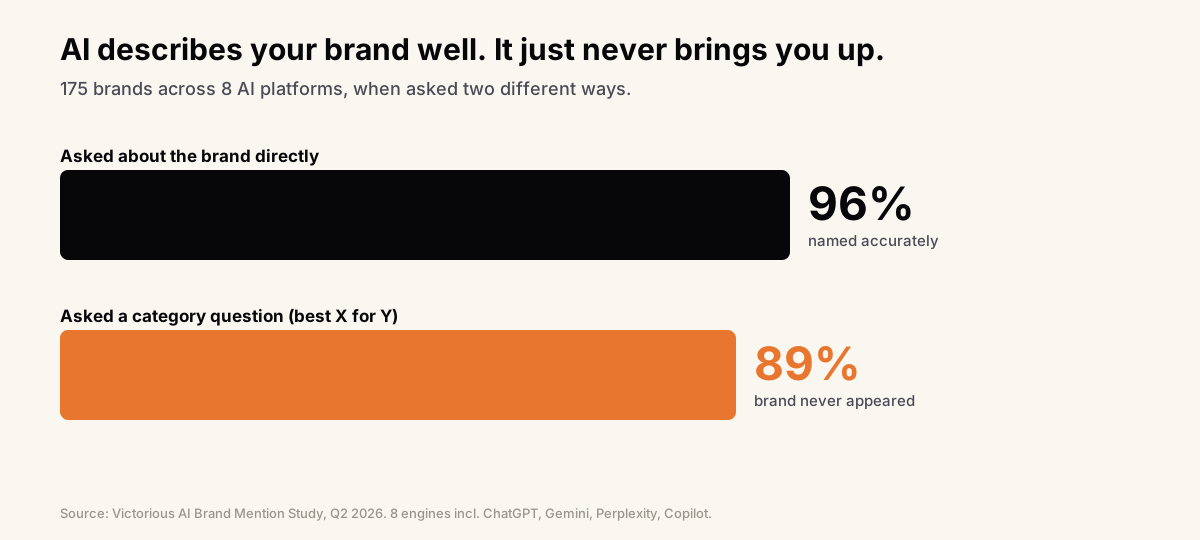
Victorious tested 175 brands across eight AI platforms in Q2 2026. When the AI was asked about a brand directly, it described the brand accurately 96 percent of the time. When it was asked a category question, the kind a real buyer asks, such as the best option for a use case, 89 percent of those brands never appeared at all. The model knows the brand exists. It just does not bring it up. And of 49,391 citations analyzed, 99.99 percent pointed to third-party sites, not the brand's own domain.
“These tools are probability engines: they're designed to generate unique answers every time”
How widespread is the problem?
Wide enough that invisibility, not visibility, is the default.
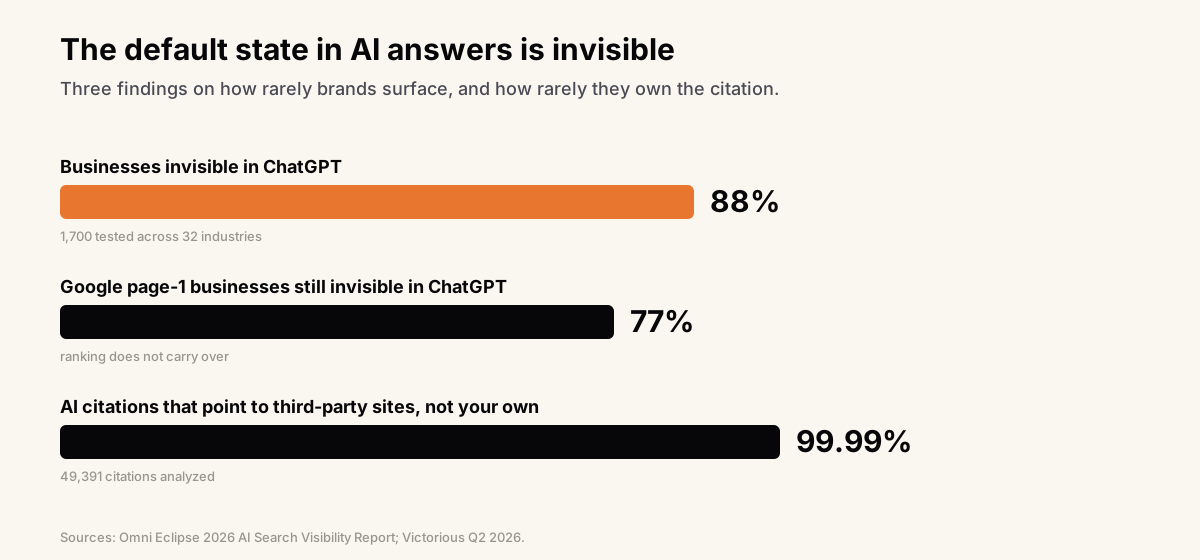
An Omni Eclipse analysis of 1,700 businesses across 32 industries found 88 percent were invisible in ChatGPT. More striking, 77 percent of businesses ranking on page one of Google were still invisible in ChatGPT. Strong traditional SEO does not carry a brand into the answer engines on its own.
Does ranking on Google put you in the AI answer?
Mostly no, and this is the single most important thing an audit reveals.
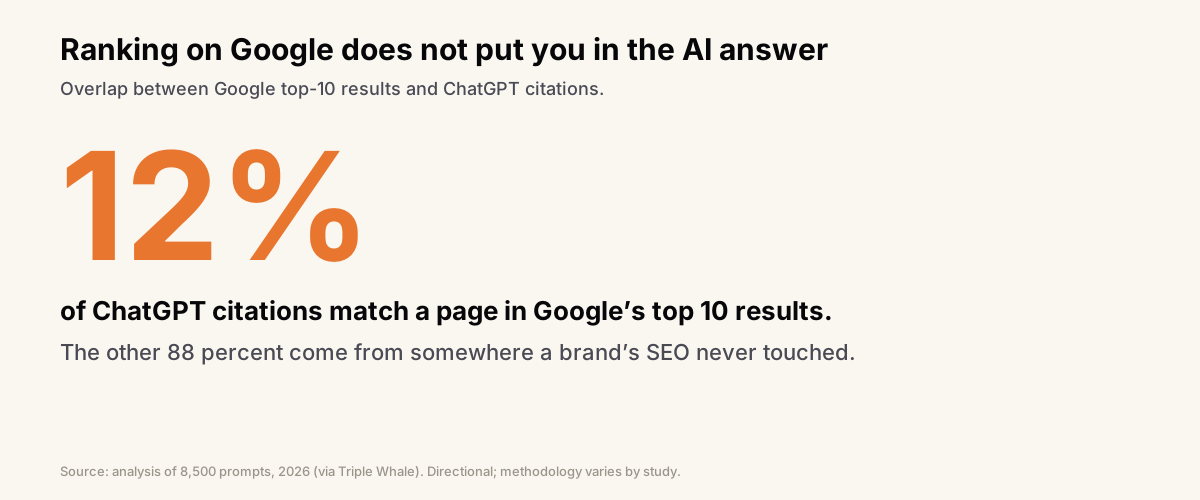
An analysis of 8,500 prompts found only 12 percent of ChatGPT citations matched a page in Google's top 10 results. The other 88 percent came from sources a brand's SEO strategy never touched: Reddit threads, review sites, YouTube, third-party roundups. That is why an AI visibility audit is a separate exercise from a rank check. It measures a different surface.
How do you audit your AI visibility?
The method is straightforward, and the key is to measure appearance rate, not rank.
| Step | What to do | Why |
|---|---|---|
| 1 | List the real questions buyers ask (category and best-for prompts, not just your brand name) | Category prompts are where 89% of brands vanish |
| 2 | Run each prompt across ChatGPT, Perplexity, Gemini, Google AI Overviews and Copilot | Visibility differs by engine; one is not a sample |
| 3 | Repeat each prompt several times | Answers are probabilistic; one run is noise |
| 4 | Log: are you named, where, is your page cited, is a competitor named instead | Turns anecdote into a measurable rate |
| 5 | Express results as a visibility percentage vs named competitors (share of voice) | Appearance rate, not rank, is the honest metric |
| 6 | Note where citations come from (Reddit, reviews, YouTube, third-party) | Shows the off-site evidence you can go earn |
“Visibility % across dozens to hundreds of prompts run multiple times is a reasonable metric”
Because answer engines are probabilistic, a single query proves nothing. Run each prompt several times across engines, log whether the brand appears, where, and whether its own page is cited, then express the result as a visibility percentage against named competitors. That share of voice, tracked over time, is the honest metric.
What makes an AI recommend a business?
Less than a brand would hope, and more of it lives off the brand's own site than on it.
“The best single external predictor explained 5.8% of variance. All 13 combined signals explain well under 20%”
The Digital Bloom analysis of more than 105,000 ChatGPT prompts found that brand demand, how much people search for and discuss a brand, was the single strongest external predictor of being recommended, ahead of backlinks. Third-party evidence matters more than owned content: reviews, consistent business listings, Wikipedia and Wikidata presence in some verticals, and community discussion on Reddit and Quora. The uncomfortable part is that 80 to 85 percent of what drives an AI recommendation cannot be explained by any external signal at all, because it lives in the model's training data and brand familiarity. That is exactly why measurement comes first: guessing is expensive, and an audit shows which of the movable signals a specific brand is missing.
Check AI visibility for my website
Free. No subscription, no card. 24 hour turnaround, checked by a human analyst.
What does a free AI visibility audit show?
A good audit answers three questions: does the AI name the business when asked a real buyer's question, does it name a competitor instead, and where are the citations coming from that a brand could earn. That is the starting line. Fixing it, earning the mentions and evidence that move the answer, is the work that follows, and it is the difference between monitoring the gap and closing it.
Every figure here is attributed: Victorious Q2 2026 for the recognition and citation data, Omni Eclipse 2026 for the invisibility rates, The Digital Bloom for the ranking-factor analysis, Yext for consumer adoption, and SparkToro for the measurement guidance. Figures are 2025 to 2026.
See whether ChatGPT, Perplexity, and Google AI name your business. Run a free AI visibility audit. →
FAQ
What is an AI visibility audit?+
An AI visibility audit checks whether AI answer engines such as ChatGPT, Perplexity, Gemini, and Google AI Overviews name or cite a brand when a customer asks a real buying question. It measures appearance rate across engines, whether a competitor is named instead, and where the citations come from.
How do I check if ChatGPT recommends my business?+
Ask ChatGPT the category and best-for questions your buyers actually ask, not just your brand name. Run each several times, because answers vary, and log whether your business appears, whether a competitor appears instead, and whether your page is cited. Repeat across Perplexity, Gemini, and Google AI for a full picture, or run a free audit that does it across engines.
Why is my business invisible in AI answers even though it ranks on Google?+
Because AI answer engines pull from a different set of sources. Only about 12 percent of ChatGPT citations match Google's top 10 results, and 77 percent of page-one Google businesses were still invisible in ChatGPT in one study. AI visibility depends heavily on off-site mentions, reviews, and third-party content that traditional SEO does not target.
How do you measure AI visibility?+
Measure appearance rate, not rank. Because answer engines are probabilistic, run each prompt multiple times across several engines and express the result as a visibility percentage against named competitors, tracked over time. A single query is not a reliable signal.
What makes an AI recommend a brand?+
Brand demand, how much people search for and discuss a brand, is the strongest external predictor, ahead of backlinks, along with reviews, consistent listings, and third-party mentions on sites like Reddit. That said, 80 to 85 percent of what drives an AI recommendation lives in training data and cannot be directly controlled, which is why auditing the movable signals first is the practical starting point.
Cite this article
Researchers and journalists: this article is freely citable. Click to copy the academic-format reference for your bibliography or footnote.
Ivanov, O. (2026). AI Visibility Checker: Is ChatGPT Recommending You? (2026). Fluenta. Retrieved from https://fluenta.space/resources/guides/ai-visibility-checker.
About the author

Oleg Ivanov
Co-founder & CEO, Fluenta
Oleg is co-founder and CEO of Fluenta. He spent the last decade shipping products across fintech, commerce, and AI tooling, and now leads Fluenta's work scoring startup ideas against 25 live market and social data feeds.
Related Resources
AI Visibility report
AI Visibility Audit: 100 Sites, 89% Invisible to AI
An AI visibility audit checks if ChatGPT, Perplexity and Gemini recommend you. Across 100 audits, 89% were named by no engine. See the data.
ANSWER ENGINE OPTIMIZATION
What Is AEO? Answer Engine Optimization Explained (2026)
Answer engine optimization (AEO): how a brand gets cited inside AI answers from ChatGPT, Perplexity, and Google AI, why it matters, and how to do it.
AI VISIBILITY · TOOLS COMPARED
AI Visibility Tools Compared (2026): Do They Get You Cited?
Six AI-visibility tools compared on the one question that matters: do they only track whether ChatGPT names you, or do they actually get you cited?
Find out if AI recommends your business
Fluenta Magnet checks whether ChatGPT, Perplexity and Google AI Overviews name your business or your competitor, then ships the fixes. Free, human-checked, in 24 hours.
Was this helpful?