What Is AEO? Answer Engine Optimization Explained (2026)

Answer engine optimization (AEO) is the practice of shaping content so an AI answer engine names, quotes, or cites a brand inside its response, rather than listing it as a blue link. It matters because the link itself is disappearing: in 2026, most Google searches end without a click at all, and when a customer asks ChatGPT, Perplexity, or Google's AI for a recommendation, being in the answer is the only visibility that counts. The companion discipline to AEO is checking whether AI already recommends a business, because a brand cannot fix a gap it has not measured.
This guide covers what AEO is, why it matters now, how it differs from SEO and GEO, what actually makes an answer engine cite a source, and the concrete steps to earn those citations.
Key Takeaways
What is answer engine optimization?
AEO is optimizing content to be selected and cited inside a machine-generated answer from an answer engine: Google AI Overviews, ChatGPT, Perplexity, Gemini, or Copilot. The goal shifts from earning a click to becoming the source the model quotes. Where classic search rewards a page for ranking in a list, AEO rewards a page, and the brand behind it, for being the thing the answer is built from.
The term carries over from the featured-snippet and voice-search era, then took on new weight after Google AI Overviews launched in May 2024 and ChatGPT reached mainstream scale.
Why does AEO matter now?
Because the click economy that SEO was built on is shrinking fast.
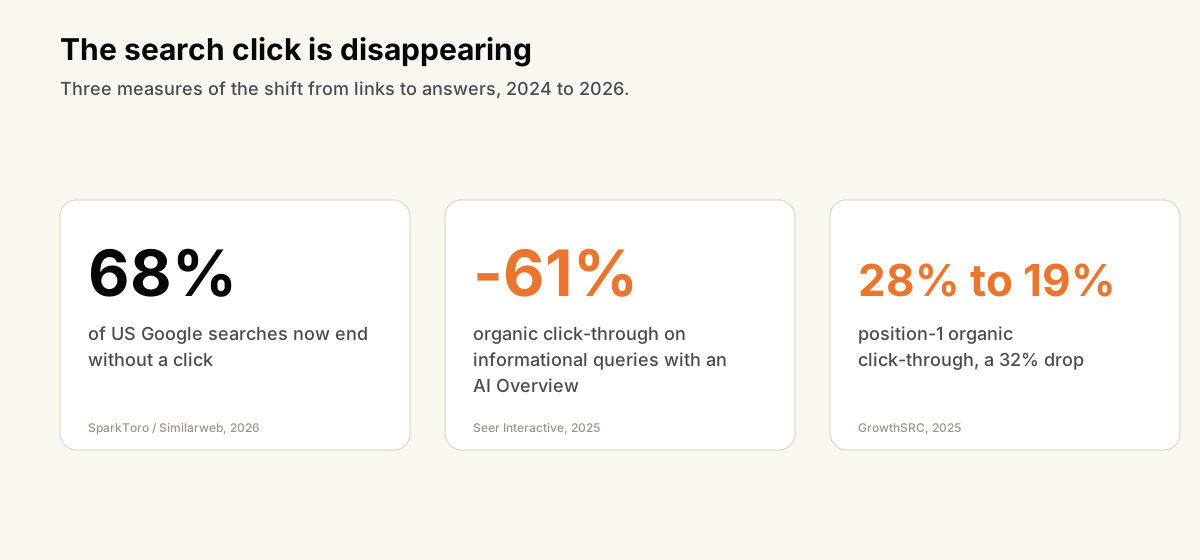
In the first months of 2026, 68 percent of US Google searches ended without a click, up from about 60 percent in 2024 (SparkToro analysis of Similarweb clickstream data). For every 1,000 searches, only around 276 now send a visit to the open web, down from 374 two years earlier. When a query triggers an AI Overview, the zero-click rate climbs to roughly 83 percent.
The click that does survive is worth less to the pages below the answer. A Seer Interactive study of 3,119 queries found organic click-through on informational queries fell 61 percent when an AI Overview was present, from 1.76 percent to 0.61 percent. Position-one organic click-through dropped from 28 percent to 19 percent across a 200,000-keyword study (GrowthSRC). The audience did not leave; it moved into the answer.
“There's not much point (nor any hope) of fighting back by simply getting better at SEO”
The scale of the answer surface is why this is not a niche concern. ChatGPT reached 900 million weekly active users by February 2026, and Perplexity was processing more than 780 million queries a month by mid-2025. A brand that is invisible in those answers is invisible to a growing share of its market.
AEO vs SEO vs GEO: what is the difference?
The three overlap, and practitioners do not fully agree on the names, but the distinction is useful.
| SEO | AEO | GEO | |
|---|---|---|---|
| Goal | Rank as a link in a list | Be cited inside an AI answer | Shape how AI represents your brand |
| Unit of success | The click | The citation | The mention across outputs |
| Where it shows | Google results page | AI Overviews, ChatGPT, Perplexity | Any generated answer or summary |
| Main lever | Backlinks and on-page | Brand mentions, quotable evidence | Entity clarity, third-party presence |
“Ultimately, AEO/GEO is not an overhaul or abandonment of SEO. Instead, it represents a new system for competing for, capturing, and measuring success across AI platforms”
GEO, generative engine optimization, was coined in a 2023 academic paper from Princeton and collaborators, published at the KDD 2024 conference. In practice AEO and GEO are used interchangeably by most teams; the important shift is from optimizing for a ranked list to optimizing for inclusion in a generated answer.
What makes an answer engine cite you?
The strongest evidence comes from an Ahrefs study of 75,000 brands, published December 2025. It measured which signals correlate with a brand appearing in AI answers, and the result overturns a decade of SEO instinct.
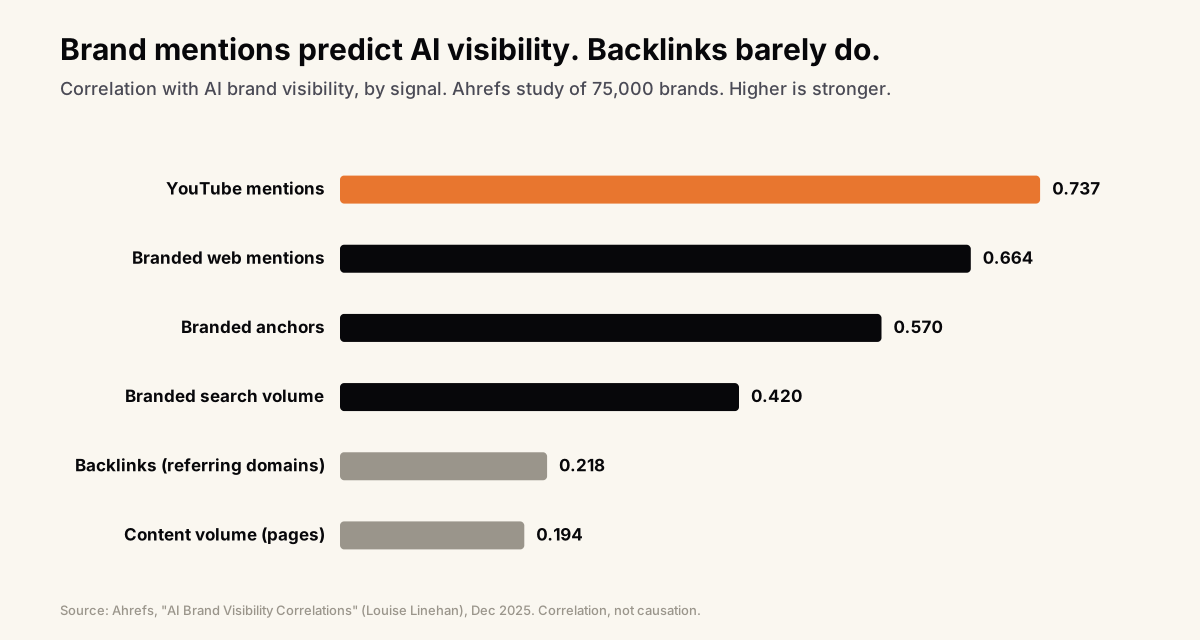
Off-site brand mentions, not backlinks, are the dominant signal. YouTube mentions showed the single strongest correlation with AI visibility, followed by branded web mentions across ChatGPT, AI Mode, and AI Overviews. Classic backlinks correlated far more weakly, and the number of pages on a site had almost no relationship with visibility at all.
“There is almost no relationship between content volume and AI visibility”
There is a second layer: what to do on the page itself. The Princeton GEO study tested content tactics inside answer engines and measured which ones raised a source's visibility.
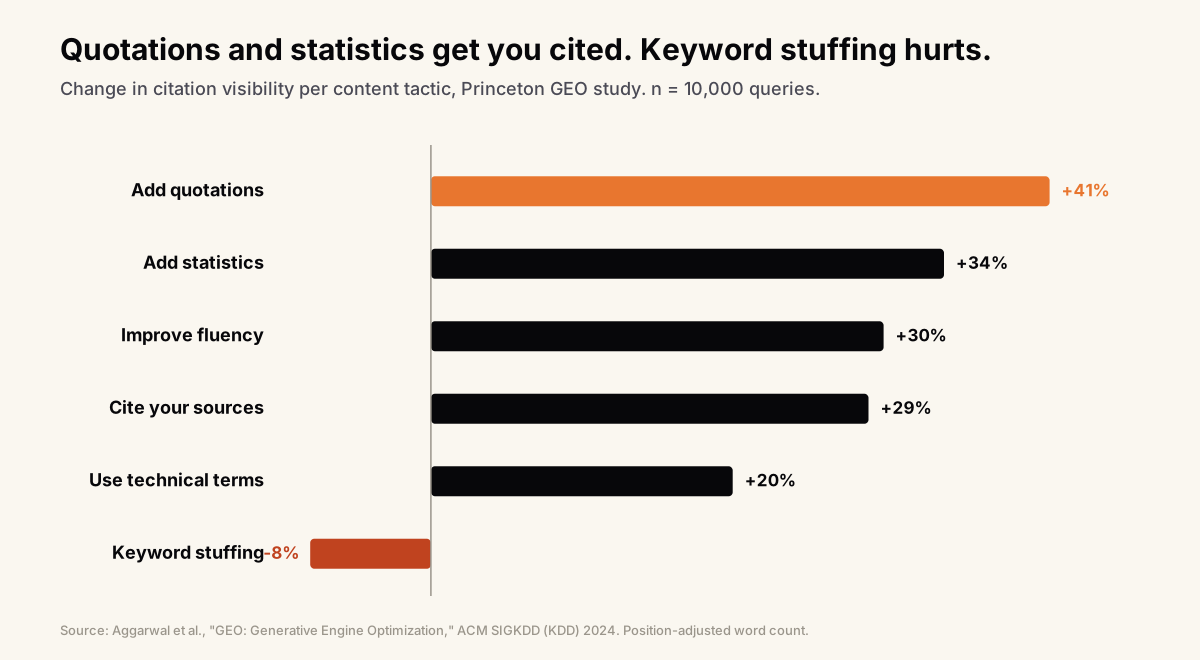
Adding quotations lifted visibility by 41 percent, statistics by 34 percent, and citing sources by 29 percent. Keyword stuffing, the oldest SEO trick, cut visibility by 8 percent. The pattern is consistent: answer engines reward content that is quotable, evidence-rich, and clearly sourced, and they discount content optimized for keywords rather than readers. One caveat worth stating: Ahrefs found that adding schema markup produced no measurable citation uplift, so ship structured data for machine-readability, but not as a citation lever.
How do you actually do AEO?
The tactics follow directly from the evidence above. In order of impact:
| Priority | Tactic | Why it works |
|---|---|---|
| 1 | Earn off-site brand mentions (YouTube, Reddit, Quora, review sites) | Highest-correlation signal for AI visibility |
| 2 | Make content quotable: original statistics and clear one-line claims | Quotations +41%, statistics +34% in the GEO study |
| 3 | Answer-first structure: a 40 to 60 word direct answer under each question heading | Matches how engines extract answers |
| 4 | Cite credible named sources and attribute them | Cite-sources +29%; provenance raises citability |
| 5 | Keep entities consistent and pages fresh; allow AI crawlers (GPTBot, ClaudeBot, PerplexityBot) | Engines ground answers in current, retrievable content |
| 6 | Measure citations across ChatGPT, AI Overviews, and Perplexity | You cannot improve a gap you have not audited |
None of this replaces SEO fundamentals like crawlability and clear structure. It layers a new priority on top: be the most quotable, best-sourced, most-mentioned answer to the questions a buyer actually asks.
Check AI visibility for my website
Free. No subscription, no card. 24 hour turnaround, checked by a human analyst.
Is AEO worth doing if AI traffic is still small?
Direct AI-referral traffic is still under 1 percent of most sites' sessions today, so the honest answer is that AEO is an investment in where attention is going, not where all of it is now. Two things make it worth starting early: the trend line is steep, and the assets that earn citations, brand mentions and quotable evidence, compound slowly, so the brands that start now hold the position when the volume arrives.
The measurable question underneath all of this is simple: when a customer asks an AI for a recommendation in your category, does it name you? A free AI visibility audit answers exactly that, across the major engines, before any of the work above begins.
Every statistic here is attributed to its published source: SparkToro and Similarweb for zero-click data, Seer Interactive and GrowthSRC for click-through, Ahrefs for the 75,000-brand correlation study, and Aggarwal et al. (KDD 2024) for the content-lever experiments. Figures are 2025 to 2026 unless noted.
See whether ChatGPT, Perplexity, and Google AI name your business. Run a free AI visibility audit. →
FAQ
What is AEO (answer engine optimization)?+
AEO is optimizing content so an AI answer engine such as ChatGPT, Perplexity, or Google AI Overviews cites, quotes, or names a brand inside its generated answer. The goal is to be the source the model builds its answer from, rather than a link the user has to click.
What is the difference between AEO, SEO, and GEO?+
SEO optimizes to rank as a link in a results list. AEO optimizes to be cited inside a generated AI answer. GEO, generative engine optimization, is the broader practice of shaping how AI represents a brand across its outputs. In everyday use AEO and GEO are treated as the same discipline.
Does AEO replace SEO?+
No. AEO builds on SEO fundamentals like crawlability and clear structure and adds a new priority: being the most quotable, best-sourced, and most-mentioned answer. Practitioners describe it as a new system layered on SEO, not a replacement for it.
What makes an AI engine cite a website?+
The strongest signal is off-site brand mentions, on YouTube, Reddit, Quora, and review sites, which correlated with AI visibility far more than backlinks in a 75,000-brand Ahrefs study. On the page, quotable statistics, direct quotations, cited sources, and answer-first structure raise the chance of being cited.
Is AEO worth it if AI search traffic is still small?+
AI-referral traffic is still under 1 percent of most sites' sessions, but the trend is steep and the assets that earn citations compound slowly. Starting early holds the position for when the volume arrives. The first low-cost step is a free audit to see whether AI already names your business.
Cite this article
Researchers and journalists: this article is freely citable. Click to copy the academic-format reference for your bibliography or footnote.
Ivanov, O. (2026). What Is AEO? Answer Engine Optimization Explained (2026). Fluenta. Retrieved from https://fluenta.space/resources/guides/what-is-aeo.
About the author

Oleg Ivanov
Co-founder & CEO, Fluenta
Oleg is co-founder and CEO of Fluenta. He spent the last decade shipping products across fintech, commerce, and AI tooling, and now leads Fluenta's work scoring startup ideas against 25 live market and social data feeds.
Related Resources
AI VISIBILITY · TOOLS COMPARED
AI Visibility Tools Compared (2026): Do They Get You Cited?
Six AI-visibility tools compared on the one question that matters: do they only track whether ChatGPT names you, or do they actually get you cited?
AI Visibility report
AI Visibility Audit: 100 Sites, 89% Invisible to AI
An AI visibility audit checks if ChatGPT, Perplexity and Gemini recommend you. Across 100 audits, 89% were named by no engine. See the data.
SEO in 2026
Is SEO Dead? What Changed in 2026, and What Works
797,444 impressions, 7 clicks. The hard 2026 data on what died in SEO, what still works, and how to get cited by ChatGPT and AI Overviews.
Find out if AI recommends your business
Fluenta Magnet checks whether ChatGPT, Perplexity and Google AI Overviews name your business or your competitor, then ships the fixes. Free, human-checked, in 24 hours.
Was this helpful?