Local SEO for Dentists: Fill Your Chairs

A generation ago a dental practice grew on word of mouth and a good sign on the street. That engine still runs, but it no longer runs alone. In a 2026 dental practice marketing survey, word of mouth and referrals slipped as the single top source of new patients from 77.5% a year earlier to 65.6%, not because referrals stopped working, but because prospective patients now vet a practice online before they ever call. About 71% of patients look up a dentist they hear about before booking, and roughly 96% read reviews first. Filling a chair today is a search problem, and the clinics that treat it as one win. For a practice new to the mechanics, the local SEO fundamentals for small business apply directly, and a free AI visibility check on /magnet shows where a practice stands before a dollar is spent.
Check AI visibility for my website
Free. No subscription, no card. 24 hour turnaround, checked by a human analyst.
The stakes are concentrated in a small piece of screen. When someone searches "dentist near me" or "emergency dentist [town]", Google answers with a map and three listings, the local pack, and most clicks never leave it. Ranking in those three slots, or being the name an AI assistant repeats, is now the difference between a full schedule and empty afternoons. The rest of a results page barely gets a look, which is why a dental practice can have a beautiful website and still starve for new patients: the website is not where the choice happens anymore.
Two forces are pulling on the same patient at once. The first is local search, still dominated by Google's map pack and the reviews attached to it. The second is the answer layer, where a patient asks an AI assistant for a recommendation and never sees a list at all. Most dental marketing advice covers only the first. The practices that pull ahead over the next few years will be the ones that treat both as jobs to be done.
Key Takeaways
Where new dental patients actually come from
Referrals still open the door, but the referred patient rarely books on trust alone. They search the name, land on a Google Business Profile, and read what other patients wrote. Even the strongest referral is now re-checked online before an appointment is made, which is why the profile and its reviews, not the homepage, are where the decision is really settled. Google reviews carry the most weight by a wide margin.
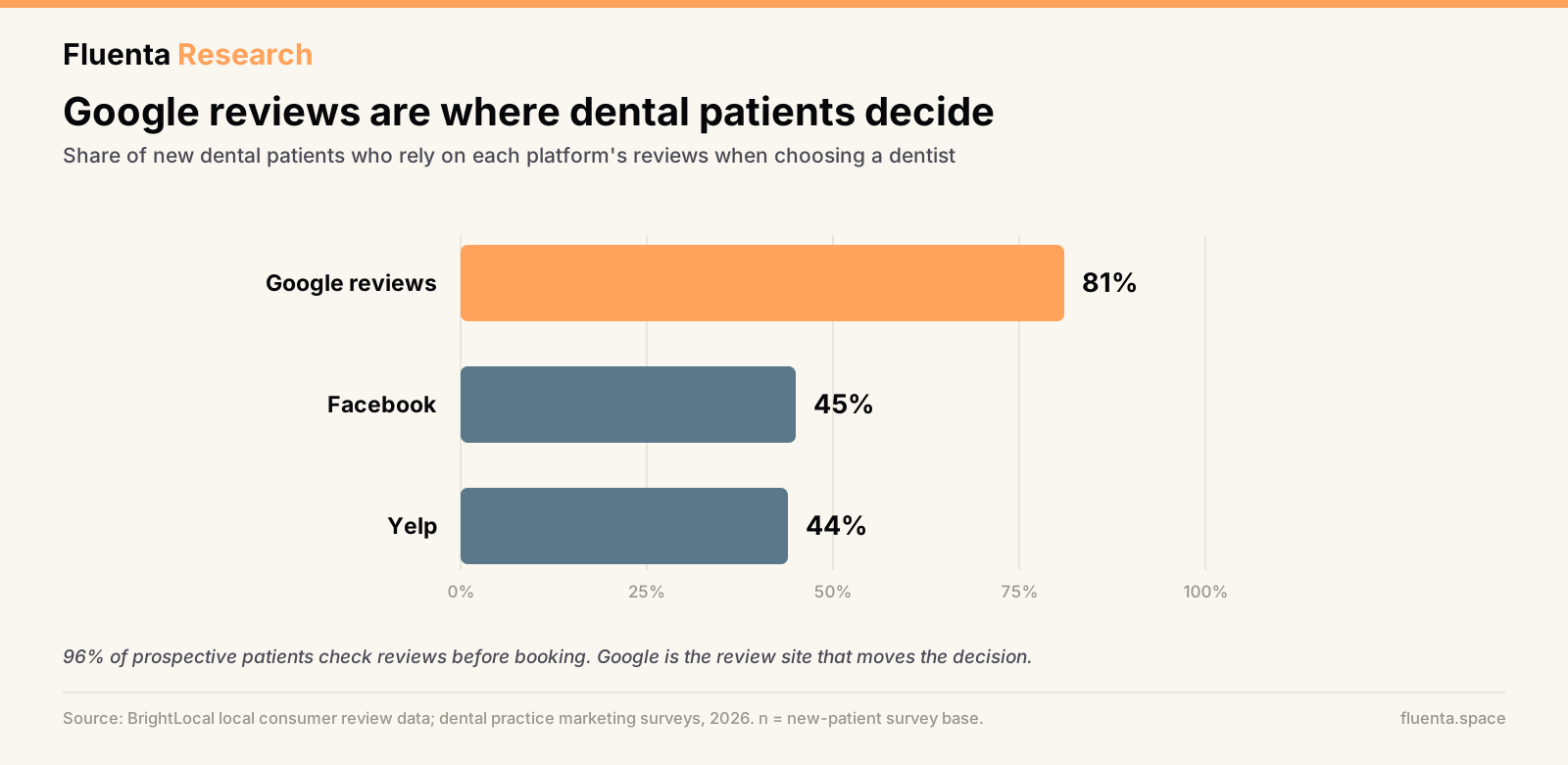
Source · BrightLocal local consumer review data; dental practice marketing surveys, 2026.
The pattern holds across independent sources. BrightLocal data puts Google reviews at the center of the decision, with Facebook and Yelp trailing, and its wider survey work finds that around 98% of consumers now read online reviews for local businesses at all. Becker's Dental has reported that roughly 43% of patients choose a dentist based on online reviews and that 84% trust those reviews as much as a personal recommendation. Referrals have not disappeared, one 2024 analysis still attributed about 37% of high-quality dental patients to them, but the referral and the review now work as a pair rather than in isolation.
Meanwhile Google itself is becoming a direct acquisition channel, not just a directory. Dental practice surveys now credit Google Business Profile organic listings as the top new-patient source for 15.6% of practices, ahead of any single paid option, with Google Ads adding another 7.6%. Put together, Google as a platform drives close to a quarter of new-patient attribution, and that share is climbing as referral's share falls. The takeaway for a dentist is unglamorous but decisive: the website matters, but the profile and the reviews attached to it matter more, because that is the surface a patient actually reads before choosing.
There is a trust dimension here that dentists cannot ignore. A dental practice sits squarely in what Google calls its "your money or your life" category, the health and finance topics it holds to a higher bar for expertise and trustworthiness. Real credentials, named clinicians, genuine patient reviews, and consistent information across the web are not cosmetic. They are the signals that decide whether Google, and later an AI engine, is willing to put the practice in front of a patient at all.
How the map pack decides who fills the chair
Google ranks the local pack on three broad ideas: relevance, distance, and prominence. Relevance is how well a profile matches the search, driven mostly by the primary category and the business name. Distance is proximity to the searcher, which a practice cannot change. Prominence is how established and trusted the business looks, and reviews are the largest lever inside it that a clinic controls.
Estimates of how Google weights these signal groups are consistent across the industry.
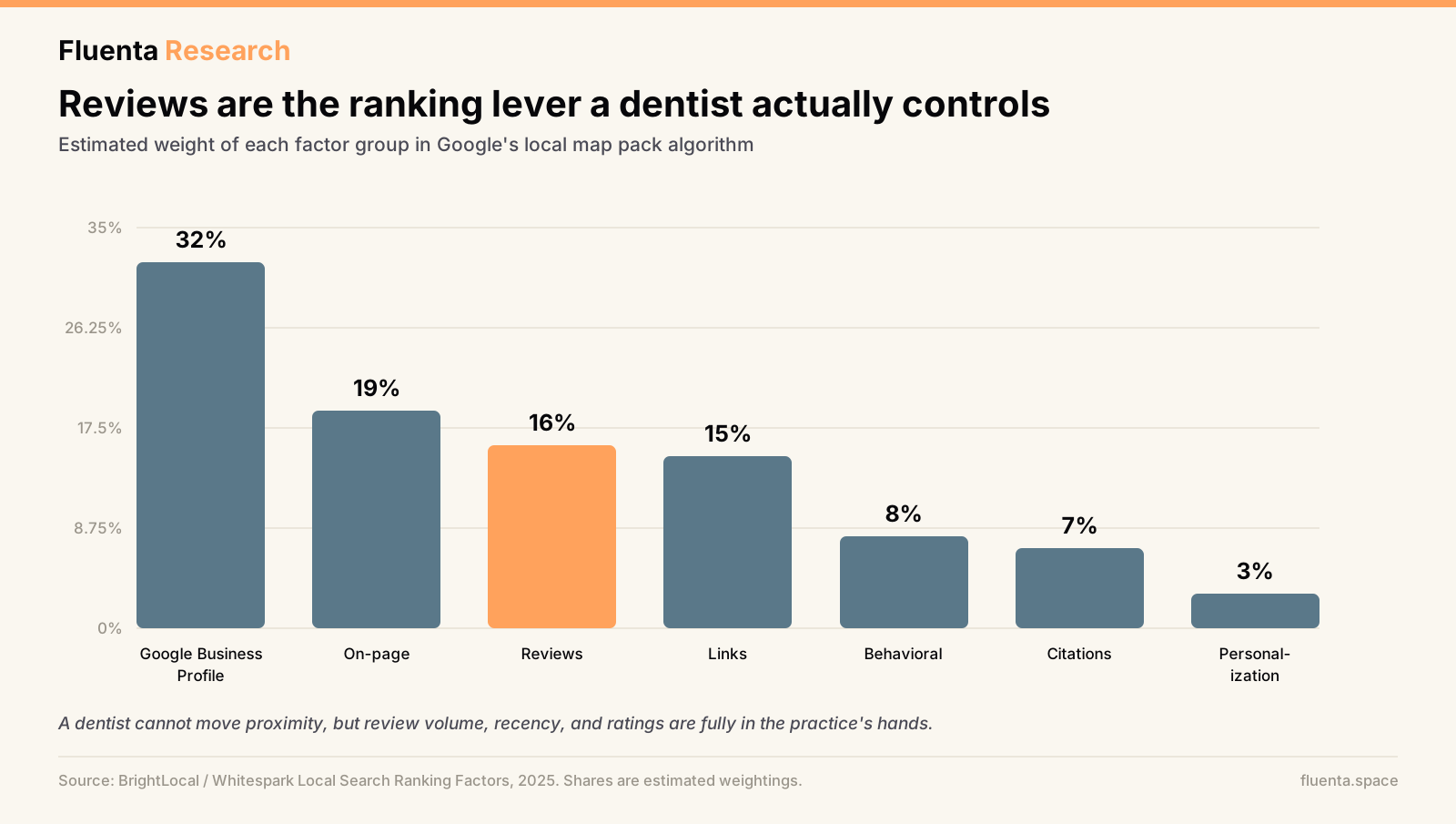
Source · BrightLocal / Whitespark Local Search Ranking Factors, 2025.
Google Business Profile signals lead, followed by on-page signals, then reviews and links. Several things follow from this. First, the unglamorous setup work is not optional: the correct primary category ("Dental clinic", or a more specific type such as "Dental implants provider"), accurate hours, a local phone number, defined service areas, booking links, and complete attributes are the foundation everything else sits on. A profile missing its primary category or holding an inconsistent address is capped before the review strategy even begins.
Second, on-page signals still matter, and for a multi-location or multi-service practice they matter a lot. A single thin "Services" page rarely ranks. A dedicated, genuinely useful page for each core treatment, implants, orthodontics, emergency care, pediatric dentistry, each naming the town it serves, gives Google the relevance it needs to match specific searches. This is basic on-site work, but most practices skip it and wonder why they only rank for their own name.
Third, among the signals a practice can actively grow, reviews are the highest-weighted, and their value is not just about the total count. Recency has quietly become the review metric that moves rankings. A profile that collected two hundred reviews three years ago and nothing since can be outranked by a competitor gathering a handful every week.
“I have clients where if they haven't gotten a review in the last three weeks, four weeks, they start to drop. And then as soon as they get a handful of new reviews, you see them jump right back up. Recency is a big thing.”
For a dental practice that means a review request cannot be a one-time campaign. It has to be a steady habit built into checkout, so the flow of fresh reviews never stops. Responding to reviews, especially the critical ones, reinforces the same prominence signal and shows prospective patients how the practice handles a problem, which is often what a nervous new patient is really scanning for.
The review engine is the one lever a practice fully controls
Proximity is fixed. The category taxonomy is fixed. The review engine is not. It is the part of local ranking a front desk can influence every single day, and it compounds. A simple operating system that the team actually runs beats a clever one that nobody touches.
| Review habit | Why it moves rankings | How often |
|---|---|---|
| Ask at checkout, every happy patient | Steady, recent reviews outweigh a stale total | Every appointment |
| Send a direct Google review link | Removes friction, lifts completion rate | With each request |
| Respond to every review, good and bad | Reinforces the prominence signal and builds trust | Within 48 hours |
| Keep a weekly review cadence | Recency is now a top-five local ranking factor | Weekly, never zero |
| Fix the root cause behind 1-star reviews | Protects the average and the story new patients read | As they arrive |
None of this requires an agency. It requires a repeatable ask at the moment a patient is happiest, usually right after a successful appointment, and one person who owns the follow-through. It is worth being explicit about what not to do, because the shortcuts carry real risk: never buy reviews, never gate them so only happy patients are asked, and never post reviews from staff. Google actively filters suspicious review patterns, and for a health practice a fake-review problem is both a ranking risk and a reputational one. The practices that win the map pack are rarely the ones with the biggest ad budget. They are the ones with the freshest wall of genuine five-star reviews and a profile that Google has learned to trust.
Winning locally, invisible to AI: the new gap
Here is where most dental marketing advice stops, and where the ground has shifted under it. A growing share of patients no longer scroll a page of results at all. They ask ChatGPT, Google's AI Overviews, or Perplexity for "a good dentist in [town]" and act on the short answer they get back. In the United States roughly 68% of Google searches already end without a click, and on searches where an AI Overview appears, Pew Research found users click a traditional result only 8% of the time versus 15% when no overview is shown, close to half as often.
“Nearly 2/3rds of all searches stay inside the Google ecosystem after making a query.”
This is not a fringe behavior. Google's AI Overviews now reach on the order of 2.5 billion users, and AI assistants have become a real referral channel: by mid 2026, Similarweb data put ChatGPT at roughly 53% of AI-assistant referral traffic and Gemini at about 27%, the latter having surged from a low single-digit share a year earlier. For a dentist, the practical meaning is simple. A meaningful and fast-growing slice of "find me a dentist" moments now resolve inside an answer box, and the map pack never enters the picture.
The problem for local practices is brutal in its simplicity: AI engines do not rank the map pack, they name sources they already know, and most independent clinics are unknown to them. In one study of 175 brands, 89% never appeared when an AI engine was asked a category question, even though the model described each brand accurately when asked by name. The engines were not incapable of describing the business, they simply did not think of it unprompted. Being findable on Google and being repeated by an AI engine are now two different problems.
A real Fluenta audit of an independent dental clinic, drtooth.co.il, shows the gap in numbers. The site scored 64 out of 100 on technical readiness, a fundamentally healthy site, but only 17 on AI visibility.
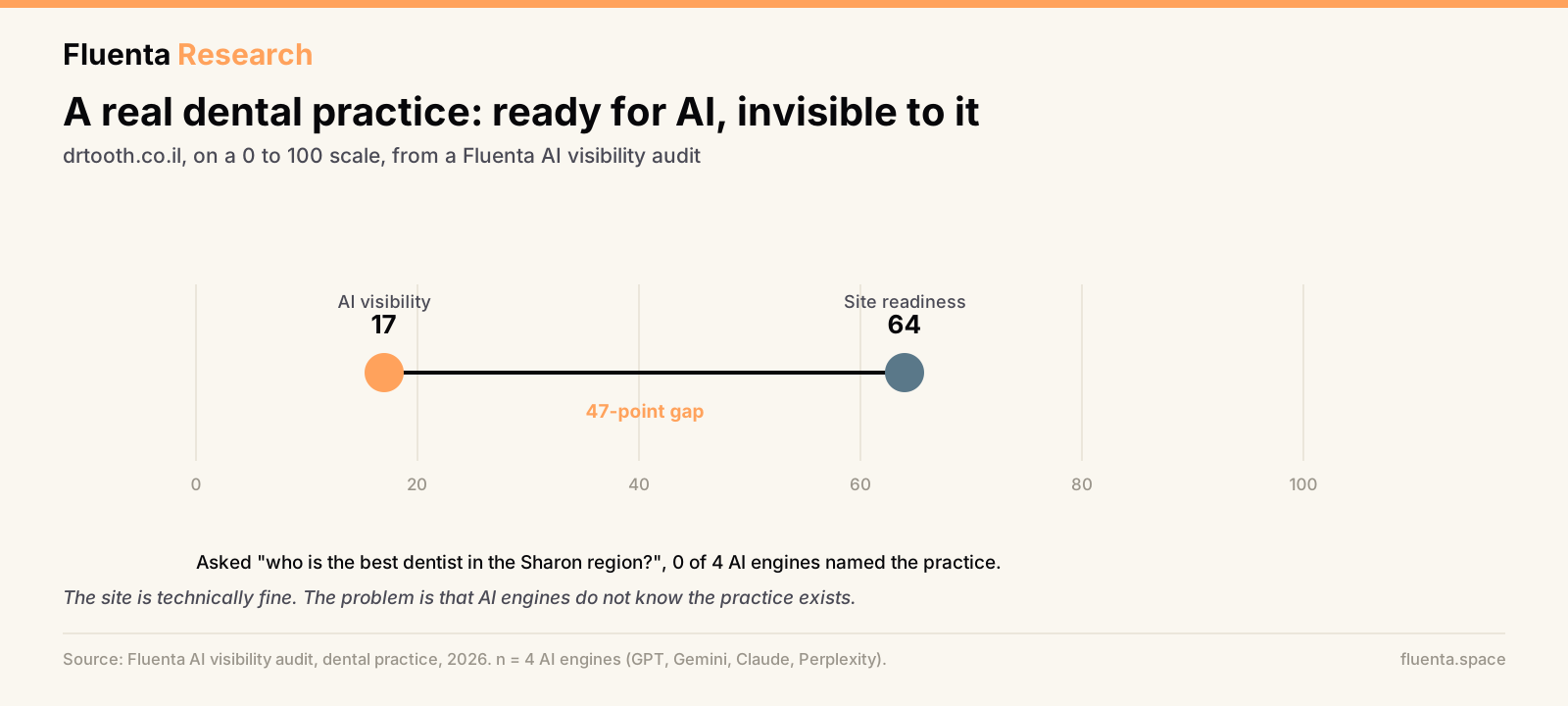
Source · Fluenta AI visibility audit, dental practice, 2026.
Asked in the practice's own language "who is the best dentist in the Sharon region?", zero of the four AI engines tested named the clinic. Worse, when one engine was asked about the dentist by name it confidently described the wrong person entirely, a different clinician in a different specialty. The engines instead pointed to aggregators such as Google Maps and the national dental association, not to the practice. The clinic ranked for local terms and had a working site, yet in the answer layer it did not exist. This is not a hypothetical risk for dentists; it is already happening to healthy, established practices.
The same audit surfaced a second, quieter problem that many dentists share. Of the roughly 250 referring domains pointing at the clinic, about 185 were flagged as spam and queued for disavow, the residue of cheap link packages sold to the practice years earlier. Those links did nothing for AI visibility, which keys off genuine mentions rather than purchased links, and at worst they were a liability. It is a common shape: a practice pays for the wrong signal for years and still ends up invisible where it now counts.
Why does this happen? Because the signals that earn an AI citation are not the same as the ones that earn a Google ranking. Off-site brand mentions, the practice being written about and named across the web, correlate far more strongly with AI visibility than backlinks do. In a large analysis across many brands, off-site mentions correlated 0.664 with AI visibility while traditional backlinks correlated only 0.218, roughly three times the predictive strength. AI engines learn who to recommend from how often and how consistently a name appears in the sources they trust, and the overlap with Google's own top results is small: only about 12% of the sources an engine like ChatGPT cites also sit in Google's top ten. That is why a dentist can dominate the map pack and still be missing from the AI answer.
What a dentist actually does about it
The fix is a sequence, not a campaign. First, lock the foundation: claim and fully complete the Google Business Profile, choose the most specific correct category, and make the name, address, and phone number identical everywhere they appear online. Inconsistent citations quietly cap local ranking, and cleaning them up is often the single highest-return afternoon of work a practice can do. The broader method is covered in the local SEO for small business guide.
Second, build the review engine described above and never let it stop. Freshness and response rate are doing more work than raw count, so a steady weekly cadence, real replies, and a fast fix for the root cause behind any one-star review will outperform a big but dormant total.
Third, and this is the step almost no practice takes, treat AI visibility as its own channel. That means getting the practice named consistently across the sources AI engines actually read, local press, directories that matter, professional associations, and genuine editorial mentions, rather than buying links that no longer move anything. It means structuring the site so a model can cleanly extract who the practice is, which clinicians work there, and what it treats. And it means measuring whether engines recommend the clinic when asked a category question, because that answer, not a rankings report, is what a modern patient sees. This is the discipline behind AI SEO services, and it starts with knowing the current baseline. An AI visibility checker or a free audit will show, in the practice's own market, whether AI engines name the clinic or a competitor.
The dentist who does all three owns both layers: the map pack that captures the patient searching today, and the AI answer that captures the patient who has stopped searching altogether. The gap is still open, because most practices are still optimizing only for the results page a shrinking share of patients ever reads. The practices that move first will be the names the next generation of patients hears, whether that name comes from a friend, a map, or a machine.
Check AI visibility for my website
Free. No subscription, no card. 24 hour turnaround, checked by a human analyst.
FAQ
How do most patients find a new dentist now?+
They combine referrals with online research. Roughly 71% look up a dentist they hear about before booking, and about 96% read reviews first, most often Google reviews attached to the Business Profile.
What matters most for ranking a dental practice in the Google map pack?+
Relevance, proximity, and prominence. A complete Google Business Profile with the correct primary category leads, followed by on-page signals, reviews, and links. Reviews are the biggest lever a practice actively controls.
How many Google reviews does a dentist need?+
There is no fixed number. Recency and a steady flow now matter more than the total. A profile gathering a few fresh reviews every week can outrank one with a large but stale count.
Why is my dental practice invisible to ChatGPT or AI Overviews?+
AI engines recommend sources they already know from consistent off-site mentions, not the map pack. Most independent clinics are simply not named often enough across the web for engines to repeat them.
Is AI visibility different from local SEO?+
Yes. Local SEO wins the map pack for patients who are searching. AI visibility decides whether an engine names the practice for patients who ask an assistant instead of searching. They require different signals and both matter.
How can a dentist check their AI visibility?+
Run an AI visibility audit that asks real AI engines a category question for the local market and reports whether they name the practice, a competitor, or an aggregator. Fluenta Magnet offers a free check.
Cite this article
Researchers and journalists: this article is freely citable. Click to copy the academic-format reference for your bibliography or footnote.
Ivanov, O. (2026). Local SEO for Dentists: Fill Your Chairs. Fluenta. Retrieved from https://fluenta.space/resources/guides/local-seo-for-dentists.
About the author

Oleg Ivanov
Co-founder & CEO, Fluenta
Oleg is co-founder and CEO of Fluenta. He spent the last decade shipping products across fintech, commerce, and AI tooling, and now leads Fluenta's work scoring startup ideas against 25 live market and social data feeds.
Related Resources
Local SEO Guide 2026
Local SEO for Small Business in 2026: Google and AI
Google AI Overviews now hit 68% of local searches. How small businesses win local SEO on both layers: the map pack and AI.
AI SEO SERVICES
AI SEO Services: Done-For-You AI Visibility (2026)
AI SEO services get a brand cited by ChatGPT, Perplexity, and Google AI, not just ranked. What done-for-you AI visibility includes, and who should buy it.
AI VISIBILITY AUDIT
AI Visibility Checker: Is ChatGPT Recommending You? (2026)
AI visibility is whether ChatGPT, Perplexity, and Google AI name your brand. How to audit it, why 89% of brands are absent, and what makes AI recommend you.
Find out if AI recommends your business
Fluenta Magnet checks whether ChatGPT, Perplexity and Google AI Overviews name your business or your competitor, then ships the fixes. Free, human-checked, in 24 hours.
Was this helpful?