Jev AI: 22 Business Ideas Built on One Model, Scored

On September 15, a model called Jev came out of a company called TypeSafe AI. Two weeks later there were hundreds of products built on top of it, four cloud gateways giving it away for free, and an open-weight clone trained on a single GPU. Fluenta scored 22 of those products, using the same method it ran on Claude agent loops. This is what the data says about which ones are businesses and which ones are just riding the wave.
Key Takeaways
The wave: one model, a two-week gold rush
For the past two weeks the loudest thing in the builder corner of Hacker News, GitHub and Product Hunt has been Jev.
Jev is not a chatbot. It is what TypeSafe calls a System One model: you send it some state and a typed question, and it returns a typed answer with a confidence score between 0 and 1. It generates no prose. It sits at the decision points inside an agent, the places where today a team makes a second call to a large model just to ask a yes or no question: is this input a jailbreak, which model should handle this task, did this tool call do what the user asked, is this diff safe to merge.
The pitch is speed and price. TypeSafe quotes 70 to 500 milliseconds per call and charges $0.042 per million input tokens with output tokens free. Its own benchmark claims Jev is 193.6 times faster and 444.6 times cheaper than a frontier model on the same decision task, a number worth treating as a vendor figure until third parties reproduce it, since TypeSafe itself notes it cannot prove the price is unsubsidized.
The launch was loud. The Hacker News thread reached 1,984 points and 520 comments. The Product Hunt page landed around 500 upvotes at second of the day. TypeSafe emerged from stealth the same week with a $40M seed round led by DCVC, at a valuation Forbes put at $200M. Then the distribution piled on: Vercel added Jev to its AI Gateway and called it the fastest-adopted model in that gateway's history, with a launch post that drew 1.07 million impressions. OpenRouter, Lovable and Cline followed, several of them giving Jev away free through the end of September to capture usage before metering it.
That is the setup founders are seeing. A cheap, fast, well-funded new primitive, free for the moment, with a visible crowd already building. The question this report answers is the one the hype threads skip: of everything being built on it, what is actually worth building.
A breakout is not a business
Every real breakout produces two waves. The first is attention: forks, demos, Show HN posts, a leaderboard of who shipped the cleverest weekend hack. The second, much smaller, is the set of products that solve a problem someone will pay to keep solved after the novelty wears off.
The two waves look identical for about a month. Then the attention wave evaporates and the demand wave keeps billing. The whole job of scoring is to tell them apart early, while they still look the same.
Jev makes this unusually stark because the attention wave is enormous. An open-weight clone called Ollaya hit 609 points on Hacker News. A post titled "Jev in 25 lines of Python" hit 690. "Jev Plays Pokemon Red" hit 276. None of those is a company. They are the sound of a primitive being interesting. Underneath them sits a much quieter set of products aimed at costs a business already pays every month, and those are the ones the score is built to find.
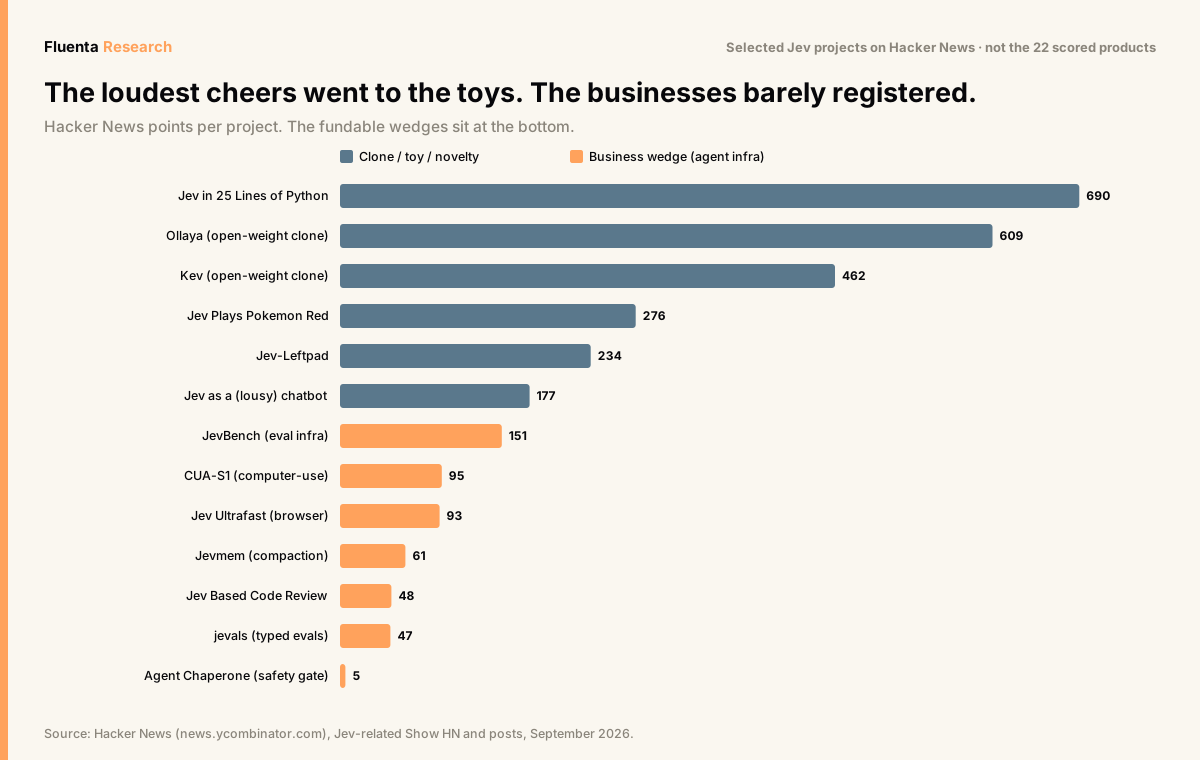
The scoreboard of attention makes the split visible. The six loudest Jev projects on Hacker News are open-weight clones and toys, topping out at 690 points for a 25-line reimplementation. The fundable wedges, a typed-eval library and an agent safety gate, sit near the bottom at 47 and 5 points. Upvotes here measure novelty, not durability.
See if AI names your business today. Run a free AI visibility check. →
How the 22 were scored
Fluenta's Launch Readiness Score is a 100-point, demand-weighted score. It leans hardest on two things: whether there is real search demand for the problem, and whether people are actively in pain about it. It then adjusts for how hard the thing is to build and defend, whether investors are funding the category, how urgent the problem is, whether there is proof of budget, and how clean the path to money is.
For this batch, one caveat sits on top of the usual ones and it matters more than normal. Jev is two weeks old, so there is no meaningful search history for anything with Jev in its name. Where a normal score leans on search demand, this batch leans harder on the durability of the underlying problem, on funding signals in the adjacent categories, and on evidence of budget. A score here is a read on the problem the product attacks, not a bet on the Jev brand surviving.
The 22, ranked
The full sortable table with every score component is at the end of this report. The shape of it is the story: the top of the range is infrastructure that makes agents cheaper, safer or more deterministic, and the bottom is consumer novelty.
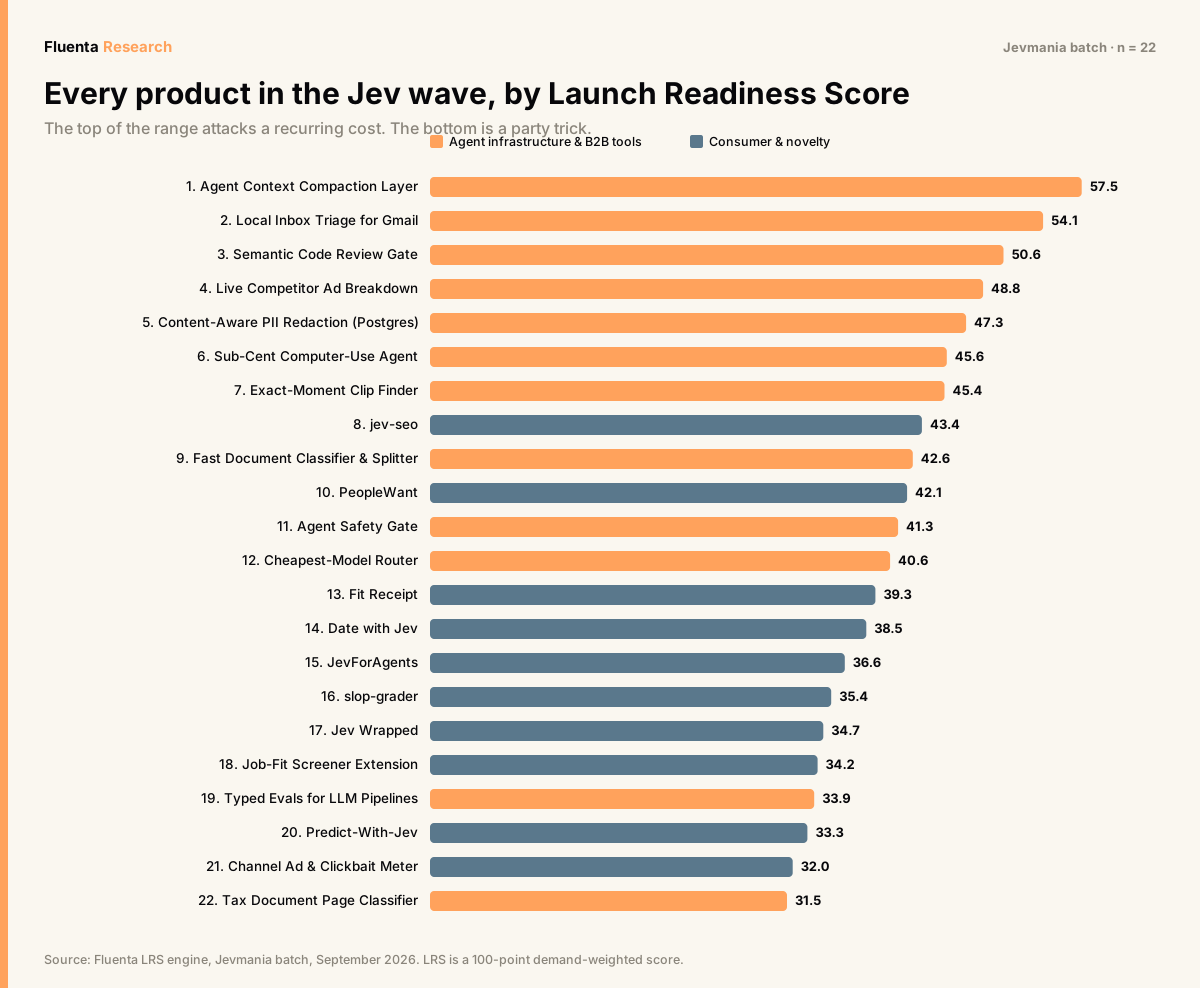
The top five all attack a recurring cost. Agent Context Compaction Layer (57.5) replaces the summary step in coding agents with typed decisions, sold as a plugin for Claude Code, Codex and Hermes. Local Inbox Triage for Gmail (54.1) sorts mail read-only on the user's own machine. Semantic Code Review Gate (50.6) scores each diff against plain-English rules before a human opens it. Live Competitor Ad Breakdown (48.8) classifies hundreds of competitor ads for cents. Content-Aware PII Redaction in Postgres (47.3) decides per field whether a value is personal data and redacts it in place.
The bottom of the table, for contrast: Channel Ad and Clickbait Meter (32.0), Predict-With-Jev (33.3), Job-Fit Screener Extension (34.2), Jev Wrapped (34.7), Date with Jev (38.5). Clever, shareable, and aimed at no recurring budget.
Six findings the hype threads never tested
1. Plumbing outscores novelty, and it is not close
Split the 22 into two buckets. Call the first agent infrastructure and B2B tools: compaction, routing, safety gates, code-review gates, typed evals, document and PII classifiers, the unglamorous machinery that makes an agent cheaper or safer to run. Call the second consumer and novelty: the wrappers that turn Jev into a party trick or a one-off utility.
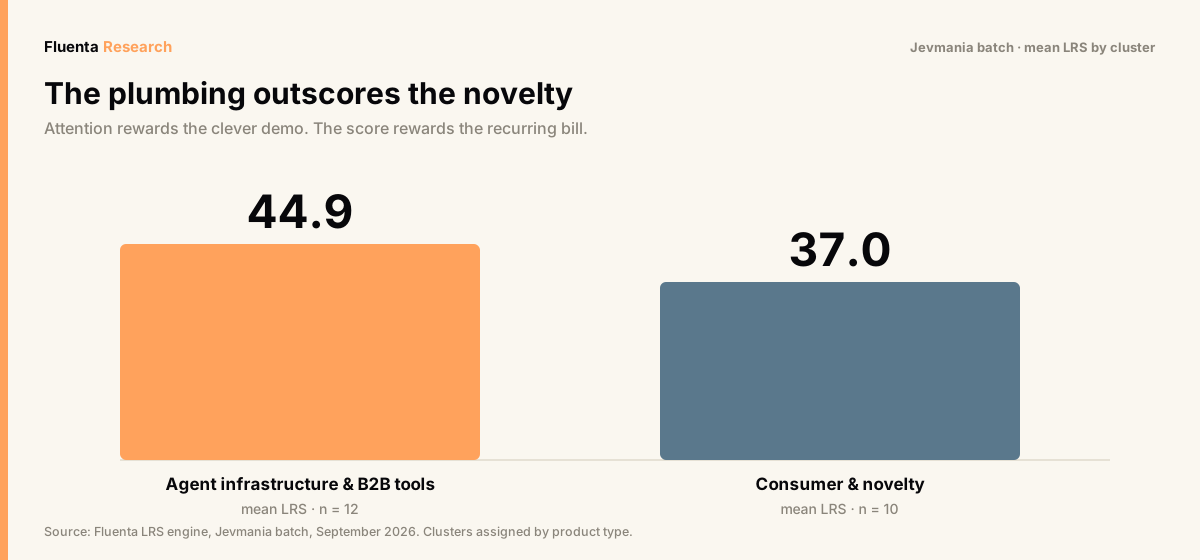
The infrastructure cluster averages 44.9 across 12 products. The novelty cluster averages 37.0 across 10. The single highest score in the batch, 57.5, is a context-compaction plugin. The lowest, 32.0, scores Telegram channels for clickbait. This is the opposite of where the attention is going. On Hacker News the novelty and clone posts pull 600 and 690 points; the compaction plugins and safety gates pull a fraction of that. The crowd rewards the clever demo. The score rewards the recurring bill.
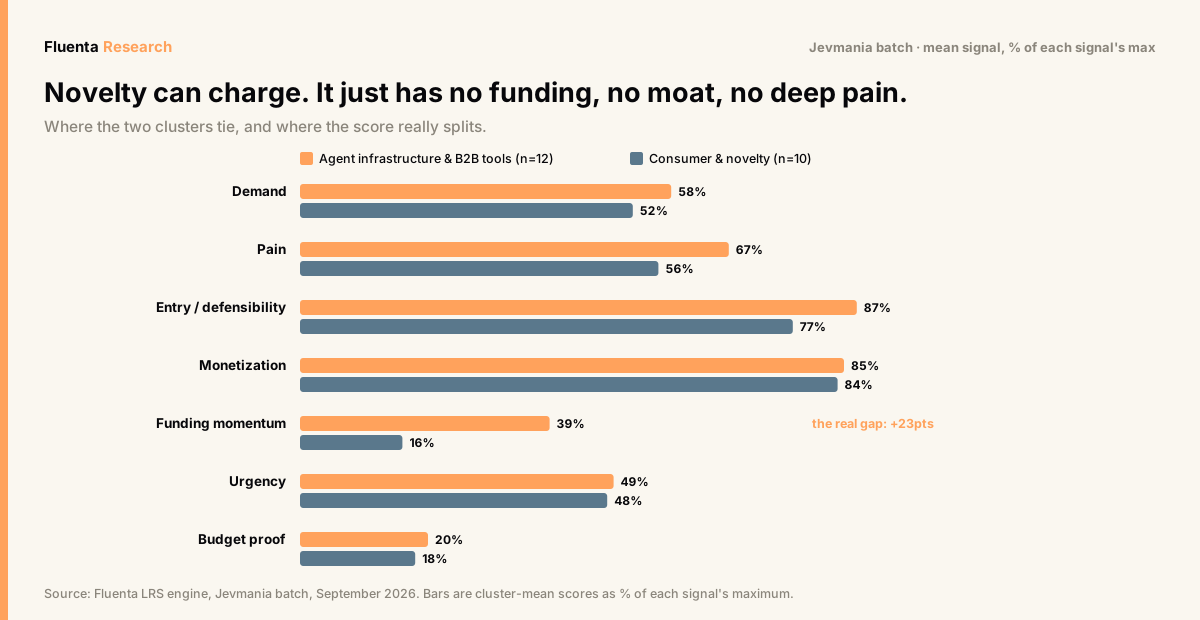
Break the score into its parts and the reason is specific. The two clusters are effectively tied on whether they can charge: monetization sits at 85 percent of maximum for infrastructure and 84 percent for novelty. Where they split is funding momentum, 39 versus 16 percent, depth of pain, 67 versus 56, and defensibility, 87 versus 77. So the novelty apps do not fail because they cannot make money. They fail because no investor is funding the category, the pain is shallow, and there is no moat.
2. The wave has exactly two businesses worth the name
Strip the novelty away and the serious products cluster around two costs companies already pay every month.
The first is the safety call. Teams running agents in production commonly make a second call to a large model on every tool call, just to ask: is this a jailbreak, does this leak PII, is this action what the user asked for. That second call is slow and it is not free. Jev does that check in under 100 milliseconds for a fraction of a cent. Two of the batch's upper ideas, the Agent Safety Gate and the Postgres PII redaction extension, attack exactly this line item.
The second is evaluation. The standard way to test a RAG pipeline or an agent today is LLM-as-judge: paying a large model to grade outputs. It is expensive, slow and inconsistent. Replacing it with typed, calibrated decisions is the clearest before-and-after in the whole ecosystem. It already has real products, jevals from Openlayer and a community benchmark called JevBench, and it maps onto a category with real money behind it: the LLM observability market is put at $2.69B in 2026, growing to $9.26B by 2030.
Everything else in the batch is a variation on one of these two, or it is novelty. If you build one thing on Jev, build a wedge into the safety call or the eval call.
3. Demand without a wedge is a trap
High demand is not the same as a high score, and this batch has a clean example. Predict-With-Jev carries the joint-highest demand signal in the set and a full funding signal, yet it lands at 33.3, because it is a thin listing with weak defensibility. Local Inbox Triage, on slightly lower demand, scores 54.1 because it owns a real workflow on the user's own machine.
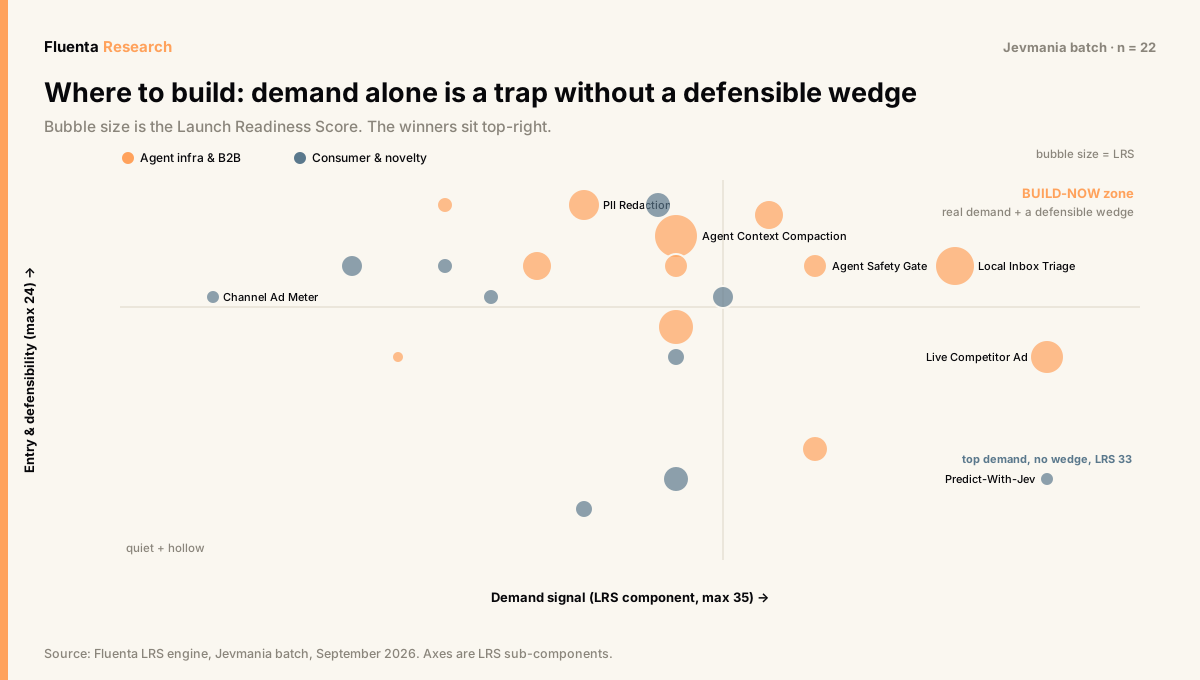
Plotted on demand against defensibility, the winners sit top-right: real demand paired with a wedge a competitor cannot copy in a weekend. Across the 22, the signal that tracks the score most closely is funding momentum, at a correlation of 0.54, ahead of demand at 0.48, while urgency barely moves it. The quick filter for this wave is not how loud the demand is. It is whether the category is already funded and whether the product owns something the next builder cannot clone.
Get the next Fluenta report
Free. Subscribing creates your Fluenta account so you can score your own ideas too.
4. The crack under every one of these ideas
There is one flaw under the entire wave, and the sharpest people on Hacker News found it in the first week. Jev returns a confidence score, and the marketing leans on the idea that it is calibrated: that when it says 0.9, it is right about 90 percent of the time. A thread titled "Jev Can't Be Calibrated" put that to the test. One commenter ran a fair die 400 times; the model chose face one with about 83 percent confidence and was right about 19 percent of the time.
“If it puts a high confidence value on a wrong answer, that is still hallucinating, no?”
TypeSafe's defenders had a fair answer, that Jev scores the answer it should pick given the information, not the true odds of a random event. But the lesson for a founder is blunt: the confidence number is a ranking signal, not a probability. The related trap is the "can't hallucinate" claim. It is true only narrowly. Jev cannot return a value outside the allowed type. It can absolutely return the wrong allowed value. Type safety is not factual correctness, and any product that shows customers a confidence has to test calibration on its own data before it promises anything.
5. There is no search desert to cross, because there is no search yet
Normally a Fluenta report leans hard on search volume to separate real demand from noise. This batch cannot, and that is itself the finding. The word Jev is two weeks old. There is no established search demand for anything named after it, and any tool that reports one is guessing.
That cuts two ways. The risk is obvious: the whole wave could be a builder bubble, people shipping to each other with no buyer underneath. The opportunity is the same fact from the other side. The durable ideas here, agent cost control, agent safety, eval, PII redaction, are not searched as Jev anything. They are searched, and budgeted, as their own categories: AI guardrails, put at $0.7B in 2024 and projected at $109.9B by 2034, and LLM observability above. The move is to ride Jev for the cost advantage and the launch attention, and to sell into a category that existed before Jev and will exist after it.
6. Jev has no moat, and neither will you unless the wedge is the product
Within two weeks of launch the ecosystem had produced Kev, a Jev-like family built on Qwen, at 462 points; Ollaya, an Ollama for decision models, at 609; and Laya, a 421-million-parameter model with a 35-millisecond forward pass trained on a single RTX 6000. A "Jev in 25 lines of Python" post hit 690 points. TypeSafe has published no weights, no parameter count and no self-hosting option, and the crowd's response was to clone it in a week.
“I suspect someone will be able to recreate this within a week by piecing together open-weight models.”
For a founder this is the most important structural fact in the report. The decision-model layer is going to be cheap and commoditised fast, possibly open-weight. So a product whose only value is calling Jev on the customer's behalf has no moat, because the thing it calls is about to be free. The value has to live above the model: in the workflow, the integration, the data, the trust. The Agent Context Compaction Layer scores highest not because it calls Jev but because it plugs cleanly into Claude Code, Codex and Hermes and owns a measurable outcome. Own the workflow, and the model underneath can be swapped for whatever is cheapest that month.
Jev vs the alternatives
Jev is winning on convenience and launch momentum, not on being the only option. What a product built on it is really competing with:
| Alternative | What it is | Where it overlaps Jev |
|---|---|---|
| LLM-as-judge | Paying a large model to grade outputs | The eval job; the typed-evals sub-wave exists to replace it |
| Guardrails AI / NeMo Guardrails | Validation and safety rails for LLM apps | The safety-screening job |
| Lakera | AI security, prompt-injection and PII gating | Screening agent inputs and outputs |
| OpenRouter / RouteLLM / Martian | Model routing by cost and quality | The cheapest-model-router job (OpenRouter now hosts a Jev router) |
| Fine-tuned classifiers / constrained decoding | Classical typed labels from open models | The core decision, embodied by open-weight clones like Laya |
The pattern: Jev competes with a mix of expensive frontier calls and free open tools. The expensive incumbents are the budget to take. The free tools cap the price a Jev-based product can ever charge.
How to read these scores
This report is not a bet that Jev the company wins. It is a read on the problems these 22 products attack, several of which are excellent and predate Jev. It is not search-validated in the usual way, because the term is too young; scores lean on problem durability, adjacent funding and budget evidence instead. And it is not a verdict on any single team. A 34 does not mean the builder is wrong. It means the problem, on public signals, has weaker demand or a harder path to money than a 54. The value is in the questions each score raises, not the number itself.
Do the same with your trend
The method here is repeatable. Take a breakout, list what people are building on it, and score each one on demand, pain, entry difficulty, funding, urgency, budget proof and monetization before writing a line of code. The trend tells you where the attention is. The score tells you where the money is. They are rarely the same place. That is what Fluenta's X-Ray does on a single idea in about 20 minutes.
Score your idea against live demand data with Fluenta X-Ray →
The 22, scored
Every product built on Jev that Fluenta scored, with the seven-signal Launch Readiness breakdown. Bars are each signal against its own maximum (Demand 35, Pain 30, Entry 24, Monetization 20, Funding 10, Urgency 10, Budget proof 10). LRS is the 100-point composite.
Agent Context Compaction Layerexperimental›
LRS breakdown
Local Inbox Triage for Gmailexperimental›
LRS breakdown
Semantic Code Review Gateexperimental›
LRS breakdown
Live Competitor Ad Breakdownexperimental›
LRS breakdown
Content-Aware PII Redaction (Postgres)experimental›
LRS breakdown
Sub-Cent Computer-Use Agentexperimental›
LRS breakdown
Exact-Moment Clip Finderexperimental›
LRS breakdown
jev-seoexperimental›
LRS breakdown
Fast Document Classifier & Splitterexperimental›
LRS breakdown
PeopleWantexperimental›
LRS breakdown
Agent Safety Gateexperimental›
LRS breakdown
Cheapest-Model Routerexperimental›
LRS breakdown
Fit Receiptweak›
LRS breakdown
Date with Jevweak›
LRS breakdown
JevForAgentsweak›
LRS breakdown
slop-graderweak›
LRS breakdown
Jev Wrappedweak›
LRS breakdown
Job-Fit Screener Extensionweak›
LRS breakdown
Typed Evals for LLM Pipelinesweak›
LRS breakdown
Predict-With-Jevweak›
LRS breakdown
Channel Ad & Clickbait Meterweak›
LRS breakdown
Tax Document Page Classifierweak›
LRS breakdown
Source: Fluenta LRS engine, Jevmania batch, September 2026. Public signals only.
FAQ
What is Jev?+
Jev is a hosted model from TypeSafe AI that answers a typed question with a labelled decision and a confidence score in under 100 milliseconds. It is meant to sit at the decision points inside AI agents, such as intent routing, tool-call gating and output checks, instead of a slow, expensive call to a large language model.
What is a System One model?+
System One is TypeSafe's term for a model that returns a typed decision with a confidence score instead of generated text. It is built for the fast, repeated yes-or-no and which-one choices inside software, rather than for open-ended conversation.
How much does Jev cost?+
TypeSafe prices Jev at $0.042 per million input tokens, with output tokens free, and quotes 70 to 500 milliseconds per call. As of September 2026 it is a hosted API in early access behind a waitlist, with no published self-hosting tier.
How is Jev different from a fine-tuned classifier or constrained decoding?+
Jev is a single hosted decision model trained, by a method TypeSafe calls RLCD, to return a calibrated-style confidence across arbitrary typed questions without per-task fine-tuning. The tradeoff is that it is closed and cloud-only, and open-weight classifiers or constrained decoding can match it on narrow, well-defined tasks.
Is Jev's confidence score calibrated?+
Treat it as a ranking signal, not a true probability. A widely shared Hacker News test rolled a fair die 400 times; the model chose one face at about 83 percent confidence and was right about 19 percent of the time. Any product that shows customers a confidence number should test calibration on its own data first.
Can Jev hallucinate or return a wrong answer?+
Jev cannot return a value outside the allowed type, which is all the can't-hallucinate claim means. It can still return the wrong value inside the type. Type safety is not factual correctness.
Can you self-host Jev or get the weights?+
No. TypeSafe has published no weights, no parameter count and no self-hosting option; Jev is a hosted API only. Builders who need local or private inference have turned to open-weight clones such as Kev, Ollaya and Laya.
Will OpenAI or open-weight models make Jev obsolete?+
The commoditisation risk is real and already visible. Open-weight clones and a 25-line reimplementation appeared within two weeks of launch, and a top community thread argues OpenAI is well positioned to fast-follow. The durable value has to live above the model, in the workflow and the data, not in the call to it.
What is the best thing to build on Jev?+
On the data, a wedge into either the agent safety call or LLM-as-judge evaluation. Both replace an expensive habit teams already pay for, and both map onto funded categories such as AI guardrails and LLM observability.
How were these 22 products scored?+
On Fluenta's Launch Readiness Score, a 100-point demand-weighted score across search demand, pain, entry difficulty, funding momentum, urgency, budget proof and monetization, using only public signals. Because Jev is a two-week-old term with no search history, this batch leans harder on problem durability and adjacent funding than a normal report.
Cite this article
Researchers and journalists: this article is freely citable. Click to copy the academic-format reference for your bibliography or footnote.
Ivanov, O. (2026). Jev AI: 22 Business Ideas Built on One Model, Scored. Fluenta. Retrieved from https://fluenta.space/resources/reports/jev-ai-business-ideas.
About the author

Oleg Ivanov
Co-founder & CEO, Fluenta
Oleg is co-founder and CEO of Fluenta. He spent the last decade shipping products across fintech, commerce, and AI tooling, and now leads Fluenta's work scoring startup ideas against 25 live market and social data feeds.
Related Resources
Agent Loops
Agent Loops: 15 AI Agent Business Ideas Ranked by Demand
The Claude loops trend reached 13.6M people in two weeks. Fluenta scored 15 agent-loop business ideas on live demand data: one promising, fourteen experimental.
Report
194 YC Spring 2026 Startups, Scored on Public Data
We scored all 194 YC Spring 2026 startups on six public signals before Demo Day. Four groups, a tight score band, and three questions to ask each founder.
Demand Spike Trackers
Demand Spike Trackers: 47 Trending Business Ideas
47 trending business ideas from Exploding Topics, Idea Browser and 3 more tools, scored on six signals. The average came back 47 of 100.
Score your idea in 20 minutes
Run Fluenta X-Ray on your idea. 25 live market + social feeds. Real demand data, real competition, real willingness-to-pay signals. From $7. 20 minutes.
Was this helpful?