How ChatGPT & Google AI Decide What to Cite (2026)

When ChatGPT, Perplexity, or Google AI writes an answer, it pulls a handful of sources to build it from, and the rules for which sources it picks are not the rules of Google ranking. Understanding how AI decides what to cite is the core of answer engine optimization, because a brand that is never cited is never recommended. The short version: answer engines favor sources that are widely mentioned, clearly quotable, and corroborated off-site, and only about 12 percent of what ChatGPT cites overlaps with Google's top results.
This guide explains where AI citations actually come from and what makes a page get quoted.
Key Takeaways
Does AI cite what ranks on Google?
Mostly no, and this is the finding that reorders everything.
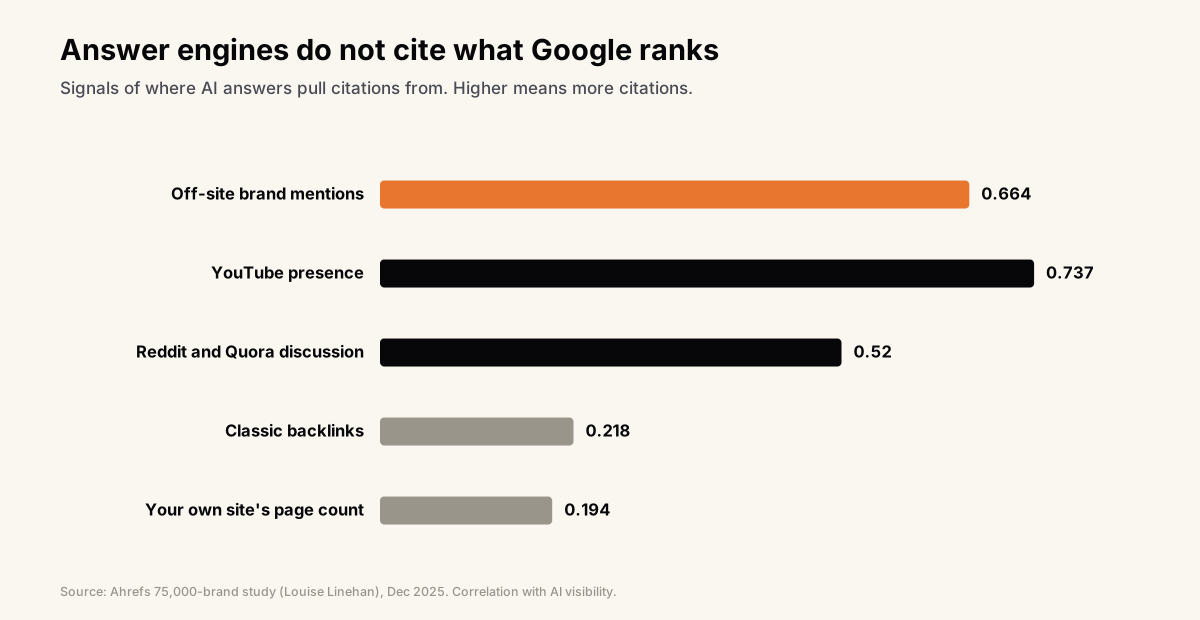
An Ahrefs study of 75,000 brands found that off-site brand mentions correlate with AI visibility far more strongly than backlinks, and that a site's page count has almost no relationship with it at all. YouTube presence showed the single strongest correlation. Only about 12 percent of ChatGPT citations match a page in Google's top 10 results, which means the majority of what AI quotes comes from places a brand's traditional SEO never touches: Reddit threads, review sites, YouTube, and third-party roundups.
“There is almost no relationship between content volume and AI visibility”
What does an answer engine look for in a source?
Two things: is this source talked about elsewhere, and is this specific passage easy to lift into an answer.
The first is corroboration. Large language models cannot verify an unfamiliar brand, so they lean on signals that many independent sources agree a brand exists and matters: mentions, reviews, and discussion across the web. The second is extractability. A passage that states a clear fact, a statistic, or a quotable one-liner is easier to drop into an answer than a paragraph of marketing prose.
“These tools are probability engines: they're designed to generate unique answers every time”
What earns a citation on the page itself?
The Princeton GEO study tested this directly by editing content and measuring which changes raised a source's visibility inside answer engines.
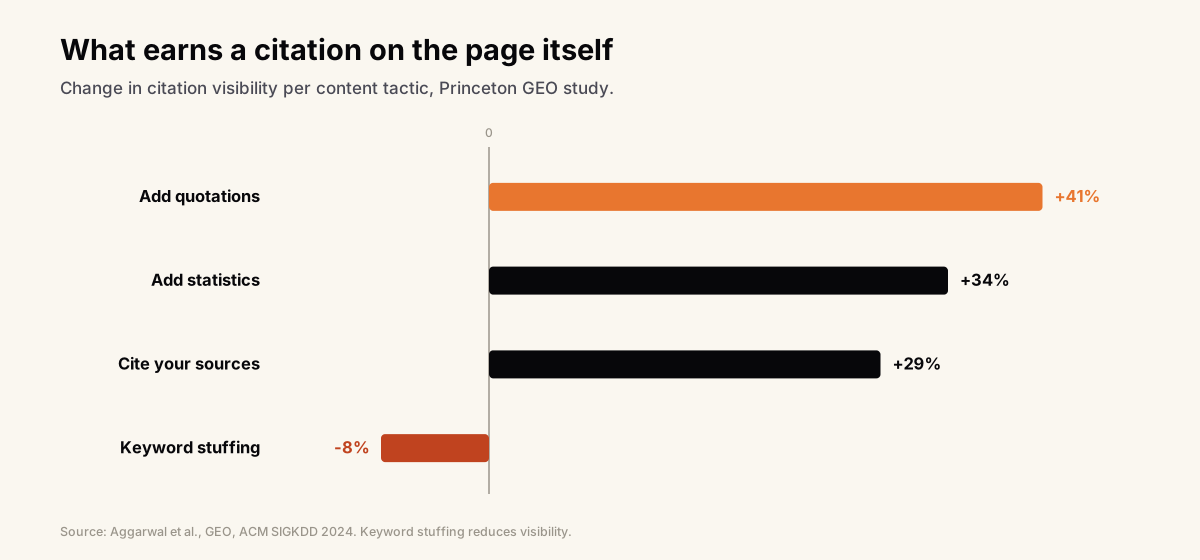
Adding quotations lifted citation visibility by 41 percent, statistics by 34 percent, and citing sources by 29 percent. Keyword stuffing, the reflex of old-school SEO, cut visibility by 8 percent. The pattern is blunt: answer engines cite content that is evidence-rich and clearly attributed, and discount content optimized for keywords rather than readers. One caveat worth stating plainly: Ahrefs found that adding schema markup produced no measurable citation uplift, so ship structured data for machine-readability, not as a citation lever.
“Ultimately, AEO/GEO is not an overhaul or abandonment of SEO. Instead, it represents a new system for competing for, capturing, and measuring success across AI platforms”
Where do the citations physically come from?
Disproportionately from third parties, not from the brand's own site. In a study of 175 brands, 99.99 percent of the AI citations analyzed pointed to third-party sites rather than the brand's own domain. That is why earning off-site mentions, on Reddit, review platforms, YouTube, and industry roundups, does more for citations than publishing another page on your own blog.
Check AI visibility for my website
Free. No subscription, no card. 24 hour turnaround, checked by a human analyst.
How do you use this to get cited?
| Lever | Do this | Evidence |
|---|---|---|
| Off-page: be mentioned | Get listed in roundups; earn Reddit, Quora, and review-site discussion; build YouTube presence | Brand mentions correlate 0.664 with AI visibility vs 0.218 for backlinks |
| On-page: be quotable | Lead with clear claims, original statistics, and named cited sources | Quotations +41%, statistics +34%, cite sources +29% (GEO study) |
| Stop: keyword stuffing | Write for readers, not keyword density | Keyword stuffing cut citation visibility 8% (GEO study) |
| Do not rely on: schema alone | Ship structured data for parsing, not as a citation lever | Schema produced no measurable citation uplift (Ahrefs) |
Work the two levers the evidence supports. Off the page, earn mentions where AI looks: get listed in the roundups, get discussed on Reddit and review sites, build a real presence on YouTube. On the page, make the content quotable: lead with clear claims, original statistics, and named, cited sources, and drop the keyword stuffing. Then measure whether it worked, because being cited is the outcome, and a free AI visibility audit shows where a brand stands before and after.
Every figure here is attributed: the Ahrefs 75,000-brand study for the correlation data, the Princeton GEO study (KDD 2024) for the content levers, and the Victorious 175-brand study for the citation-destination data. Figures are 2024 to 2026.
See whether ChatGPT, Perplexity, and Google AI name your business. Run a free AI visibility audit. →
FAQ
How does ChatGPT decide what to cite?+
ChatGPT favors sources that are widely mentioned and corroborated across the web and passages that are easy to extract, such as clear facts, statistics, and quotations. It does not primarily cite what ranks on Google; only about 12 percent of its citations overlap with Google's top 10 results.
Why does AI cite third-party sites instead of my own?+
Because large language models lean on independent corroboration to trust an unfamiliar brand. In one 175-brand study, 99.99 percent of AI citations pointed to third-party sites like Reddit, review platforms, and roundups rather than the brand's own domain. Earning those off-site mentions is what moves citations.
What makes a page more likely to be cited by AI?+
Quotable, evidence-rich content. A Princeton study found adding quotations raised citation visibility 41 percent, statistics 34 percent, and citing sources 29 percent, while keyword stuffing reduced it 8 percent. Lead with clear claims, original data, and named sources.
Does schema markup help AI citations?+
Not directly. An Ahrefs study found adding schema produced no measurable citation uplift. Structured data is still worth shipping so machines can parse your content, but it is not a lever that earns citations on its own.
Do backlinks help with AI citations?+
Far less than brand mentions. In a 75,000-brand study, off-site brand mentions correlated with AI visibility much more strongly than classic backlinks, which had a weak relationship. For AI citations, being mentioned matters more than being linked.
Cite this article
Researchers and journalists: this article is freely citable. Click to copy the academic-format reference for your bibliography or footnote.
Ivanov, O. (2026). How ChatGPT & Google AI Decide What to Cite (2026). Fluenta. Retrieved from https://fluenta.space/resources/guides/ai-platform-citation-patterns.
About the author

Oleg Ivanov
Co-founder & CEO, Fluenta
Oleg is co-founder and CEO of Fluenta. He spent the last decade shipping products across fintech, commerce, and AI tooling, and now leads Fluenta's work scoring startup ideas against 25 live market and social data feeds.
Related Resources
ANSWER ENGINE OPTIMIZATION
What Is AEO? Answer Engine Optimization Explained (2026)
Answer engine optimization (AEO): how a brand gets cited inside AI answers from ChatGPT, Perplexity, and Google AI, why it matters, and how to do it.
AI VISIBILITY · TOOLS COMPARED
AI Visibility Tools Compared (2026): Do They Get You Cited?
Six AI-visibility tools compared on the one question that matters: do they only track whether ChatGPT names you, or do they actually get you cited?
AI VISIBILITY AUDIT
AI Visibility Checker: Is ChatGPT Recommending You? (2026)
AI visibility is whether ChatGPT, Perplexity, and Google AI name your brand. How to audit it, why 89% of brands are absent, and what makes AI recommend you.
Find out if AI recommends your business
Fluenta Magnet checks whether ChatGPT, Perplexity and Google AI Overviews name your business or your competitor, then ships the fixes. Free, human-checked, in 24 hours.
Was this helpful?