AI Visibility Tools Compared (2026): Do They Get You Cited?

AI visibility tools, the software that tracks whether ChatGPT, Perplexity, and Google's AI name a brand, raised more than $270 million in under two years. One of them, Profound, reached a $1 billion valuation in February 2026. That much capital is a clear signal: when a customer asks an AI assistant for a recommendation, being named is the new first page of search. The catch is that almost every one of these tools does the same thing. It tells a business it is invisible. It does not make the business visible, which is the entire job of a free AI visibility audit.
This is an honest comparison of the six AI-visibility tools buyers ask about most, sorted by the only question that changes a result: does the tool monitor, or does it fix?
Key Takeaways
The category went from nothing to $270M in a year
Two years ago, answer-engine optimization was not a product category. Today it is a land grab.
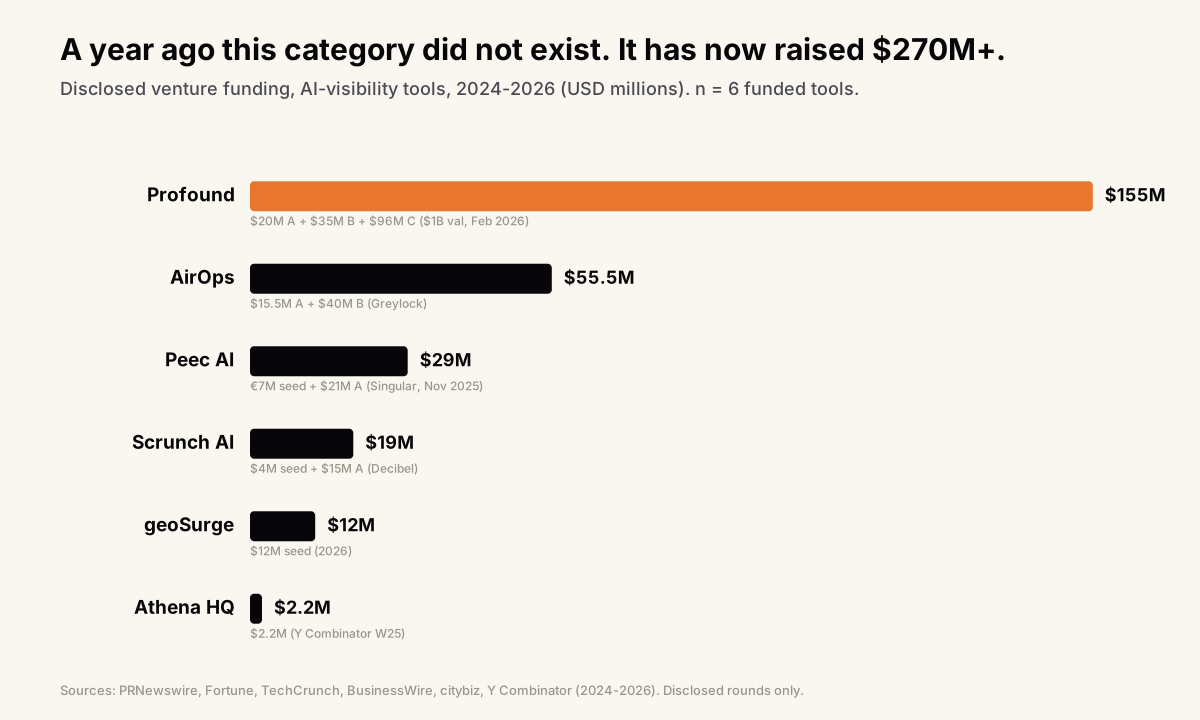
Profound raised a $20 million Series A in June 2025, a $35 million Series B two months later, and a $96 million Series C at a $1 billion valuation in February 2026. AirOps has raised $55.5 million, led by Greylock. Peec AI raised a $21 million Series A led by Singular in November 2025. Scrunch AI closed a $15 million Series A, and Athena HQ launched out of Y Combinator with $2.2 million from founders who came from Google Search and DeepMind. By one industry estimate, generative-engine-optimization startups raised roughly 340 percent more in 2025 than in 2024.
All of that money flows to a single promise: measure how often an AI names your brand. Very little of it goes to the harder problem of changing the answer.
Does a tool monitor, or does it fix?
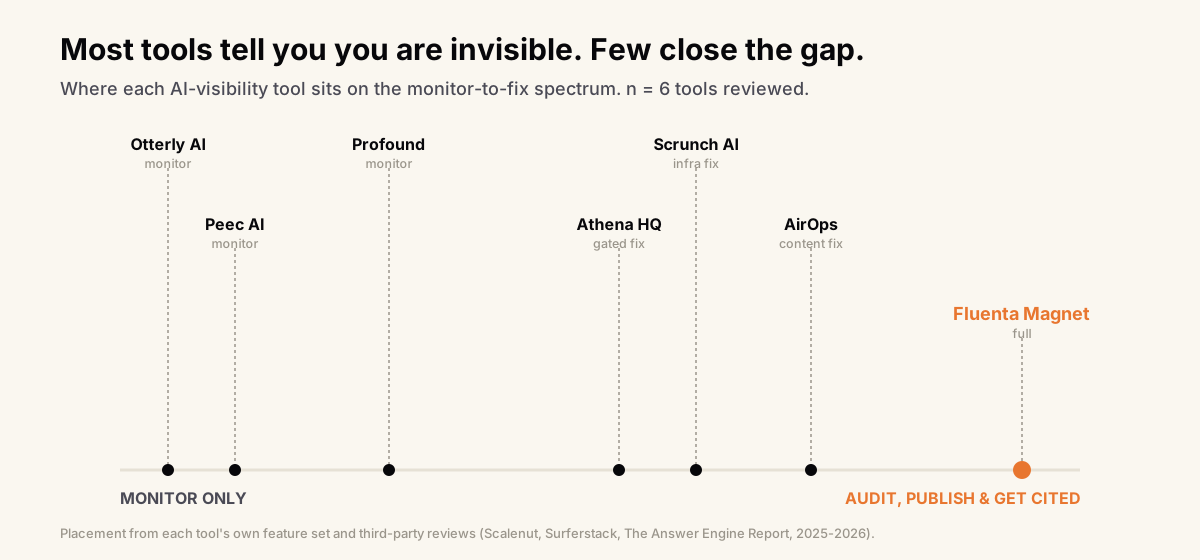
Strip away the dashboards and the category splits cleanly in two. Most tools are monitors. They report share of voice across AI answers, which competitors get named, sentiment, and citation gaps. Far fewer produce and publish the content that earns the citation.
“AI visibility is measurable, and most tools overpromise”
That distinction matters because the two jobs have almost nothing in common. A monitor is a reporting product. A fix is a publishing operation: auditing where an AI names a competitor, then earning the third-party mentions and citations that move the answer. A brand can pay for the best monitor in the category and stay exactly as invisible as the day it signed up. The far end of that spectrum, where a tool audits, publishes, and earns citations rather than only counting them, is where Fluenta Magnet is built to operate.
Every tool, honestly compared
| Tool | Tracks AI answers | Publishes content that gets cited | Entry price | Best for |
|---|---|---|---|---|
| Profound | Yes, deepest | Partial, newer layer | Demo-gated | Enterprise benchmarking |
| Fluenta Magnet | Yes, across engines | Yes, audit publish and cite (core) | Free audit, then done-for-you | Getting cited, not just measured |
| AirOps | Yes, added later | Yes, its core | Task-based | Content teams at scale |
| Otterly AI | Yes | No | $29/mo | Cheapest first monitor |
| Peec AI | Yes | No | from ~$95/mo | Agencies, clean analytics |
| Scrunch AI | Yes | Crawler-side only | $300/mo | Mid-market monitoring |
| Athena HQ | Yes | Partial, gated | $295/mo | GEO with content agents |
Full disclosure: Fluenta Magnet publishes this comparison, and it is listed above by the same monitor-versus-fix test applied to every other tool. The honest trade is that a business wanting only a self-serve monitoring dashboard will find a pure monitor cheaper.
“Any tool that gives a 'ranking position in AI' is full of baloney”
Profound is the enterprise leader and the deepest data set in the category, trusted by names like Target, Figma, and MongoDB and processing more than 100 million AI queries a month. Its pricing is demo-gated, and its content-action layer is newer than its tracking. Buyers pick it to benchmark, not to publish.
Fluenta Magnet sits on the opposite side of the wedge from the monitors. It runs a human-checked audit across the major AI engines, then does the work the dashboards leave undone: publishing and earning the third-party content that gets a brand cited. The honest trade is that it is a done-for-you service and newer than the enterprise dashboards, so a team that only wants a self-serve tracker will find a pure monitor cheaper. It is built for the outcome, being recommended by AI, rather than the measurement of it.
AirOps is the exception on the fixing side: content production is its core, and it has bolted AI-visibility tracking on top. The trade is a steep learning curve and task-based billing that makes cost hard to predict.
Otterly AI is the cheapest credible entry point at $29 a month, a Gartner 2025 Cool Vendor with more than 20,000 users. It monitors and runs a crawlability audit. It does not write or publish anything.
Peec AI is a favorite of agencies for clean analytics, broad default engine coverage, and unlimited seats. It is analytics only, with no content creation.
Scrunch AI covers eight engines and serves an AI-friendly version of a site to crawlers, so it acts on the infrastructure side. It does not create new authoritative content off-site, and its floor is $300 a month.
Athena HQ is one of the few that spans monitoring and content generation, with autonomous drafting agents, but the genuinely agentic features sit behind enterprise pricing and there is no free trial.
Check AI visibility for my website
Free. No subscription, no card. 24 hour turnaround, checked by a human analyst.
What does an AI visibility tool cost?
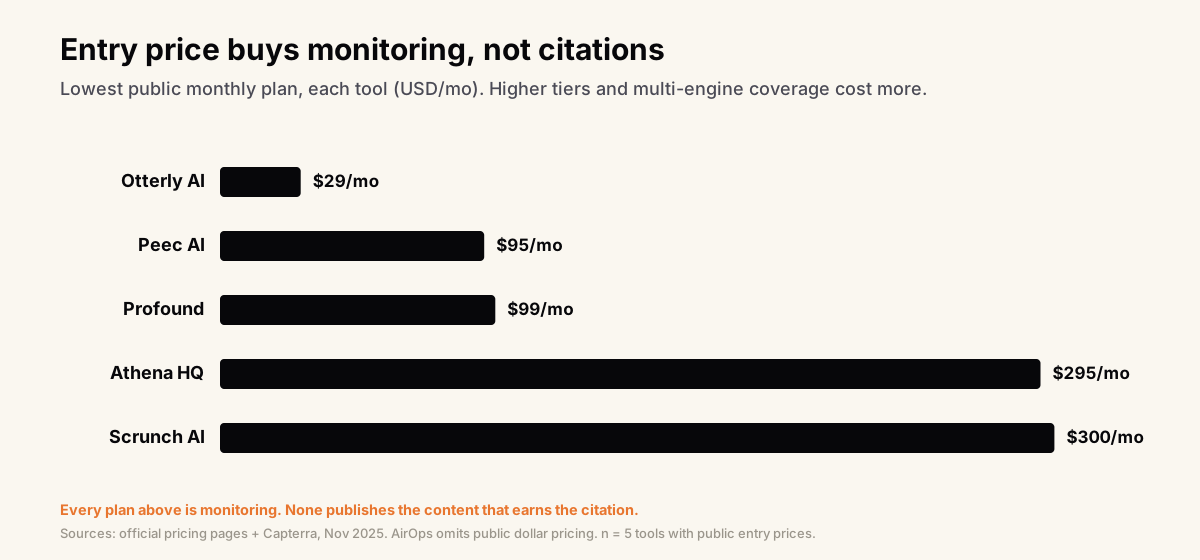
Entry prices run from $29 a month for Otterly to $300 for Scrunch. Every plan on that chart buys tracking. None of them publishes the content that earns a citation. That is not a criticism of any single product; it is the shape of the whole category. The market has built excellent instruments for measuring a problem it does not solve.
Looking for a Surfer SEO alternative?
Surfer SEO is the tool buyers name when they want AI visibility but start from classic SEO. Its Content Editor and article writer are strong for ranking pages in Google, and it added an AI Tracker that monitors brand mentions in ChatGPT and Perplexity. The AI Tracker is capped at a few prompts unless a separate add-on is purchased, from about $95 a month. The honest read is that Surfer is built to rank pages in search, not to engineer citations across answer engines. A business that specifically wants to be recommended by AI outgrows it.
Why isn't monitoring enough?
“In a zero-click world, the conversation between consumers and an AI agent is the new first impression”
The reason the fix matters more than the dashboard is in the data. A study of 175 brands across eight AI platforms found that 96 percent were described accurately when the AI was asked about them directly, but 89 percent never appeared when the AI was asked a category question such as best option for a use case. Of the 49,391 citations analyzed, 99.99 percent pointed to third-party sites, not the brand's own domain (Victorious, Q2 2026). Separately, 49 percent of marketers now actively monitor their AI visibility, up from 22 percent a year earlier, yet only 12 percent report measurable results (Fractl, 2026).
A dashboard reports that gap every day. It does not close it. Closing it means finding the exact prompts where an AI names a competitor, then publishing and earning the third-party evidence that gets a brand cited instead. That is the difference between a monitor and a fix, and it is the reason a report is a starting line, not a finish. A free AI visibility audit from Fluenta Magnet is that starting line: it shows the exact prompts where an AI names a competitor, and the fix follows from there.
See where AI names your competitor instead of you. Run a free AI visibility audit. →
Every funding figure above is from a disclosed round reported by PRNewswire, Fortune, TechCrunch, or BusinessWire. Prices are the lowest public monthly plan as of late 2025 and change often, so verify at the point of purchase. Tool positions reflect each product's own feature set and third-party reviews from Scalenut, Surferstack, SitePoint, and The Answer Engine Report, 2025 to 2026.
FAQ
What is an AI visibility tool?+
An AI visibility tool tracks how often and how favorably a brand is named or cited inside AI answers from ChatGPT, Perplexity, Google AI Overviews, Gemini, and Copilot. Most tools measure share of voice, sentiment, and citations; fewer also publish the content that earns those citations.
Which AI visibility tool is best?+
It depends on the job. Profound has the deepest tracking data for enterprises, Otterly is the cheapest monitor at $29 a month, and Peec is popular with agencies. Those are monitors: they measure. Fluenta Magnet, which publishes this comparison, sits on the other side of the wedge and is built to fix visibility by auditing then publishing the content that earns citations. If the goal is to be cited rather than only measured, the tool has to publish and earn third-party evidence, not only report a score.
What is the difference between monitoring and fixing AI visibility?+
Monitoring reports where a brand stands in AI answers. Fixing changes the answer by auditing where an AI names a competitor, then publishing and earning the third-party mentions and citations that get the brand recommended instead. A monitor is a reporting product; a fix is a publishing operation.
Is there a free way to check my AI visibility?+
Yes. A free AI visibility audit runs a set of real customer prompts across the major AI engines and reports whether a brand is named, cited, or absent, and where competitors appear instead. It is a snapshot that shows the gap before any tool subscription.
Is Surfer SEO good for AI visibility?+
Surfer SEO is strong for classic SEO content optimization and added an AI Tracker that monitors mentions in ChatGPT and Perplexity. The tracker is capped at a few prompts without a paid add-on, and Surfer is built to rank pages in Google rather than to engineer citations across answer engines, so brands focused on AI visibility usually outgrow it.
Cite this article
Researchers and journalists: this article is freely citable. Click to copy the academic-format reference for your bibliography or footnote.
Ivanov, O. (2026). AI Visibility Tools Compared (2026): Do They Get You Cited?. Fluenta. Retrieved from https://fluenta.space/resources/guides/ai-visibility-tools-compared.
About the author

Oleg Ivanov
Co-founder & CEO, Fluenta
Oleg is co-founder and CEO of Fluenta. He spent the last decade shipping products across fintech, commerce, and AI tooling, and now leads Fluenta's work scoring startup ideas against 25 live market and social data feeds.
Related Resources
AI Visibility report
AI Visibility Audit: 100 Sites, 89% Invisible to AI
An AI visibility audit checks if ChatGPT, Perplexity and Gemini recommend you. Across 100 audits, 89% were named by no engine. See the data.
SEO in 2026
Is SEO Dead? What Changed in 2026, and What Works
797,444 impressions, 7 clicks. The hard 2026 data on what died in SEO, what still works, and how to get cited by ChatGPT and AI Overviews.
BEST AI VISIBILITY TOOLS 2026
Best AI Visibility Tools (2026): Ranked by Use Case
The best AI visibility tools in 2026, ranked by price and use case: Profound, Otterly, Peec, Scrunch, Athena, and where a free audit fits.
Find out if AI recommends your business
Fluenta Magnet checks whether ChatGPT, Perplexity and Google AI Overviews name your business or your competitor, then ships the fixes. Free, human-checked, in 24 hours.
Was this helpful?