Medical SEO: How Patients Find Doctors in 2026

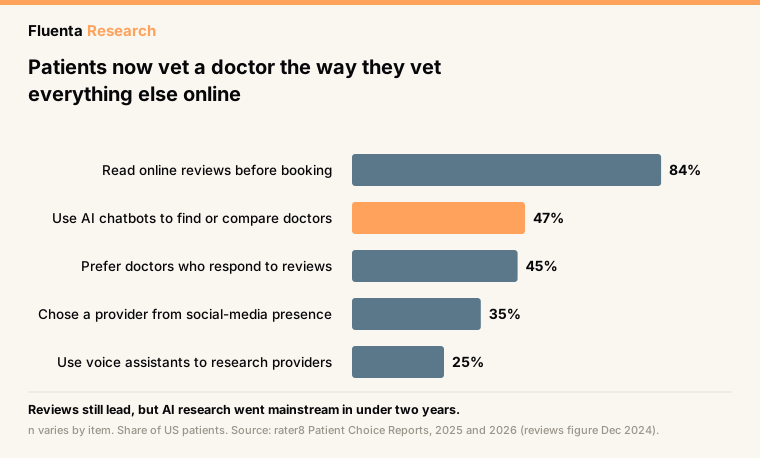
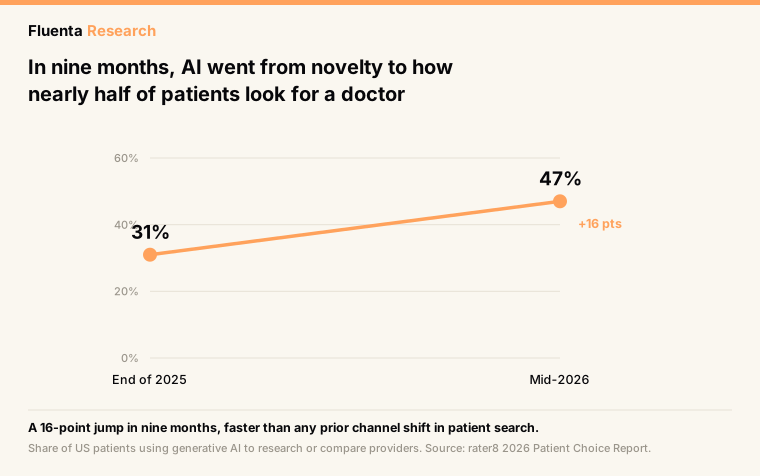
A patient with a new symptom rarely calls a friend first. They open a search bar. In a 2025 survey of how patients choose care, 84% said they read online reviews before booking, and by mid-2026, 47% reported using an AI chatbot such as ChatGPT or Gemini to find or compare doctors. Medical SEO is the discipline of making a practice the answer those patients land on, and it now spans three surfaces at once: the Google local pack, the reviews that sit under it, and the AI assistants that increasingly summarize both. The mechanics overlap heavily with local SEO for any small business, but healthcare carries an extra weight that most verticals never feel, because a wrong answer about a clinic can affect someone's health.
Check AI visibility for my website
Free. No subscription, no card. 24 hour turnaround, checked by a human analyst.
That weight changes the strategy. A restaurant that ranks a little lower loses a booking. A clinic that is invisible when a patient searches "urgent care near me" at 9pm loses a patient who needed care and found someone else. The stakes raise the bar Google applies to medical pages, and they raise the cost of being absent from the AI answers patients now trust. A practice can run a free AI visibility check at /magnet to see where it already stands before spending a dollar on ads.
Source · rater8 Patient Choice Reports, 2025 and 2026
The pattern in the data is consistent across surveys: patients treat choosing a doctor the way they treat any considered purchase. They read reviews, they compare, and a growing share ask an AI assistant to shortlist for them. rater8's Patient Choice reporting found that AI research jumped from a novelty to a mainstream habit in under two years, and that patients increasingly prefer providers who visibly respond to reviews. Two findings from the 2026 wave sharpen the point. For the first time, AI results influenced provider selection for 36% of patients, edging past Google search results at 34%. And review reading is not casual: more than half of patients read at least six reviews before deciding, and 40% reported that a negative review caused them to cancel or avoid an appointment they had already planned. None of that behavior rewards a practice with a thin website and an unclaimed Google Business Profile. All of it rewards a practice that shows up, with proof, exactly where the patient is looking.
The move to AI carries a risk that cuts the other way, too, and it is one practices should not ignore. In the same 2026 research, two-thirds of patients who used AI to research a provider encountered incorrect information, wrong addresses, phone numbers, insurance details, or hours, yet 60% trusted the AI summary without verifying it. An out-of-date directory listing is no longer a minor housekeeping issue. It is a source an AI engine may repeat to a patient with full confidence, sending that patient to a disconnected number or a former address. Accuracy across the open web has become a patient-safety and acquisition problem at the same time.
Key Takeaways
The local pack still decides who gets the call
For most medical searches with local intent, the three-result map block at the top of Google, the local pack, captures the majority of clicks before a patient ever scrolls to the classic blue links. Ranking there is not the same problem as ranking a blog post. Google's local algorithm weighs proximity, relevance, and prominence, and the relative weight of each factor shifts by industry. A machine-learning study of 3,269 local businesses by Search Atlas, run in May 2025, isolated those weights for the health sector specifically.
| Local ranking factor | Share of ranking weight, health sector top 10 |
|---|---|
| Proximity / distance | 36.1% |
| Review count | 19.4% |
| Review keyword relevance | 13.1% |
| Relevance, prominence and profile features | Remainder |
Two things stand out for medical practices. Proximity is the single largest factor, which means a clinic mostly competes inside its own catchment area rather than against the whole city, and a practice with several locations should treat each one as a distinct entity with its own profile, address, and reviews. Review count and review keyword relevance together rival proximity in weight, which is why a steady flow of recent, specific reviews ("Dr. Lopez explained the MRI results clearly") outperforms a burst of generic five-star ratings. Reviews are not a vanity metric in healthcare. They are a ranking input, a trust signal, and, increasingly, the raw material AI assistants summarize when a patient asks which clinic to pick.
The foundation under all of it is a complete, accurate Google Business Profile: correct category, hours, phone, insurance and services, and a name, address, and phone number (NAP) that matches the website and every directory exactly. Inconsistent NAP data across health directories is one of the most common and most fixable reasons a legitimate practice underperforms in the pack. The same discipline that governs a dental practice applies here, and the sibling guide on local SEO for dentists walks through the review-generation and profile mechanics in depth.
There is also a behavioral detail worth designing around. Patients respond to visible engagement: in the 2026 research, 45% said whether a provider responds to reviews influenced their choice, and a large majority said they would leave a review when prompted at the right time, most often within 24 hours of an appointment. A practice that responds to reviews, professionally and without disclosing protected health information, is doing two jobs at once. It is feeding the review-relevance signal Google's health-sector model rewards, and it is producing the exact public, third-party text that AI engines later read when a patient asks which clinic to choose. The reviews a practice earns are not only social proof. They are training data for the answer engines.
E-E-A-T and YMYL: the bar medical content has to clear
Google classifies health pages as Your Money or Your Life (YMYL) content, meaning topics that can materially affect a person's wellbeing. That classification triggers Google's strictest quality expectations, which its own rater documentation states plainly.
“We have very high Page Quality rating standards for YMYL pages because low-quality YMYL pages could potentially negatively impact a person's happiness, health, financial stability, or safety.”
The framework raters and ranking systems apply to that content is E-E-A-T: Experience, Expertise, Authoritativeness, and Trustworthiness. For a medical practice, E-E-A-T is not an abstraction, it is a checklist. Expertise means clinical content is written or reviewed by a named, credentialed clinician, with that authorship shown on the page, not hidden. Authoritativeness means the practice is referenced by sources Google already trusts: hospital affiliations, medical associations, licensing bodies, and reputable health directories. Trustworthiness means the obvious signals are all present and correct: real physician bios with credentials and licenses, clear contact and location details, secure forms, accurate service and insurance information, and citations to primary medical sources rather than unattributed claims.
The September 2025 revision of Google's rater guidelines, a 182-page document, kept medical advice, medication and supplement pages, and mental-health content in the highest-scrutiny tier. Practically, that means a symptom or treatment page thrown together without a clinician's name attached is not just weak content, it is content Google is actively instructed to distrust. The practices that win YMYL search are the ones that make their real-world clinical experience legible to both a rater and an algorithm: who wrote this, what are their credentials, when was it last reviewed, and what does it cite.
Why AI engines describe a clinic but do not recommend it
Here is the shift most practices have not priced in. Search is no longer only a list of links. A large and rising share of patients get an answer, not a page, and that answer is assembled by an AI engine drawing on reviews, directories, and third-party content. The share of patients using generative AI to research providers is climbing fast enough that it now rivals the traditional search snippet as a first touch.
Source · rater8 2026 Patient Choice Report
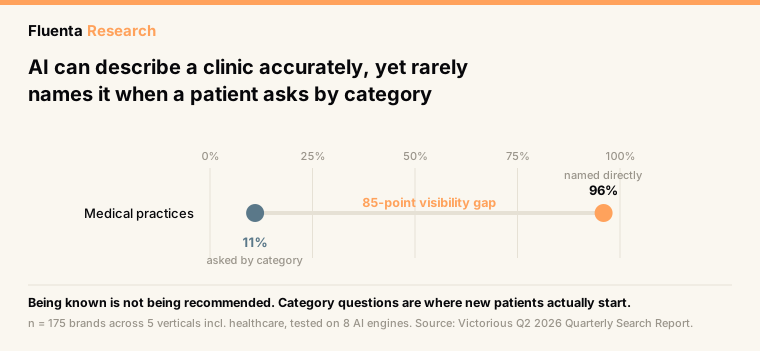
The problem is not that AI engines have never heard of a given practice. In a study of 175 brands across five verticals including healthcare, run by Victorious in mid-2026 across eight AI platforms, 96% of brands were described accurately when the model was asked about them by name. The failure appears one step earlier, at the category question, the exact question a new patient asks. When the same engines were asked a research question like "who are the best providers for X in this city", 89% of those brands never appeared at all.
Source · Victorious Q2 2026 Quarterly Search Report, 175 brands across 8 AI engines
That gap has a mechanical cause worth understanding, because it points at the fix. AI engines assemble answers largely from what other sites say about an entity, not from what the entity says about itself. Across a study of roughly 75,000 brands, off-site brand mentions correlated 0.664 with AI visibility while traditional backlinks correlated 0.218, meaning mentions predicted AI citation about three times more strongly than links. And the sources AI engines cite are mostly not the brand's own domain: an estimated 99.99% of AI citations point to third-party sites. A clinic can have a flawless website and still be missing from the answer, because the answer is built from directories, review platforms, association pages, and news, not from the homepage.
It is tempting to assume that ranking well on Google carries over to being cited by AI, but the two are only loosely related. Analyses of AI answers have found that only about 12% of the sources ChatGPT cites overlap with Google's top ten organic results for the same query. AI engines are reading a different, wider slice of the web, which means a practice can hold a solid Google position and still never surface in the AI shortlist. The consequence for medical marketing is direct: the AI layer is a separate scoreboard, and it has to be measured on its own terms rather than inferred from classic rankings.
“For every 1,000 searches on Google in the United States, 360 clicks make it to a non-Google-owned, non-Google-ad-paying property.”
The same open web that Google keeps siphoning traffic away from is where AI engines now go to decide who to name. The controllable levers are documented. A Princeton study on generative engine optimization (GEO) found that adding well-attributed quotations to a source lifted its citation visibility by up to 41% and adding statistics by up to 34%, while keyword stuffing reduced visibility by roughly 8%. AI answers reward the same signals a careful clinician already values: specific, cited, verifiable claims. The audit questions are concrete, and a structured AI visibility check answers them: which engines cite the practice, for which patient questions, and which third-party sources feed those answers.
What a medical practice actually does about it
The work divides cleanly into three layers, and the order matters. The first layer is the local pack: claim and complete the Google Business Profile, fix NAP consistency across every health directory, and build a durable review engine that asks satisfied patients at the right moment and captures specific, keyword-relevant feedback. This is the layer that fills the schedule this quarter, and it is where a practice with no marketing budget should start.
The second layer is the site itself, built to the YMYL standard. Every clinical page carries a named clinician's byline with credentials, a last-reviewed date, and citations. Service and location pages are distinct, complete, and locally specific. Bios establish real experience and authority rather than listing keywords. This is the layer that lets a practice rank for the intent-rich, non-branded searches ("pediatric allergist accepting new patients") that a complete-but-generic profile cannot reach on its own. A structured approach to AI-ready SEO services treats this content as the substrate both Google and AI engines read.
The third layer is AI visibility, and it is the one almost no local practice is actively managing. It means knowing, not guessing, whether AI engines name the practice for the category questions patients ask, and then feeding the third-party surfaces those engines cite: accurate directory and association listings, earned mentions, review depth, and cited, quotable content. Because off-site mentions outweigh a clinic's own site in the AI layer, this work looks more like digital PR and directory hygiene than classic on-page SEO. The first move is measurement, because a gap that is not measured cannot be closed.
A concrete program for that third layer starts by writing down the ten or fifteen category questions a real patient would type or speak: "best dermatologist near me", "pediatric urgent care open now", "who treats sports injuries in [city]". Each question is then run against the AI engines patients actually use, and the practice records whether it appears, which competitors appear instead, and which third-party sources the engine cited to build the answer. That list of cited sources is the roadmap. If an engine leans on a specific health directory, an association page, or a review platform to name competitors, those are the surfaces where the practice needs an accurate, complete, and ideally review-rich presence. The work is unglamorous and durable: correct listings, real reviews with specific language, credentialed content other sites are willing to reference, and consistent naming of the practice everywhere it appears. It compounds, because every accurate third-party mention makes the next AI answer slightly more likely to include the practice.
None of this replaces the older discipline of ranking on Google, and the zero-click reality is precisely why it matters. When 68% of US searches end without a click and Google keeps routing users to its own surfaces, the practice that only optimizes for a blue-link position is competing for a shrinking slice of attention. The map pack, the review stars, and the AI summary are where the decision is increasingly made, often before a single website loads. Medical SEO in 2026 is the work of being present and credible on all three, in the patient's own words, at the moment the question is asked.
The takeaway
Patient acquisition has quietly split into three races: the map pack that captures local intent, the YMYL-grade content that earns trust and non-branded rankings, and the AI answers that are becoming the first thing a growing share of patients see. A practice can be strong in one and invisible in the others, and most are strong in none. The advantage does not go to the biggest ad budget. It goes to the practice that shows up with proof, in the patient's own language, on the surface the patient actually opened. The first step costs nothing but attention: find out which of the three races the practice is currently losing, and start there.
Check AI visibility for my website
Free. No subscription, no card. 24 hour turnaround, checked by a human analyst.
FAQ
What is medical SEO?+
Medical SEO is the practice of making a clinic or physician visible where patients now look for care: Google's local map pack, the online reviews beneath it, and the AI assistants that summarize both. It combines local search optimization, YMYL-grade website content, and AI visibility work.
How do patients find a doctor in 2026?+
Most start with an online search and reviews. In 2025 surveys, 84% of patients read reviews before booking, and by mid-2026, 47% used an AI chatbot such as ChatGPT or Gemini to find or compare providers, a share that now rivals traditional Google results as a first touch.
Why is E-E-A-T so important for medical websites?+
Google classifies health pages as Your Money or Your Life content and holds them to its strictest quality standards. E-E-A-T (Experience, Expertise, Authoritativeness, Trustworthiness) means clinical content should be written or reviewed by named, credentialed clinicians, with clear citations and accurate practice details.
How do medical practices rank in Google's local pack?+
A machine-learning study of local businesses found that for the health sector, proximity contributes about 36.1% of ranking weight in the top ten, review count 19.4%, and review keyword relevance 13.1%. A complete Google Business Profile, consistent NAP data, and a steady flow of specific reviews are the core levers.
Why do AI assistants not recommend my practice?+
AI engines usually recognize a practice when asked by name but rarely surface it for category questions like best clinic near me. In a 175-brand study, 96% were described accurately when named yet 89% never appeared in category answers, because AI builds answers mostly from third-party mentions, not the practice's own site.
How can a practice check its AI visibility?+
List the category questions real patients ask, run them against the AI engines patients use, and record whether the practice appears and which sources the engine cited. Fluenta Magnet runs this free AI visibility audit at /magnet so a practice can see the gap before spending on ads.
Cite this article
Researchers and journalists: this article is freely citable. Click to copy the academic-format reference for your bibliography or footnote.
Ivanov, O. (2026). Medical SEO: How Patients Find Doctors in 2026. Fluenta. Retrieved from https://fluenta.space/resources/guides/medical-seo.
About the author

Oleg Ivanov
Co-founder & CEO, Fluenta
Oleg is co-founder and CEO of Fluenta. He spent the last decade shipping products across fintech, commerce, and AI tooling, and now leads Fluenta's work scoring startup ideas against 25 live market and social data feeds.
Related Resources
Local SEO Guide 2026
Local SEO for Small Business in 2026: Google and AI
Google AI Overviews now hit 68% of local searches. How small businesses win local SEO on both layers: the map pack and AI.
Local SEO Guide
Local SEO for Dentists: Fill Your Chairs
How patients choose a dentist through the map pack, reviews, and AI answers, why most practices are invisible to AI, and how to fix it.
AI SEO SERVICES
AI SEO Services: Done-For-You AI Visibility (2026)
AI SEO services get a brand cited by ChatGPT, Perplexity, and Google AI, not just ranked. What done-for-you AI visibility includes, and who should buy it.
Find out if AI recommends your business
Fluenta Magnet checks whether ChatGPT, Perplexity and Google AI Overviews name your business or your competitor, then ships the fixes. Free, human-checked, in 24 hours.
Was this helpful?