Semrush vs Ahrefs vs Moz: Which SEO Suite Wins

There is no universal winner in semrush vs ahrefs vs moz. The three best-known all-in-one SEO suites answer the same question, "where does a site stand in search and how does it improve," in three different ways, and the right pick depends on the job at hand rather than a single scoreboard. This comparison weighs them on data, backlinks, rank tracking, price, ease of use, and who each one is really for. For a wider field map of tools by the job they do, start with the pillar guide to the best SEO tools for small business.
One clarification first. Similarweb is often dropped into these lists, but it belongs to a different category: traffic and market intelligence modeled from clickstream data, not an all-in-one SEO suite. It answers "how much traffic does a competitor get and from where," which is a separate job from keyword research, backlink analysis, and site audits. Semrush, Ahrefs, and Moz are direct rivals; Similarweb sits beside them, not against them.
Key Takeaways
Semrush vs Ahrefs vs Moz at a glance: which SEO suite wins?
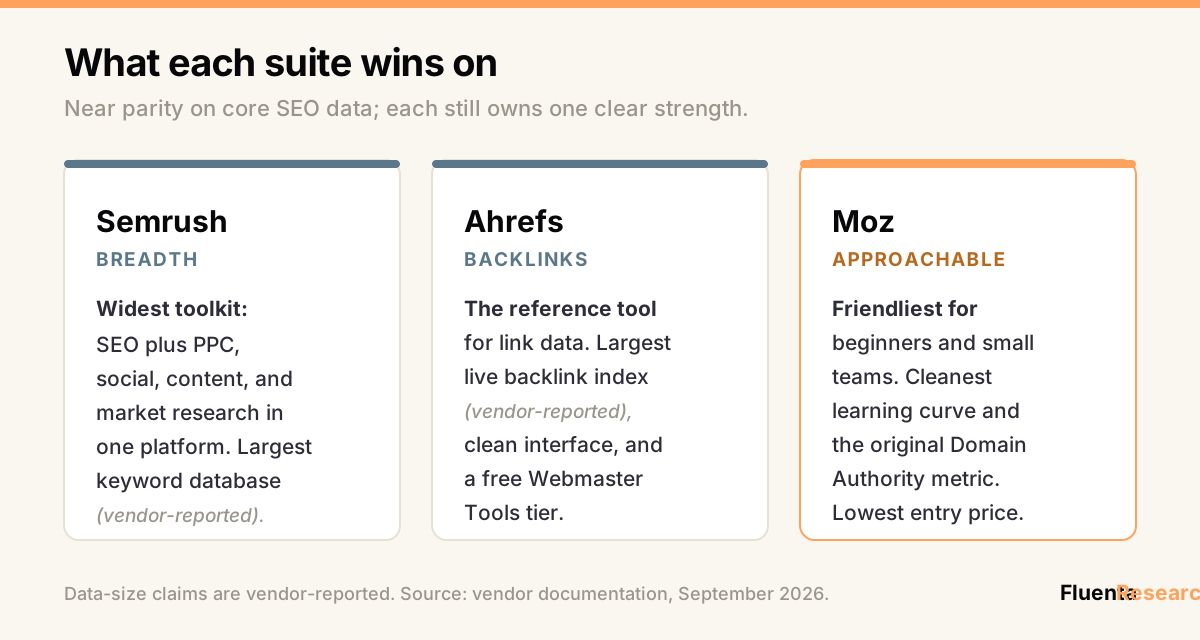
There is no single winner. Semrush wins on breadth, Ahrefs on backlinks, and Moz on approachability and price. All three cover the core SEO jobs to a professional standard, so the decision comes down to which strength matches the work and how much complexity a team can absorb.
Semrush is the widest platform of the three. It pairs deep keyword and backlink data with tools for paid search, social, content, and market research, which makes it the natural home for a full marketing team or an agency running more than search. That breadth is also its cost: the interface is dense, and a first-time user meets a wall of tools.
Ahrefs is the specialist's choice. It built its reputation on link data and keeps a tight focus on search: keywords, backlinks, site audits, and competitor analysis, presented in one of the cleaner interfaces in the category. It also offers a free Webmaster Tools tier for verified site owners, which lowers the on-ramp for a small site.
Moz is the friendliest way in. Its learning curve is the gentlest, its entry price the lowest, and it created Domain Authority, the third-party score much of the industry still quotes. For a beginner or a small team that wants clarity over raw depth, Moz is the least intimidating of the three.
| Capability | Semrush | Ahrefs | Moz |
|---|---|---|---|
| Keyword data | Largest database (vendor-reported) | Large and clean | Smaller, simpler |
| Backlink index | Strong, has caught up | Largest live index (vendor-reported) | Smaller; pioneered DA |
| Rank tracking | Deep, multi-market | Focused, accurate | Solid, straightforward |
| Site audit | Exhaustive | Clean, action-ordered | Approachable |
| Content tools | Broad suite | Focused | Basic |
| Learning curve | Steep, dense | Moderate | Gentle |
| User rating (G2, Sep 2026) | 4.4/5 (4,035) | 4.5/5 (714) | 4.3/5 (608) |
| Entry price per month | $139.95 Pro | $129 Lite | $99 Standard |
| Best for | Marketing teams, agencies, PPC | SEO specialists, link building | Beginners, small teams, budget |
Keyword data: which suite has the biggest, most usable database?
Semrush reports the largest keyword database of the three (vendor-reported), Ahrefs runs a large and notably clean dataset, and Moz keeps a smaller, simpler index. For most teams the gap in raw size matters less than how quickly the numbers turn into a usable list of terms to target.
Keyword research is table stakes now, so the real difference is workflow. Semrush surfaces the most angles, from related terms to SERP features and intent, which rewards an analyst and overwhelms a novice. Ahrefs balances depth with a layout that stays legible under load, and its keyword difficulty and traffic-potential estimates are widely trusted. Moz trims the option set on purpose, which suits a small team that wants a shortlist rather than a spreadsheet with four thousand rows. Data-size claims here come from the vendors and are not independently audited, so the figure that matters is not the headline count but how fast a term becomes a brief a writer can act on.
Coverage of local and international markets is another quiet differentiator. Semrush and Ahrefs both maintain large multi-country databases, which suits agencies serving clients across regions. Moz is strongest for a single primary market and a team that mostly researches in one language. None of the three is thin here; the split is between broad international depth on one side and a lighter, more focused index on the other.
Backlinks: is Ahrefs still the strongest for link data?
Ahrefs is still the reference tool for backlinks. It reports the largest live backlink index of the three (vendor-reported) and rebuilt its name on link data. Semrush has closed much of the gap and is now a credible second, while Moz Link Explorer runs a smaller index but gave the industry Domain Authority.
For anyone whose main job is link building or backlink analysis, Ahrefs remains the default, and its anchor, referring-domain, and broken-link views are deep and fast. Crawl frequency matters as much as index size, because a live index catches new and lost links sooner, and this is where Ahrefs still sets the pace by its own account. Semrush is close enough that a team already inside it rarely needs a second subscription for links, and its Backlink Gap view is a genuine strength for competitive analysis. Moz covers the basics and leans on Domain Authority and the newer Brand Authority score as quick proxies, which is fine for tracking trend lines but thinner for granular link work. A useful rule of thumb: if links are the point of the subscription, choose Ahrefs; if links are one job among many, Semrush is enough; if a single trend number will do, Moz suffices.
Rank tracking, site audits, and content tools: how close are they?
Close. All three track rankings, crawl a site for technical issues, and offer content guidance, and the core outputs are comparable. The separation is one of scope: Semrush stretches furthest into adjacent channels, Ahrefs keeps a tight and accurate search focus, and Moz favors simplicity over configuration.
Rank tracking is near parity, with Semrush offering the most market and device granularity and Ahrefs prized for accuracy. Site audits follow the same pattern: Semrush is exhaustive, Ahrefs is clean and action-ordered, Moz is the most approachable. On content, Semrush ships the broadest set of writing and topic tools, Ahrefs stays focused, and Moz keeps it basic. A team that needs SEO plus PPC and social reporting leans Semrush; a team that wants search done well without the extra surface area leans Ahrefs or Moz.
Reporting is worth weighing too, especially for agencies. Semrush has the deepest client-reporting and white-label options, Moz keeps branded reports simple and clear, and Ahrefs favors in-app dashboards over heavy report builders. For an in-house team of one, the difference rarely bites; for an agency sending monthly deliverables to a dozen clients, it can decide the subscription on its own.
Semrush vs Ahrefs vs Moz pricing in 2026: which is cheapest?
Moz is the cheapest of the three to start. Verified in September 2026: Moz Pro Standard is $99 a month, Ahrefs Lite is $129, and Semrush Pro is $139.95. Cheaper on-ramps exist below those tiers, and annual billing trims each price by roughly 17 to 20 percent.
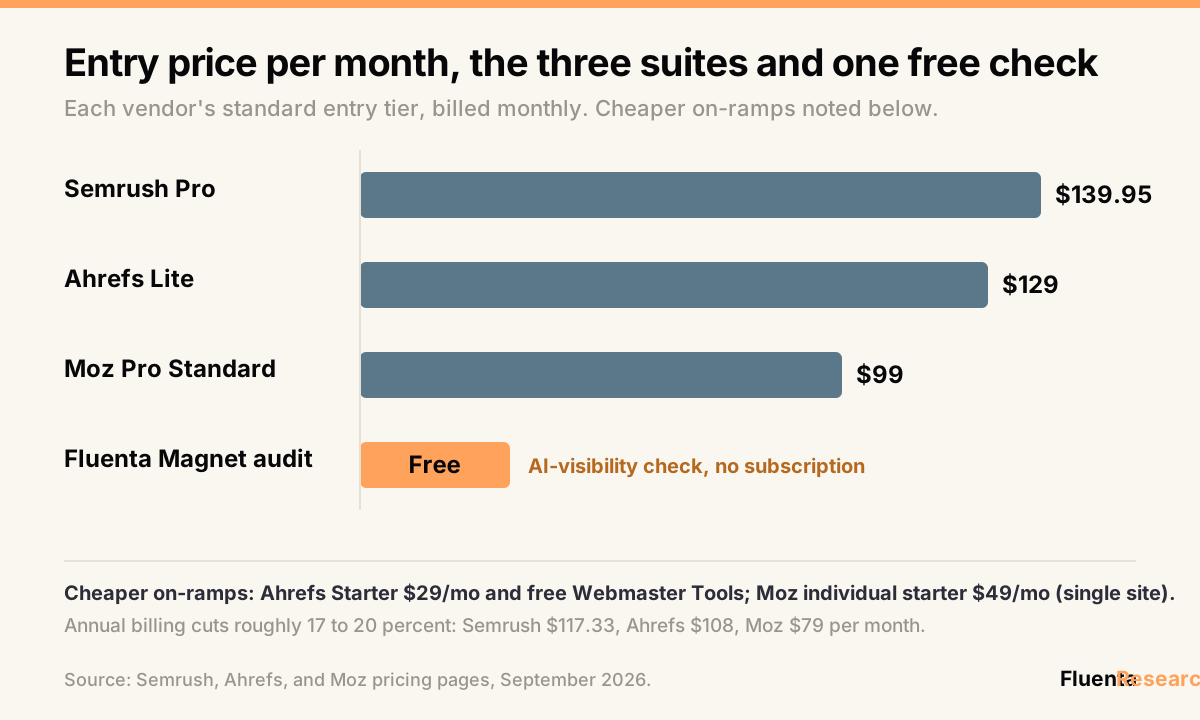
The on-ramps matter as much as the headline tiers. Ahrefs offers a Starter plan at $29 a month and a genuinely free Webmaster Tools tier for verified site owners, so a small site can begin at no cost. Moz runs an individual starter plan at $49 a month for a single website, below its $99 Standard tier, and scales up through Medium at $179 and Large at $299. Semrush has the highest floor at $139.95 for Pro, reflecting the breadth of what is bundled. Annual billing lowers the monthly figure to about $117.33 for Semrush, $108 for Ahrefs, and $79 for Moz. In every case the subscription buys access to the data, not the hours to act on it.
Ease of use: which SEO suite has the gentlest learning curve?
Moz is the friendliest for beginners, Ahrefs is clean and quick to learn, and Semrush is the most powerful but the densest. The more tools a suite bundles, the steeper its curve, which is why the broadest platform is also the one new users most often describe as confusing.
Moz was designed around approachability, with guided workflows and a metric, Domain Authority, that gives a beginner one number to anchor on. Ahrefs keeps its interface uncluttered despite deep data, so an intermediate user is productive fast. Semrush trades simplicity for reach: the payoff is that almost everything lives in one place, and the cost is that the dashboard can feel crowded. User sentiment tracks this. On G2 in September 2026, Ahrefs held 4.5 out of 5 across 714 reviews, Semrush 4.4 across 4,035, and Moz Pro 4.3 across 608, ratings close enough that satisfaction is high everywhere and none of the three is a weak product.
“SEMrush has too many things embedded in their dashboard. Too many tools and can be confusing.”
That reaction is common with the broadest platform, and it is a fair trade rather than a flaw. A dense toolkit is a strength for a team that will use most of it and a burden for a solo operator who needs three features. Matching the tool to the size and skill of the team matters more than chasing the longest feature list.
Which SEO suite should you pick?
Pick Semrush for all-round marketing teams, agencies, and anyone running PPC beside SEO. Pick Ahrefs for SEO specialists and serious link building. Pick Moz for beginners, small teams, and budget-conscious buyers who value a gentle curve and Domain Authority. The best suite is the one whose main strength matches the main job.
A short list of do's helps. Do match the tool to the team's skill and the channels it actually runs. Do use free tiers first, Ahrefs Webmaster Tools and the vendors' trials, before committing. Do pick one suite and learn it deeply rather than half-using two.
| If your main job is... | Pick | Why |
|---|---|---|
| Running SEO plus PPC and social in one place | Semrush | Widest toolkit and market data |
| Serious link building and backlink analysis | Ahrefs | Largest live backlink index (vendor-reported) |
| Learning SEO on a small-business budget | Moz | Gentlest curve, lowest entry price |
| Tracking Domain Authority over time | Moz | It created the DA metric |
| Deep competitor and keyword research at scale | Semrush or Ahrefs | The two biggest search datasets |
| Checking whether AI engines cite you, for free | Fluenta Magnet | Free AI-visibility audit the suites lack |
The don'ts are just as useful. Do not buy the broadest platform to use a tenth of it. Do not treat a vendor's data-size claim as an audited fact; every one of those numbers is vendor-reported. And do not assume that any of the three, on its own, tells a site whether AI engines are citing it, which is the gap the next section covers.
The blind spot all three share: do any check AI visibility?
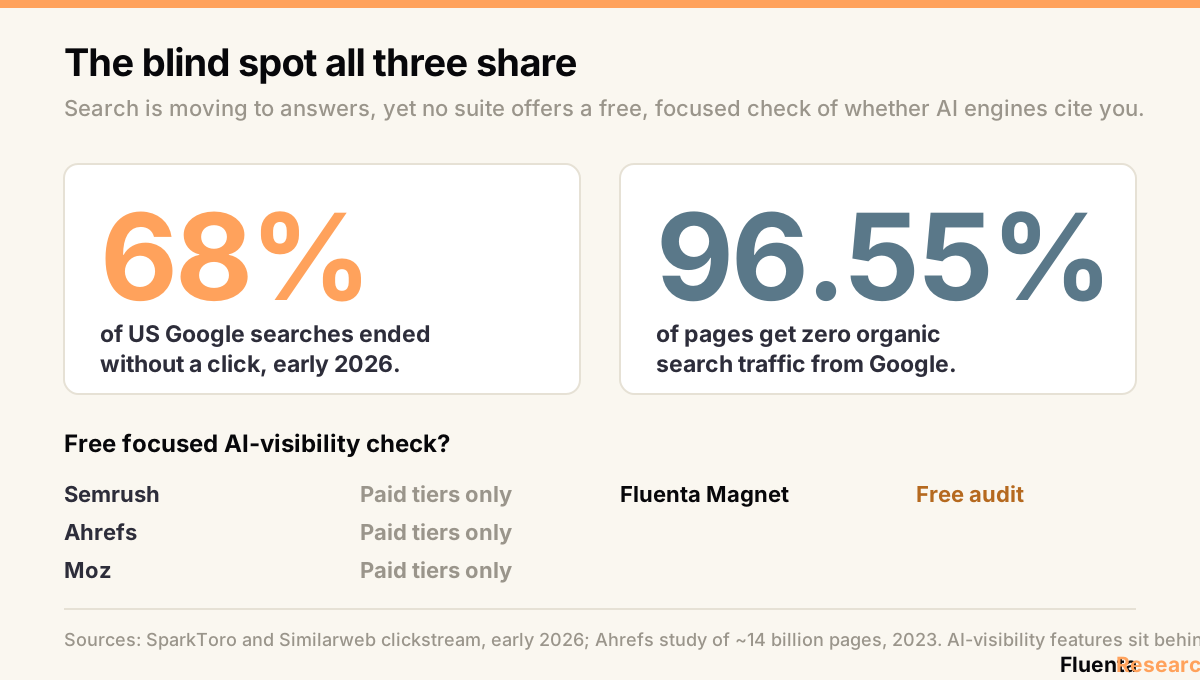
Not for free. All three suites now sell AI-visibility features, tracking whether ChatGPT, Perplexity, and Google's AI answers mention a brand, but only on paid tiers. None offers a free, focused check of whether AI engines cite a specific site, even as search shifts toward answers that never produce a click.
The shift is not marginal. In early 2026, 68.01 percent of US Google searches ended without a click, according to SparkToro and Similarweb clickstream data, up from about 60 percent two years earlier. Ahrefs' own study of roughly 14 billion pages found 96.55 percent get no organic search traffic from Google at all. Research from Princeton on generative-engine optimization found that cited quotations lifted a source's visibility in AI answers by 41 percent and added statistics by 34 percent, while keyword stuffing cost 8 percent. Getting cited by an AI engine is a distinct discipline, and it is the one all three suites leave to their paid add-ons.
That is the honest limit of a suite comparison. Whichever of the three a team picks, it will still be paying to learn whether AI engines cite it, and the answer to that question is now as important as any keyword ranking.
Where does Similarweb fit in this comparison?
Beside the three, not among them. Similarweb is a traffic and market-intelligence platform that estimates how much traffic a site or competitor gets and where it comes from. It is useful for market sizing and competitive benchmarking, but it does not do keyword research, backlink analysis, or site audits the way an SEO suite does, so it is a complement rather than a fourth option. A team might pair Similarweb with one of the three suites, using Similarweb to size a market and read a competitor's traffic mix, then using Semrush, Ahrefs, or Moz to do the keyword and link work that turns that reading into pages. Treating it as a rival to the suites is the category error that starts most of these comparisons on the wrong foot.
Where Fluenta Magnet fits
Fluenta Magnet covers the gap the suites charge for. Its free AI-visibility audit checks whether AI engines and search cite a domain, surfaces the technical blockers holding a site back, shows where the site stands against named competitors, and maps the content gaps worth pursuing, with no subscription and no card. For teams weighing a suite against a lighter path, the ahrefs alternatives guide covers the cheaper options, and the best SEO tools for small business pillar maps the whole landscape. The audit ends where the suites stop pretending to help: it names the work, and for teams that would rather not staff it, the Fluenta Magnet flywheel does the implementation directly.
Check AI visibility for my website
Free. No subscription, no card. 24 hour turnaround, checked by a human analyst.
FAQ
Semrush vs Ahrefs, which is better?+
Neither is better outright. Semrush is broader, covering SEO plus PPC, social, and market research, which suits marketing teams and agencies. Ahrefs is the specialist's tool with the largest live backlink index (vendor-reported) and a cleaner focus on search. Pick Semrush for breadth, Ahrefs for link building and a tighter workflow.
Is Moz good for beginners?+
Yes. Moz has the gentlest learning curve of the three, the lowest entry price, and it created Domain Authority, a single score beginners can anchor on. For a small team that wants clarity over raw depth, Moz is the least intimidating way into SEO tooling.
Semrush vs Ahrefs vs Moz for backlinks, which wins?+
Ahrefs. It reports the largest live backlink index of the three (vendor-reported) and built its name on link data. Semrush has closed much of the gap and is a strong second. Moz Link Explorer runs a smaller index but gave the industry the Domain Authority metric.
Which is cheapest, Semrush, Ahrefs, or Moz?+
Moz. As of September 2026, Moz Pro Standard is $99 a month, Ahrefs Lite is $129, and Semrush Pro is $139.95. Cheaper on-ramps exist: Ahrefs Starter at $29 a month with a free Webmaster Tools tier, and a Moz individual starter at $49 a month for a single site.
Do any of them check AI visibility?+
Only on paid tiers. All three now sell AI-visibility tracking for engines like ChatGPT and Perplexity, but none offers a free, focused check of whether AI engines cite a specific site. A free AI-visibility audit, such as the one from Fluenta Magnet, covers that gap.
Semrush vs Similarweb, are they the same category?+
No. Similarweb is a traffic and market-intelligence platform that estimates how much traffic a site gets and from where. Semrush is an all-in-one SEO suite for keyword research, backlinks, and audits. They solve different jobs and are complements, not direct substitutes.
Cite this article
Researchers and journalists: this article is freely citable. Click to copy the academic-format reference for your bibliography or footnote.
Ivanov, O. (2026). Semrush vs Ahrefs vs Moz: Which SEO Suite Wins. Fluenta. Retrieved from https://fluenta.space/resources/guides/semrush-vs-ahrefs-vs-moz.
About the author

Oleg Ivanov
Co-founder & CEO, Fluenta
Oleg is co-founder and CEO of Fluenta. He spent the last decade shipping products across fintech, commerce, and AI tooling, and now leads Fluenta's work scoring startup ideas against 25 live market and social data feeds.
Related Resources
AI VISIBILITY · TOOLS
Best AI Visibility Tools (2026): Ranked by Use Case
An AI visibility tool shows whether AI engines name your small business. This guide ranks the best by use case, splits monitor from fix, and lists dated prices.
AI VISIBILITY · TOOLS COMPARED
AI Visibility Tools Compared (2026): Do They Get You Cited?
Six AI-visibility tools compared on the one question that matters: do they only track whether ChatGPT names you, or do they actually get you cited?
AHREFS ALTERNATIVES · 2026
Ahrefs Alternatives (2026): Ranked, Priced, Honest
Eight Ahrefs alternatives for 2026, ranked and priced by the job each does, plus the one thing you give up leaving the deepest backlink index.
Find out if AI recommends your business
Fluenta Magnet checks whether ChatGPT, Perplexity and Google AI Overviews name your business or your competitor, then ships the fixes. Free, human-checked, in 24 hours.
Was this helpful?