Best SEO Tools for Small Business: What Each Does

There is no single best SEO tool, because the phrase covers at least four different jobs that have almost little to do with each other. A tool that tells a business where it ranks is not the same as a tool that models a competitor's traffic, which is not the same as a tool that grades a URL, which is not the same as the work of publishing content a search engine or an AI model will actually surface. For a small business trying to get more organic traffic, the useful question is not which tool wins, but which job needs doing.
That framing matters because most tools do one thing well: they show a version of reality. Searches like "best seo tools for small business" run about 1,300 times a month in the US, "best seo tools" about 5,700, and "free seo tools" about 9,400, and nearly every one of those result pages now carries an AI Overview that answers before a single tool gets clicked. The guide below sorts the market by the job each tool does, what it costs, and the one stage no dashboard covers.
The map that follows names four jobs. Three of them inform. One of them executes, and it is where a small business actually gets found or stays invisible.
Key Takeaways
Do you even need an SEO tool?
Not at the start. A brand-new small business can go a long way with Google Search Console, which is free and shows the exact queries a site already appears for, plus one free checker for technical hygiene. A paid tool earns its place once there is a content plan to prioritize and a budget to defend, not before.
The honest version of the answer is that a tool tells a business what is happening; it does not do the work of changing it. Google's own guidance on whether a site needs an SEO says the value is in expertise and time, not software. Buying a $139 subscription before there is anyone to act on its output usually just adds a monthly bill and a dashboard nobody opens. Start with the free layer, add paid tools when a specific question justifies one.
There is also a difference between wanting an SEO tool and needing one. A tool becomes necessary when a specific decision depends on data the free layer cannot supply: a competitor's full backlink profile, the search volume behind a hundred candidate topics, or rank movement tracked daily across dozens of terms. Until a decision like that is actually on the table, the tool is a purchase in search of a use.
The four jobs SEO tools do, and why comparing them is apples to oranges
SEO tools sort into four jobs. Trackers show where a site stands over time. Analytics suites hand over a raw dataset to interpret. Checkers grade a URL into a report. Implementation is the work of producing, publishing, and indexing content on a cadence. The first three describe reality; only the fourth changes it.
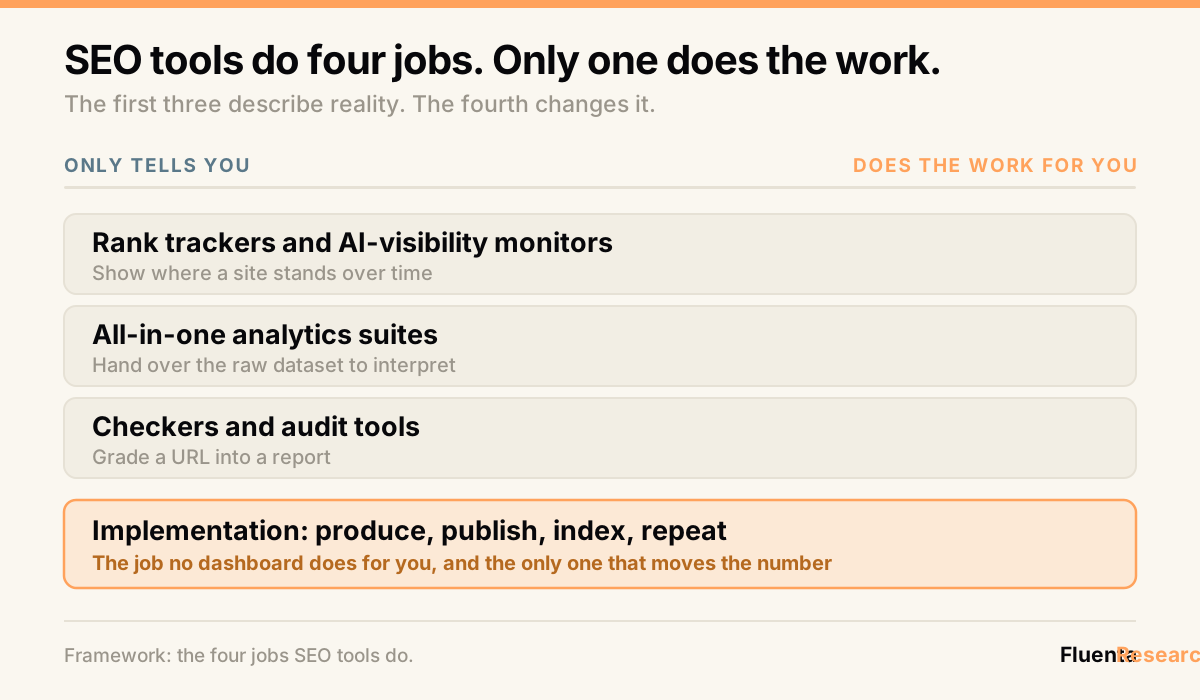
Read across the landscape and the tools sort into three that inform and one that executes. Comparing a rank tracker to an analytics suite to a checker is like comparing a thermometer, a chemistry set, and a home inspection report: all measure something about the house, none of them build it. The table below lays out the four jobs and, just as important, what each one does not do.
| Category | Core job | Example tools | What it does not do |
|---|---|---|---|
| Trackers and monitors | Show where a site stands over time | AccuRanker, Wincher, SE Ranking; Profound, Otterly, Peec AI | Tell you why, or fix it |
| Analytics suites | Hand over the raw dataset to interpret | Semrush, Ahrefs, Similarweb, Moz, SISTRIX | Decide or execute for you |
| Checkers and audit tools | Grade a URL into a report | SEOptimer, WooRank, Lighthouse, Sitechecker, Seobility | Produce or publish the fix |
| Implementation | Produce, publish, index, repeat | In-house hire, agency, freelancer, content flywheel | This is the work itself |
Rank trackers and monitors: the seo tracking tools that show where you stand
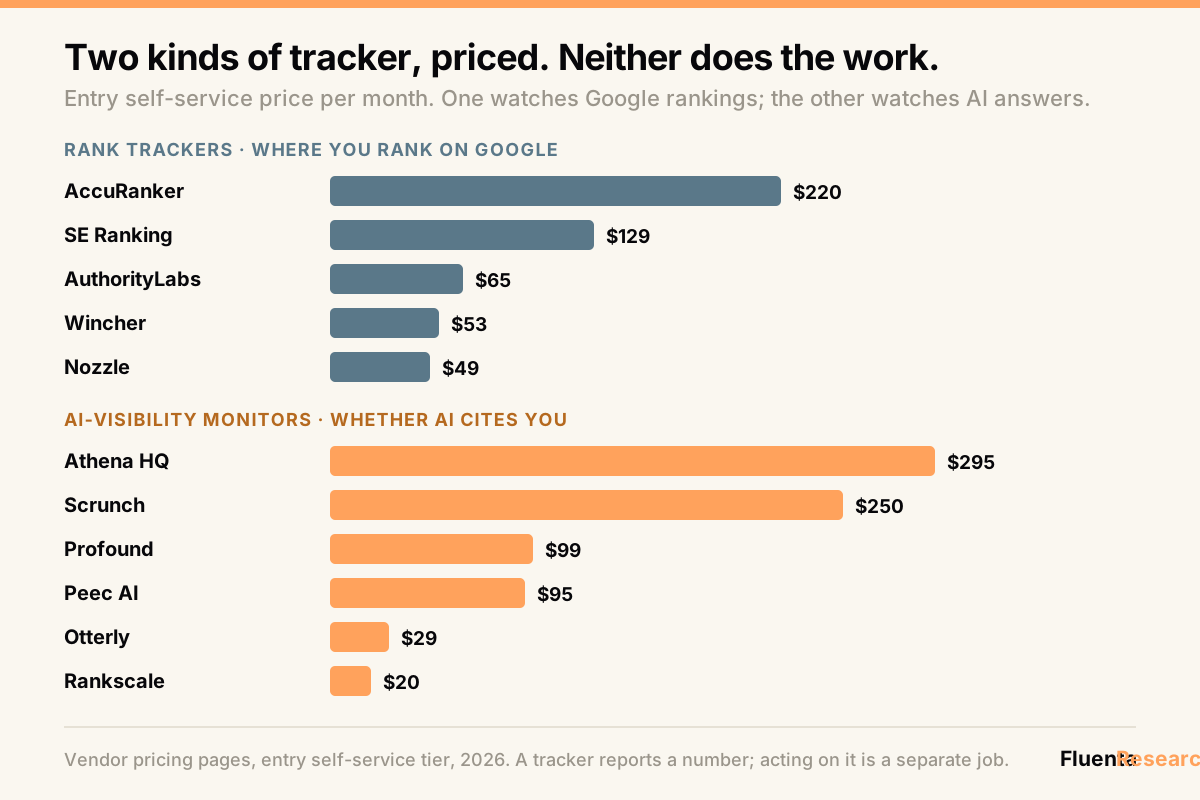
A rank tracker answers one question: where does a site stand, and how is that changing. Classic rank tracker tools like AccuRanker (low $200s a month), Wincher (about 49 euros), SE Ranking ($129), Nozzle ($49), and AuthorityLabs ($65) watch keyword positions across locations and devices and chart the movement over time. They are precise, relatively cheap, and honest about their scope: they measure, they do not act.
For a small business, the most useful trackers are often the ones scoped to a local market, following a short list of terms in one city rather than a national keyword universe. That keeps the cost low and the signal relevant, since a neighborhood service business competes with a handful of local rivals, not the whole web.
A newer sub-category watches the same question for AI answers instead of blue links. AI-visibility monitors such as Profound ($99), Peec AI ($95), Otterly ($29), Scrunch ($250), Athena HQ (free tier, then about $295), and Rankscale ($20) query ChatGPT, Perplexity, Google's AI Overviews, and others to report whether a brand is mentioned or cited and who is named instead. The category went from nothing to crowded in under two years. Either way, a tracker's output is a number and a trend line. Turning that number into a higher one is a different job. A rank tracker that shows a page slipping does not write the better page, and an AI-visibility monitor that shows a brand missing from ChatGPT does not earn the mentions that would get it cited. The AI-visibility monitors get a direct comparison in the best AI visibility tools guide and AI visibility tools compared.
All-in-one analytics suites: Semrush, Ahrefs, Similarweb, and the seo software small businesses reach for
This is the category most people picture when they hear "SEO tool," and it is where the two most-compared products live. Semrush (about $139.95 a month for Pro), Ahrefs ($129 for Lite, a free Webmaster Tools tier, and a $29 Starter plan), Similarweb (roughly $125 to $199 for a single seat), Moz Pro ($49), and SISTRIX (about 119 euros) are vast datasets with an interface on top. The phrase "all in one seo tool" is exactly what these promise, and for a trained analyst they deliver.
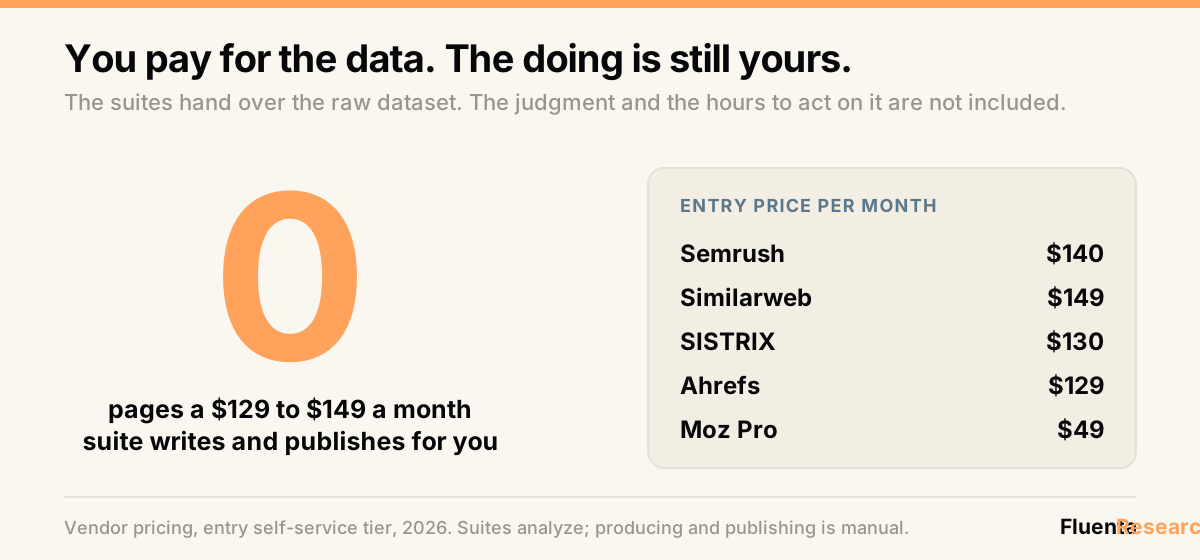
What unites them is that they hand over raw material and leave the interpretation to the buyer. That is a feature for an analyst and a wall for everyone else. A keyword-gap export with four thousand rows is not a plan; it is a spreadsheet someone still has to read, prioritize, and turn into briefs. The suites are powerful precisely because they do not presume to decide, which is also why a solo founder often opens one, sees a wall of numbers, and closes it.
“SEMrush has too many things embedded in their dashboard. Too many tools and can be confusing”
The price buys access to the data. It does not buy the judgment to use it or the hours to act on it. For a small business, that distinction is the whole game. Semrush and Similarweb get a full head-to-head in Semrush vs Ahrefs vs Moz, and the Ahrefs alternatives guide ranks the cheaper options.
SEO checkers and audit tools: on-page, analysis, and reporting in one graded report
Enter a web address, wait a few seconds, and get back a report with a score and a list of issues. That is the checker, and it doubles as the entry point for the searches "seo audit tools" (3,500 a month), "on page seo tools" (1,700), "seo analysis tools" (2,500), and "seo reporting tools" (3,400). The field includes Google's own PageSpeed Insights and Lighthouse (free), Ahrefs Webmaster Tools (free), the Site Audit built into Semrush Pro, WooRank (free, then $53.25), SEOptimer (free, then $29), Sitechecker (free, then $49), Seobility (free, then about 49.90 euros), and SEO SiteCheckup ($24.95). Many are free, which is why they are often the first tool a business ever touches.
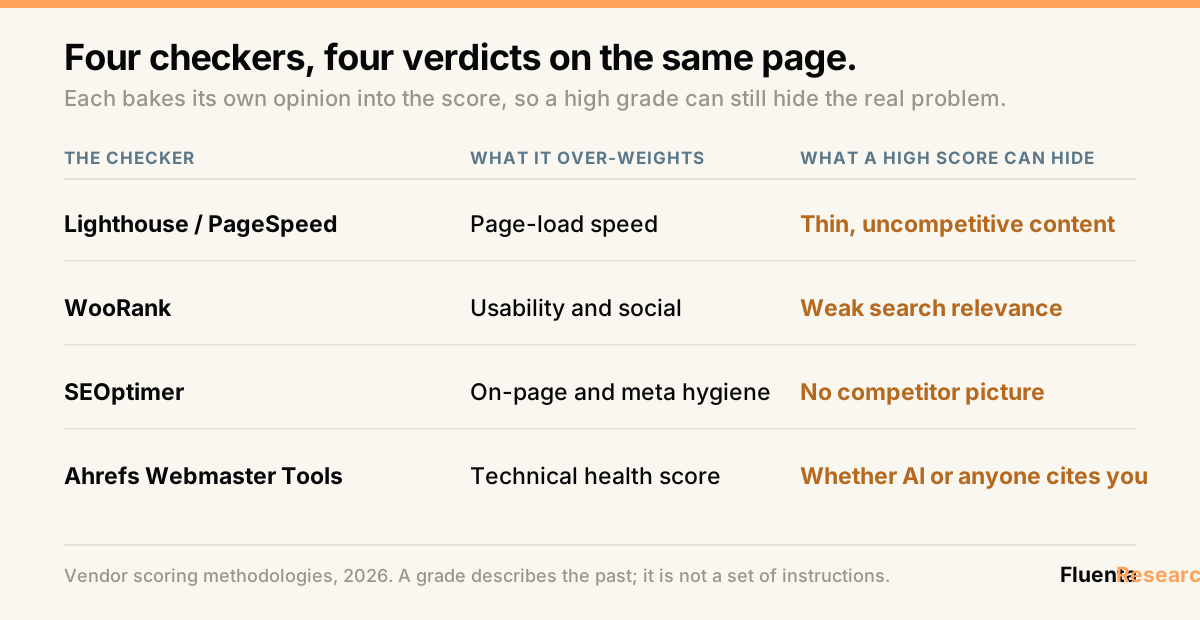
The catch is that every checker bakes an opinion into its score, and the opinions differ. Lighthouse over-weights page performance, so a fast site with thin content grades well. WooRank blends in usability and social signals. SEOptimer leans on on-page and meta hygiene. Run the same URL through three of them and get three different grades stressing three different things. A checker is a useful snapshot and a poor strategy, because a grade describes the past, not a set of instructions for the future.
“We have masses of pages noted as errors yet no way to resolve logically”
Two sites with identical scores can have completely different reasons for being invisible, and the report rarely says which.
Best free SEO tools for small business
For a business on no budget, four free tools cover most of what matters. Google Search Console shows the exact queries a site ranks for and flags indexing problems. Google PageSpeed Insights and Lighthouse grade speed and core web vitals. Ahrefs Webmaster Tools gives a free backlink and site-audit view of an owned domain. Ubersuggest and Mangools offer cheap entry-level keyword research when a paid suite is out of reach.
That stack answers the two questions a small business actually needs early: what am I already showing up for, and what is technically broken. It will not hand over a competitor's full backlink profile or a four-thousand-row keyword universe, but those are not the early constraint. The early constraint is finding the time to act on what the free tools already show, which no free tool solves.
A sensible sequence is to connect Search Console first and let it collect a few weeks of query data, run PageSpeed on the pages that already get impressions, and only then reach for keyword research once there is a page worth improving. Reaching for a paid suite before the free tools have surfaced a real problem tends to produce more data than a small team can use.
The stage no tool covers: actually doing the work
Implementation is the unglamorous middle of the work, and it is where nearly everyone stalls. It means finding the angle a piece of content should take, producing it to a standard a search engine or an AI model will trust, publishing it, making it technically indexable, and doing that on a regular cadence rather than once. None of that shows up in a dashboard, because none of it is measurement. It is production.
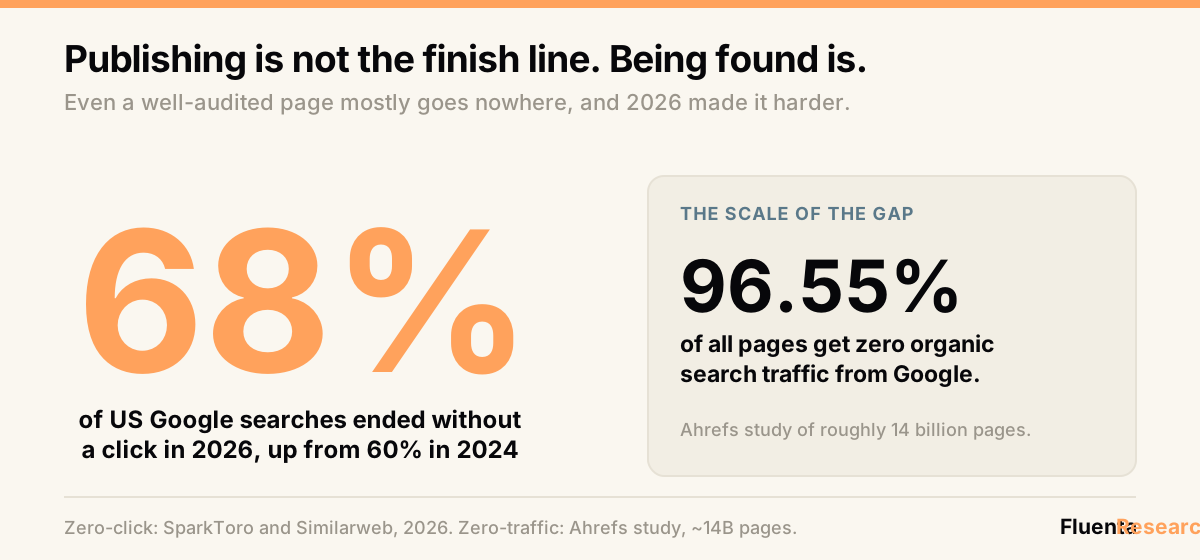
The scale of that gap is easy to underrate, and 2026 widened it. By early 2026, 68% of US Google searches ended without a click to any site, up from 60% two years earlier, according to SparkToro and Similarweb. And across a study of roughly fourteen billion pages, Ahrefs found that 96.55% of them get no organic search traffic from Google at all. The web is not short of pages. It is short of pages anyone finds, and every invisible one of them passed through some tool's checklist and still went nowhere.
“We're a small product-based ecommerce business, just the founder and me for now, so no SEO expert on board atm”
For a single founder or a small team, this is the real constraint. The expertise is learnable and the tools are available, but the hours are not. seoClarity's survey of 1,195 enterprise SEO teams found the two biggest blockers to implementing SEO were not knowing what to do; they were lack of SEO resources at 55% and lack of developer and engineering resources at 52.5%. In the same survey, 92% of SEOs said they could not implement structured data without a developer. If execution capacity is the binding constraint for well-staffed enterprise teams, it is a wall for a founder doing it alone.
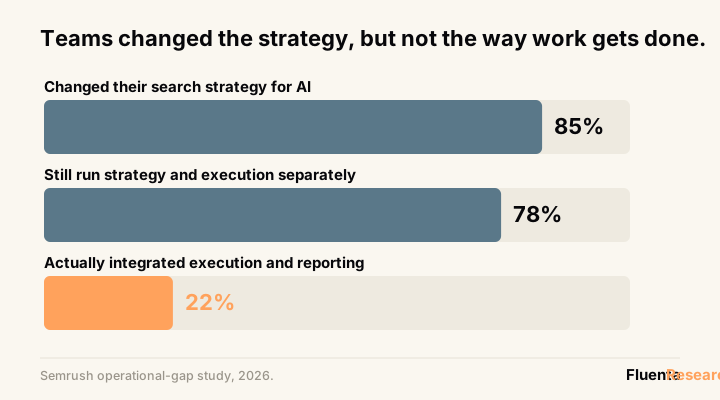
Semrush put a number on the same gap from the inside. In its 2026 study, 85% of teams said AI had changed their search strategy, but only 22% had actually integrated that strategy across execution and reporting, and 78% still run strategy and execution as separate things. Integrated teams reported far better results, 81% seeing more traffic and leads versus 36%. The thinking has moved. The doing has not.
Should you do SEO yourself, hire a freelancer, or an agency?
There are only a few ways to get implementation done, and each has a real price and a real failure mode. Do it yourself and it costs time you may not have. Hire a freelancer and quality ranges from excellent to a lottery. Retain an agency and the average fee is higher, with a churn problem practitioners complain about openly. The right answer depends on how many hours a week the business can actually give the work.
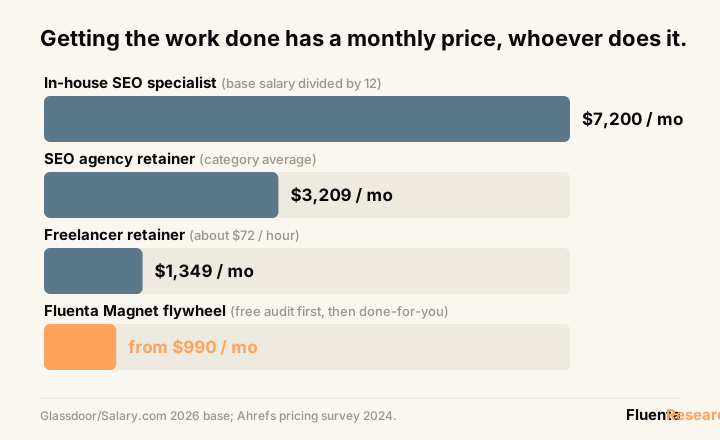
Hire in-house and a US SEO specialist runs roughly $80,000 to $97,000 a year in base salary before benefits, which is a lot of fixed cost for one function. Retain an agency and the average monthly fee is about $3,209, though 64% of agencies charge under $1,000 a month. Hire a freelancer and rates average around $72 an hour, or roughly $1,349 a month on retainer. Or buy a content and on-page tool such as Surfer ($79), Clearscope ($129), MarketMuse, or Screaming Frog ($279 a year), which are genuinely useful but still assume a person on the other side doing the writing, the publishing, and the follow-through.
“I've had a few experiences in the past with so-called SEO experts who promised the world, but ended up either giving super obvious advice, making things worse, or just slowly draining the budget with very little real value”
Every one of these paths buys the one thing the tools do not provide: execution. That is the actual market, and it sits downstream of every tracker, suite, and checker. For a business weighing local SEO against broader organic growth, the choice of who implements matters more than the choice of which dashboard to rent.
How to get more organic traffic without a big tool budget or an agency
The cheapest way to grow organic traffic without paid ads is to publish content that answers the questions a target audience already searches, on a schedule, using free tools to find those questions and check the technical basics. No subscription is required to start. What is required is a plan and the discipline to keep producing.
The hard part is the plan. Knowing which questions to answer, in what order, and to what standard is the judgment that separates content that ranks from content that joins the 96.55%. This is where a free audit earns its keep: it produces the plan, the blockers, and the content gaps without a card, so the work can start with direction instead of guesswork. The debate over whether SEO is dead misses the point; the channel still works, but only for businesses that actually execute against a real plan.
Where Fluenta Magnet fits: analyze, plan, and implement
Fluenta Magnet is built for the whole journey rather than a single step, and it splits into two products that line up with the four steps above. The first is a free AI visibility audit, and it covers the first two steps at no cost. It analyzes the technical blockers holding a site back, maps the competitor environment, and shows how the site stacks up against the LLMs today. Then it finds the opportunities: the keyword gaps by volume and difficulty, the ideal customer profiles with their jobs to be done, their pain and switching signals, and the backlinks or spam that can be cleaned quickly. The output is a first-90-days plan a business can take and run itself, free, and enough work to keep a small team busy cleaning up its web presence for the next couple of months.
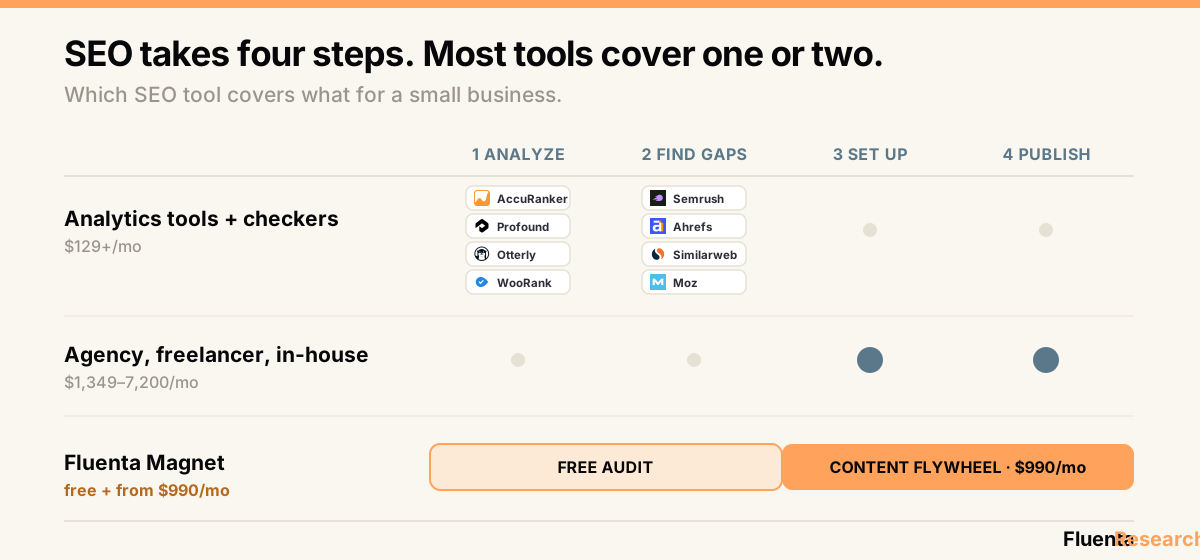
The second product is the Fluenta Magnet content flywheel, which starts at $990 a month and covers the last two steps, the ones every tool leaves to people. It opens with a fast setup, the technical cleanup that brings a site up to the standard Google Search Console and the LLM crawlers expect, so the pages are readable and visible in the first place. Then it runs on a regular cycle, listening to the market across 42 connected platforms, evaluating the most relevant and fastest-growing topics with the highest potential, producing the content, publishing and indexing it, and repeating. Two products, four steps. None of the tracker, suite, or checker platforms in this guide covers more than one of them.
Which SEO tool should you use? A quick decision
Write the question down before buying anything. If the question is where a site ranks and how it is trending, that is a rank tracker. If it is whether a brand is cited in AI answers, that is an AI-visibility monitor. If it is what the whole competitive dataset shows, that is an analytics suite. If it is a quick graded snapshot, that is a checker. And if the honest answer is "I know what to do, I just need it done," then no tool in the first four rows is the answer, because that is implementation, bought from people or a flywheel, not a dashboard.
| If the question is | The tool type | An example |
|---|---|---|
| Where do I rank and how is it trending | Rank tracker | AccuRanker, Wincher, SE Ranking |
| Am I cited in AI answers | AI-visibility monitor | Otterly, Profound, Peec AI |
| What does the whole competitive dataset show | Analytics suite | Semrush, Ahrefs, Similarweb |
| Give me a quick graded snapshot | Checker or audit tool | Lighthouse, WooRank, SEOptimer |
| I need a starting point for free | Free toolkit | Search Console, PageSpeed, Ahrefs Webmaster Tools |
| I know what to do, I just need it done | Implementation | Freelancer, agency, or a content flywheel |
The cheapest first move is to get analysis and planning for nothing, then decide who executes with a real plan in hand rather than a guess. The tools were never the bottleneck. Execution was.
See if AI and search cite your business
Free. No subscription, no card. A human analyst returns the audit within 24 hours.
FAQ
Do I need an SEO tool for a small business?+
Not at the start. Google Search Console (free) plus one free checker covers the early questions: what a site already ranks for and what is technically broken. A paid tool earns its place once there is a content plan to prioritize and a budget to defend.
Which SEO tool is best for a small business on a budget?+
None single-handedly. Match the tool to the job: a rank tracker for positions, a checker for a graded snapshot, an analytics suite for the full dataset. On a tight budget, the free layer (Search Console, PageSpeed Insights, Ahrefs Webmaster Tools) answers most early questions.
What are the best free SEO tools for small businesses?+
Google Search Console for the queries a site ranks for and indexing issues, Google PageSpeed Insights and Lighthouse for speed and core web vitals, Ahrefs Webmaster Tools for a free backlink and audit view, and Ubersuggest or Mangools for cheap keyword research.
Is Semrush or Ahrefs worth it for a small business?+
They give you the data and the audit, not the execution. Ahrefs' own research found 96.55% of pages get zero organic traffic, most having passed some checklist. The suites inform the work; they do not do it. Worth it once someone can act on the output.
Should I do SEO myself or hire an agency?+
It depends on available hours. In-house specialists run about $80,000 to $97,000 a year, agencies average $3,209 a month, freelancers around $72 an hour. A done-for-you content flywheel starts at $990 a month, after a free audit that provides the plan first.
How do I get more organic traffic without paid ads?+
Publish content that answers the questions a target audience already searches, on a schedule, using free tools to find the questions and check the technical basics. The hard part is the plan, which a free audit can produce before any work starts.
Cite this article
Researchers and journalists: this article is freely citable. Click to copy the academic-format reference for your bibliography or footnote.
Ivanov, O. (2026). Best SEO Tools for Small Business: What Each Does. Fluenta. Retrieved from https://fluenta.space/resources/guides/best-seo-tools-for-small-business.
About the author

Oleg Ivanov
Co-founder & CEO, Fluenta
Oleg is co-founder and CEO of Fluenta. He spent the last decade shipping products across fintech, commerce, and AI tooling, and now leads Fluenta's work scoring startup ideas against 25 live market and social data feeds.
Related Resources
Website Traffic 2026
How to Increase Website Traffic When Google Sends Less
Your rankings held but traffic fell. The 2026 data on why, plus a barbell playbook to diversify off Google and get found inside AI assistants.
Local SEO Guide 2026
Local SEO for Small Business in 2026: Google and AI
Google AI Overviews now hit 68% of local searches. How small businesses win local SEO on both layers: the map pack and AI.
SEO in 2026
Is SEO Dead? What Changed in 2026, and What Works
797,444 impressions, 7 clicks. The hard 2026 data on what died in SEO, what still works, and how to get cited by ChatGPT and AI Overviews.
Find out if AI recommends your business
Fluenta Magnet checks whether ChatGPT, Perplexity and Google AI Overviews name your business or your competitor, then ships the fixes. Free, human-checked, in 24 hours.
Was this helpful?