What Is Entity Optimization? (Why AI Search Needs It)

Entity optimization is the practice of making a brand an unambiguous entity that AI search and knowledge systems can recognize, connect, and trust, rather than a string of keywords they have to guess about. It matters because answer engines resolve a query to entities, not words, and a brand they cannot resolve is a brand they will not recommend in an AI answer. Entity optimization is the part of answer engine optimization that fixes who you are in the machine's eyes.
This guide covers what an entity is to an AI, why it decides visibility, and how to build entity strength.
Key Takeaways
What is an entity, and why does AI care?
To a person, "Fluenta" is a name. To an answer engine, it is either a resolved entity, a specific organization with a known description, category, and set of relationships, or an unknown string it cannot safely reason about. Large language models cannot verify an unfamiliar brand, so an unresolved entity is quietly dropped from answers. Making the entity resolvable is the whole job.
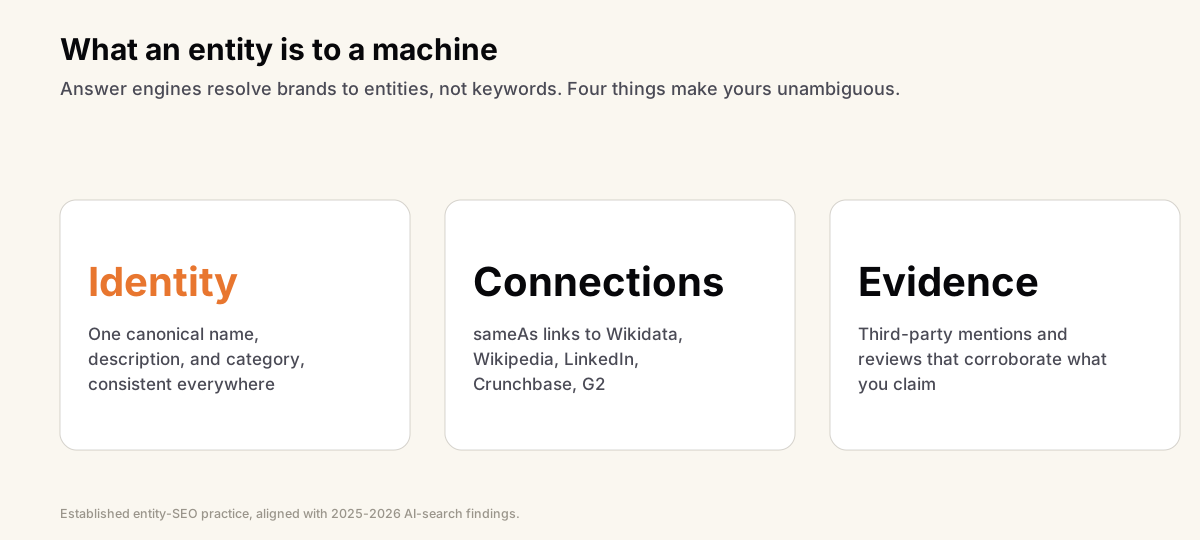
An entity becomes unambiguous through three things: a consistent identity (one canonical name, description, and category, everywhere), connections (sameAs links to authoritative profiles like Wikidata, Wikipedia, LinkedIn, Crunchbase, and G2), and corroborating evidence (third-party mentions and reviews that confirm what the brand claims about itself).
“The best single external predictor explained 5.8% of variance. All 13 combined signals explain well under 20%”
How much does entity strength actually move AI visibility?
In some categories, it is close to decisive.
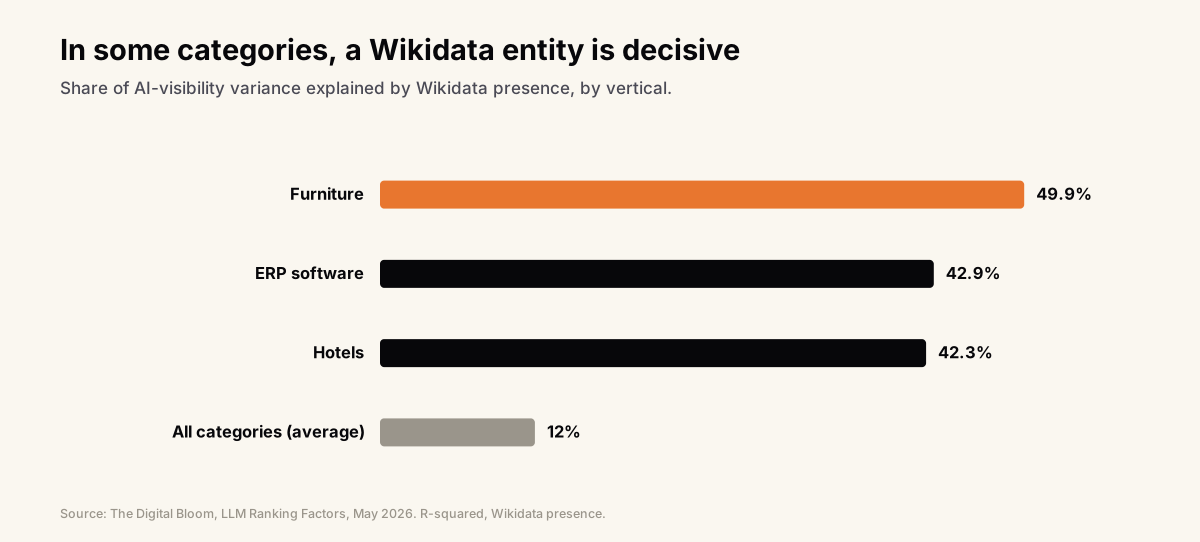
The Digital Bloom analysis of more than 105,000 ChatGPT prompts found that a Wikidata presence explained about 12 percent of AI-visibility variance across all categories, but in specific verticals it dominated: roughly 50 percent in furniture, 43 percent in ERP software, and 42 percent in hotels. Yet only about 5.5 percent of the domains studied had a Wikidata record at all. The signal is strong and the field is wide open.
“There is almost no relationship between content volume and AI visibility”
Why do entity signals beat backlinks for AI?
Because AI trusts identity and corroboration over link authority. The same body of research that ranks brand mentions above backlinks for AI visibility is really measuring entity strength: a brand that is mentioned, reviewed, and profiled across the web is one the model can resolve and trust. Branded web mentions correlated with AI citations far more than backlinks, which is entity corroboration outperforming link equity.
“Ultimately, AEO/GEO is not an overhaul or abandonment of SEO. Instead, it represents a new system for competing for, capturing, and measuring success across AI platforms”
How do you optimize your entity?
The work is unglamorous and high-leverage. In order:
| Priority | Action | What it does |
|---|---|---|
| 1 | Publish Organization schema with sameAs links to every canonical profile | Declares the entity so machines can resolve it |
| 2 | Create or claim a Wikidata entry, and Wikipedia where genuinely notable | The single highest-value entity signal in many verticals |
| 3 | Make name, description, and category identical across every profile | Removes ambiguity the model cannot resolve |
| 4 | Earn third-party mentions and reviews (Reddit, G2, industry roundups) | Corroborates the entity beyond your own claims |
| 5 | Keep schema in the page head and content fresh | AI crawlers parse the head first and favor current data |
None of this is a quick win, and that is the point: entity strength compounds and is hard for a competitor to copy. The first step, as always, is to see where a brand stands today.
Check AI visibility for my website
Free. No subscription, no card. 24 hour turnaround, checked by a human analyst.
Is entity optimization the same as schema markup?
No, though schema is part of it. Schema markup is how you declare your entity in code, using Organization markup, sameAs links, and where credible a Wikidata QID. But declaring an entity is not the same as being one. The declaration only works when it is corroborated by consistent identity across the web and real third-party evidence. Notably, one large study found schema alone produced no measurable citation uplift, which is exactly why entity optimization is the corroboration, not just the markup.
Every figure here is attributed: The Digital Bloom for the Wikidata and variance data, and the Ahrefs 75,000-brand study for the mentions-versus-backlinks comparison. Figures are 2025 to 2026.
See whether ChatGPT, Perplexity, and Google AI name your business. Run a free AI visibility audit. →
FAQ
What is entity optimization?+
Entity optimization is making a brand an unambiguous entity that AI search and knowledge systems can recognize, connect, and trust. It combines a consistent identity, sameAs links to authoritative profiles like Wikidata and Crunchbase, and third-party corroboration, so answer engines can resolve and recommend the brand.
Why does entity optimization matter for AI search?+
Answer engines resolve a query to entities, not keywords, and large language models cannot safely reason about a brand they cannot identify. A brand that is not a resolvable entity is quietly left out of AI answers, which is why entity strength now drives AI visibility.
How do I optimize my entity for AI?+
Publish Organization schema with sameAs links to every canonical profile, create or claim a Wikidata entry (and Wikipedia if genuinely notable), keep your name and description identical across profiles, and earn third-party mentions and reviews. These corroborate the entity so AI can resolve it.
Is entity optimization the same as schema markup?+
No. Schema markup declares your entity in code, but declaring an entity is not the same as being a recognized one. The declaration works only when corroborated by consistent identity across the web and real third-party evidence. One study found schema alone produced no measurable citation uplift.
Do I need a Wikidata or Wikipedia page?+
A Wikidata entry is one of the highest-value entity signals and is achievable for most legitimate businesses. It explained up to about half of AI-visibility variance in some verticals in one study. Wikipedia requires genuine notability, so pursue it only where the brand credibly qualifies.
Cite this article
Researchers and journalists: this article is freely citable. Click to copy the academic-format reference for your bibliography or footnote.
Ivanov, O. (2026). What Is Entity Optimization? (Why AI Search Needs It). Fluenta. Retrieved from https://fluenta.space/resources/guides/what-is-entity-optimization.
About the author

Oleg Ivanov
Co-founder & CEO, Fluenta
Oleg is co-founder and CEO of Fluenta. He spent the last decade shipping products across fintech, commerce, and AI tooling, and now leads Fluenta's work scoring startup ideas against 25 live market and social data feeds.
Related Resources
ANSWER ENGINE OPTIMIZATION
What Is AEO? Answer Engine Optimization Explained (2026)
Answer engine optimization (AEO): how a brand gets cited inside AI answers from ChatGPT, Perplexity, and Google AI, why it matters, and how to do it.
AI VISIBILITY · TOOLS COMPARED
AI Visibility Tools Compared (2026): Do They Get You Cited?
Six AI-visibility tools compared on the one question that matters: do they only track whether ChatGPT names you, or do they actually get you cited?
AI VISIBILITY AUDIT
AI Visibility Checker: Is ChatGPT Recommending You? (2026)
AI visibility is whether ChatGPT, Perplexity, and Google AI name your brand. How to audit it, why 89% of brands are absent, and what makes AI recommend you.
Find out if AI recommends your business
Fluenta Magnet checks whether ChatGPT, Perplexity and Google AI Overviews name your business or your competitor, then ships the fixes. Free, human-checked, in 24 hours.
Was this helpful?