Generative Engine Optimization (GEO) Guide

Generative engine optimization, or GEO, is the practice of getting a brand's content selected, quoted, and cited inside the answers that AI systems write. Those systems, ChatGPT, Google's Gemini and AI Overviews, Perplexity, and Microsoft Copilot, no longer return a plain list of ten blue links. They read the web, synthesize a single answer, and name a short list of sources. GEO is the discipline of becoming one of those named sources. It sits next to classic search optimization and answer engine optimization, but it optimizes for a different moment: the instant a model decides which pages to trust as it composes a reply.
Check AI visibility for my website
Free. No subscription, no card. 24 hour turnaround, checked by a human analyst.
The term is now a real market, not a buzzword. "Generative engine optimization" draws about 8,000 US searches a month and roughly 27,000 worldwide, at an $11 average cost per click and a keyword difficulty of 64, which places it among the harder commercial terms in marketing (Ahrefs Keywords Explorer, US, August 2026). The related query "what is geo" adds another 2,500 US searches a month. Demand for the definition is climbing faster than most brands are answering it, which is exactly why a definitional guide is worth owning.
The pressure behind that demand is a change in how people finish a search. In 2024, roughly 68% of US Google searches ended without a click to any website (SparkToro, 2024 Zero-Click Search Study). AI answers accelerate that pattern: the response is delivered on the page, and only a fraction of readers travel onward to a source. For a decade, the goal of digital marketing was to rank. The goal now is to be the sentence the model repeats, with a citation attached.
A brand cannot assume its existing rankings carry over, either. The sources AI engines cite are not the same pages Google ranks. Only about 12% of ChatGPT's citations overlap with Google's top ten organic results, which means a brand can own the classic rankings for a term and still be absent from the answer a buyer actually reads. Roughly 99.99% of those AI citations point to third-party sites rather than the brand's own domain, so reputation earned across the web, not polish on the homepage, is what puts a brand into the answer. GEO is the work of closing both gaps at once.
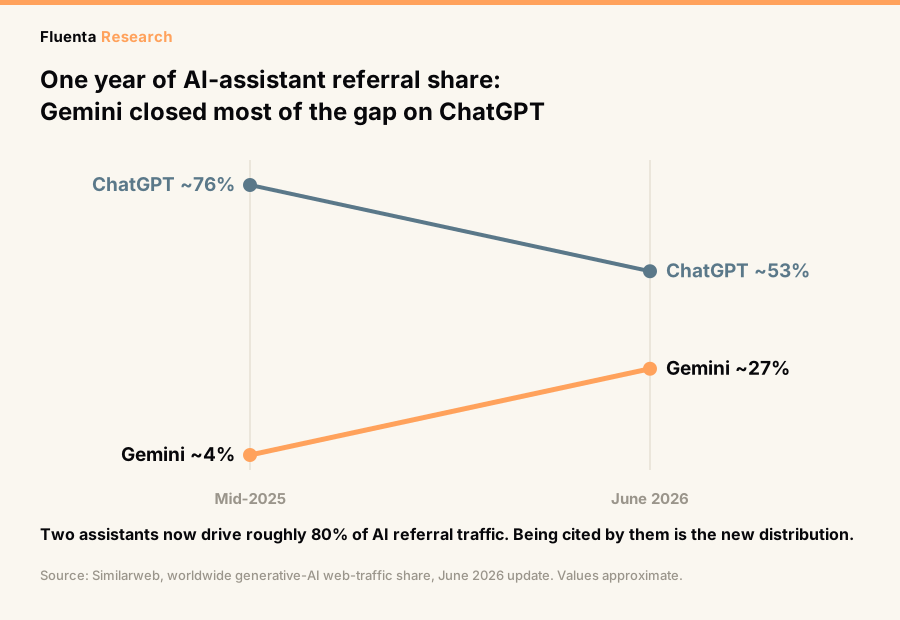
The audience for those answers has also consolidated fast. Two assistants already account for the bulk of AI referral traffic, and the balance between them moved sharply in a single year.
Source · Similarweb, worldwide generative-AI web-traffic share, June 2026 update
Google's Gemini went from a low single-digit share of AI-assistant referrals to roughly a quarter of them, while ChatGPT's share fell from about three-quarters to just over half (Similarweb, June 2026). The lesson for a brand is not to bet on one engine. It is that a small number of models now sit between most buyers and most answers, and being absent from them is a distribution problem, not a branding one.
Key Takeaways
How generative engines pick their sources
A generative engine does not rank pages the way Google's ten links do. It retrieves a set of candidate documents, reads them, and decides which passages to lift into its answer and which sources to attribute. The most rigorous public study of that behavior comes from Princeton and IIT Delhi, whose 2024 paper introduced the term generative engine optimization and tested it on a 10,000-query benchmark against real engines including Perplexity.
“including citations, quotations from relevant sources, and statistics can significantly boost source visibility, with an increase of over 40% across various queries”
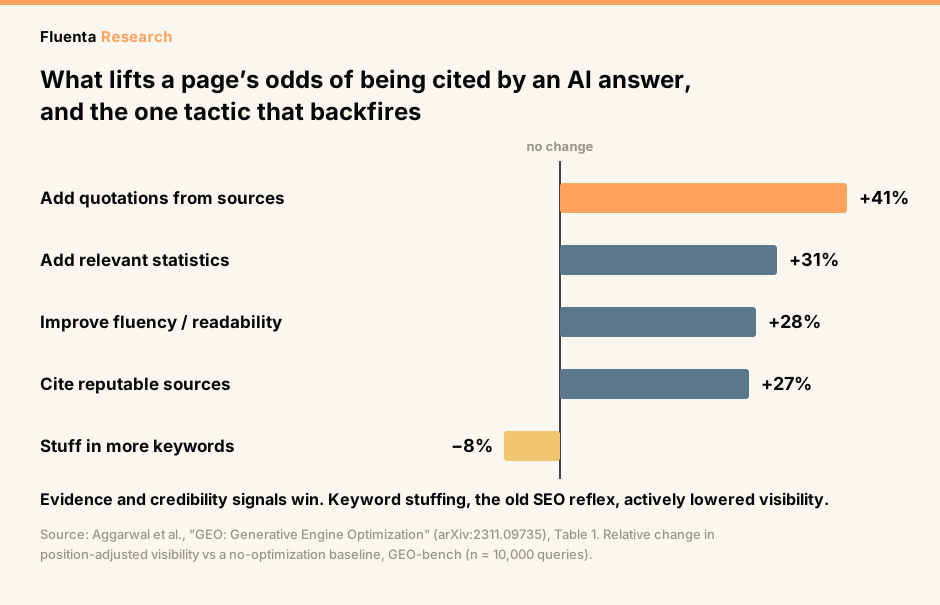
The study's central finding is that content changes which raise credibility, not keyword density, are what move a page into the answer. Adding direct quotations from named sources produced the largest lift. Adding relevant statistics, improving fluency, and citing reputable sources all helped. Keyword stuffing, the reflex that defined a generation of search tactics, made things worse.
Source · Aggarwal et al., arXiv:2311.09735, Table 1 (GEO-bench, n = 10,000 queries)
The ordering matters more than the exact percentages. Every winning tactic is a signal of trustworthiness that a language model can read directly in the text: a quote it can attribute, a number it can repeat, a source it can point to. Keyword stuffing sends the opposite signal, and the model demotes the page for it. This is the single most important reframe in GEO. The old game rewarded matching the query. The new game rewards being the most quotable, most verifiable passage on the topic.
There is a second mechanism the paper surfaces that favors smaller brands. When every source in a query optimized at once, lower-ranked pages gained the most: a fifth-ranked page saw its visibility rise by about 115% while the top-ranked page's visibility fell by roughly 30%. Generative engines weigh the substance of a passage, not only the domain authority behind it, which gives a well-written challenger a real path into answers that it never had in the ten-link era. That is the democratizing property of the medium, and it is the reason a focused GEO effort can outrun a larger competitor's link budget.
The right lever also depends on the question. The same study found the winning tactic shifts by domain: adding quotations worked best for topics like explanation, history, and personal or social questions, where a direct human voice adds authenticity; adding statistics worked best for law, government, and opinion questions, where data settles a claim; and citing sources helped most on plainly factual queries, where verification is the whole game. A brand should match the tactic to the kind of question its buyers ask, rather than applying one recipe everywhere.
GEO vs SEO vs AEO
GEO does not replace search optimization. It layers on top of it. The three disciplines share plumbing, but they optimize for different surfaces and score success differently. A brand that treats them as one thing tends to over-invest in rankings and under-invest in the credibility signals that AI answers actually reward. The table below separates them.
| Dimension | SEO | AEO | GEO |
|---|---|---|---|
| Optimizes for | Ranking in the ten blue links | Being the direct answer in a snippet or voice reply | Being quoted and cited inside an AI-written answer |
| Primary surface | Google results page | Featured snippets, voice assistants | ChatGPT, Gemini, Perplexity, AI Overviews |
| Unit of success | Position and organic clicks | Owning the answer box | Citation and quote share in AI answers |
| Strongest levers | Links, keywords, technical health | Structured, direct answers to questions | Quotes, statistics, entity clarity, mentions |
| What backfires | Thin, duplicate pages | Vague, buried answers | Keyword stuffing, unverifiable claims |
The practical takeaway is that the technical foundation is shared. A page that cannot be crawled, has no clear structure, and states no verifiable facts will fail at all three. What GEO adds on top is a specific bias toward evidence: named sources, current statistics, direct quotes, and clean entity definitions that a model can attach to a brand. For the deeper split between answer engines and generative engines, the AEO vs SEO guide works through the overlap in detail.
Why the research phase already runs on AI answers
The reason GEO is urgent is that the top of the funnel has quietly moved inside the answer. When a buyer asks a model to compare options, name vendors, or explain a category, the model's reply is the shortlist. If a brand is not cited, it is not considered, and the buyer often never visits a website to discover it.
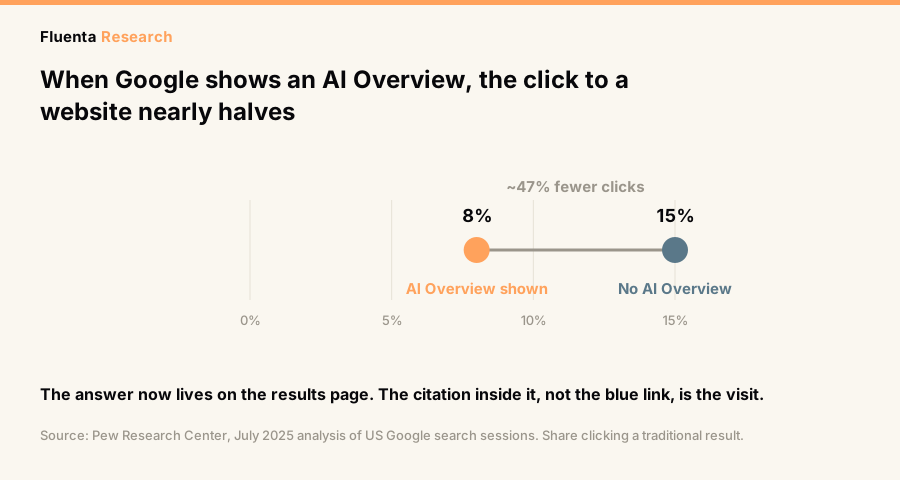
Google's own results page shows the same effect in miniature. Pew Research tracked what happens when an AI Overview appears above the classic links.
Source · Pew Research Center, July 2025 analysis of US Google search sessions
On searches where an AI Overview appeared, users clicked a traditional result about 8% of the time, against 15% when no AI Overview was present, close to half as often (Pew Research Center, July 2025). This is the strictest measurement to date, not a vendor estimate, and it points at a structural shift: the answer is now the destination, and the citation inside it is the visit. A brand that is quoted in the overview captures attention that never reaches a blue link at all.
The scale of that surface is not niche. Google's AI Overviews reach about 2.5 billion users, a figure Sundar Pichai gave at Google I/O in May 2026. When a feature that changes click behavior sits in front of that many people, being cited inside it stops being a nice-to-have and becomes the difference between showing up in a category and disappearing from it.
It is worth resisting the doom framing, though. The most useful skeptical voice in this debate belongs to the researcher who has measured click behavior longest.
“Both the fear of AI Overviews and the 'death of Google search quality' are all sound and fury, signifying nothing. Or, at least, not very much.”
Both things are true at once. Search is not dying, and the mechanics of visibility are changing underneath it. GEO is the response to the second fact, not a panic about the first. The brands that win treat AI citation as a new channel to earn, not as a reason to abandon the fundamentals that still feed it.
What actually moves an AI citation
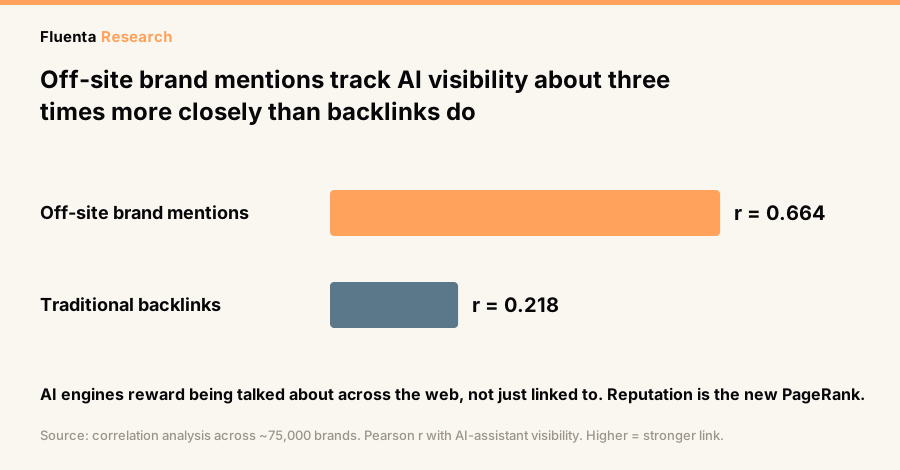
If quotes and statistics win inside a single page, the off-page question is what makes a model trust the brand behind the page. The strongest available signal is not the backlink. It is the mention.
Source · Correlation analysis across ~75,000 brands; Pearson r with AI-assistant visibility
Across an analysis of roughly 75,000 brands, off-site brand mentions correlated with AI visibility at about 0.664, while traditional backlinks correlated at about 0.218. Mentions tracked AI citation roughly three times more closely than links did. The reason is intuitive once stated: a language model learns what a brand is, and how often it comes up in a category, from the text of the whole web, not from a link graph. Being talked about, in the right context, is what teaches the model to reach for a brand when a relevant question arrives.
That is why entity clarity sits at the center of GEO. A model needs to resolve a brand to a single, consistent thing: what it does, who it serves, what category it belongs to, and what makes it distinct. Inconsistent naming, thin descriptions, and a fuzzy category leave the model unsure, and an unsure model stays silent. The entity optimization guide covers how to make a brand legible as a distinct entity, and the AI platform citation patterns guide covers how the specific engines differ in what they cite.
The practical version of entity work is boring on purpose. The same name, the same one-line description, and the same category should appear on the site, in the structured data, and on every third-party profile a model is likely to read, from directories to review platforms to reference pages. Structured data does not force a citation, but it gives the model an unambiguous statement of what the brand is, which reduces the chance it guesses wrong or leaves the brand out. Repetition across independent sources is what turns a description into something the model treats as fact.
One number frames the size of the gap. In a study of 175 brands, 89% never surfaced when an AI engine was asked a category question, even though the same models described those brands accurately when asked about them by name. The models knew the brands existed. They simply did not think to recommend them. GEO closes that specific gap between being known and being recommended.
The GEO playbook
The tactics follow directly from the mechanisms above. A practical GEO program does seven things, and each one is a credibility signal expressed in a form a language model can read.
Answer the real question in the first two sentences. Generative engines lift self-contained passages. A page that buries its answer under three paragraphs of preamble hands the model nothing clean to quote. State the claim, then support it.
Put verifiable evidence on the page. Add current statistics with named sources, direct quotes from real experts with their title and firm, and clear citations. These are the exact levers the Princeton study found move a page into answers, and they are levers most competitors skip.
Structure content for extraction. Use descriptive headings phrased as the questions people ask, short definitional openers, and clean lists and tables. A model that can parse the structure can reuse the passage. The domain-specific finding applies here too: for factual pages lead with the verifiable claim and its source, and for explanatory or opinion pages lead with a quotable line, because those are the forms the study found each kind of question rewards.
Fix entity consistency everywhere. Use the same brand name, description, and category across the site, the schema markup, and every third-party profile. Give the model one coherent thing to attach to a query.
Earn mentions, not just links. Prioritize being named in roundups, comparisons, expert commentary, and reputable category coverage. Mentions teach the model the brand belongs in the conversation, and they correlate with AI visibility far more strongly than links. Since almost all AI citations point off the brand's own domain, this is where the majority of GEO effort belongs, not on the homepage.
Stop the tactics that backfire. Drop keyword stuffing and thin, templated pages. They lowered visibility in testing and signal low quality to the model.
Make sure AI crawlers can read the site. Confirm that the bots behind the assistants are allowed, that content is not locked behind script rendering they skip, and that the pages a brand wants cited are actually reachable. Full-cycle checks belong in a technical AI visibility review.
None of these steps is exotic. The discipline is doing them deliberately, on the pages that matter, instead of hoping ranking alone carries a brand into the answer.
Where GEO programs go wrong
The failures are as instructive as the wins, because most of them come from applying old habits to a new surface.
The first is optimizing only the owned domain. Since roughly 99.99% of AI citations point to third-party sites, a brand that pours everything into its own pages and nothing into being mentioned elsewhere is optimizing the one place the model is least likely to cite. The homepage still matters for entity clarity, but the citations are earned off-site.
The second is treating rankings as a proxy for AI visibility. Because only about 12% of ChatGPT's citations overlap Google's top ten, a page-one ranking is weak evidence that a brand is in the answer. Teams that watch only the rank tracker will miss the channel entirely and wrongly conclude they are covered.
The third is the reflex to add keywords. The Princeton testing is unambiguous that stuffing lowered visibility, yet it remains the default instinct when a page underperforms. In the generative era, the fix for an invisible page is more evidence and clearer structure, not more repetitions of the target term.
The fourth is entity drift. A brand described three different ways across its site, its schema, and its third-party profiles gives the model no stable thing to attach to a query. The model resolves ambiguity by staying silent, and the brand never learns why it was left out.
Measuring GEO, and where most brands stand now
GEO is measurable, but not with the rank tracker most teams already own. Rankings describe the ten-link page, not the answer. The metrics that matter are the share of AI answers a brand appears in for its core questions, which sources get cited alongside it, whether it is quoted or merely mentioned, and how that citation share moves over time across ChatGPT, Gemini, Perplexity, and AI Overviews.
Most brands have never run that measurement once, which is why the 89% invisibility figure is so common. The first step is a baseline: ask the real questions buyers ask, across the major engines, and record who gets cited. Measurement also has to be repeated. Model outputs shift as the engines retrain and as competitors publish, so a single snapshot ages quickly; citation share is a trend to watch monthly, not a number to check once. The useful comparison is not against a brand's own past rankings but against the sources currently winning its category answers, because those are the pages a model has decided to trust for the exact questions that matter.
Fluenta Magnet runs that audit and returns the specific prompts where a brand is missing, who is winning those citations instead, and the pages to fix first. Because Magnet is a GEO audit built for this exact problem, it measures the surface that classic SEO tools do not see. A free scan at /magnet is the fastest way to turn GEO from a concept into a list of concrete gaps, and it names the third-party sources a brand would need to earn a mention on to close them.
The takeaway
Generative engine optimization is not a rebrand of SEO. It is optimization for a new intermediary that reads the web, decides what to trust, and speaks a single answer with a short list of sources. The signals it rewards are credibility signals: quotes, statistics, citations, entity clarity, and being genuinely talked about across the web. The tactics that defined the last era, keyword density above all, actively work against a brand now. The engines have already consolidated most of the audience, and the research phase is moving inside the answer. The brands that get named in that answer will own the category. The rest will remain accurate, well-described, and unrecommended.
Check AI visibility for my website
Free. No subscription, no card. 24 hour turnaround, checked by a human analyst.
FAQ
What is generative engine optimization (GEO)?+
GEO is the practice of optimizing content so that AI systems such as ChatGPT, Gemini, Perplexity, and Google AI Overviews select, quote, and cite it inside the answers they write. The goal is to become a named source in the answer rather than only ranking in the list of links.
How is GEO different from SEO and AEO?+
SEO optimizes for ranking in Google's ten blue links, AEO optimizes for being the direct answer in a snippet or voice reply, and GEO optimizes for being quoted and cited inside an AI-generated answer. They share technical foundations, but GEO rewards credibility signals such as quotes, statistics, entity clarity, and mentions more than keyword density.
What content changes actually improve GEO?+
The Princeton and IIT Delhi GEO study found that adding direct quotations from named sources, relevant statistics, improved fluency, and citations to reputable sources raised a page's visibility in AI answers, with quotations giving the largest lift. Keyword stuffing lowered visibility, so it should be dropped.
Do backlinks still matter for AI visibility?+
They matter less than most teams assume. Across an analysis of roughly 75,000 brands, off-site brand mentions correlated with AI visibility at about 0.664, while traditional backlinks correlated at about 0.218. Being talked about across the web in the right context predicts AI citation roughly three times more strongly than links.
How do you measure GEO?+
Not with a rank tracker. The metrics that matter are the share of AI answers a brand appears in for its core questions, which competitors get cited alongside it, whether it is quoted or only mentioned, and how that citation share moves over time across the major engines. A GEO audit tool such as Fluenta Magnet baselines this by asking real buyer questions across the engines.
Why are most brands invisible in AI answers?+
Because they have never optimized for citation and often cannot even be resolved as a clear entity. In a 175-brand study, 89% never appeared on a category question even though the models could describe them accurately by name. The gap is between being known and being recommended, and closing it is what GEO does.
Cite this article
Researchers and journalists: this article is freely citable. Click to copy the academic-format reference for your bibliography or footnote.
Ivanov, O. (2026). Generative Engine Optimization (GEO) Guide. Fluenta. Retrieved from https://fluenta.space/resources/guides/generative-engine-optimization.
About the author

Oleg Ivanov
Co-founder & CEO, Fluenta
Oleg is co-founder and CEO of Fluenta. He spent the last decade shipping products across fintech, commerce, and AI tooling, and now leads Fluenta's work scoring startup ideas against 25 live market and social data feeds.
Related Resources
ANSWER ENGINE OPTIMIZATION
What Is AEO? Answer Engine Optimization Explained (2026)
Answer engine optimization (AEO): how a brand gets cited inside AI answers from ChatGPT, Perplexity, and Google AI, why it matters, and how to do it.
AEO VS SEO
AEO vs SEO: What's the Difference? (2026)
AEO vs SEO: SEO ranks a page for the click, AEO gets a brand cited inside AI answers. How they differ, why SEO alone is not enough, and what to do.
HOW AI PICKS ITS SOURCES
How ChatGPT & Google AI Decide What to Cite (2026)
How ChatGPT, Perplexity, and Google AI choose which sources to cite: off-site mentions beat backlinks, and only 12% overlaps Google.'s top results.
Find out if AI recommends your business
Fluenta Magnet checks whether ChatGPT, Perplexity and Google AI Overviews name your business or your competitor, then ships the fixes. Free, human-checked, in 24 hours.
Was this helpful?